
[Assessing the 22nd National Assembly] Supporting the Reshoring of Korean Companies Overseas
-
Writer
CFE
-
 Supporting the Reshoring of Korean Companies Operating Overseas
◈ The Center for Free Enterprise (CFE) is researching and analyzing bills processed or introduced in the 22nd National Assembly that have contributed to advancing liberal values, including the realization of a small and efficient government, the abolition and reform of outdated regulations, the minimization of government intervention in private businesses and market order, and the guarantee of autonomy.
Introduction
The return of production facilities that companies had previously moved overseas back to Korea is called “reshoring.” As global supply chains become increasingly block-based around major alliances and the free versus anti-free camps, and as local operations in countries such as China—which once attracted global firms through cheap labor—have become more difficult due to various regulations, political instability, and rising labor costs, incentives for Korean companies to return home are also increasing.
As part of its policy to promote reshoring, the Yoon Suk Yeol administration announced the
In the 22nd National Assembly, there have been legislative efforts to expand tax benefits to increase reshoring. Let us look at the status of bills introduced, focusing on the Partial Amendment to the Restriction of Special Taxation Act.
Status of Bill Introduction and Processing
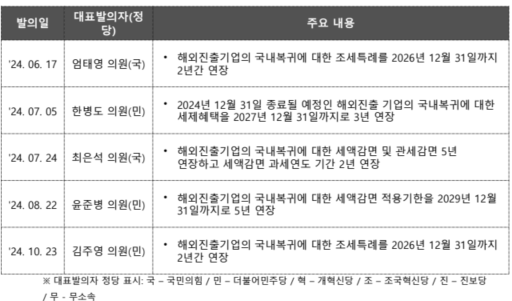
The tax credit reduction system for companies returning to Korea after operating overseas is provided for in Article 104-24 of the Restriction of Special Taxation Act. If a business site that has been continuously operated abroad for at least two years is fully or partially relocated to Korea by December 31, 2024, income tax and corporate tax are fully exempted for the first seven years, followed by a 50% reduction in income tax and corporate tax for the following three years. In addition, under Article 118-2 of the same Act, tariff reductions are available through December 31, 2024. In this regard, five lawmakers from both the ruling and opposition parties each introduced amendment bills to extend the sunset deadline of December 31, 2024.
Lawmakers Tae Young Eom, Byungdo Han, Junbyung Yoon, and Jooyoung Kim all proposed bills extending the sunset period for the tax special provisions from as short as two years to as long as five years. Tae Young Eom explained the reason for his bill, saying, “According to data released in January 2023, only an average of 19 companies returned to Korea over the past five years, so it is necessary to extend the sunset period of this special provision so that competitive firms can create quality jobs in Korea.” Byungdo Han emphasized, “Amid the recent reorganization of global supply chains, major countries such as the United States are implementing reshoring policies to induce companies operating overseas to return home, and as advanced industries such as semiconductors are becoming increasingly important not only economically but also from a national security perspective, there are calls for Korea as well to provide incentives for companies to return.”
In the case of lawmaker Eunseok Choi, in addition to extending the sunset deadline for tax credits and tax reductions themselves by five years to December 31, 2029, he also added measures to extend the period of full tax exemption from seven years to nine years and the period of the 50% reduction from three years to five years, respectively.
Analysis and Implications
According to a report published by the Korea Development Institute, the companies currently engaging in reshoring are mainly smaller, labor-intensive multinational firms with low productivity and limited overseas production experience. Of course, every company returning from overseas brings its own positive effects, but the types of firms from which reshoring is most expected are somewhat different.
They are mainly large manufacturing companies capable of creating large numbers of quality jobs and contributing to the revitalization of domestic supply chains for materials, parts, and equipment. There are many cases in which companies must inevitably invest in expanding local plants in places such as the United States due to various international political factors. However, it is regrettable from the standpoint of the national economy that manufacturing production facilities with strong potential to create quality jobs have recently been leaving Korea, especially from non-capital regions, and moving overseas. In that sense, it is desirable for the 22nd National Assembly to at least move quickly to pass an extension of the sunset period for tax special provisions for reshoring companies. In addition, as in the bill introduced by Eunseok Choi, it is necessary to provide a sufficiently generous tax reduction period in order to increase the appeal of reshoring for companies operating overseas.
Moreover, the 22nd National Assembly needs to recognize clearly that labor reform is an unavoidable task if reshoring is to be promoted more effectively. A review of companies that have moved overseas shows that many have left in search of a flexible and stable labor market environment, seeking to avoid Korea’s rigid labor market and militant labor unions that inflict enormous losses through illegal strikes. In addition, the sharp rise in the minimum wage during the Moon Jae-in administration was also a major factor, as it increased labor costs, especially for small-scale production facilities, and added to cost burdens.
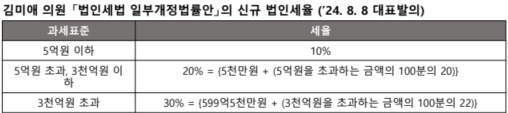
Compared with the United States, which is drawing in global manufacturing like a black hole through extraordinary benefits such as astronomical subsidies and the provision of vast production sites for as little as $1, there is a need to seriously consider what practical benefits our government can offer companies. In that sense, the corporate tax cut bill introduced by People Power Party lawmaker Miae Kim could be considered a fundamental solution.
Miae Kim introduced a bill stating, “Korea’s top corporate tax rate is higher than the OECD average top corporate tax rate of 21.5%, so it needs to be adjusted,” while also proposing to simplify the tax base structure.
The burdens on businesses are ultimately passed on as burdens on the people, and where businesses leave behind empty spaces, unemployment, stagnation, and deterioration in livelihoods remain. Ultimately, what serves the people is for the 22nd National Assembly to come up with fundamental solutions that can block the incentives for companies to move overseas in the first place and instead empower greater domestic investment and employment.
Wiki:
https://www.cfe.org/w/bbsDetail.php?&idx=11
Original title: [22대 국회 진단] 해외 진출 국내기업 리쇼어링 지원
Author: Ju-jin Yoon
Date: 2024-11-07
Source: https://www.cfe.org/bbs/bbsDetail.php?cid=bill&pn=1&idx=26996