
[Assessing the 22nd National Assembly] Fostering Next-Generation Innovative Industries
-
Writer
CFE
-

 Fostering Next-Generation Innovative Industries
◈
The Center for Free Enterprise (CFE) is researching and analyzing bills that have been processed or introduced in the 22nd National Assembly and that have contributed to advancing liberal values, such as achieving a small and efficient government, dismantling and reforming outdated regulations, minimizing government intervention in private businesses and the market order, and guaranteeing autonomy.
Introduction
New industries that emerge on the back of technological advancement invariably run into barriers such as conflict with existing industries and opposition from vested interest groups. In addition, various institutional frameworks built to fit the existing industrial order often act as obstacles to the smooth settlement of new industries. In such circumstances, the National Assembly has an important responsibility to mediate conflicts of interest and present a new legal order to promote the harmonious development of new industries.
There remain several unresolved tasks related to fostering innovative industries that the 21st National Assembly failed to address. Representative examples include the legalization of telemedicine and the resolution of conflict factors surrounding the legal tech industry. Although there have been measures such as government pilot projects and the invalidation of improper disciplinary actions against lawyers by interest groups, the report card for “legislation,” which would constitute a fundamental solution, remains poor.
Since the launch of the 22nd National Assembly, some lawmakers from both the ruling and opposition parties have been making legislative efforts to support and foster next-generation innovative industries such as legal tech, autonomous driving, digital healthcare, and food tech. Below is a look at the legislative progress in each industry.
Status of Bill Proposals and Passage
■
Fostering Legal Tech
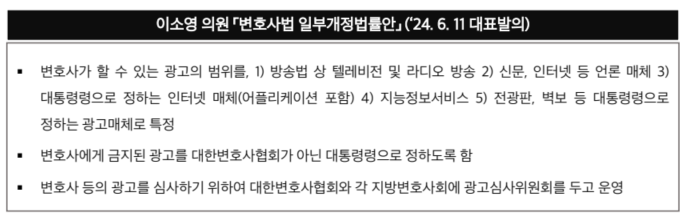
The conflict surrounding the legal tech industry—symbolized by the so-called “LawTalk incident”—between the Korean Bar Association and legal tech companies has long been a social issue. In particular, under the Attorneys-at-Law Act, which allows the Korean Bar Association to prohibit “advertising” that introduces lawyers to legal service consumers, the bar association caused a major stir by disciplining lawyers who joined platform services run by legal tech companies such as LawTalk in order to attract clients. Although the Ministry of Justice ruled those disciplinary actions invalid, the aftereffects have lingered. Against this backdrop, Democratic Party lawmaker Soyoung Lee introduced the following bill.
Soyoung Lee explained, “Because restrictions on advertisements by attorneys directly affect the public’s access to and trust in legal services, they need to be clearly stipulated by law,” adding, “New forms of media such as online platforms are not explicitly specified as advertising means under the current regulations, and this has led to controversy and conflict.” If Lee’s bill is passed, the Korean Bar Association will no longer be able to arbitrarily ban advertising through legal tech platforms.
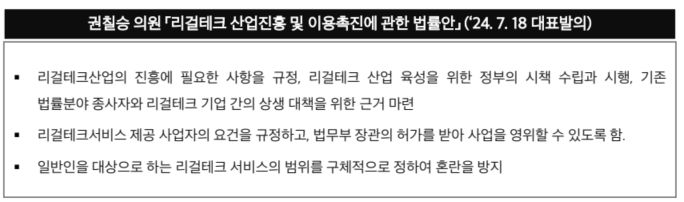
Meanwhile, Democratic Party lawmaker Chilsung Kwon introduced the Framework Act on the Promotion and Facilitation of the Legal Tech Industry, a special act aimed at developing the legal tech industry.
■
Use of Autonomous Driving Functions in Freight and Passenger Transportation Businesses
In step with the accelerating pace of autonomous driving technology development, People Power Party lawmaker Youngse Kwon introduced a bill to allow autonomous driving to be used more actively in passenger and freight transport services that ordinary drivers tend to avoid, such as dawn and late-night routes and remote-area routes.
■
Fostering the Digital Healthcare and Food Tech Industries
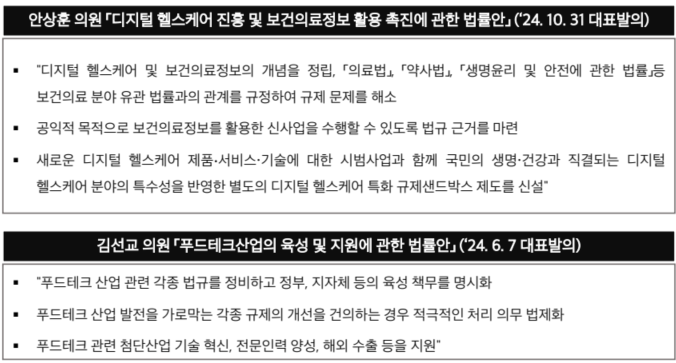
Meanwhile, bills were also introduced to foster the digital healthcare and food tech industries, which can be regarded as representative sectors of next-generation innovative industries.
Analysis and Implications
The government and the political sphere share a strong consensus that a “second Tada incident” must never happen again. Nevertheless, citing reasons such as collective resistance from existing industry players and electoral disadvantages, they tend to be passive even about basic legislative measures needed to ensure the smooth settlement of innovative industries. Under such conditions, the repeated prisoner’s dilemma in regulatory repeal must be overcome through cooperation at the party level, rather than leaving the matter to individual lawmakers.
Innovative industries tied to future growth engines, such as the legal tech industry, will bring a variety of positive effects, including greater convenience in people’s lives and job creation. If even the 22nd National Assembly misses the critical timing for fostering next-generation industries, the result will ultimately be the encroachment of the domestic market by overseas global giants. For the survival of strong domestic companies as well, the 22nd National Assembly must step up efforts to foster next-generation innovative industries.
Wiki:
https://www.cfe.org/w/bbsDetail.php?idx=119
Original title: [22대 국회 진단] 차세대 혁신산업 육성
Author: Ju-jin Yoon
Date: 2024-11-05
Source: https://www.cfe.org/bbs/bbsDetail.php?cid=bill&pn=1&idx=26993