
[Diagnosing the 22nd National Assembly] Easing Big Business Criteria and Ending Reverse Discrimination
-
Writer
CFE
-

 Easing the Criteria for Large Business Groups and Resolving Reverse Discrimination
◈
The Center for Free Enterprise (CFE) is examining and analyzing bills processed or introduced in the 22nd National Assembly that have contributed to advancing liberal values, including the realization of a small and efficient government, the abolition and reform of outdated regulations, the minimization of government intervention in private companies and market order, and the guarantee of autonomy.
Introduction
In an effort to curb the concentration of economic power in a small number of firms, Korea introduced the designation system for “large business groups” in 1987 under the Chun Doo-hwan administration. At the time, the system ranked the top 30 business groups. Later, beginning in 2002, the government designated two separate categories: business groups subject to the total investment limit and business groups subject to cross-shareholding restrictions. In 2009, however, the total investment limit system was abolished, and today only the disclosure-target business group system and the cross-shareholding-restricted business group system remain in operation.
A disclosure-target business group refers to a business group whose affiliated companies have combined total assets of at least 5 trillion won. Groups in this category are subject to regulations requiring board resolutions and disclosure for large-scale internal transactions, disclosure of major matters concerning unlisted companies, and disclosure regarding the status of the business group. Meanwhile, the Fair Trade Commission, which had originally designated business groups with total assets of 10 trillion won or more as cross-shareholding-restricted business groups, decided in 2020, together with a full amendment of the Fair Trade Act, to designate as such any business group whose total assets amount to at least 0.5% of GDP, and this standard took effect in 2024. Accordingly, the 2024 threshold for designation as a cross-shareholding-restricted business group is total assets of at least 10.4 trillion won.
However, the business community still harbors deep skepticism about the operation of both the disclosure-target business group system and the cross-shareholding-restricted business group system themselves. According to an analysis by the Korea Enterprises Federation of the concentration of economic power among disclosure-target business groups excluding those subject to cross-shareholding restrictions, asset concentration stood at 2.4% and sales concentration at 4.2%. In other words, concerns about economic concentration do not align with reality. In addition, many point out that the cross-shareholding restriction regime—with its various regulations such as bans on cross-shareholding, circular shareholding, and debt guarantees, as well as restrictions on the voting rights of financial and insurance companies—does little to promote the growth of small and medium-sized or mid-sized enterprises in practice, while merely holding back Korea’s global companies. Moreover, “reverse discrimination” regulations applied only to large business groups are also obstructing the growth of Korea’s innovative industries. In this regard, let us look at reform legislation attempted in the 22nd National Assembly.
In response to the business community’s criticism of the effectiveness of the disclosure-target business group system itself, there has been movement in the National Assembly to improve the system so that, like the cross-shareholding-restricted business group system, the threshold for disclosure-target business groups is also linked to the size of the national economy. Rep. Sanghoon Kim and Rep. Yeonwook Jeong of the People Power Party each introduced partial amendment bills to the Monopoly Regulation and Fair Trade Act.
Rep. Yeonwook Jeong explained the rationale for his proposal as follows: “The current threshold for designating disclosure-target business groups was introduced in 2009, and criticism has been raised that it does not properly reflect the growth in the size of the economy since then,” adding, “The number of disclosure-target business groups increased from 48 in 2009 to 76 in 2022, and as the scope of large business group regulation has expanded due to the fixed threshold, it has become a factor causing mid-sized firms to delay entering the ranks of large corporations. Some assess that the burden on mid-sized firms has reached a level that can no longer be ignored.”
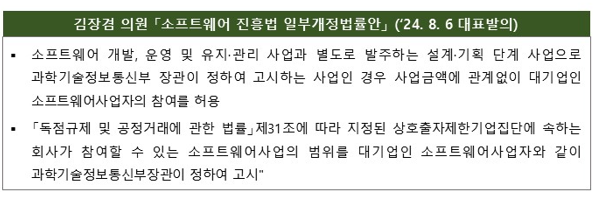
Meanwhile, in Korea, large companies are restricted in public software projects to participating only in projects above a certain contract amount, while firms belonging to cross-shareholding-restricted business groups are completely barred from participation. Although the original purpose was to guarantee small and medium-sized and mid-sized firms opportunities to participate in government public software projects, it has been pointed out that, as technical requirements grow increasingly sophisticated and the need to strengthen the security of government electronic systems rises, participation by large companies with advanced technological capabilities has become essential. In particular, after the November 2023 computer system failure involving the local finance management system administered by the Ministry of the Interior and Safety, calls for allowing large companies to participate in public software projects gained credibility. In this regard, Rep. Jang-gyeom Kim of the People Power Party introduced the following bill.
In explaining the reason for the proposal, Rep. Jang-gyeom Kim stated, “While the current system has contributed in some respects to expanding the foundation of the domestic software industry—such as by supporting the growth of small and medium-sized enterprises and diversifying prime contractors in the public software market—there has also been criticism that it constitutes excessive discriminatory regulation based on company size.” He further explained, “To improve the quality of software projects and modernize the public software market, it is necessary to ensure that the content and structure of each project are clearly established from the design and planning stages, while also promoting the transition to cloud systems and facilitating the adoption of new private-sector technologies such as artificial intelligence.”
Analysis and Implications
Cases in which economic concentration is assessed solely on the basis of numerical indicators such as total asset size and sales volume, with regulations then applied uniformly, are difficult to find anywhere in the world other than Korea. Government intervention should be justified only when the concentration of economic power leads to the abuse of the dominant position and authority of market-leading firms, thereby aggravating monopolies or oligopolies, and when this in turn results in tangible harm such as excessive profits. Among 19 OECD countries, Korea ranks only 15th in terms of asset concentration or sales concentration among the top 100 firms. It is worth examining whether our society is overly bound by exaggerated fears of “economic concentration.”
In that sense, it is difficult not to raise a fundamental question as to whether it is justifiable to designate disclosure-target business groups and impose a large bundle of regulations based on the threshold of “5 trillion won in total assets,” which was introduced as long as 15 years ago. Even if public sentiment makes it difficult to abolish the large business group system itself, it would at the very least be common sense to raise the threshold by applying something like the inflation rate over the past 15 years.
In that sense, the legislative attempt by People Power Party lawmakers Sanghoon Kim and Yeonwook Jeong to designate firms as disclosure-target business groups only when their total assets exceed a certain proportion of GDP—just as in the cross-shareholding-restricted business group system—can be seen as legislation that at least gives some breathing room to large Korean companies.
Likewise, the bill introduced by Rep. Jang-gyeom Kim, which lowers the barriers to participation by large firms in public software projects and opens the door for cross-shareholding-restricted business groups to participate as well, can be regarded as timely. The Yoon Suk Yeol administration also announced, following the 2023 government computer network outage, that it would prepare an amendment to the Software Promotion Act allowing large companies to bid for public software projects.
It is said that when a company ceases to qualify as a small business, it becomes subject to 126 additional regulations. If it then becomes a disclosure-target business group, the number rises to 274, and if it is again designated a cross-shareholding-restricted business group, it becomes subject to 342 regulations. Under such a system, it is difficult to expect small and medium-sized or mid-sized firms to grow into large companies. The 22nd National Assembly must now transform the order of “leveling down” among Korean firms into an order of “leveling up.”
Wiki:
https://www.cfe.org/w/bbsDetail.php?idx=118
Original title: [22대 국회 진단] 대기업 기준 완화 및 역차별 해소
Author: Ju-jin Yoon
Date: 2024-11-04
Source: https://www.cfe.org/bbs/bbsDetail.php?cid=bill&pn=1&idx=26991