
[Diagnosing the 22nd National Assembly] Normalizing Inheritance and Gift Taxes
-
Writer
CFE
-
 Normalization of the Inheritance and Gift Tax
◈ The Center for Free Enterprise (CFE) researches and analyzes bills that were processed or introduced in the 22nd National Assembly and that have contributed to advancing liberal values, including the realization of a small and efficient government, the abolition and reform of outdated regulations, the minimization of government intervention in private enterprise and market order, and the guarantee of autonomy.
■ Introduction
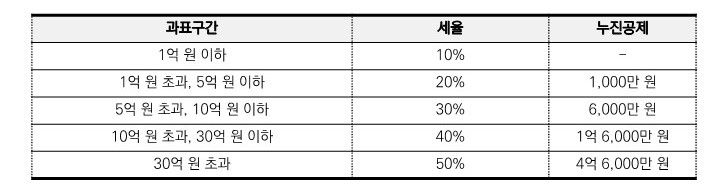
Korea’s top inheritance and gift tax rate is 50%, the second highest among OECD countries after Japan. When the premium valuation system for the largest shareholder is applied, the rate rises to 60%, making it the highest. The share of inheritance and gift tax revenue relative to GDP is also the second highest in the OECD. Among the OECD’s 38 member countries, 15 do not have an inheritance tax at all. Even among the remaining 23 countries, inheritance tax on direct descendants is either exempted or subject to reduced rates. The current inheritance and gift tax brackets and rates were introduced in 1999, and their details are as follows.
The inheritance tax system contains various deduction provisions. These include a basic deduction of KRW 200 million from the taxable estate at death; a business inheritance deduction of up to KRW 60 billion for decedents who have operated a small or medium-sized enterprise or a mid-sized company for a certain period; a spousal inheritance deduction ranging from a minimum of KRW 500 million to a maximum of KRW 3 billion; and other personal deductions.
One major controversy surrounding inheritance and gift taxes is that they constitute “double taxation.” The assets subject to inheritance or gift taxation have already been accumulated after fulfilling various tax obligations, including income tax. There is also persistent criticism that such taxes contribute little to wealth redistribution while merely encouraging tax avoidance. Above all, concerns continue to be raised that excessive tax burdens undermine the autonomy and dynamism of the national economy.
■ Status of Bill Proposals and Deliberation
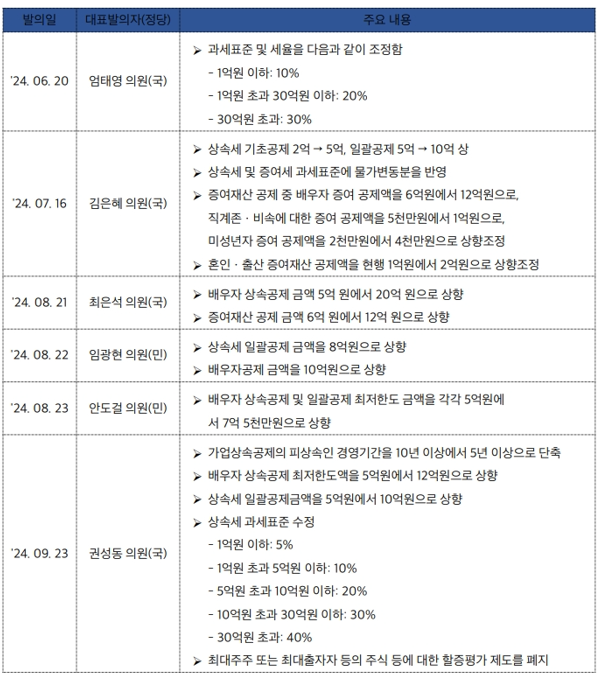
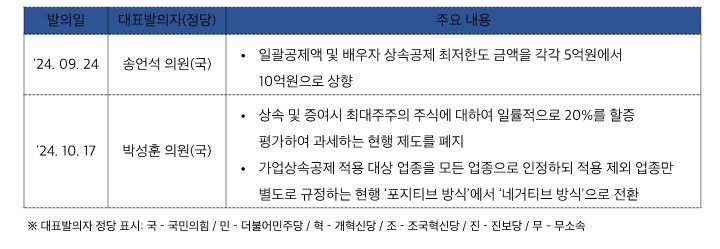
Since the opening of the 22nd National Assembly, many lawmakers from both the ruling and opposition parties have introduced partial amendment bills to the Inheritance Tax and Gift Tax Act, making various legislative efforts to ease the burden of inheritance and gift taxes. Broadly, these efforts can be divided into two categories: ① adjustments to tax brackets and rates, and ② expansion of deduction ranges. Looking at the bills in the order in which they were introduced, the current status is as follows.
■ Analysis and Implications
In July, the Yoon Suk Yeol administration announced the “2024 Tax Law Revision Bill,” expressing its intention to substantially ease the burden of inheritance and gift taxes. The proposed amendments to tax brackets and rates are as follows.
In addition, the child deduction was dramatically increased from KRW 50 million per child to KRW 500 million, significantly expanding the deductible amount for children’s inherited shares. This is understood as a measure aimed at actively encouraging marriage and childbirth among young people who face difficulties in securing housing. The tax revision bill also includes a plan to double the scope of the business succession deduction for each bracket based on the length of time the business has been operated.
Concern that excessive inheritance and gift taxes make smooth succession of corporate management difficult, thereby only encouraging predatory speculative funds to target control of sound companies, has long existed within Korea’s economic ecosystem. In many cases, the commencement of inheritance due to sudden death also forces families to bear enormous economic losses in the process of disposing of assets. It must also be pointed out that opaque and unlawful asset accumulation has become widespread as people seek to avoid paying inheritance and gift taxes.
As noted above, both the ruling and opposition parties share the view that the current inheritance and gift tax system imposes economic burdens across classes and generations alike. Centered on the tax law revision bill proposed by the government, it is hoped that the 22nd National Assembly will, in its first regular session, normalize the inheritance and gift tax system without fail.
Wiki:
https://www.cfe.org/w/bbsDetail.php?idx=117
Original title: [22대 국회 진단] 상속세 및 증여세 정상화
Author: Ju-jin Yoon
Date: 2024-11-01
Source: https://www.cfe.org/bbs/bbsDetail.php?cid=bill&pn=1&idx=26987