
[Assessing the 22nd National Assembly] Support for Carbon Neutrality Technology Innovation
-
Writer
CFE
-

 Support for Carbon Neutrality Technology Innovation
◈ The Center for Free Enterprise (CFE) researches and analyzes bills that were processed or proposed in the 22nd National Assembly and that have contributed to advancing liberal values, including the realization of a small and efficient government, the abolition and reform of outdated regulations, the minimization of government intervention in private businesses and market order, and the guarantee of autonomy.
■ Introduction
The global movement toward implementing carbon neutrality is accelerating and imposing a significant economic burden on both governments and businesses. Apple, Google, Microsoft, and BMW have joined the RE100 campaign, which calls for using only 100% renewable electricity. Nine Korean companies included in Fortune magazine’s Global 500, such as Samsung Electronics, Hyundai Motor, SK Hynix, and LG Electronics, have also declared their participation in RE100. Companies that are passive in implementing carbon neutrality are bound to fall behind in ESG indicators published by major corporate rating agencies, and they are also more likely to become targets of climate-conscious consumers or NGOs.
Above all, there is a strong possibility that companies failing to meet a certain level of carbon neutrality requirements may face restrictions on exports themselves. The EU has introduced the Carbon Border Adjustment Mechanism (CBAM), placing limits on trade with countries that generate high carbon emissions. Beginning in 2026, the EU will impose taxes based on carbon emissions on all imported steel, cement, fertilizer, aluminum, and electricity products. In effect, this amounts to an additional tariff of about 2.7 percentage points. The United States is likewise planning, from 2024, to impose a carbon tax of $55 per ton on 12 imported raw materials, including fossil fuels, aluminum, steel, and cement, under the Clean Competition Act, and later expand its scope to finished products.
The problem is the economic burden on businesses. Carbon neutrality technologies require long-term investment, and in the short term companies must bear high costs and low efficiency. If businesses are to adapt more proactively to global pressure for carbon neutrality, incentive policies that induce firms’ own technological innovation are essential. Representative examples include tax benefits for investment in carbon neutrality technologies and broad financial support. In this era of carbon neutrality, which has already become an irresistible global trend, it is worth examining the legislative efforts of the 22nd National Assembly aimed at reducing corporate costs.
■ Status of Bill Proposals and Passage
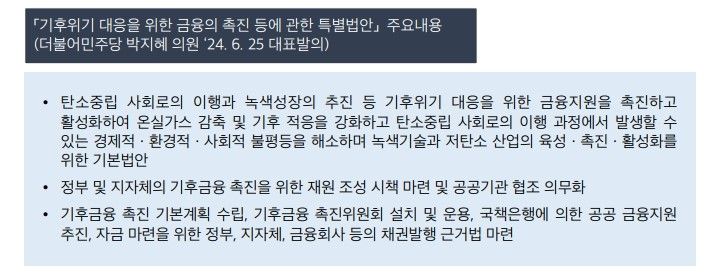
Legislative support at the National Assembly level for decarbonization technology, or green technology innovation, can largely be divided into two tracks. First is the proposal of special acts focused on expanding carbon neutrality. Rep. Kim Sohee of the People Power Party and Rep. Park Jihye of the Democratic Party of Korea each proposed related bills.
A noteworthy feature of the special act proposed by Rep. Park Jihye is that it seeks to secure and provide funding through special accounts or funds such as the Climate Response Fund and the Electric Power Industry Foundation Fund, while also improving regulations affecting carbon neutrality-related companies. It also includes enabling provisions that would allow various tax benefits to be granted within the scope of the relevant legislation. Rep. Kim Sohee of the People Power Party likewise introduced a special act focused on climate finance.
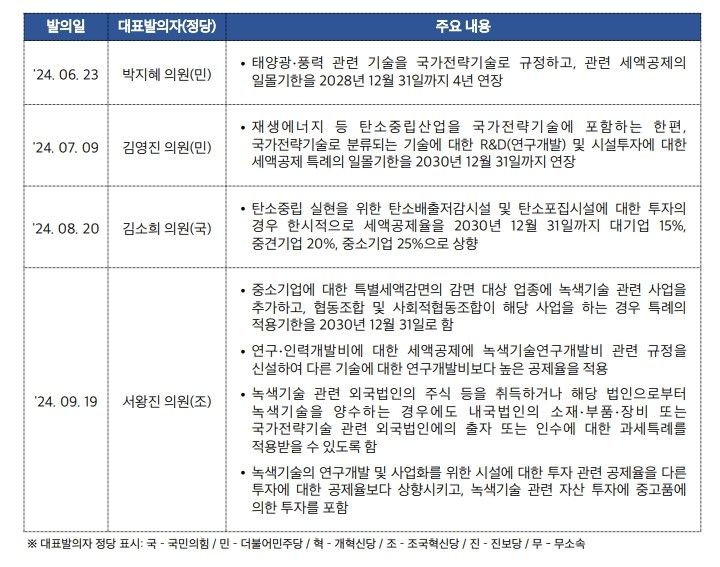
The second type of legislative movement involves amending the Restriction of Special Taxation Act to provide tax benefits and other support for investment in carbon neutrality technologies. The proposed bills are as follows.
■ Analysis and Implications
Unilaterally imposing a certain level of carbon neutrality targets on businesses and forcing compliance undermines corporate dynamism and autonomy, while also making it more difficult to achieve globally competitive innovation in carbon neutrality technologies. The right strategy is to encourage companies, on their own initiative, to hire specialized personnel in carbon neutrality and invest in facilities, equipment, and technology in order to survive within the global trade order. At the same time, this must not deteriorate into a patronage-style policy in which public funds are unilaterally handed out to businesses. A fairer and stricter system should be established so that stronger support is guaranteed for firms that perform well, thereby creating a virtuous cycle of competition and ensuring that investment in carbon neutrality technologies ultimately leads to the growth of Korean companies and the development of the national economy.
Wiki:
https://www.cfe.org/w/bbsDetail.php?idx=116
Original title: [22대 국회 진단] 탄소중립 기술 혁신 지원
Author: Ju-jin Yoon
Date: 2024-10-30
Source: https://www.cfe.org/bbs/bbsDetail.php?cid=bill&pn=1&idx=26968