
[Assessing the 22nd National Assembly] Improving Fiscal Soundness
-
Writer
CFE
-
 Introduction of a Regulatory Legislative Impact Assessment System
◈ The Center for Free Enterprise (CFE) is researching and analyzing bills that were passed or introduced in the 22nd National Assembly and that contributed to advancing liberal values, such as realizing a small and efficient government, abolishing and reforming outdated regulations, minimizing government intervention in private businesses and market order, and guaranteeing autonomy.
■ Introduction
As of August 2024, South Korea’s national debt was tallied at a total of 1,167.3 trillion won, the largest amount ever recorded. Combined with a shortfall in tax revenue, the government had already posted a total fiscal deficit of 84 trillion won by August 2024. In the first half of this year alone, the managed fiscal balance recorded a deficit of 103 trillion won. Fiscal soundness has come under serious threat.
The sharp rise in national debt became especially pronounced during the Moon Jae-in administration. National debt, which stood at 660 trillion won in the first year of the Moon administration, increased by more than 400 trillion won to reach 1,067 trillion won in 2022. Although the aggressive fiscal spending implemented during the COVID-19 pandemic had a major impact, the ultimate cause was the Moon administration’s overarching pursuit of “big government.”
South Korea’s national debt-to-GDP ratio stands at 46.9%, which is relatively low compared with other advanced countries. However, it must not be overlooked that the worsening low birthrate and aging population are reducing the working-age population while increasing the burden of supporting the elderly. By 2060, South Korea’s national debt is projected to rise to 144.8% of GDP.
Threats that make it difficult to maintain fiscal soundness are lurking everywhere.
In politics, where voters’ ballots translate directly into power, there is a constant temptation toward expansionary fiscal spending.
Critics point out that if fiscal soundness depends solely on the “goodwill” of governments and politicians or on their sense of responsibility toward future generations, that stance can easily be shaken. Accordingly, voices in the National Assembly have continued to call for the enactment of so-called “fiscal rules”—that is, legislation setting out fiscal management goals and means of achieving them, including quantified targets for aggregate fiscal indicators such as the fiscal balance, fiscal spending, and national debt.
With the launch of the 22nd National Assembly, it is worth examining legislative efforts to secure fiscal soundness and introduce fiscal rules.
■ Status of Bill Proposals and Deliberation
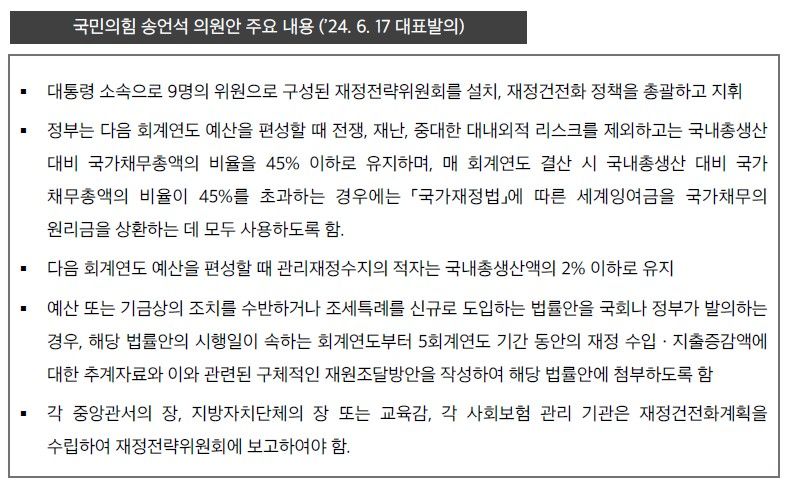
First, the most direct and proactive legislative attempt to secure fiscal soundness since the opening of the 22nd National Assembly is the proposal of the Fiscal Soundness Act by People Power Party lawmaker Song Eon-seok. Unlike previous legislative efforts that sought to introduce fiscal rules through partial amendments to the National Finance Act, Rep. Song sought to institutionalize fiscal soundness by creating a new statute equivalent to a “framework act.”
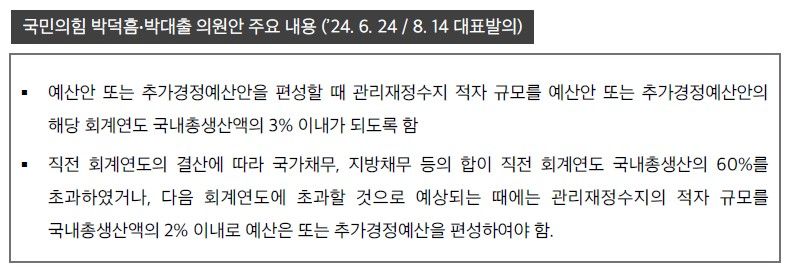
Within the same party, lawmakers Park Deok-heum and Park Dae-chul each introduced a partial amendment bill to the National Finance Act as a legislative effort necessary to improve fiscal soundness. The two bills align on the following key points.
According to the International Monetary Fund (IMF), as of 2022, among the 38 OECD member countries, only South Korea and Türkiye had not introduced fiscal rules. However, Türkiye’s situation is entirely different from ours, because its Public Fiscal Management and Debt Management Law, introduced in 2002, and its Public Accounting and Auditing Law, introduced in 2003, function with effects comparable to fiscal rules.
The Ministry of Economy and Finance has repeatedly called for the introduction of fiscal rules. Broadly speaking, it seeks to keep the managed fiscal balance deficit ratio within 3%, but when the national debt-to-GDP ratio exceeds 60%, to reduce the managed fiscal balance deficit ratio to within 2%. This approach is also reflected in the bills discussed above. Among EU member states, the most common debt benchmark for lowering the managed balance limit to 2% is 60%.
The introduction of fiscal rules can do more than simply slow the pace of fiscal spending; it can also have the additional effect of improving the country’s credit rating and lowering government bond yields. It can also ease fiscal anxiety for future generations. In fact, since the 2000s, the number of fiscal rules has been increasing, especially among advanced countries. Whereas in the 1990s each country had an average of two fiscal rules, since 2020 that figure has risen to an average of three. This shows the effort being made to improve fiscal soundness through fiscal rules.
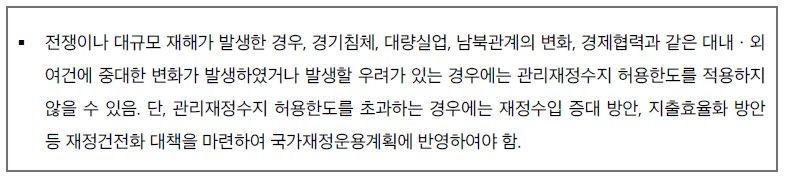
In the 21st National Assembly, a total of nine bills were introduced to adopt fiscal rules, but none made it past the Strategy and Finance Committee before being discarded upon the expiration of the Assembly’s term. Some worry that adopting fiscal rules would make flexible fiscal management more difficult and weaken the ability to respond to risks such as economic downturns, but this can be addressed by providing broad exception clauses. In fact, even countries with strong fiscal rules managed their finances exceptionally during COVID-19 so that the rules would not apply.
Regarding National Pension reform, both the ruling and opposition parties have formed a consensus that reform should proceed in a direction that slows the pace of spending and expands the burden of pension contributions. The same principle can likely be applied to fiscal management as well. We look forward to reform legislation in the 22nd National Assembly aimed at improving fiscal soundness.
Wiki:
https://www.cfe.org/w/bbsDetail.php?idx=115
Original title: [22대 국회 진단] 재정건전성 제고
Author: Ju-jin Yoon
Date: 2024-10-28
Source: https://www.cfe.org/bbs/bbsDetail.php?cid=bill&pn=1&idx=26954