
[Assessing the 22nd National Assembly] Introducing a Regulatory Impact Assessment System for Legislation
-
Writer
CFE
-
 Introduction of a Regulatory Legislative Impact Assessment System
◈ The Center for Free Enterprise (CFE) investigates and analyzes bills that were processed or introduced in the 22nd National Assembly and that have contributed to advancing liberal values, such as realizing a small and efficient government, abolishing and reforming outdated regulations, minimizing government intervention in private businesses and market order, and guaranteeing autonomy.
■ Introduction
The number of member-introduced bills, that is, bills directly introduced by members of the National Assembly, in the 21st National Assembly reached 22,637. This is an increase of 1,043 compared to the 20th National Assembly. The fiercer the legislative competition becomes, not only between the ruling and opposition parties but also among individual members of the National Assembly, the more member-introduced bills increase. Meanwhile, only 2,357 bills were passed in the 21st National Assembly, for a passage rate of just 9.6%. The bill passage rate in past National Assemblies has steadily declined: 37.7% in the 16th, 25.5% in the 17th, 16.9% in the 18th, 15.7% in the 19th, and 13.2% in the 20th. Put differently, this can also be interpreted as a proliferation of unnecessary member-initiated legislation.
The problem is that such indiscriminate member legislation leads to the unchecked production of regulatory bills that place a considerable burden on the private economy and businesses. Under a system in which any member of the National Assembly can easily introduce a bill as long as they secure the joint sponsorship of 10 fellow members, even absurd regulatory bills can be proposed without sufficient deliberation, review, or objective evaluation. Government-initiated legislation, by contrast, involves highly complex and stringent procedures. Before a bill is introduced, consultations with relevant agencies must first take place, and then a preliminary impact assessment must be conducted. Once the legislation is announced in advance, it comes under criticism from the media, experts, and major interest groups.
Crucially, when the head of the agency responsible for a bill seeks to enact or amend legislation that establishes or strengthens regulations, that agency must undergo regulatory review by the Regulatory Reform Committee before requesting legal review of the bill from the Ministry of Government Legislation, attaching a regulatory impact analysis and the agency’s own review opinion. Government legislation must then go through review by the Ministry of Government Legislation and deliberation by the Cabinet at the final State Council meeting. In other words, hurdles for regulatory review are built into every stage of the process. This stands in sharp contrast to member-introduced legislation. For this reason, voices from the business community and experts have consistently called for the regulatory review applied to government legislation to be introduced for member-introduced legislation as well. This is the so-called “regulatory legislative impact assessment” system.
Last February, the Korea Enterprises Federation proposed introducing into the National Assembly Act a provision making regulatory impact assessments mandatory in the legislative process. Lee Minho, a senior researcher at the Korea Institute of Public Administration, has also pointed out that “in the case of regulations introduced through member legislation, unlike regulations introduced through government legislation, there are concerns about possible omissions in the process of regulatory registration and follow-up management, and systematic and proactive management is required after such regulations are transferred to the executive branch.”
In the 21st National Assembly as well, six bills were introduced to establish a regulatory legislative impact assessment system. However, none were ultimately processed, and the matter was carried over to the 22nd National Assembly.
■ Status of Bill Introduction and Processing
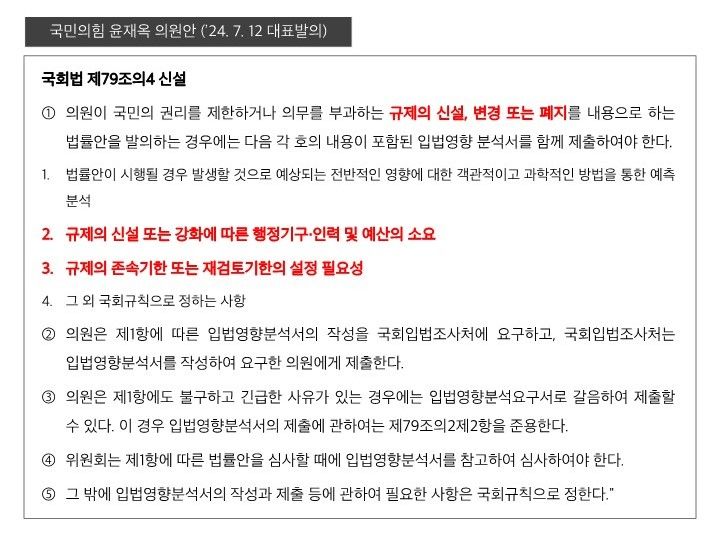
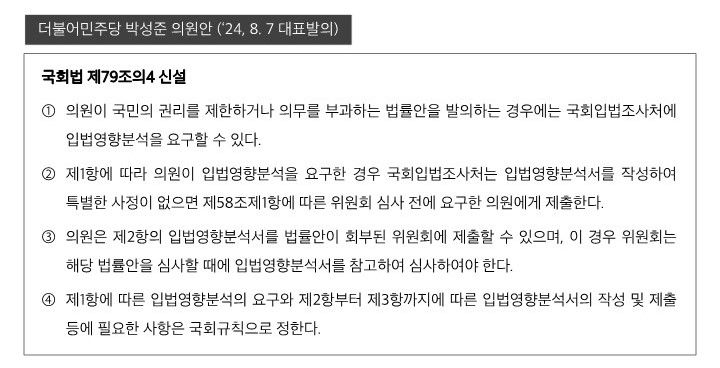
Since the launch of the 22nd National Assembly, as of October 2024, a total of three amendments to the National Assembly Act have been introduced to establish a “legislative impact assessment” system. Their main contents are as follows.
The partial amendment to the National Assembly Act, introduced by Democratic Party of Korea lawmaker Seungchan Boo, is largely similar in content to the bill proposed by fellow party lawmaker Sungjoon Park, so a detailed introduction of its contents will be omitted.
A review of the introduced bills shows that the most fundamental difference between the bill proposed by Jaeok Yoon and the bills proposed by Sungjoon Park and Seungchan Boo lies in whether they directly include an assessment item for “regulatory impact.”
In paragraph 1 of the newly added Article 79-4, the Yoon Jaeok bill specifically designates “cases where a bill is introduced that establishes, changes, or abolishes regulations” as subject to legislative impact assessment, and it mandates concrete analysis of the administrative organizations, personnel, and budget required as a result of establishing or strengthening regulations, as well as the need to set a duration for the regulation or a deadline for its reconsideration.
Meanwhile, the Park Sungjoon and Boo Seungchan bills present a broader scope, applying to “bills that restrict the rights of the people or impose obligations on them,” and do not separately mention regulations in the text of the bill. Of course, regulatory bills are representative examples of legislation that restricts rights and imposes obligations, so they would presumably be included among the subjects of legislative impact assessment. Still, it is regrettable that these bills do not enumerate which specific items related to regulation should be the focus of intensive review. That said, in explaining the purpose of his bill, Seungchan Boo did mention the need for regulatory assessment, stating that “the National Assembly will be able to build an advanced legislative support system through legislative impact analysis when formulating important policies or setting regulations.”
Taken together, the bill that most faithfully meets the need for objective verification of member-introduced bills aimed at establishing or strengthening regulations can be seen as the Yoon Jaeok bill.
Yoon explained the reason for introducing the bill as follows: “It has long been pointed out that the absence of a procedure for reviewing the regulatory impact of member-introduced legislation leads to indiscriminate regulatory legislation, serving as a major factor that undermines social vitality and innovation despite the government’s efforts at regulatory reform,” and “there have also been repeated cases in which laws produce side effects contrary to legislative intent, drawing criticism as hasty legislation.”
It is regrettable that, more than half a year after the launch of the 22nd National Assembly and with its first regular session underway, efforts to introduce a legislative impact assessment system for regulation-related legislation remain subdued across both the ruling and opposition parties. Even if the likelihood of final passage in the plenary session is low, once a regulatory bill is introduced, businesses have no choice but to treat it as a sensitive matter. Corporate government-relations work, undertaken because companies cannot completely rule out even the slightest possibility that such a bill might pass, becomes heavier, and this ultimately leads to burdens on the public and on other businesses. It should be entirely possible to establish an institutional framework for assessing regulatory impact without excessively infringing on the autonomy of the legislative power, which is a core authority of members of the National Assembly. If regulatory assessment is introduced, a more cautious attitude toward regulation can naturally be expected to spread throughout legislative activity as a whole, and as a result the likelihood of passage for bills introduced by members will also increase. Centering discussion on the amendment to the National Assembly Act introduced by People Power Party lawmaker Jaeok Yoon, one hopes that both ruling and opposition parties will prepare substantive alternatives for introducing a regulatory legislative impact assessment system.
Wiki:
https://www.cfe.org/w/bbsDetail.php?idx=114
Original title: [22대 국회 진단] 규제 입법영향평가 제도 도입
Author: Ju-jin Yoon
Date: 2024-10-23
Source: https://www.cfe.org/bbs/bbsDetail.php?cid=bill&pn=1&idx=26942