
[Proposal for the 22nd National Assembly] A Bill to Permit Uber
-
Writer
CFE
-

 Declining Numbers of Drivers and the Taxi Shortage Crisis: Flexible Supply Measures Are Needed Through Allowing Uber
• Korea’s version of Uber was derailed by the Passenger Transport Service Act’s ban on “paid transportation” by private individuals, yet the need for it is becoming more evident over time
• Although transportation platforms have been introduced, political burdens and uncertain review procedures have reduced predictability and worsened business viability
• Uber has become commonplace in roughly 70 countries; the 22nd National Assembly should begin serious discussions on a gradual plan to introduce Uber
◈ Ahead of the 2024 general election, the Center for Free Enterprise (CFE) proposes 22 legislative tasks for the 22nd National Assembly to pursue based on liberal values, spanning the economy and business as well as politics, society, education, culture, and foreign and security affairs.
■ Introduction
Uber is currently operating legally in about 10,500 cities across 70 countries worldwide. As of the end of 2022, Uber was used by 120 million riders per month, and it is already quite familiar to many Koreans with overseas travel experience. In Southeast Asia, Grab is even more common. Many say Grab has significantly reduced concerns over so-called “rip-off fares” caused by communication difficulties. Grab’s average monthly user base reaches 35 million.
Uber and Grab are both leading companies in the ride-sharing industry. They have gone far beyond merely competing with the existing taxi industry, aggressively expanding into food delivery and freight transport as well. Uber has even given rise to the term “Uberization,” which refers broadly to business models in which online platforms connect supply and demand directly, allowing providers to offer idle goods or services without intermediaries. That is how firmly Uber has become a global standard.
Korea presents the exact opposite situation. Uber was blocked from the outset by regulation, and the so-called “Tada ban law” remains in force. Even a newly launched premium shared taxi service introduced by a joint venture established by Uber and a domestic firm announced on January 30, 2024, that it would suspend service. Fierce resistance from the taxi industry, combined with the defensive posture of government authorities and the National Assembly, both wary ahead of elections, has led to repeated second and third “Tada incidents.” This report examines the fundamental reasons that block the introduction of a Korean version of Uber and reviews the task facing the 22nd National Assembly in allowing Uber.
■ Current Status and Problems with the Existing System
Uber’s service falls precisely into the category of “ride hailing.” Related concepts include “car sharing,” which simply refers to renting out vehicles, and “ride sharing,” more commonly understood as carpooling. Ride hailing, with “hailing” meaning to call a taxi or similar vehicle, refers to a business model that connects drivers using their own vehicles with passengers seeking transportation, in which private vehicle owners personally provide transport services and receive monetary compensation. Companies such as Uber and Lyft earn connection fees.
Uber entered the Korean market in August 2014 by launching a service model called “UberX.” This is the Uber business model most people are familiar with. The Seoul Metropolitan Government immediately declared UberX illegal and even went so far as to operate an “Uber paparazzi” system, rewarding those who reported Uber drivers. In the end, however, Uber waved the white flag and shut down UberX in Korea. Why, then, was UberX ultimately unable to shake the label of an illegal service in Korea? The answer can be found in the relevant law, the Passenger Transport Service Act.
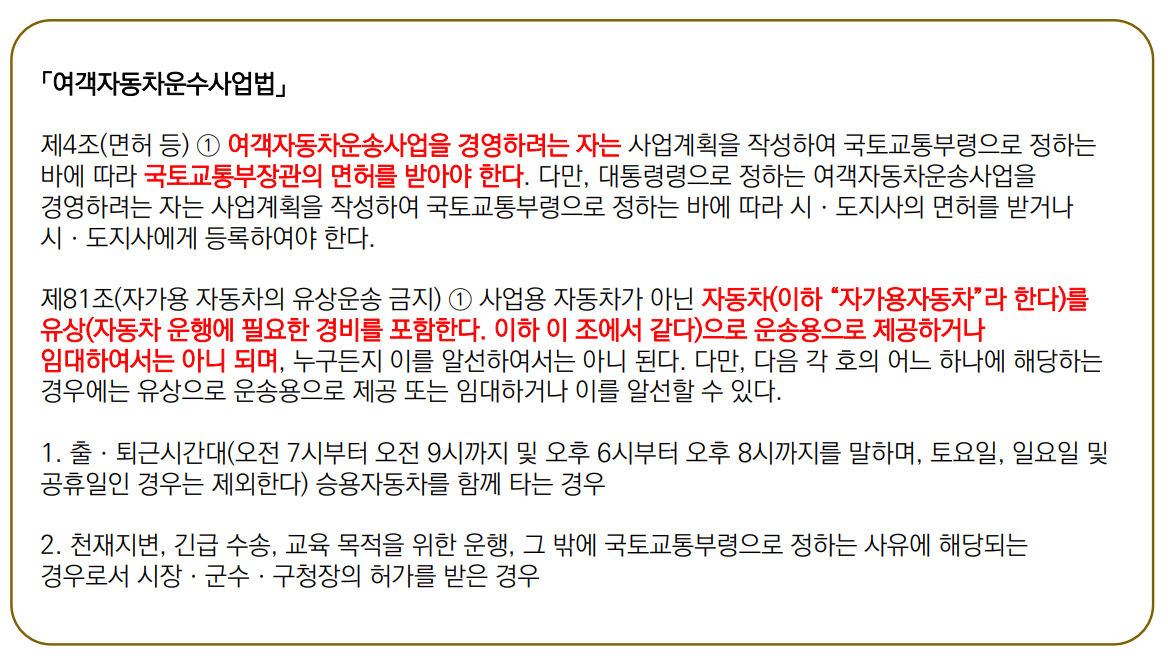
First, under the Passenger Transport Service Act, a passenger transport business is defined as “a business that transports passengers for compensation by automobile in response to another person’s demand.” If an Uber driver receives a fare from a passenger, then that driver must obtain a passenger transport business license in advance from the Minister of Land, Infrastructure and Transport. In that sense, it is illegal from the outset as unlicensed transportation.
An even clearer conflict with the law lies in Article 81. The defining feature of Uber and similar services is that drivers personally provide transportation using their own private vehicles. Article 81 of the Passenger Transport Service Act prohibits paid transportation in precisely such cases. It allows paid transportation only for exceptional reasons, such as carpooling during rush hour or natural disasters.
This law can be applied to an ordinary real-life example. Suppose two office workers in Busan each happen to need to go to Seoul for different reasons. One of them offers to drive the other to Seoul in a private car and receives 50,000 won in return for the favor. Would this violate the law? The answer is yes. In actual court precedents, there have been cases in which what seems like a perfectly natural and reasonable arrangement was ruled illegal. In one case in Daejeon, the owner of a 21-seat private van transported 18 high school students to school and received 450,000 won per month. The Daejeon District Court sentenced the owner to a 500,000 won fine. Presumably, parents of students inconvenienced by commuting had privately arranged a dedicated vehicle. But under the Passenger Transport Service Act, this was clearly a legal violation. The gap between the law and reality is stark.
■ Previous Legislative Discussions and Alternatives
Unlike UberX, in which individuals provide taxi services using their private cars, services in which companies directly provide paid transportation through transportation platforms using owned or leased vehicles are currently operating legally. The National Assembly passed a partial amendment to the Passenger Transport Service Act—commonly known as the “Tada ban law”—while also introducing the “passenger transportation platform business.”
The National Assembly could not simply ignore consumer demand for new mobility industries. It therefore added Article 49-2 to the Passenger Transport Service Act and created three types of transportation platform businesses.
While these are not paid transportation services provided through individuals’ private cars like UberX, the amendment can be understood as a legislative effort to permit businesses of the former Tada type within a limited scope, while seeking a certain level of social compromise by requiring platform companies to pay a “contribution for stabilizing the passenger transportation market.”
The problem is that in order to operate such a transportation platform business, a company must obtain authorization from the Minister of Land, Infrastructure and Transport, and the Platform Transportation Business Committee under the ministry reviews whether permission should be granted. In the shared mobility industry, businesses complain that the outcome of these reviews is highly unpredictable and that the review periods are excessively long, making business expansion difficult. In 2023, Macaron Taxi, which fell under Type 2, went bankrupt. Papamobility, a Type 1 operator, requested approval from the ministry in early 2023 to add 280 vehicles, but received permission for only 100, causing disruptions to its business plan.
Shortly after President Yoon Suk Yeol took office, Minister of Land, Infrastructure and Transport Won Hee-ryong mentioned the possibility of reviving Tada and Uber. He signaled a willingness to legalize Uber and Tada, saying the circumstances differed from when the Tada ban law had been enacted. In reality, however, the ministry remains passive under pressure from the taxi industry. When Coactus, a Type 1 startup, sought cooperation with Kakao Mobility, the ministry—after initially showing a positive attitude—abruptly changed course and effectively opposed the move, saying approval from the review committee was required. Earlier, platform sharing between UT, the joint venture of Uber and a domestic mobility company, and Type 1 company Rainforcompany was also discontinued due to a shift in the ministry’s position. This came after organized pressure from groups such as the National Federation of Taxi Workers’ Unions and the National Federation of Private Taxi Transport Business Associations, which reportedly formed teams and filed hundreds of complaints a day with the ministry.
In the National Assembly, resistance to the emergence of the shared mobility industry was even more pronounced. Some examples of related legislative revisions are as follows.
■ Proposals for the 22nd National Assembly
It is natural for the existing taxi industry to oppose the emergence of ride-sharing services such as Uber. There is, of course, the simple concern that revenue will fall as passengers shift to Uber drivers. More fundamentally, however, the concern lies in the declining asset value of taxi licenses. As of November 2023, the market price of a so-called “taxi medallion” in Seoul was close to 100 million won. Demand for taxi licenses had briefly weakened during COVID-19, but has since rebounded.
At the same time, however, the total number of taxi drivers has been steadily declining. The number of taxi drivers nationwide, which reached 270,000 in 2018, had fallen to 239,000 as of May 2022, with a particularly large share of the decrease coming from a reduction of 30,000 corporate taxi drivers. There is another noteworthy point beyond the absolute decline in driver numbers: aging drivers. The inflow of new drivers is low, so the decline in taxi drivers is expected to accelerate further. And because older drivers tend to avoid nighttime driving, the gap in taxi service supply between day and night is worsening even more. This is precisely why the late-night “taxi shortage crisis,” when public transportation options are limited, is becoming increasingly severe. The government responded by raising taxi fares, but the number of corporate taxi drivers in 2023 stood at 70,126—actually down by about 2,700 over the six months following the fare hike.
For this reason, voices are once again calling for expanded introduction of ride-hailing services such as Uber. Under the current system of only private taxis and corporate taxis, it is difficult to provide a flexible supply response to taxi service demand. When it is hard to catch a taxi, or when existing taxi drivers avoid operating during certain hours, there is a growing need to allow private car owners to provide paid transportation and fill the service gap. Even in Japan, whose legal system resembles ours in many ways, discussions on legalizing ride-sharing have recently emerged. Prime Minister Fumio Kishida has also expressed a positive view toward the full-scale introduction of ride-sharing.
It appears to be only a matter of time: the introduction of Uber is ultimately an unavoidable trend. At a time when Uber has already become commonplace in major countries overseas, banning it only in Korea runs counter to innovation. With advances in software technology, it should be possible to design institutional measures that minimize the negative impact on the earnings of the existing taxi industry while allowing ride-sharing businesses like UberX to enter, centered on time periods and regions where service gaps are most severe. It is by no means difficult, using big data technology, to predict when and in which regions severe mismatches between taxi demand and supply will occur. Gradual introduction measures could also be discussed, such as institutional arrangements that allow taxi operators to maintain competitive advantages through pricing, frequency of operation, or transportation type, including long-distance exclusivity. Exit strategies for retiring taxi drivers should also be presented together.
Remaining completely silent on ways to introduce Uber simply because of opposition from the taxi industry is an irresponsible failure to prepare for the future. The 22nd National Assembly must put forward realistic measures to ensure the smooth landing of the shared mobility industry. The 22nd National Assembly must resolve the paradox of Galápagos-style regulation, under which ride-sharing services that are commonplace even in developing countries become illegal only when they come to Korea.
Original title: [22대 국회를 향한 제안] 우버 허용법
Author: Ju-jin Yoon
Date: 2024-02-05
Source: https://www.cfe.org/bbs/bbsDetail.php?cid=bill&pn=1&idx=26442