
[Proposal for the 22nd National Assembly] Anti-Time Theft Act
-
Writer
CFE
-

 Labor Reform’s Top Priority Is Labor Market Flexibility: Establish Rules for Ordinary Dismissal of Low Performers
• The “just cause” for dismissal under Article 23 of the Labor Standards Act is abstract and vague, resulting in a lack of predictability
• Emotional slogans such as “dismissal is murder” have delayed reform to make dismissal more flexible and ease a rigid labor market
• Companies can create more jobs only when they are able to dismiss low performers through ordinary dismissal, not only disciplinary dismissal
◈ Ahead of the 2024 general election, the Center for Free Enterprise (CFE) proposes 22 legislative tasks for the 22nd National Assembly to pursue based on liberal values across a wide range of fields, including the economy and business, as well as politics, society, education, culture, and foreign affairs and security.
■ Introduction
In labor circles, the slogan “dismissal is murder” is often heard. Negative perceptions of job loss and memories of the mass layoffs during the Asian financial crisis strongly reinforce the sentiment that “dismissal = murder.” Yet reactions diverge when the question becomes, “dismissal of whom?” In February 2016, at the height of labor reform debates, a public opinion survey conducted by Maeil Business Newspaper and Hankook Research found that 48.3% supported dismissing low-performing employees, while 42.5% opposed it, with supporters holding a slight edge. Another survey found that 70% of responding companies supported implementing guidelines for the ordinary dismissal of low performers.
In the early 2010s, the Korean neologism wolgeup lupang appeared. It refers to an employee who neglects duties, wastes time at work, and contributes nothing to the company while still collecting a salary. The term itself already implies that it is not easy to sanction poor employees. Because dismissal or discipline is difficult, such employees can, in effect, “steal” their wages like Arsène Lupin. So in reality, is it difficult to dismiss a “salary thief”? The issue of so-called “ordinary dismissal of low performers” is directly related to this question. Let us examine the current legal framework, its problems, and possible legislative alternatives.
■ Current Status and Problems with the Existing System
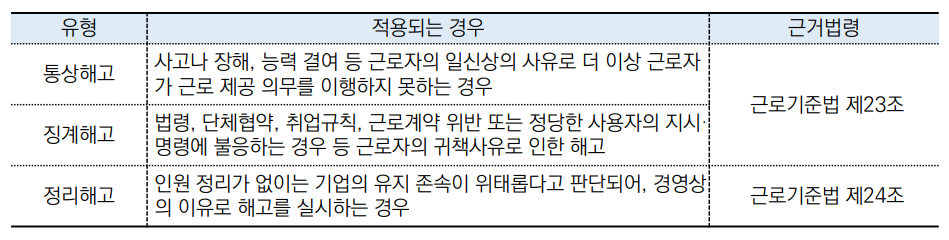
Legally, dismissals can largely be divided into the following three types.
Redundancy dismissal is relatively objective in terms of both the applicable standard and the assessment of appropriateness. The judiciary’s position is that redundancy dismissal may be recognized not only in urgent situations such as bankruptcy, but also when workforce reduction is considered reasonable in light of management conditions. In other words, courts tend to interpret the scope of managerial necessity relatively broadly. However, the requirements include prior efforts to avoid dismissal, reasonable selection of those to be dismissed, and notice to the labor union representative 50 days before the redundancy dismissal.
The issue of dismissing low performers mainly arises from the unclear boundary and distinction between ordinary dismissal and disciplinary dismissal. Article 23 of the Labor Standards Act, the relevant provision, provides as follows.
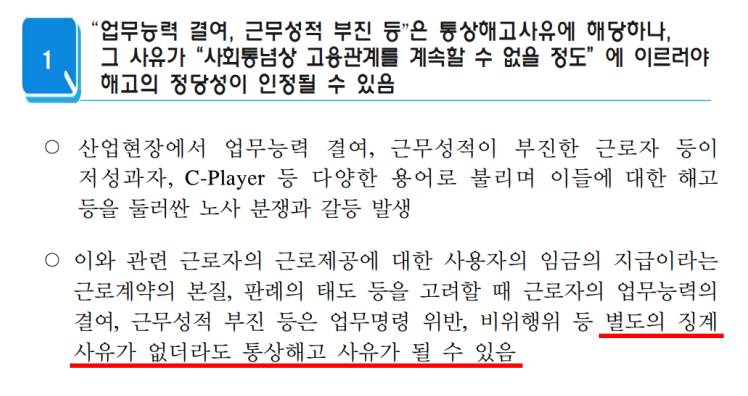
The Labor Standards Act does not explicitly define ordinary dismissal and disciplinary dismissal in statutory language. If there is “just cause” for dismissal, either ordinary dismissal or disciplinary dismissal may be used. Then can low performance constitute just cause? If the rules of employment or a collective agreement contain provisions authorizing discipline against low-performing workers, and if the degree of low performance is so serious that there is effectively no other measure besides dismissal, then disciplinary dismissal for low performance may be possible.
However, merely including a provision in the rules of employment allowing disciplinary dismissal of low performers does not automatically make it valid. First, the employee must be given sufficient opportunity to improve job performance. Only if, despite that, the court concludes under socially accepted norms that the employment relationship can no longer reasonably be maintained and that there is no real prospect of improvement will it recognize the legitimacy of disciplinary dismissal for low performance. Unless the employer has undertaken efforts such as training and counseling programs or job reassignment, dismissal for low performance is generally not upheld. The courts also take the view that the period of recognized low performance must be at least three years. There is even case law holding that dismissal was unfair where an employee received the lowest grade in semiannual performance evaluations for two consecutive years.
If there is no disciplinary provision for low performers in the rules of employment, employers must rely on ordinary dismissal. A company may dismiss an employee for reasons such as markedly insufficient job competence, frequent conflict with co-workers, or a personality ill-suited to collaboration. But whether such reasons constitute “just cause” within the meaning of Article 23 of the Labor Standards Act is a separate issue. Above all, the burden of proving “just cause” lies with the employer. As a result, documentary evidence and records that can identify and substantiate the employee’s low performance become critical. And as with disciplinary dismissal, the employer also has an obligation to give the worker sufficient opportunity to improve work ability.
The problem, ultimately, is that the standard for “just cause” under Article 23 of the Labor Standards Act is vague and in practice is determined case by case largely through judicial precedent. Because there is no objective standard, it is common for dismissed workers to file an application for relief from unfair dismissal with the Labor Relations Commission or to bring a lawsuit against the company seeking confirmation that the dismissal is invalid, resulting in reversals of dismissal decisions and payment of back wages and damages for emotional distress. The causes of low performance are varied. It may stem from an absolute lack of ability, but even when low performance results from deliberate neglect by the worker, companies often cannot take appropriate action. Some workers, aware of this reality, are uncooperative in efforts to improve their work performance.
■ Previous Legislative Discussions and Alternatives
The most notable effort to make ordinary dismissal of low performers more flexible came during the Park Geun-hye administration as part of labor reform, in the form of the so-called “two major guidelines.” In January 2016, the Ministry of Employment and Labor issued the Fair Personnel Management Guidelines. The Labor Standards Act itself remained unchanged, but the government announced revised guidelines for practical application in the workplace. These guidelines made clear that even in the absence of grounds for discipline, a situation could still fall under grounds for ordinary dismissal.
At the time, the government emphasized that the guidelines did not newly introduce a form of ordinary dismissal that had not previously existed, but merely clarified standards and categories to minimize confusion in the field. In reality, however, the guidelines were regarded as a symbolic labor reform measure aimed at recognizing ordinary dismissal under broader conditions. In the end, because this did not lead to an amendment of the basic statute, the Labor Standards Act, many pointed out that the guidelines might not be upheld once disputes reached the courts.
The guidelines were formally abolished in September 2017, one year and eight months later, under the Moon Jae-in administration. At the same time, the 2016 Guidelines for Interpretation and Operation of Rules of Employment, which had served as the basis for reviewing and revising rules of employment and investigating procedural violations, were also repealed, and the Ministry of Employment and Labor reverted to the standards set out in 2009.
Upon taking office, the Yoon Suk Yeol administration put labor reform front and center as one of its three major reform tasks, drawing attention to measures aimed at labor market flexibility. However, the issue of dismissal has not been seriously discussed, given its sensitivity in public opinion. The Comprehensive Tasks in Employment and Labor (Regulations), reportedly drafted in July 2022 by the Office for Government Policy Coordination under the Prime Minister, which oversees overall state affairs, included “expansion of grounds for dismissal,” but the Ministry of Employment and Labor, the competent ministry, drew a line by saying it was not under discussion. In December 2022, the Korea Employers Federation (KEF), representing employers, proposed “clarifying grounds for dismissal and easing requirements for managerial dismissal” as one of 67 regulatory innovation tasks. In March 2023, the Center for Free Enterprise (CFE), through a seminar co-hosted with member of the National Assembly Kim Hyeongdong and others, also emphasized that making it “easier to change jobs and easier to dismiss” was an urgent labor reform task facing the Yoon Suk Yeol administration.
At the National Assembly level, moves to amend the Labor Standards Act have mainly focused on “stronger regulation” that would further tighten the grounds on which dismissal is permitted. Since the 18th National Assembly, it has been difficult to find legislative efforts aimed at making ordinary dismissal of low performers and similar employees more flexible and easier.
■ Proposal to the 22nd National Assembly
Making dismissals easier may at first glance appear to undermine workers’ rights and job security. In reality, however, the argument is gaining traction that the easier it is to dismiss employees, the more job opportunities there are and the more dynamic companies become, ultimately producing outcomes that benefit workers as well.
According to a survey conducted by the Korea Employers Federation (KEF) of 200 foreign-invested companies with at least 100 employees, respondents who answered yes to the question, “Is Korea’s labor market more rigid than the labor market in the country where your headquarters is located?” outnumbered those who answered no by 2.7 to 1. In addition, when asked about the biggest risk factor in the labor market and labor-management relations, “lack of employment flexibility (dismissal and temporary dispatch regulations, etc.)” ranked first at 34.%. Concerns over rigid employment laws are widespread both domestically and internationally.
The indiscriminate abuse of dismissal is, of course, socially inappropriate. It can damage trust between employers and workers and risk undermining the foundations of the national economy. However, it is not desirable to continue relying, as we do now, on the abstract and vague phrase “just cause” in Article 23 of the Labor Standards Act as the basis for ordinary dismissal and disciplinary dismissal. Article 23 should be made clearer in order to minimize unnecessary legal disputes and increase predictability for businesses.
One option worth considering is to improve compliance with the principle of clarity by creating new provisions governing dismissal of low performers, as distinct from various forms of misconduct, deviance, or antisocial conduct that objectively and clearly violate social norms. For example, Article 23-2 of the Labor Standards Act could be newly established to provide legal grounds for dismissing low performers. At present, there is no legal basis for enforcement decrees setting out standards for identifying low performers, procedures for selecting the relevant employees, or the obligations of both companies and workers to make efforts to improve work performance. As a result, a vicious cycle continues in which ineffective government guidelines or judicial precedents must be relied upon.
A “salary thief” who contributes little or nothing to the workplace or has no intention of improving is not merely a burden on the company. Such a person increases the workload of co-workers and blocks opportunities for capable and motivated job seekers, thereby reducing the efficiency of society as a whole. In the World Economic Forum’s labor market flexibility rankings, Korea placed 35th out of 37 OECD countries. In a March 2022 economic policy survey conducted by the Korean Economic Association, 25 of the 31 participating economists (80%) agreed on the need to expand labor market flexibility.
The most fundamental and basic means of securing labor market flexibility is to reduce the burden of hiring by making dismissal easier. Companies ultimately need workers. The more difficult dismissal becomes, the more likely companies are to prefer hiring non-regular workers, raising the risk that quality jobs will also shrink. The 22nd National Assembly must overcome its preconceptions about dismissal and actively move to amend the Labor Standards Act in order to secure a freer labor market.
Original title: [22대 국회를 향한 제안] 월급루팡 방지법
Author: Ju-jin Yoon
Date: 2024-01-30
Source: https://www.cfe.org/bbs/bbsDetail.php?cid=bill&pn=1&idx=26433