
[Proposal for the 22nd National Assembly] A Bill to Permit Medication Delivery
-
Writer
CFE
-

 Drug delivery is legal in the G7 but illegal in Korea; it should be allowed to help telemedicine take root
• With the end of the temporary allowance for telemedicine, drug delivery has been blocked again
…a factor hindering the effectiveness of the pilot program
• “Arguments against” it—such as drug misuse, contamination, and the limits of medication guidance—are unpersuasive; this outdated regulation introduced in 1957 should be revised
• Telemedicine has taken root in people’s daily lives, and to fully enjoy its effects and convenience, the final piece—drug delivery—must be put in place
◈ Ahead of the 2024 general election, the Center for Free Enterprise (CFE) has selected and proposes 22 legislative tasks for the 22nd National Assembly to pursue based on liberal values across a wide range of fields, including the economy and business as well as politics, society, education, culture, and foreign and security policy.
■ Introduction
One of the most representative sectors where strong opposition from existing industries has made it difficult for new industries to gain a soft landing is telemedicine.
Telemedicine, which was temporarily allowed when the health authorities raised the infectious disease crisis response to the “serious” level during the COVID-19 pandemic, faced suspension when the crisis response level was lowered to “alert.” However, as the number of telemedicine users increased and demands from related industries to allow it grew louder, the health authorities have partially allowed telemedicine in the form of a pilot program. Initially, telemedicine was in effect permitted only for follow-up visits (a second consultation in the same medical department), but beginning in December 2023, its scope was greatly expanded so that first-time patients (initial consultations) could also use telemedicine in certain cases.
Yet despite the pilot project, one element remains entirely unregulated in the sense that restrictions have not been eased at all: drug delivery. Given that receiving and taking prescription medication prepared according to a prescription is effectively the final stage of the entire treatment process, a complete ban on drug delivery is cited as a key issue in getting telemedicine firmly established. Let us now examine the legislative task of allowing drug delivery in order to successfully introduce telemedicine, which has now become an irreversible trend.
■ Current status and problems with the current system
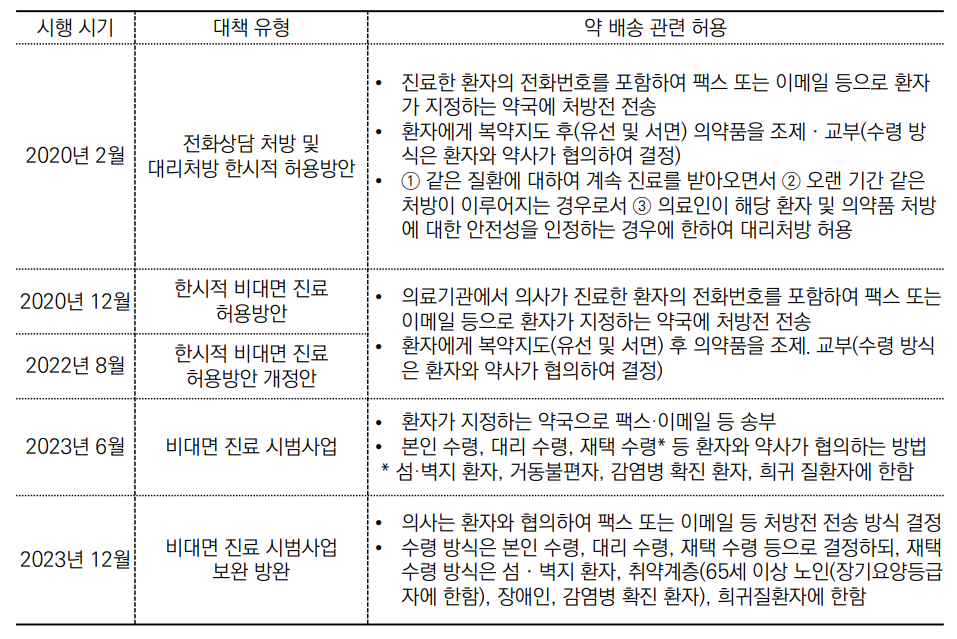
As COVID-19 infections spread widely from early 2020, people gradually became reluctant to visit medical institutions such as hospitals and pharmacies. In response, calls for the introduction of telemedicine (remote healthcare) began to be strongly raised by civic groups and the media, prompting the government to announce measures allowing telemedicine for the first time. In March 2020, the Ministry of Health and Welfare implemented the “Temporary Measures to Allow Telephone Consultation or Prescription and Proxy Prescription.”
As the COVID-19 crisis intensified, measures allowing telemedicine became more concrete; conversely, as the crisis subsided, telemedicine was reduced and allowed only in the form of a pilot project. The policy developments related to drug delivery are as follows.
From the pilot program stage that began in the post-COVID-19 era, eligibility for drug delivery was narrowed to island and remote-area patients, vulnerable groups, and patients with rare diseases, effectively bringing telemedicine-based drug delivery to a complete halt. Those who had accounted for a large share of increased telemedicine use could no longer use drug delivery, and as a result stopped using telemedicine itself.
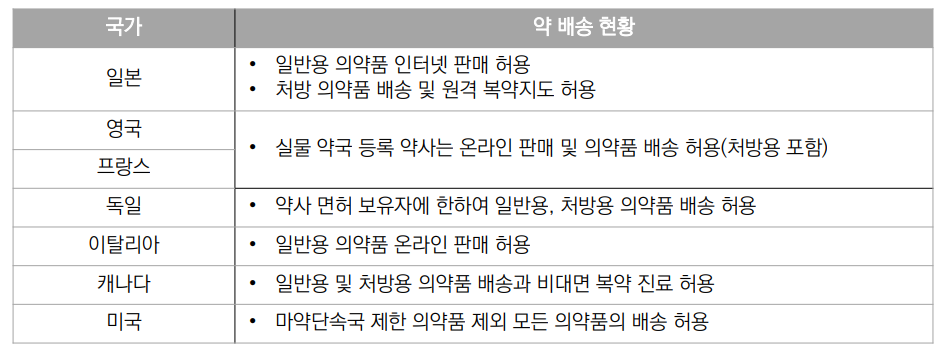
So what is the status of drug delivery in major advanced countries? According to data released in May 2023 by the Remote Healthcare Industry Council, the status of drug delivery in G7 countries is as follows.
Looking more closely at Germany, although mail-order sales of pharmaceuticals have been allowed there since 2004, criticism was raised that delivery sales of prescription drugs should be banned to strengthen the competitiveness of local pharmacies, leading to two years of social debate. As a result of national deliberation, Germany decided to continue allowing drug delivery while seeking measures to strengthen the competitiveness of local pharmacies, thereby reaching a social consensus. It is a precedent worth referencing.
What is the fundamental reason drug delivery is not allowed in Korea? First of all, it is blocked by statute under the Pharmaceutical Affairs Act. The Act prohibits the sale of pharmaceuticals anywhere other than pharmacies or stores. The issue is whether delivery itself falls within the concept of “sale.” On this point, there is a Constitutional Court precedent. A pharmacist at a pharmacy in Gyeongju, North Gyeongsang Province, consulted by phone with a patient suffering from a neuropsychiatric disorder about the patient’s disease and symptoms, then delivered medication to the patient by courier, and was fined 20 million won. The pharmacist appealed and requested a referral for constitutional review of the law, but lost again and ultimately filed a constitutional complaint.
The Constitutional Court held that Article 50(1) of the Pharmaceutical Affairs Act and its penalty provision were constitutional. Regarding the relationship between sale and delivery mentioned above, the Court ruled that “‘sale’ means selling a product for a certain price, and the sale of pharmaceuticals includes a series of acts constituting the entire process from receiving an order from the consumer to delivery, including ordering, compounding, handing over the medicine, and providing medication guidance.” In other words, the Court regarded the entire process through delivery of pharmaceuticals to the consumer as part of the sale.
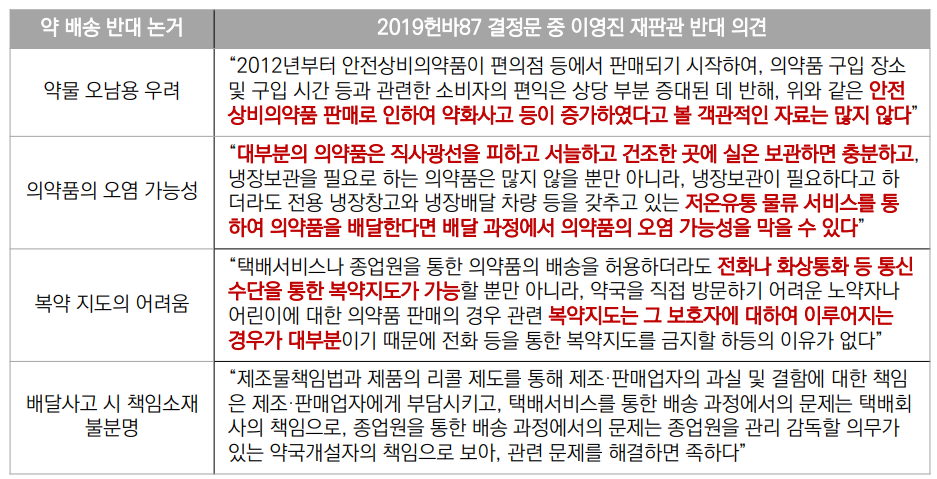
In reality, however, the fundamental reason drug delivery is not allowed can be seen as the strong opposition of pharmacists. In August 2022, the Korean Pharmaceutical Association stated that “delivery of dispensed medicines entails constant risks of drug misuse and abuse, leakage of National Health Insurance finances, dispensing by unqualified persons, and the exposure of patients’ personal information due to misdelivery, illegal delivery of dispensed medicines, identity theft, and the like; it also makes it difficult to identify prescription errors, and when medication accidents occur as a result, responsibility becomes unclear,” and it expressed opposition to revising the Pharmaceutical Affairs Act to legalize drug delivery. Because of the public backlash from one of the most powerful interest groups, the pharmacists’ association, the government and the National Assembly have been reluctant to revise the Act.
■ Previous legislative discussions and alternatives
Does that mean amendment of the Pharmaceutical Affairs Act has no chance at all? Looking at bills introduced in the National Assembly since the 18th Assembly, attempts to amend the Act have been rare. Over the four terms from the 18th through the 21st National Assembly, there was only one legislative attempt to amend the Pharmaceutical Affairs Act in connection with drug delivery. It was the “Partial Amendment to the Pharmaceutical Affairs Act,” introduced in March 2011 by then-Hannara Party lawmaker Jonghyuk Lee.
At the time, former lawmaker Lee explained the purpose of the bill as “resolving problems in purchasing pharmaceuticals for patients living in medically underserved areas or those with limited mobility, and promoting public health, by allowing the dispensing and delivery of pharmaceuticals by the medical institution to which the remote physician belongs for patients who received remote healthcare.” Under a “special provision on prescriptions for remote healthcare,” the bill sought to add a clause allowing the dispensary of the medical institution to which the remote physician belongs to dispense and deliver pharmaceuticals according to the prescription. The bill was discarded upon expiration of the 18th National Assembly’s term.
Another important voice to note regarding allowing drug delivery is the dissenting opinion of Justice Youngjin Lee in the Constitutional Court case introduced earlier. Justice Lee points out in detail the outdated thinking behind the Pharmaceutical Affairs Act’s ban on drug delivery and the concerns that are disconnected from reality.
Justice Youngjin Lee’s opinion contains a logical rebuttal to the historical rationale for banning the sale of pharmaceuticals outside pharmacies. In fact, Article 50(1) of the Pharmaceutical Affairs Act was originally enacted to prevent people without pharmacist licenses—so-called “peddler fake pharmacists”—from illegally acquiring medicines and gathering people to sell them on the street or in hidden shops. This law, introduced in 1957, no longer fits its original purpose at all.
There is also opposition to the Constitutional Court’s interpretation that delivery is included within sale. In a media interview, attorney Taeeon Koo said, “The problem is the executive branch’s expansive interpretation,” adding that “sale and delivery are clearly separate acts.” As support for this point, he noted that when consumers buy goods from online shopping malls, it is common practice to pay delivery fees separately.
■ Proposals for the 22nd National Assembly
Telemedicine has already become an indispensable medical service in people’s lives. As of March 2023, approximately 13.79 million people had used telemedicine about 36.61 million times over the three years of COVID-19. Even excluding cases of at-home COVID treatment, the figure still stood at about 7.36 million, reflecting ordinary medical consumers’ preference for telemedicine.
This is why the government has been expanding the scope of the telemedicine pilot program despite fierce opposition from medical interest groups. Calls to allow telemedicine for working mothers and fathers, vulnerable groups, the elderly, and people with disabilities—those who have difficulty visiting medical institutions—moved the government. On top of that, innovative telemedicine startups were facing bankruptcy and closure, and the government’s passive response came under heavy criticism. Ultimately, beginning in December 2023, the Yoon Suk Yeol administration announced a highly groundbreaking pilot-program guideline allowing even initial consultations, which has been well received by the industry.
The problem is the hurdle posed by the Pharmaceutical Affairs Act. Is amendment of the Act really possible? On this issue, three alternatives may be presented.
First, there is the literal repeal or amendment of Article 50(1) of the Pharmaceutical Affairs Act. Beyond the issue of drug delivery, in light of the fact that advanced countries allow online sales of pharmaceuticals, it would be possible to discuss deleting the provision requiring pharmaceuticals to be sold only in pharmacies and stores, or expanding permitted sales venues to include online and offline channels. Alternatively, the entire provision could be changed to a negative regulatory approach. That is, only the types of sales that are prohibited would be enumerated, with all other sales channels opened. This would be the most exemplary and fundamental solution.
Second, supplementation through an enforcement decree. The clause banning sales outside pharmacies and stores could remain as it is, while exceptions are delegated to presidential decree, allowing the Ministry of Health and Welfare to permit delivery, online sales, and the like through the decree. However, this approach would be unstable because government ministries could easily change their position depending on public opinion. If the enforcement decree changes according to the orientation of the administration or external pressure from outside groups, the telemedicine industry will have difficulty making long-term investments and growing businesses.
Third, though less realistic, the existing Constitutional Court precedent treating delivery as a stage of sale could be overturned. If that happened, delivery of pharmaceuticals would no longer count as a sale and could therefore be allowed without amending the law. However, because of the burden of reversing a recent Constitutional Court ruling, this option is somewhat unrealistic.
In conclusion, it is clear that amending the law is the most effective solution. In the 21st National Assembly, lawmakers who had to be mindful of pharmacist voters in their districts did not readily step forward to revise the Pharmaceutical Affairs Act. If this defensive posture continues in the 22nd National Assembly, Korea’s telemedicine industry will once again lose an opportunity to leap forward. We live in an age when even seafood—which requires far higher freshness standards than pharmaceuticals—can be ordered in the morning and delivered that evening. Even if people are made to visit pharmacies to receive prescriptions, misuse and abuse can still occur if they go from one hospital and pharmacy to another. The rationale for banning drug delivery is gradually disappearing, while the public clearly remembers the usefulness and convenience of telemedicine services during COVID-19, when drug delivery was also allowed.
Will the 22nd National Assembly have the courage to amend the Pharmaceutical Affairs Act? It is necessary to watch closely whether, even in the 22nd National Assembly, the rights and interests of medical consumers will once again be buried under the voices of interest groups. The 22nd National Assembly must not become the final stumbling block to the introduction of telemedicine into people’s daily lives.
Wiki:
https://www.cfe.org/w/bbsDetail.php?idx=109
Original title: [22대 국회를 향한 제안] 약 배송 허용법
Author: Ju-jin Yoon
Date: 2024-01-23
Source: https://www.cfe.org/bbs/bbsDetail.php?cid=bill&pn=1&idx=26403