
[Proposal for the 22nd National Assembly] Legalizing Home Sharing
-
Writer
CFE
-
 Accepting only foreigners? Home-sharing in a legislative gray zone should be legalized through institutional reform
• There are 10 times more Airbnb lodgings than officially registered accommodations, exposing the stark reality of a legal system out of step with the market
• Home-sharing has become commonplace worldwide, yet in Korea it is still restricted to serving foreign guests only
• Home-sharing should be institutionalized through the Tourism Promotion Act and deregulated, while also strengthening measures to prevent side effects and harm
◈ Ahead of the 2024 general election, the Center for Free Enterprise (CFE) has selected and proposed 22 legislative tasks for the 22nd National Assembly to pursue based on liberal values, spanning not only the economy and business but also politics, society, education, culture, and foreign and security affairs.
■ Introduction
Airbnb has already become an indispensable option in the travel planning process. Excellent accessibility, a wide variety of housing types, the convenience of cooking and laundry, and the home-like atmosphere that feels more like “living” than simply traveling have driven the explosive growth of various “home-sharing platforms,” including Airbnb. It is especially helpful for long-term travel such as “living somewhere for a month.”
Home-sharing platforms, familiar to overseas travelers, have also become an essential lodging infrastructure in the domestic travel market. In fact, when accessing platform services, one can easily find ordinary homes and mixed-use officetels openly brokered and traded, with guest reviews steadily accumulating. The media often reports that home-sharing in Korea is illegal and that regulatory reform is urgently needed, but the reality appears to be entirely different. So what are the actual facts?
The conclusion is that “most of it is illegal.” The reason lies in a legal framework divorced from reality and in legislative inadequacies that have remained stagnant, unable to keep pace with change. Countless home-sharing operators and users are unintentionally breaking the law in the gray zone between legality and illegality. Let us look at the causes and possible solutions.
■ Current Status and Problems with the Existing System
Supply and demand for home-sharing platforms in Korea’s travel market have shown steady growth. According to data released in June 2023 by Democratic Party lawmaker Jinseok Moon, as of June 2022 there were 4,955 businesses officially registered nationwide as home-sharing operators. However, the actual number of home-sharing properties listed nationwide on Airbnb, the leading home-sharing platform, was found to be about 50,000. This suggests that 90% are unregistered lodging businesses.
There is also another way to examine the issue. According to data released by fellow Democratic Party lawmaker Seongguk Hong, there were a total of 1,133 value-added tax filings by home-sharing operators in 2022. Meanwhile, the monthly average number of lodging listings registered on Airbnb stood at 62,861. A simple comparison of the two datasets may be imperfect, but the gap between the system and reality is unmistakable.
The types of tourist accommodations, as well as their licensing requirements and regulations, are comprehensively governed by the Tourism Promotion Act and its subordinate enforcement decrees. Article 3, “Types of Tourism Business,” does not separately specify home-sharing as a category. Article 3(1)2, on tourist lodging businesses, provides only for hotel businesses and vacation condominium businesses. Article 2 of the Enforcement Decree of the same Act, which is delegated authority over the law’s details, mentions tourism business categories in greater detail, but again does not specifically identify home-sharing.
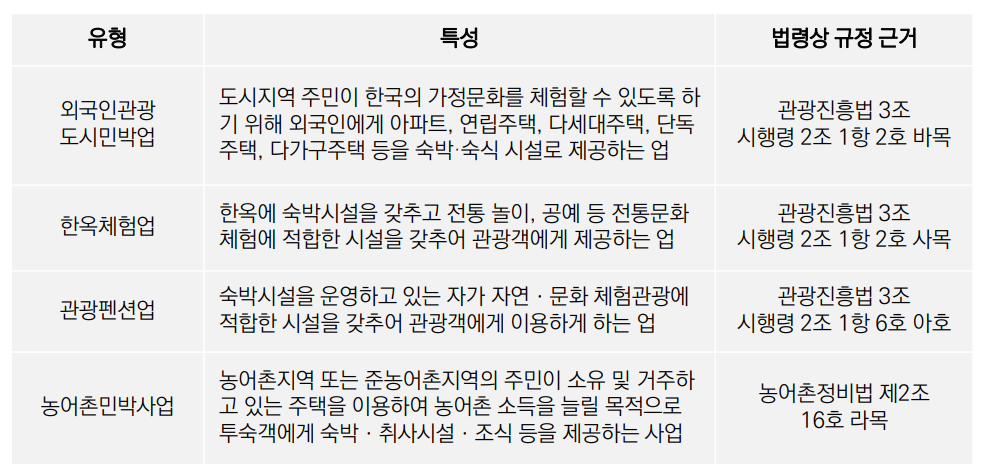
Does that mean home-sharing is illegal? Not entirely. A home-sharing business is one in which an idle portion of an existing residence, originally built for residential use rather than specifically constructed or remodeled for lodging, is provided as accommodation in exchange for monetary compensation. Under current law, four broad categories of such home-sharing-related businesses are recognized.
Among the home-sharing types discussed above, those that may provide lodging services to Korean nationals are hanok experience businesses, tourist pension businesses, and rural fishing village private lodging businesses. Foreign tourist urban homestay businesses, by their very name, are limited to foreign guests. (Under the Urban Regeneration Act, however, village enterprises may provide accommodations and meals to Korean nationals for specialized cultural experiences to the extent that doing so does not interfere with use by foreigners, though the scope is limited.)
Of these, the home-sharing type most familiar to the public is the foreign tourist urban homestay business. Fundamentally, demand for home-sharing arises as a substitute where lodging itself is insufficient or too expensive, and that demand is higher in urban areas. In suburbs, rural areas, and regions with hanok housing, tourism is often already developed or real estate prices are lower, reducing the cost burden of accommodations and therefore lessening the need for home-sharing.
The problem is that foreign tourist urban homestay businesses are, in reality, being used as a loophole for offering home-sharing services to Korean nationals. Cases are already widespread in which residents in urban housing register under the foreign tourist urban homestay category and then operate for domestic customers. If Korean travelers in large cities such as Seoul or Busan used a home-sharing platform to rent apartments or similar housing, that would be illegal.
For this reason, it is easy to find online cases in which home-sharing hosts make somewhat odd requests to domestic guests, such as asking them never to leave a review, or telling them to identify themselves as residents rather than travelers if a security guard or neighbor asks who they are.
It is nearly impossible to individually crack down on the illegal operations of every home-sharing property. In most cases, enforcement depends on neighbors’ suspicions and reports, especially when there is severe noise or involvement in serious crimes such as prostitution or drug use. Moreover, because these operations are conducted underground under the current law, it is also difficult to discuss in advance measures to prevent various side effects and minimize harm to the surrounding environment.
■ Existing Legislative Discussions and Alternatives
The root cause of the problems discussed so far is that policymakers have ignored the reality of a home-sharing market with abundant demand and active voluntary supply, ultimately driving the market underground. Behind this were intense opposition from existing lodging businesses and concerns over the many side effects that might arise from revitalizing home-sharing. This is similar to the case in which collective opposition from taxi operators ultimately led to even a prohibition law against the ride-sharing platform service Tada.
Nevertheless, the fact that Airbnb has already become commonplace around the world, and that home-sharing is also attracting attention as a tool for revitalizing the economies of tourism-neglected areas, has become a source of pressure on the government and the National Assembly to institutionalize home-sharing. According to a 2021 survey on perceptions of “home-sharing for Korean nationals in urban areas” conducted by Kyung Hee University’s Tourism Industry Research Institute and market research firm Embrain, 73% of 500 adult respondents said they supported expanding home-sharing. Although commissioned by an interested company, a 2023 survey conducted by Embrain for Airbnb likewise found that 74% of 1,000 respondents supported revitalizing home-sharing, and 84% said home-sharing could provide income-generating opportunities for the economically vulnerable.
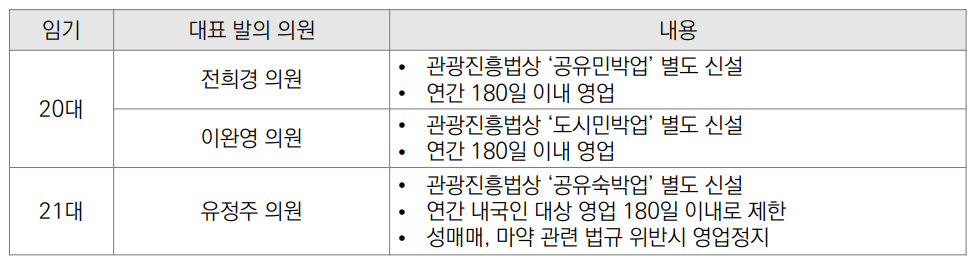
In the 20th and 21st National Assemblies, after the full-scale arrival of home-sharing, some legislative attempts were made to legalize and formalize the sector.
The fact that these proposed amendments uniformly included a 180-day rule suggests that they were intended as a kind of compromise, limiting the number of operating days to an appropriate level in consideration of potential harm to the interests of existing lodging businesses.
There have also been moves at the government and local government levels to ease regulations. Under the Moon Jae-in administration, the Ministry of Economy and Finance designated the Korean lodging platform Wehome as a regulatory sandbox demonstration special-case business, allowing it from July 2020 to July 2024 to provide home-sharing services for Korean nationals in Seoul for up to 180 days per year. The Yoon Suk Yeol administration is considering expanding this regulatory special case to Busan and has taken a positive stance on amending the Tourism Promotion Act. Busan, a leading tourism city, has expressed expectations for an expanded application of the regulatory special case.
On the other hand, there have also been legislative efforts to prevent harm caused by illegal home-sharing. In December 2021, the National Assembly raised the penalty for operating an unreported lodging business from imprisonment of up to one year or a fine of up to 10 million won to imprisonment of up to two years or a fine of up to 20 million won. Lawmaker Youngin Ko proposed a bill to strengthen the prior verification obligations of home-sharing platform operators with respect to illegal or substandard lodging establishments, and that bill is currently pending in the National Assembly.
■ Proposals for the 22nd National Assembly
It is impossible to dismiss complaints and conflicts arising from the expansion of home-sharing. The most widespread problem is the inconvenience suffered by existing residents due to noise caused by guests or illegal garbage disposal. Complaints about home-sharing businesses have been building among residents living in popular tourist areas, especially in small officetels.
There are also voices pointing to “tourification,” an idea derived from gentrification, in which rising rents driven by commercial revitalization displace existing economic actors. The criticism is that the supply of home-sharing services increases tourism demand, raises commercial real estate prices, and pushes out existing residents and merchants. There was a case of large-scale protests in Barcelona, Spain, in 2016, and in September 2023 New York City announced that it would establish new regulatory barriers aimed at reducing the number of registered home-sharing operators.
Given these various circumstances, in what direction should the 22nd National Assembly address the home-sharing issue?
First, the most urgent task is to legalize and formalize home-sharing. As things stand, operating through the loophole of the foreign tourist urban homestay category is abnormal, and temporary measures such as regulatory special cases cannot accommodate market demand for home-sharing. The Tourism Promotion Act should be amended so that home-sharing, which has already grown to a scale comparable to the existing tourism industry, is defined as a separate tourism business category and governed at the statutory level rather than merely by enforcement decree.
Second, it is not appropriate to remain bound by the 180-day operating standard. If the 180-day cap is applied based on actual transaction volume, there may be cases in which operators cannot fill all 180 operating days due to various circumstances such as sudden booking cancellations. Moreover, lodging services could in practice be used for more than 180 days if operators and users agree. In the end, such a rule only drives the market underground in another way.
Third, tourification should be viewed as the natural result of a market economy and one that is realistically difficult to prevent, and the better solution is to strengthen welfare support for vulnerable groups. The tourism activation brought about by home-sharing services cannot be artificially blocked. Rising local preference and increasing real estate prices due to greater outside inflows are also the result of voluntary choices. If home-sharing is suppressed out of concern over tourification, competition will regress and the region will miss opportunities for economic development. Nor is there any justification for protecting the vested interests of existing lodging businesses.
Fourth, stronger preventive measures should be put in place regarding inconvenience to residents caused by home-sharing. Lodging operators should be required to clearly notify guests of the rules they must follow when using home-sharing facilities, and to impose definite disadvantages in the event of violations. In the case of multi-unit residential facilities, another option would be to establish a legal basis allowing communities to create their own rules requiring resident consent, through representative bodies such as residents’ councils, when someone wishes to operate a home-sharing business. If this is provided for in law, local governments could readily prepare detailed guidelines through municipal ordinances.
Whether one sees it as good or bad, home-sharing has already become an irreversible “travel constant.” We are no longer in an era in which traditional lodging businesses can satisfy all tourist accommodation demand. The slogan “Travel is living somewhere” has completely transformed the lodging paradigm. It is only natural that the law should follow such change. Rather than leaving this gray zone created by legislative inadequacy untouched, the 22nd National Assembly should amend the Tourism Promotion Act and fully incorporate home-sharing into the institutional framework.
Original title: [22대 국회를 향한 제안] 공유숙박 양성화법
Author: Ju-jin Yoon
Date: 2024-01-02
Source: https://www.cfe.org/bbs/bbsDetail.php?cid=bill&pn=1&idx=26328