
[Proposals for the 22nd National Assembly] Realizing Local Fiscal Decentralization
-
Writer
CFE
-
 Greater Local Government Autonomy and Regulatory Reform Are the Fundamental Solutions for Fiscal Decentralization in the Era of Local Autonomy
• The share of local taxes is low compared with federal countries and Japan… fiscal dependence on the central government remains severe
• There have been efforts to raise the local consumption tax rate and the local shared tax rate, but these are difficult to regard as fundamental solutions
• It is desirable to attract population and businesses by strengthening local governments’ competitiveness through broader flexible tax rates and regulatory innovation
■ Introduction
Whether urban or rural, a region’s competitiveness can only truly be secured when backed by sufficient fiscal resources. When fiscal self-reliance declines due to insufficient tax revenue, and various local projects and welfare programs are scaled back as a result, population outflow accelerates, which in turn leads to further declines in tax revenue—creating a vicious cycle. For the “era of local autonomy” proclaimed by the Yoon Suk Yeol government to fully achieve its goals, the indispensable precondition is none other than the realization of local fiscal decentralization.
In reality, local governments’ fiscal dependence on the central government remains serious. Various factors are at play, but fundamentally, local governments have an absolute shortage of tax bases they can collect directly, and the scope within which they can exercise “tax competitiveness” through autonomous tax-rate adjustments and similar measures is also limited.
This report seeks to explore legislative alternatives from multiple angles for realizing local fiscal decentralization in the true sense. It is difficult to expect stronger competitiveness from local governments through one-sided, “benefactor-style” support. Such an approach only encourages informal lobbying to secure resources distributed by the central government, ultimately producing high-cost inefficiency. A more effective approach would be institutional design that enhances the fiscal self-reliance of local governments at the structural level.
■ Current Status and Problems with the Existing System
In truth, no unified standard can exist for measuring and comparing the level of local fiscal decentralization across countries. This is because each country differs in the types of taxes imposed, tax rates, and tax bases, and the very concept of local government differs depending on whether a country is federal or unitary. Comparison becomes even more difficult when taking into account various social security fund burdens that are effectively quasi-taxes. Nevertheless, there are commonly used indicators for roughly comparing fiscal decentralization: the share of local taxes, revenue decentralization, expenditure decentralization, and autonomous taxing authority.
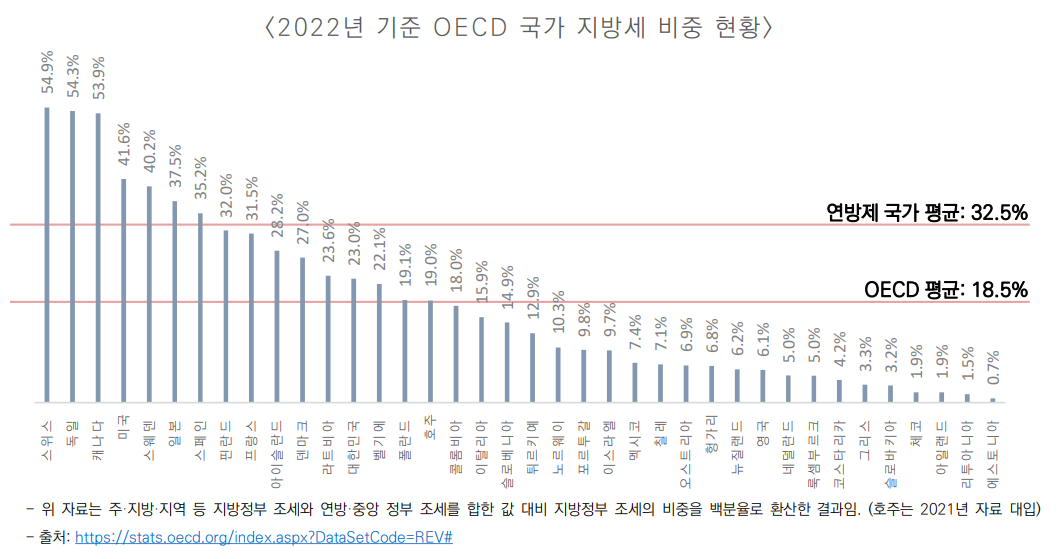
The share of local taxes refers to the share of local taxes in total tax revenue (national taxes + local taxes). Revenue decentralization refers to the share of local government revenue in the total revenue of central and local governments. Applying the concept to expenditures instead of revenue yields expenditure decentralization. Autonomous taxing authority is a somewhat qualitative criterion. It is an evaluation indicator of how freely local governments can establish laws, standards, and other rules regarding budget formation and use. Among these indicators, a comparison of the share of local taxes among OECD member countries is as follows.
Among OECD member countries, Korea ranks 13th in the share of local taxes, placing it relatively high and above the average. However, compared with federal countries where local decentralization is more developed, Korea’s local tax share is low at only 56% of their level. In particular, Japan—which, like Korea, is a unitary state and operates a very similar tax system—has a local tax share twice as high as Korea’s.
According to OECD Fiscal Decentralisation in Comparative Perspective (2021), published by the Korea Institute of Local Finance in March 2023, Korea’s revenue decentralization ratio stands at 18.5%, similar to the OECD average, while its expenditure decentralization ratio is 44.2%, much higher than the average. However, revenue decentralization is again very low compared with federal countries, and is only about 60% of Japan’s level.
In addition to local taxes, local fiscal revenue consists of non-tax revenue, grants, and national subsidies. Strictly speaking, however, the only revenues collected directly by localities are local taxes and non-tax revenue; grants and national subsidies are resources transferred from the central government. Local available resources refer to the sum of local taxes, grants, and national subsidies. The share of these local available resources jumped from 47.3% in 1990 to 59.4% in 2001, then continued rising, recently reaching the high-60% range. Yet the share of local taxes within local available resources has generally trended downward, while the share of national subsidies has gradually increased.
It is true that the absolute size of local finances has grown compared with the past. In reality, however, many policies and projects previously carried out directly by the central government were merely transferred to the jurisdiction of local governments, so only the entity using the budget changed. The finances that local governments can operate autonomously have not increased substantially in relative terms. Moreover, grants and national subsidies distributed according to predetermined ratios are fiscal revenues unrelated to the efforts of local governments or regional competitiveness, and are therefore far removed from fiscal decentralization.
■ Existing Legislative Discussions and Alternatives
The previous Moon Jae In government pursued measures to increase the share of local taxes in order to realize local fiscal decentralization. It proposed improving the ratio of national to local taxes from the existing roughly 8:2 level to 7:3, with the ultimate goal of reaching 6:4. As part of this effort, in November 2021, the government and the National Assembly passed a partial amendment to the Local Tax Act that raised the local consumption tax rate from 21% in 2021 to 23.7% in 2022 and 25.3% in 2023.
The local consumption tax is a tax in which part of the national value-added tax is converted into a local tax. Following this amendment, the Moon Jae In government explained that annual resources totaling KRW 4.1 trillion would be transferred from the central government to local governments, narrowing the national-local tax ratio from 73.7:26.3 in 2020 to 72.6:27.4 in 2023.
During its launch, the Yoon Suk Yeol government presented “strengthening the fiscal capacity of local governments” as Policy Task No. 11. According to The Direction and Tasks of the Yoon Suk Yeol Government’s Decentralization Policy published by the Governors Association of Korea, the Yoon government’s fiscal decentralization stance emphasizes “transferring fiscal authority for substantive balanced development and establishing a foundation for local fiscal responsibility.” Its detailed measures include setting goals based on fiscal autonomy to strengthen local fiscal authority, expanding local independent revenue sources, improving the Special Account for Balanced National Development and the national subsidy system, introducing a management system for cash welfare programs, establishing an integrated local subsidy management system and conducting local fiscal diagnostics, and improving the fiscal crisis management system. However, after recording a tax revenue shortfall of KRW 59 trillion in 2023, the government appears to have little room to pursue concrete policies to strengthen the fiscal foundation of local governments. In addition, the Yoon government cut local shared taxes by a total of KRW 8.5 trillion in its 2024 government budget proposal. Local governments, already seeing reduced acquisition and registration tax revenues due to sluggish real estate market transactions, are expected to face even tighter fiscal conditions.
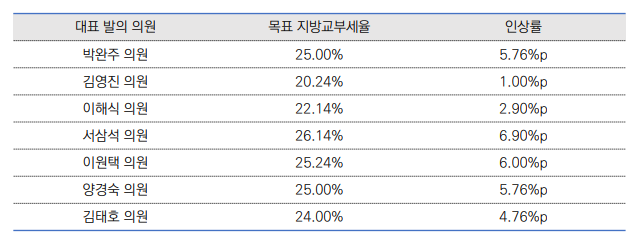
Similar legislative attempts continued even after passage of the bill raising the local consumption tax rate. A proposed amendment to the Local Tax Act, introduced by People Power Party lawmaker Kwon Myungho, would raise the local consumption tax rate from 25.3% to 26%. Democratic Party of Korea lawmaker Lee Haesik proposed a bill to increase it slightly from 25.3% to 25.75%, while fellow party member Kim Cheolmin proposed raising the local consumption tax to 30%, though that bill was discarded in the 21st National Assembly after its contents were incorporated into an alternative bill.
Moves to raise the local shared tax rate have been especially active. The current local shared tax rate of 19.24%, set in 2006, has remained unchanged. Accordingly, many lawmakers from both ruling and opposition parties have argued for an increase. The target local shared tax rates proposed in partial amendments to the Local Shared Tax Act introduced in the 21st National Assembly are as follows.
■ Proposals for the 22nd National Assembly
Local fiscal decentralization in the true sense does not simply mean making local finances more abundant. In the strict sense, fiscal decentralization means guaranteeing local governments autonomy in every stage of securing finances, drafting budgets, and using them. Accordingly, once fiscal decentralization is established, some local governments may gain a solid fiscal foundation, while others may see their finances worsen. As with firms, fiscal performance can diverge depending on local governments’ efforts to secure revenue and their success in attracting business investment.
In that sense, raising the local consumption tax rate and the local shared tax rate has fundamental limitations. After all, such measures merely adjust the boundary of classification within total domestic taxes; they do not produce revenue that rises in accordance with the actual contribution of local governments. Moreover, because both the local consumption tax and local shared tax are applied at uniform rates determined by the center, they do not strengthen local governments’ autonomous taxing authority.
To fundamentally realize local fiscal decentralization, institutional improvements based on the following principles are necessary.
First, the share of national subsidies in local government revenue should be reduced. Subsidies are allocated unilaterally by the central government. Earmarked subsidies, in particular, are distributed with their uses designated by the central government, so local governments merely serve as implementing agents. Such national subsidies only increase the size of local government finances on paper and are far removed from local fiscal decentralization. The share of finances that local governments can use autonomously must grow.
Second, institutional incentives should be provided to actively utilize flexible tax rates. As of 2019, flexible tax rates could be applied to all tax items except the leisure tax and local consumption tax. For example, in the case of the acquisition tax and local income tax, tax rates can be adjusted from -50% to +50%. The problem, however, is that very few local governments actually apply flexible tax rates, and tax items for which flexible rates are not permitted account for more than 60% of total tax revenue. The incentives enjoyed by local governments when applying flexible tax rates are limited, and the requirements for using them are rather strict. A representative successful case is the September 2020 ordinance passed by the Seocho District Council in Seoul to lower the property tax rate on single-home households below a certain property value threshold. Flexible tax rates are one of the most representative means of guaranteeing local governments autonomous taxing authority. Their use needs to become far more common.
Third, the authority of local governments to carry out regulatory reform should be greatly expanded. In particular, non-capital regions with low fiscal self-reliance need to offer dramatic incentives to firms and workers in order to secure a comparative advantage over the Seoul metropolitan area. Based on this orientation, the Yoon Suk Yeol government established the First Comprehensive Plan for the Era of Local Autonomy. In particular, the government identified the establishment of high-quality educational infrastructure as an essential condition for strengthening local competitiveness and announced a blueprint for Education Development Special Zones. Opportunity Development Special Zones, Urban Convergence Special Zones, and Cultural Special Zones are also core strategies of the comprehensive plan.
Under a structure in which influential politicians’ “pork-barrel budgets” and round-the-clock waiting in Yeouido by each local government’s National Assembly liaison office are repeated, it is difficult to expect the realization of true fiscal decentralization. Local governments must be given both autonomous authority over fiscal matters and responsibility for them. The more their dependence on grants and subsidies increases, the more their fiscal capacity will decline. The 22nd National Assembly must seek fundamental solutions for realizing local fiscal decentralization.
Original title: [22대 국회를 향한 제안] 지방 재정분권 실현
Author: Ju-jin Yoon
Date: 2023-12-26
Source: https://www.cfe.org/bbs/bbsDetail.php?cid=bill&pn=2&idx=26309