
[Proposal for the 22nd National Assembly] Protecting Private Property Rights in Military Areas
-
Writer
CFE
-
 Private property rights violations in affected areas must be addressed by shrinking military protection zones and easing regulations
▪
Various forms of economic development are blocked, causing severe property losses…inconveniencing residents and worsening regional decline
▪
Although a special act exists, its effectiveness is limited, and a fundamental solution is difficult because the Military Bases and Installations Act takes precedence
▪
Given the nature of modern warfare, broad protection zones are unnecessary, and the Yoon Suk Yeol administration has shown signs of reducing them
■ Introduction
South Korea, which remains in a state of confrontation with North Korea, operates military facilities extensively across the entire country. In the southern border areas centered on the Military Demarcation Line, commonly referred to as the “ceasefire line,” military-related facilities are intermingled with civilian housing and economic activity. Under the Military Bases and Military Installations Protection Act (hereinafter the “Military Bases Act”) and its subordinate statutes, the government designates as “protection zones” those areas that must be managed and controlled for national security purposes.
In political circles, there has long been controversy over the scope of these protection zones, the extent to which residents within them may engage in economic activity, and the allocation of authority between local governments and military units. The core of the conflict is that residents living in these areas, or owners of real estate assets such as land, forests, and buildings there, complain of inconvenience in their everyday economic activities and violations of private property rights, calling for deregulation, while the authorities have responded somewhat passively. Regardless of party affiliation, a member of the National Assembly representing areas that include large border regions or military protection zones tends to support deregulation and express a willingness to amend the law, but in reality progress has been slow for security reasons.
This report examines the current state of private property rights violations arising in so-called “military areas,” including military protection zones, and considers legislative alternatives.
■ Current Status and Problems with the Existing System
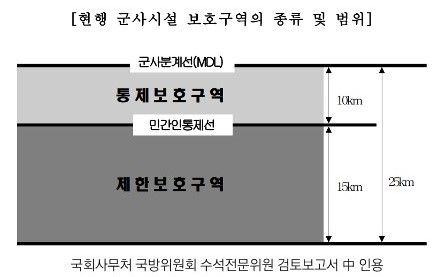
The Military Bases Act separately designates four types of military zones. The northern area beyond the boundary commonly called the “Civilian Control Line” is the control protection zone, while the restricted protection zone stretches from south of the Civilian Control Line to 25 km south of the Military Demarcation Line; together, these are referred to as protection zones. In addition, the law provides for flight safety zones and air defense cooperation zones.
The acts prohibited or restricted within protection zones are extremely broad. In control protection zones, entry itself is prohibited without permission, and the construction of new buildings is prohibited in principle. (Separate permission may be granted by presidential decree.)
Matters that may be permitted by administrative agencies but require consultation with the Minister of National Defense or the commander of the competent military unit are set out in Article 13 of the Act. Although presidential decrees provide for exceptions, the matters subject to consultation cover virtually most economic activities. These include the extension or reconstruction of buildings, installation of structures, changes in building use, logging, land reclamation, and the installation of telecommunications facilities. The provisions restricting development are dense and comprehensive.
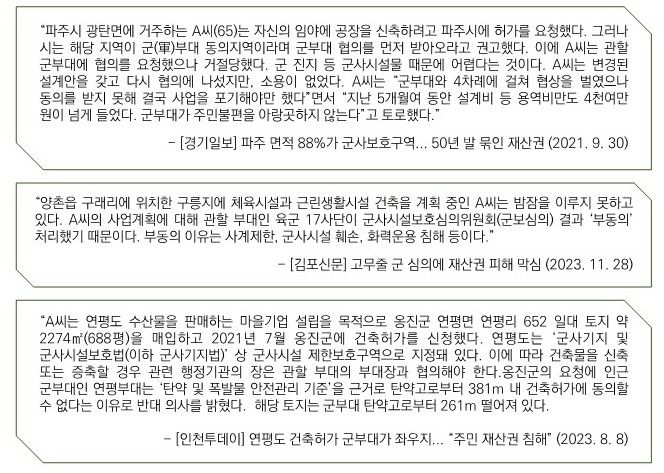
How smoothly administrative approval and consultation with the military proceed from the standpoint of development actors can easily be seen in local press reports reflecting residents’ views.
As such reports show, military units, which bear responsibility for ensuring security, tend to take a comparatively passive approach toward consultation, and the high uncertainty surrounding development in these areas forces local residents and property owners to bear financial disadvantages. The very condition that consultation with a military unit is required lowers asset values and suppresses market demand.
■ Existing Legislative Discussions and Alternatives
Legislative efforts to improve the rights and interests of residents and property stakeholders in protection zones have continued steadily in political circles. A representative example is the Special Act on Support for Border Areas. This law was enacted to promote the development of underdeveloped border areas, improve resident welfare, and advance balanced regional development. Introduced in 2001, it has been amended more than 35 times in the direction of expanding support policies. Under this law, the government formulates a Comprehensive Border Area Development Plan and revises it annually in line with local demand and balanced development policy.
However, doubts persist about the effectiveness of the Border Area Support Act. According to “Measures to Improve the Legal and Institutional Framework for Support for Border Areas,” published by the Gangwon Institute in January 2022, actual implementation of projects desired by local communities is impossible because of Article 3, which gives priority to the Military Bases Act and the Framework Act on the National Land, and the priority clause of the Military Bases Act restricts infrastructure improvements and economic activity in border areas, thereby infringing on residents’ basic rights. In short, the limitation is that regulations applying to protection zones under the Military Bases Act take precedence.
There have also been attempts to amend the law in this regard. In June 2020, Kim Seongwon of the People Power Party introduced a bill to delete the provisions giving priority to the Capital Region Readjustment Planning Act and the Military Bases and Military Installations Protection Act. Likewise, an amendment to the Border Area Support Act introduced in July 2020 by his party colleague Han Gih-o reflected provisions stating that matters relating to the development and support for use of border-specialized development districts would take precedence over the Framework Act on the National Land, the Capital Region Readjustment Planning Act, and the Military Bases and Military Installations Protection Act.
The Moon Jae-in administration moved to ease regulations by lifting military facility protection zones. In November 2018, the Ministry of National Defense lifted protection zone status from 336.99 million m2 of land. Then in 2021, it lifted protection zones covering an area about 35 times the size of Yeouido, and in 2022 it additionally lifted protection zones about three times the size of Yeouido.
Under the Yoon Suk Yeol administration, the Ministry of National Defense announced improvements at a more fundamental level. In January 2023, during President Yoon Suk Yeol’s annual policy briefing, the ministry said it would reexamine military facility protection zones from scratch. This reflected an intention to realistically readjust the Demilitarized Zone (DMZ) in line with current military capabilities, the security environment, and combat conditions.
There have also been legislative attempts along similar lines. An amendment introduced in November 2022 by Kim Seongwon of the People Power Party proposed adjusting the Civilian Control Line from the existing 10 km south of the Military Demarcation Line to 5 km, and likewise adjusting the restricted protection zone to extend 15 km south of the Military Demarcation Line from the Civilian Control Line.
Explaining the reason for the proposal, Kim stated: “Even militarily, with the advance of modern warfare, operations are being conducted under a three-dimensional battlefield concept rather than the old concept of lines and areas, including the operation of scientific surveillance systems in parallel with mobile strike units, so it cannot be said that wide-ranging military protection zones are necessarily required.”
■ Proposal for the 22nd National Assembly
The bill introduced by Kim Seongwon is also supported by Han Gih-o, of the same party, who served as chair of the National Defense Committee in the second half of the 21st National Assembly. According to a January 2023 article in the Gangwon Ilbo, Han stated, “The current military facility protection zones are meaningless. The standards established immediately after the war have remained in place until now, and the damage suffered by residents is beyond words,” adding that “the time has come to create a realistic DMZ.”
Given expert observations that, due to the nature of modern warfare, much of the rationale for designating broad ground areas as protection zones has disappeared, and given that once an area is designated as a protection zone there are inevitably fundamental constraints on guaranteeing private property rights, shrinking both control protection zones and restricted protection zones across the board is being discussed as the most realistic option. However, a review report by the chief specialist of the National Assembly Secretariat expressed the view that careful consideration is needed, noting that reducing protection zones would require changes to wartime and peacetime operational plans, mine removal, relocation of guard posts, fence reinstallation, and other measures that would demand enormous budgets and long periods of time. Ultimately, if the security anxiety resulting from shrinking protection zones is significantly low and the resulting economic benefits to residents and regions are substantial, then it would be desirable to put gradual reductions into practice even if that entails some costs and takes a long time.
In this regard, two legislative supplementary measures may also be considered.
First, the Military Bases Act could be partially amended to apply special provisions on various prohibitions and permit requirements only to areas that are clearly expected to be removed from protection zone status in the future. In this case, administrative and military measures for lifting protection zone status could proceed, while at the same time proactively guaranteeing the exercise of private property rights by residents and stakeholders, thus satisfying multiple conditions at once.
Second, Article 3 of the Border Area Support Act needs to be amended to revise the clause giving priority to general laws such as the Military Bases Act. If various benefits and policy support available under the Border Area Support Act could partially remedy the disadvantages caused by infringements on private property rights, some of the dissatisfaction of affected parties could be alleviated. If there is concern about deleting the priority clause outright, a realistic alternative would be to consider excluding priority application for specific projects, as proposed in Han Gih-o’s amendment bill.
Since the outbreak of the Korean War, residents of border areas have endured numerous disadvantages arising from the inter-Korean confrontation, including security anxiety, constraints on economic freedom, and regional underdevelopment. Yet simply by remaining in these areas, protecting their communities, carrying out economic activities there, and forming residential communities, these residents can be said to have made a considerable contribution to national security. The mere fact of their constant presence helps deter localized provocations. Nor should it be overlooked that these residents have also provided infrastructure for the welfare and leisure of soldiers stationed in the relevant military units.
The time has come to provide fair treatment to residents and property owners in border areas and protection zones. In a free-market economic system, the state must not infringe upon individuals’ fundamental rights, and when such infringement is unavoidable, it has an obligation to provide proper compensation. One can only hope that the 22nd National Assembly will take active steps to shrink protection zones and ease regulations under the Military Bases Act.
Original title: [22대 국회를 향한 제안]군사지역 사유재산권 보호법
Author: Ju-jin Yoon
Date: 2023-12-19
Source: https://www.cfe.org/bbs/bbsDetail.php?cid=bill&pn=2&idx=26299