
Cutting 109 Public Agencies: Consolidation and Merger Are Not a Cure-All
-
Writer
CFE
-
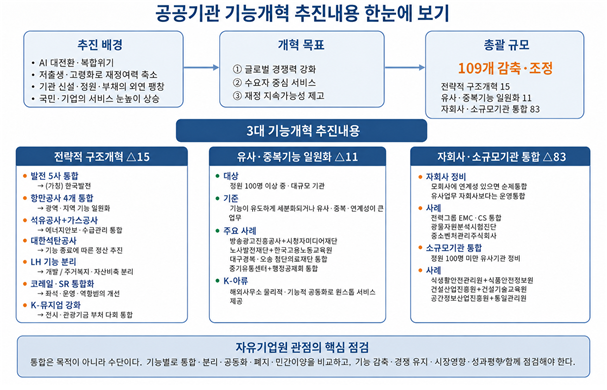
1. Introduction: The Meaning of Reducing 109 Entities and the Criteria for Reform
On September 3, 2026, the government announced the “Plan to Promote Functional Reform of Public Institutions,” the so-called “Public Institutions DIET 2026.” It seeks a total reduction of 109 entities: 15 through strategic structural reform, 11 through consolidation of similar and overlapping functions, and 83 through the integration of subsidiaries and small institutions.
However, not all mergers and consolidations should be viewed in the same way. The proposed integration of the five power generation companies, the four port authorities, the Korea National Oil Corporation and Korea Gas Corporation, and Korail and SR is viewed negatively because it raises serious concerns about weakening competition and specialization. By contrast, the liquidation of Korea Coal Corporation, whose functions have effectively expired; the separation within LH of land development and housing construction from housing welfare and asset stockpiling; and the streamlining of similar and overlapping functions and subsidiaries are relatively positive. In the case of regional airports as well, it is preferable to maintain separation and competition rather than pursue integration, while strengthening cooperation where necessary.
The government’s recognition that it is difficult to leave unchanged the outward expansion of public institutions and their overlapping functions is valid. The government plan identifies major environmental changes such as the AI transformation, multiple overlapping crises, shrinking fiscal capacity, and rising service expectations among citizens and businesses. Its diagnosis is that the number of institutions, organizations, and personnel has continued to grow, while similar functions have been dispersed across institutions, increasing fixed and administrative costs.
But the success or failure of reform should not be judged by “how many institutions were merged.” Consolidation is not the goal but a means. Some functions are more efficiently performed through integration, while others require preserving competition; some are better abolished or transferred to the private sector; and where objectives conflict, separation may actually be more efficient. In fact, the government plan itself opts for functional separation in LH, cooperation rather than immediate integration for airport corporations, and shared overseas hubs for K-Maru rather than a corporate merger.
For this reform to succeed, it must move beyond the “number of institutions” and instead begin by asking about “the necessity of each function and the appropriate entity to perform it.”
. Three Major Reform Types in “Public Institutions DIET 2026”
Reform type
Scale of reduction
Core direction presented by the government
Strategic structural reform
15
Reorganization of the national infrastructure management system in areas such as power generation, ports, energy, coal, airports, LH, and railways
Consolidation of similar and overlapping functions
11
Integration of medium- and large-scale similar institutions; unification of overseas offices into K-Maru
Integration of subsidiaries and small institutions
83
Vertical integration of parent companies and subsidiaries; horizontal integration of similar subsidiaries; streamlining of institutions with fewer than 100 employees
Source: Jointly compiled by relevant ministries (2026), “Plan to Promote Functional Reform of Public Institutions.”
Source: Jointly compiled by relevant ministries (2026), “Plan to Promote Functional Reform of Public Institutions.”
◩ More Important Than the Number 109 Is “What Is Being Reduced”
Reducing the number of institutions is an easy metric for explaining reform performance. But even if Institution A and Institution B are merged into Institution C, the number of institutions may fall only nominally if the existing projects, personnel, budget, and organization all remain intact. Conversely, even if the number of institutions does not decline much, the government’s role and the burden on the public can shrink substantially if unnecessary projects are abolished and functions that can be carried out by the private sector are transferred to the market.
Accordingly, the “reduction of 109” can be evaluated as the starting point of reform, but it should not be treated as the final performance indicator. It is also necessary to assess whether overlapping departments and projects are actually eliminated after integration, whether administrative costs and debt are reduced, whether functions that had encroached on private markets are scaled back, and whether users’ access to services improves.
Key judgments
◆ The first question in public institution reform should not be “Which institutions should be merged?” but “Is this function still necessary?”
◆ Even when a public function is necessary, it should first be reviewed whether the government must perform it directly or whether it can be replaced through a competitive market or private contracting.
◆ Whether to integrate should be decided only after considering the effects on competition, regional characteristics, specialization, and transition costs.
2. Large-Scale Infrastructure Integration: We Must Consider Both Economies of Scale and Tensions with Competition
◩ The integration of the five power generation companies, the four port authorities, and the oil and gas corporations is negative: maintaining separation and competition is preferable
The government has proposed consolidating the five power generation companies—Korea South-East Power, Korea Midland Power, Korea Western Power, Korea Southern Power, and Korea East-West Power—into a single corporation tentatively named Korea Power Generation. It has also proposed integrating the four port authorities—Busan, Incheon, Ulsan, and Yeosu Gwangyang—into a tentative Korea Port Authority. In the power sector, the plan is to concentrate dispersed R&D and renewable energy investment and to gain efficiencies through joint purchasing of fuel and maintenance materials and the streamlining of overlapping personnel. In the port sector, the idea is to enhance international competitiveness by unifying policy and planning functions. The government uses similar logic for integrating the Korea National Oil Corporation and Korea Gas Corporation: to coordinate national energy supply strategy within one organization.
However, in these fields, the benefits of preserving separation and competition outweigh those of creating a single corporation. The five power generation companies were split in 2001 to introduce competition, and it remains necessary to preserve mechanisms for comparison and competition. Likewise, port authorities operate under different cargo structures and regional strategies, so centralized integration could weaken local autonomy. Oil and gas also differ in procurement markets, pricing structures, infrastructure, and business risks, making it more appropriate to preserve separate specialization and accountability than to integrate them. By contrast, because all mines of Korea Coal Corporation have been closed and its functions have effectively ended, liquidation after debt resolution and legal revision is appropriate.
Major Large Public Institution Restructuring Plans and Points of Concern/Criticism
Sector
Government restructuring plan
Problems, criticism, and evaluation
Five power generation companies
Consolidate the five power generation companies into a single corporation tentatively named Korea Power Generation
Evaluation: Negative. Comparison and competition among institutions established after the 2001 split would disappear, and there is a risk of organizational bloat, slower decision-making, and weaker accountability in a single giant public enterprise. Joint investment in renewable energy and joint fuel purchasing can be pursued as joint projects without corporate integration. Rather than integration, it is preferable to maintain the separation-and-competition framework of the five power generation companies while strengthening selective cooperation such as joint procurement and joint R&D.
Four port authorities
Integrate the Busan, Incheon, Ulsan, and Yeosu Gwangyang Port Authorities into a tentative Korea Port Authority
Evaluation: Negative. Each port has different hinterland industries, cargo structures, and regional strategies, so centralizing policy and planning could weaken regional specialization and local responsiveness. Competition among ports for cargo volume and service improvement would also decline. Joint development of overseas hubs and shared purchasing and information systems are possible without a corporate merger. It is more appropriate to keep the four port authorities separate and competing, while cooperating only on necessary joint projects.
Oil and gas corporations
Integrate the Korea National Oil Corporation and Korea Gas Corporation to unify energy security and supply strategy
Evaluation: Negative. Oil and natural gas differ in procurement markets, pricing structures, infrastructure, and business risks; combining them into one organization risks diluting specialization and concentrating financial risks and debt in a single entity. Negotiations over overseas resources and energy security strategy can also be coordinated through a pan-government consultative body or joint projects. It is preferable to keep the institutions separate to preserve specialization and accountability while strengthening cooperation at the level of national energy strategy.
Korea Coal Corporation
Liquidate after resolving debt, following the closure of all mines
Evaluation: Positive. If an institution whose functions have effectively ended is kept in existence, administrative and interest costs will continue to accumulate. Liquidation following the end of its functions is therefore a valid and substantive reduction of functions compared with keeping the institution alive. However, the financing of accumulated debt, the disposal of residual assets, and the criteria for workforce transition should be disclosed transparently.
Sector
Government restructuring plan
Problems, criticism, and evaluation
Korea Land and Housing Corporation (LH)
Separate land development and housing construction from housing welfare and asset stockpiling into two corporations
Evaluation: Positive. The profitability and speed of development projects differ in nature and performance criteria from the public character of housing welfare, making conflict within one organization likely. It is reasonable to separate functions, accounts, and accountability so that each objective becomes clearer. The key challenge after separation will be clearly designing how development gains are fed back into housing welfare and assigning financial responsibility to each corporation.
Korail and SR
Unify the operating system for high-speed rail
Evaluation: Negative. If comparative competition between operators disappears, pressure for service quality, pricing discipline, and operational innovation may weaken, while the monopoly structure of rail operations may be strengthened. Better seat connections, transfers, and fare and mileage compatibility can also be improved through system linkage and agreements. It is preferable to maintain the separation-and-competition system between Korail and SR while expanding connected services for user convenience.
Incheon International Airport Corporation and Korea Airports Corporation / regional airports
Do not immediately merge Incheon International Airport Corporation and Korea Airports Corporation; reconsider after revitalizing regional airports
Evaluation: Mostly positive. Airports differ in the roles, demand, and regional characteristics of hub and regional airports, so the efficiency of integration into a single institution is not clear. Keeping the two corporations separate leaves room to compare operational performance and pursue airport-specific strategies. Rather than airport integration, it is preferable to maintain separation and competition and strengthen necessary cooperation through bodies such as an airport strategy council. Only functions such as aviation security, where the benefits of standardization and specialization are large, may merit separate integration.
Source: Jointly compiled by relevant ministries (2026), “Plan to Promote Functional Reform of Public Institutions.”
◩ The Larger the Scale of Integration, the More We Must Examine Diseconomies of Scale Alongside Economies of Scale
If several institutions purchase the same raw materials and invest in the same types of facilities and R&D, the benefits of joint procurement and strategic integration are clear. But a single giant public enterprise is not automatically more efficient than several public enterprises. As organizations grow, layers of decision-making increase and internal coordination costs may rise. In the public sector, where external competition is weak, inefficiencies may also remain hidden for long periods. In sectors such as power generation and railways, where the government previously separated organizations to increase competition or comparability, it is necessary to calculate not only the benefits of integration but also the costs of lost competition. Even if integration is pursued, it should be accompanied by devices such as internal responsibility accounting that allows comparison of performance by generation source and region, room for private-sector entry, and mechanisms to preserve competition in procurement, construction, and services.
3. Mergers and Consolidations Are Not a Cure-All: Three Different Solutions Shown by the Government Plan Itself
◩ The separation of LH functions, maintaining separation among regional airports, and streamlining K-Maru and similar overlapping functions are relatively positive
Paradoxically, the government plan itself shows that “integration alone is not reform.” In LH’s case, the government argues that land development and housing construction functions and housing welfare and asset stockpiling functions pursue different goals within one institution, causing inefficiency. It therefore seeks to separate them into the tentatively named Housing and Urban Development Corporation and Housing and Urban Assets Corporation. This can be viewed positively because business-oriented, speed-focused functions differ in nature from public-interest, welfare-centered functions, and dividing them into separate corporations can clarify accountability and financial structure.
Regional airport policy is also better served by maintaining separation and competition than by integration. Rather than combining Incheon International Airport Corporation and Korea Airports Corporation into one, it is better to keep a separate structure that preserves each airport’s role and regional character while strengthening cooperation on routes, transfers, and industrial linkages where needed. The government’s decision to prioritize regional airport revitalization and role-sharing rather than immediate integration is consistent with this direction. The approach of considering separate integration only in areas such as aviation security, where standardization and specialization generate major benefits, is acceptable.
K-Maru overseas offices are also meaningful because they represent a model of physical and functional sharing rather than corporate mergers. This preserves the expertise of multiple institutions while integrating points of contact for users to provide one-stop services. Similarly, the streamlining of similar and overlapping functions and the integration of subsidiaries are generally positive because they offer substantial room to reduce duplicative support organizations and administrative costs.
Integration Is Not the Only Tool of Functional Reform
Reform tool
Suitable situation
Example from the government plan
Evaluation
Liquidation/abolition
The core function has ended or the public need has disappeared
Liquidation of Korea Coal Corporation
The most direct way to reduce functions. Residual debt and legal responsibilities must be resolved.
Institutional integration
Functional overlap is large and the benefits of competition or regional diversity are small
Some subsidiaries and similar institutions
Effective for eliminating duplicative support organizations. The key is reducing projects and personnel after integration.
Functional separation
Objectives, finances, and performance criteria conflict within one institution
Separation of LH functions
Can strengthen accountability by separating public-interest and business-oriented functions. A positive case in the current government plan.
Cooperation/shared platforms
Specialization should be preserved, but user contact points or support organizations overlap
K-Maru, airport strategy council, some overseas hubs
A middle-ground alternative that delivers coordination effects without integration costs. Appropriate for areas like regional airports where separation should be maintained.
Transfer to the private sector/market opening
Functions that can be competitively supplied by the private sector
Relatively weak in the government plan
The area that most needs strengthening in follow-up reform
Source: Prepared by the author based on Jointly compiled by relevant ministries (2026).
◩ The Standard for Reform Is Not “Organizational Form” but Transaction Costs, Competition, and Accountability
Even when the same function is carried out by several institutions, the solution should differ depending on whether it is simple duplication or a structure in which institutions compete for different regions and demand. Integration may reduce coordination costs, but it may also remove competitive pressure for service improvement. In sectors such as regional ports and airports, where local economies and on-the-ground information are important, the benefits of centralization must be weighed against the loss of regional autonomy.
Accordingly, every restructuring proposal should include an “alternative comparison table” before integration is pursued. Maintaining the status quo, functional sharing, institutional integration, functional separation, abolition, and transfer to the private sector should all be compared on the same criteria, and the optimal tool should be selected in terms of cost, service, competition, and accountability.
4. The Streamlining of 83 Subsidiaries and Small Institutions Could Be the Most Substantive Reform
◩ The streamlining of similar and overlapping functions and subsidiaries is generally positive
The largest component of this plan is the restructuring of 83 subsidiaries and small institutions. The government has proposed vertical integration, in which subsidiaries performing similar or related work are absorbed into their parent organizations, and horizontal integration, in which subsidiaries performing similar tasks are merged with one another. Examples such as facility management and customer management subsidiaries of financial public institutions, security and facility management subsidiaries of port authorities, and the reorganization of some small similar institutions are generally positive because they can reduce duplicative support structures and simplify accountability.
Compared with large-scale infrastructure integration, the benefits and risks of reform in this area are relatively clear. If separate corporations, management teams, personnel systems, accounting systems, and audit systems are maintained at each institution while they effectively perform the same facility management or customer management functions, there is a high likelihood of duplicated administrative costs. Creating shared function-based organizations or absorbing them into the parent company can simplify command structures and cost structures. Even in this case, however, it should also be examined whether the private sector could provide these functions more efficiently.
◩ But before “merging public institutions with one another,” we should ask whether the private market could replace the function
Facility management, cleaning, customer support, and some education, consulting, and distribution support functions are already widely provided by private firms. If these functions are simply gathered into another public subsidiary, only their position within the public sector may change. The public necessity of each function should be reassessed, and for areas where competitive procurement or private contracting is more efficient, market-based options should also be considered.
Priorities for Streamlining Subsidiaries and Small Institutions
Type
Priority direction for review
Criteria for judgment
Functions essentially identical to those of the parent company
Absorption/integration
Practical benefit of maintaining a separate corporation, scale of duplicative support organizations, accountability
Identical support functions across several institutions
Function-based sharing or competitive procurement
Economies of scale, potential for standardization, existence of a private supply market
Similar institutions with fewer than 100 employees
Integration or transfer of functions
Overlap in policy objectives, cost of maintaining independent institutions, need for specialization
Projects replaceable by the private sector
Transfer to the private sector / outsourcing / market opening
Public-good character, market failure, existence of competitors, user choice
Functions whose policy objective has ended
Abolition/liquidation
Need for continued existence, residual assets and liabilities, legal obligations
Source: Jointly compiled by relevant ministries (2026).
◩ Without Restraints on New Creation, Numbers Could Rise Again After Mergers
The government argues that the past creation of new institutions and the expansion of subsidiaries increased inefficiency. If so, discipline at the stage of creating new institutions should also be strengthened alongside the current restructuring. When new policy needs arise, the first comparison should not automatically be the creation of a new institution, but adjustment of existing institutions’ functions, temporary projects, and private contracting. It is also worth considering sunset-type management that periodically reexamines the need for institutions to continue to exist.
Principles for reforming subsidiaries and small institutions
◆ The first review should not be “Can they be merged?” but “Should the public sector continue doing this at all?”
◆ If integration is chosen, performance indicators should disclose whether the heads of institutions, support departments, and overlapping projects are actually reduced.
◆ New subsidiaries and small institutions should be allowed only exceptionally, after reviewing adjustments to existing functions and the possibility of private-sector replacement.
5. We Must Be Cautious About Integration That Eliminates Competition
◩ In sectors such as power generation and railways, “overlap among institutions” must be distinguished from “the benefits of competition”
The mere fact that public institutions do similar work does not automatically mean there is duplication. If different institutions compare performance and compete on service quality in the same market, that itself can be a mechanism for improving efficiency. The five power generation companies were split in 2001 to introduce competition into the electricity business, and the government plan explicitly notes this background. Now integration is being pursued again in the name of responding to the energy transition and large-scale projects.
If the policy environment has changed, governance can of course be reconsidered. But it must be verified whether the reasons for introducing competition have truly disappeared, and whether the gains from integrated investment and bargaining power outweigh the costs of lost competition. Unifying Korail and SR may also improve user convenience and seat-operation efficiency, but it may weaken competitive pressure that allows comparison of service, fares, and operational performance.
◩ If Large Public Enterprises Are Integrated, Internal Decentralization and External Competition Must Be Designed Together
Even when integration is unavoidable, all authority need not be concentrated in one central organization. In the power sector, responsibility accounting can be established by energy source, region, and project, with performance disclosure preserving internal comparative competition. In ports, policy planning and overseas hubs may be integrated while still guaranteeing substantial autonomy over business, pricing, and marketing to regional branches. In railways as well, competition should be reexamined by function, including facilities, control, and operations.
① Is the public function itself necessary?
Unnecessary → Abolish
↓
② Should the government/public institution perform it directly?
No → Transfer to the private sector / outsource / open to the market
↓
③ Is it a similar or overlapping function?
Yes → Functional unification / shared platform
↓
④ Are the benefits of competition, regional characteristics, and specialization large?
Yes → Maintain independence + cooperation
↓
⑤ Are the benefits of integration greater than the transition costs?
Yes → Review institutional integration
Note: Integration should be a tool chosen only after examining functional necessity, market substitutability, and competition effects.
◩ “Market impact assessment” should be a separate item in merger and consolidation reviews
The current government plan emphasizes cost reduction, concentration of functions, and service convenience. In the follow-up detailed roadmap, it should also be assessed whether integration makes entry more difficult for private businesses or strengthens public monopolies. As public institutions grow larger, their impact on surrounding markets such as procurement, distribution, sales, consulting, and research support also increases.
Oversight of integrated institutions’ market share, transaction conditions, and subsidiary expansion should be strengthened. Activities open to competition should be separated in accounting so that they compete with private firms on equal terms. A market-competition perspective is necessary to ensure that public institution reform does not end up simply creating “larger public institutions.”
6. Functions the Private Sector Can Perform Should Be Returned to the Market: The Missing Piece in Functional Reduction Must Be Filled
◩ Compared with internal integration, the current plan gives relatively weak attention to transfer to the private sector
The government plan broadly covers integration among public institutions, functional unification, and subsidiary restructuring, but the issue of transferring functions that can be carried out by the private sector to the market is relatively less visible. Merely moving Institution A’s work to Institution B within the public sector does not reduce the scope of the government’s role. Genuine functional reform must go further and redraw the boundaries of what functions the public sector should perform at all.
Public institutions have an important role in areas such as public goods, safety, and universal service, where markets alone may not provide enough supply. But in fields where private suppliers exist—such as information provision, education and consulting, some distribution and marketing, facility management, and simple certification support—competitive procurement, vouchers, or private contracting may be more efficient than direct public provision. Under such an approach, the government designs the rules and supervises performance, while service providers compete.
Criteria for Selecting Reform Tools by Function
Question for judgment
Yes
No
Is the function still necessary for a public purpose?
Review the next stage
Abolish/terminate
Must the government produce it directly?
Compare public provision methods
Transfer to the private sector / outsource / open to the market
Is the same function duplicated across several institutions?
Review sharing/integration
Independent maintenance possible
Are the benefits of competition, regional characteristics, and specialization large?
Maintain independence + prioritize cooperation
Review integration benefits
Are the benefits of integration greater than transition costs and the loss of competition?
Institutional integration
Functional sharing / maintain the status quo
◩ Public Institutions Should Be “Providers When Necessary,” Not “Providers of Last Resort”
When public institutions expand into businesses before the private sector does, space for private firms to grow shrinks, and over time a self-reinforcing structure can emerge: “Because the public institution is already doing it, it must continue.” Conversely, if public institutions step back in fields where private markets are already mature, the government can focus resources and personnel on core public functions.
Accordingly, after this restructuring of 109 entities, a follow-up program is needed to regularly inspect the “market substitutability” of all public institution projects. Beyond reviewing whether institutions themselves should exist, it is necessary to assess each individual project for possible abolition, transfer to the private sector, or the introduction of competition.
Market principles for follow-up reform
◆ In functions where a private market exists, direct performance by public institutions should be treated as the exception, and its necessity should be proven.
◆ In businesses where public institutions compete with private firms, accounting separation and equal rules should be applied to reduce implicit advantages.
◆ When establishing new institutions or expanding projects, a “private substitution feasibility review” should be made mandatory.
7. Employment Succession and Reform Performance: Transitional Protection Must Not Turn Into Organizational Preservation
◩ The government has proposed employment succession and maintenance of treatment for employees affected by mergers and consolidations
The government stated that it would engage in labor-management-government consultations during the reform process, guarantee employment succession for employees of merged and consolidated institutions, and operate the compensation system so that employees’ treatment does not deteriorate before and after consolidation. This is an understandable approach in that it seeks to ease uncertainty caused by functional restructuring and facilitate institutional transition. (Jointly compiled by relevant ministries, 2026)
However, if employment succession is interpreted as a principle of permanently preserving overlapping organizations, positions, and projects as well, the cost-saving effects of reform will be limited. Even if institutions are merged, if headquarters, departments, and managerial posts all remain intact, only the organizational chart may change. Employment stability during the transition and long-term workforce efficiency must be distinguished.
◩ Rather than artificial layoffs, natural attrition, redeployment, and job transition should be used—but staffing levels must still be reduced
Immediately reducing redundant personnel after integration could intensify labor conflict and organizational confusion. A more realistic approach is to adjust new hiring, rely on natural attrition through retirements, redeploy staff to core functions, and use job-transition training to optimize staffing over the medium to long term. The important thing is not “whom to cut” but “which functions and positions will no longer be maintained.”
Proposed Performance Evaluation Indicators After Merger and Consolidation
Evaluation area
Key indicator
Evaluation question
Organization
Changes in headquarters, departments, managerial posts, and staffing ceilings
Were overlapping organizations actually reduced after integration?
Fiscal
Administrative costs, labor costs, debt, support budgets
Did the public burden and latent fiscal risks decrease?
Projects
Number of overlapping projects abolished, integrated, or transferred to the private sector
Were functions—not just institutions—actually reorganized?
Service
Processing time, accessibility, satisfaction, price
Did users experience better service?
Market
Private entry, procurement competition, changes in market share
Was the public monopoly strengthened?
Accountability
Disclosure of performance by project, responsibility accounting, ex post evaluation
Did performance and responsibility become clearer?
◩ Incentives in management evaluation should also be linked not to “completion of integration” but to “realization of results”
The government plans to reflect incentives for target institutions of functional reform in management evaluations. These incentives should be linked not to the mere completion of integration procedures but to outcomes such as reduction of overlapping costs, service improvement, functional abolition and transfer to the private sector, and improvements in financial soundness. Rather than rushing formal integration, it is important to disclose ex post performance over a period of 2 to 3 years.
For each reform target institution, the government should disclose a pre-integration baseline and annual goals, and establish a feedback mechanism under which additional functional adjustment or restructuring is automatically reviewed when targets are not met.
8. Six Major Policy Tasks to Complete Functional Reform of Public Institutions
◩ First, function reduction—not the number of institutions—should be used as the performance indicator
◆ Alongside the reduction of 109 itself, the government should disclose abolished projects, reduced staffing, lower administrative costs, and the scale of transfer to the private sector.
◆ By disclosing lists of functions before and after integration, it can filter out “formal integration” in which only names have changed.
◩ Second, “comparison of alternatives” should be made mandatory before mergers and consolidations
◆ Maintaining the status quo, cooperation, functional sharing, institutional integration, functional separation, abolition, and transfer to the private sector should be compared using the same standards.
◆ The benefits of integration should be demonstrated through quantitative and qualitative assessment of competition effects, regional characteristics, specialization, and transition costs.
◩ Third, review of private substitution feasibility should be made a core procedure in functional reform
◆ For services where private suppliers exist, the need for direct performance by public institutions should be proven separately.
◆ Competitive procurement, private contracting, vouchers, and market opening should be reviewed as reform tools on equal footing with mergers and consolidations.
◩ Fourth, the public monopolization of large integrated institutions must be prevented
◆ In potentially competitive fields such as power generation, railways, and ports, internal responsibility accounting, performance comparison, and private entry should be maintained.
◆ Separate market impact assessments should be applied to the expansion of subsidiaries and entry into adjacent markets by integrated institutions.
◩ Fifth, restraints on new establishment and sunset reviews should be institutionalized
◆ Before establishing new institutions or subsidiaries, existing institutions’ functional adjustment and the possibility of private-sector replacement should be reviewed first.
◆ The necessity of maintaining institutions and projects should be periodically reverified to block renewed expansion.
◩ Sixth, reform performance should be disclosed to the public in numerical terms
◆ For 2 to 3 years, the government should disclose changes in personnel, budget, debt, service, and market impact compared with the pre-integration baseline.
◆ Management evaluation incentives should be linked not to integration itself but to cost reduction, service improvement, and actual functional reduction.
Because this reform requires legal amendments, coordination with regional interests, and labor-management-government consultations at the same time, it cannot be judged by speed alone. What matters is not how quickly institutions are merged, but clearly distinguishing between the goals and the means of reform. Integration should be pursued boldly where appropriate, but in areas where separation, shared platforms, or transfer to the private sector are better options, those alternatives should be chosen.
9. Conclusion: Function, Competition, and Accountability—Not Merger and Consolidation—Should Be the Standards of Reform
“Public Institutions DIET 2026” is significant in that it seeks to massively restructure the similar and overlapping functions of public institutions, as well as subsidiaries and small institutions, and to redesign the organizational systems of key infrastructure in areas such as power generation, ports, energy, railways, and housing. However, the evaluation should clearly differ by sector. The integration of the five power generation companies, the four port authorities, the oil and gas corporations, and Korail and SR should be viewed negatively because it raises major concerns about weakening competition and specialization. By contrast, the liquidation of Korea Coal Corporation, whose functions have effectively ended; the separation within LH of land development and housing construction from housing welfare and asset stockpiling into two corporations; and the streamlining of similar and overlapping functions and subsidiaries are relatively positive. Regional airports as well should move in the direction of strengthening necessary cooperation while maintaining separation and competition rather than integration.
Public institution reform should not become a competition in mergers and consolidations. A single solution cannot be mechanically applied to every field. In fields where the benefits of competition are large, a separated structure should be maintained; in fields where functions have ended, institutions should be liquidated; where objectives conflict within one institution, functions should be separated; and clearly similar and overlapping functions and subsidiary support organizations should be integrated and streamlined. A selective approach is needed.
Therefore, the number 109 should not be the policy goal, but the first line on the checklist. The next lines should state the functions actually abolished, the projects transferred to the private sector, the administrative costs and debt reduced, the services improved, and the degree of competition preserved. If sectors such as the five power generation companies, the port authorities, the oil and gas corporations, and Korail and SR—where the benefits of competition and specialization are large—are forcibly integrated, the result may not be reform but an expansion of public monopoly.
Because public institutions operate on the basis of taxpayers’ money and government credit, they should focus on truly necessary public functions. The more public institutions take on work that the market can do, the more private-sector growth space shrinks and the greater the latent burden on the public becomes. The ultimate goal of public institution reform should not be “a few oversized public enterprises,” but rather a redesign of the public sector that preserves necessary functions, removes unnecessary ones, and sustains both competition and accountability.
That is why this reform must go beyond “institutional integration” and expand into a “redesign of functions and markets.” In fields such as the five power generation companies, port authorities, oil and gas corporations, and Korail and SR—where the benefits of competition and specialization are substantial—it is preferable to maintain separation while strengthening cooperation; Korea Coal Corporation, whose function has ended, should be liquidated; LH, where objectives conflict, should have its functions separated; and the restructuring of similar and overlapping functions and subsidiaries should be actively pursued. For regional airports as well, maintaining separation and competition with selective cooperation is more appropriate than integration.
◩ References
• Jointly compiled by relevant ministries (2026.9.3.), “Plan to Promote Functional Reform of Public Institutions – Public Institutions DIET 2026.”
• National Law Information Center, “Act on the Management of Public Institutions.”
• ALIO, Public Institution Management Information Disclosure System, public institution management disclosure data.
Original title: 공공기관 109개 감축, 통폐합이 능사는 아니다
Author: Center for Free Enterprise (CFE)
Date: 2026-09-04
Source: https://www.cfe.org/bbs/bbsDetail.php?cid=issue&pn=1&idx=29480