
Key Issues in Treasury Stock Regulation and Market-Friendly Reforms
-
Writer
CFE
-
Key Message
The amendment to the Enforcement Decree of the Capital Markets Act approved on June 23, 2026 expands disclosure on the holding and disposal of treasury shares to all listed companies and, in line with the revised Commercial Act, deletes provisions concerning exchangeable bonds backed by treasury shares and on-exchange disposal in the regular market. Suspending the voting rights of treasury shares and transparently disclosing changes in the counterparty, price, and purpose of disposal are necessary to protect ordinary shareholders. However, applying the same detailed disclosure requirements and mandatory cancellation within one year to all firms, while completely blocking exchangeable bonds and on-exchange disposal, could go beyond preventing abuse and effectively allow the government to decide even normal corporate capital allocation. The government cannot uniformly determine the optimal holding period and method of using treasury shares. Basic disclosure should apply to all listed companies, but detailed disclosure and enhanced procedures should be differentiated according to the holding ratio, transaction size, dilution effect, and whether related parties are involved. On-exchange disposal and exchangeable bonds should, in principle, be permitted under transparent trading rules through a market-friendly regulatory approach.
◩ Summary of Policy Recommendations
· Basic disclosure, including the status of treasury share holdings, should apply to all listed companies, but detailed holding and disposal plans and mandatory external valuations should be limited to material cases, such as holdings above a certain threshold or related-party transactions.
· The holding and use of treasury shares should in principle be allowed, and the requirement to cancel them within one year should not be a uniform obligation. Instead, exceptions and approval procedures should be rationalized so they can reflect firms’ capital needs and shareholder judgment.
· For on-exchange disposal in the regular market, a safe harbor should be introduced allowing such transactions if they satisfy prior program disclosure, daily trading volume limits, blackout periods, and post-transaction disclosure.
· Exchangeable bonds backed by treasury shares should, rather than being completely banned, be permitted in principle for non-related-party transactions provided they meet conditions such as an exchange price at or above market price, prior disclosure, and board accountability, while transactions involving controlling shareholders and specially related parties should be strictly limited.
· External valuation, independent director review, and special shareholder resolutions should not be layered onto all transactions. They should be applied proportionately to related-party transactions with large transaction sizes and dilution rates, and the system’s performance should be assessed not by the amount canceled but by corporate value, investment, employment, and regulatory costs.
1. Background and Main Contents of the Institutional Reform
As a follow-up measure to the Commercial Act revision that took effect in March 2026, the government approved an amendment to the Enforcement Decree of the Capital Markets Act related to treasury shares at the Cabinet meeting on June 23. The revised Commercial Act requires companies, in principle, to cancel treasury shares they acquire within one year, and if they wish to hold or dispose of them for exceptional reasons such as employee compensation, they must prepare a treasury share holding and disposal plan and obtain shareholder meeting approval. Treasury shares are denied both voting rights and dividend rights, and the issuance of bonds exchangeable into or redeemable with treasury shares, as well as the allocation of new shares in mergers or spin-offs using treasury shares, is also prohibited (Ministry of Government Legislation, 2026).
This Enforcement Decree amendment expands the scope of disclosure on treasury share holdings and treatment plans from listed companies holding treasury shares equal to at least 1% of total issued shares to all listed companies holding treasury shares. In business reports, companies must state the holding and disposal plan approved by the shareholder meeting, the cancellation deadline, the original acquisition purpose and actual disposal purpose, and differences between the prior plan and actual implementation. At the same time, the amendment deletes provisions relating to exchangeable bonds backed by treasury shares, disposal during trust periods, and on-exchange disposal through the exchange’s regular market (Financial Services Commission, 2026b).
Comparison Before and After the Revisions to the Commercial Act and the Enforcement Decree of the Capital Markets Act
Category | Previous | Revised Content | Issue from the Center for Free Enterprise (CFE) Perspective
Disclosure 대상 | Listed companies holding treasury shares of 1% or more | All listed companies holding treasury shares | Basic disclosure is reasonable, but detailed disclosure should require a materiality threshold
Disclosure scope | Focus on holding status and treatment plan | Includes holding purpose, disposal and cancellation plans, and actual implementation | Information benefits and compliance costs for smaller listed firms should be evaluated together
Cancellation principle | Long-term holding possible | In principle, cancellation within 1 year of acquisition; exceptions require shareholder meeting approval | Uniformly standardizes firm-specific capital needs and shareholder choice
Exchangeable bonds | EB issuance backed by treasury shares allowed | Complete ban on EB backed by treasury shares | Abusive transactions and normal financing should be distinguished
Trust contracts | Partial disposal during trust period allowed | Disposal during trust period prohibited; immediate return upon termination | Need to balance blocking indirect holding with operational flexibility
On-exchange disposal | Sale possible in the exchange’s regular market | On-exchange disposal route to unspecified multiple parties deleted | Even market sales, which are lower risk than related-party transactions, are blocked
Note: The Commercial Act revision took effect on March 6, 2026, and the Enforcement Decree of the Capital Markets Act and subordinate regulations are scheduled to take effect on June 30, 2026. Source: Ministry of Government Legislation (2026), Financial Services Commission (2026a; 2026b).
◩ The policy goal is valid, but the regulatory tools must be evaluated separately
Concerns are valid that treasury shares may be held for a long time without voting rights and then disposed of to a friendly third party during a control dispute, or transferred to a specific counterparty at a low price, thereby diluting the economic value and voting rights of ordinary shareholders. Mechanisms are also needed to disclose the link between the acquisition purpose and the actual disposal purpose and to monitor related-party transactions. However, the mere existence of abuse cases does not automatically lead to the conclusion that all holding and use of treasury shares should be restricted in the same way. The policy objective of shareholder protection should be assessed separately from the proportionality of regulatory means such as mandatory cancellation, a ban on exchangeable bonds, and blocking on-exchange disposal.
2. The Economic Functions of Treasury Shares and Risks of Conflicts of Interest
◩ Treasury shares are a more flexible capital allocation tool than dividends
Companies acquire treasury shares for reasons beyond shareholder returns alone. These include returning excess cash, signaling that the market price is below intrinsic value, employee stock compensation, consideration for strategic alliances and business combinations, capital structure adjustment, responding to market shocks, and defending corporate control. Surveys of managers also show that share repurchases are seen as a more flexible payout tool than dividends because they are easier to adjust and their size can be changed depending on investment opportunities and liquidity conditions (Brav et al., 2005).
In particular, growth firms and industries with high business-cycle volatility can return excess cash while avoiding the negative signal that arises when cash dividends are first increased and then cut back. Held treasury shares can also be used for employee performance compensation or as consideration in M&A, reducing the time and cost associated with issuing new shares. The optimal holding period and use of treasury shares vary by a company’s stage of growth, industry characteristics, financial condition, and investment opportunities, making it difficult for the government to prescribe a single uniform approach.
◩ The core risk lies not in holding itself, but in conflicts of interest at the disposal stage
Treasury shares carry no voting rights while held by the company, but those rights revive the moment the shares are disposed of to a third party. If management can arbitrarily determine the disposal counterparty and price, shares acquired with company assets may be transferred to friendly forces to strengthen control or to provide economic benefits to a specific party. Accordingly, regulation should focus not on holding itself but on whether related parties are involved, the fairness of the price, dilution effects, changes in purpose, and board responsibility. Rather than automatically deeming a transaction improper simply because it serves a control-defense purpose, the standard should be its effect on total shareholder value and the fairness of the process.
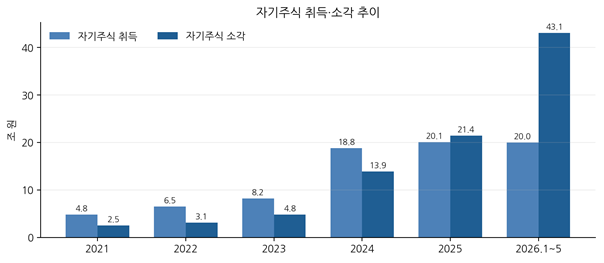
Source: Financial Services Commission (2026b), Korea Exchange disclosure standards. For 2026, the period is January 1 to May 31. Acquisitions and cancellations during the same period do not necessarily refer to the same shares and therefore cannot simply be netted out.
◩ A sharp increase in the amount canceled does not by itself prove an increase in corporate value
According to Financial Services Commission data, the amount of treasury shares canceled from January to May 2026 was KRW 43.1 trillion, more than double the full-year 2025 figure of KRW 21.4 trillion. This reflects both the effect of institutional reform accelerating cancellations and the clearing of previously accumulated holdings. Cancellation can increase the ownership ratio of existing shareholders, but it also reduces capital instruments that could otherwise be used for growth investment, employment, R&D, M&A, and crisis response. The system’s performance should be judged not by short-term cancellation amounts alone, but together with total shareholder return, cost of capital, investment and employment, financial stability, and regulatory compliance costs.
3. Even with Stronger Disclosure, the Principle of Proportionality Is Necessary
◩ Basic disclosure should be universal, but detailed disclosure should vary by materiality
Requiring all listed companies to disclose standardized basic information—such as treasury share holdings, whether voting rights are suspended, and performance in acquisition and cancellation—helps reduce information asymmetry. However, if firms with only minimal holdings and no disposal plans are required to provide the same detailed plans, external valuations, and repeated approval procedures as large related-party transactions, compliance costs may exceed the additional benefits to investors. A proportional regulatory approach is appropriate, concentrating detailed holding and disposal plans and dilution-effect analysis on cases where the holding ratio, transaction amount, scale relative to market capitalization, or third-party disposal exceeds a certain threshold.
◩ Disclosure costs should be evaluated together with investor benefits
Disclosure is not free. It generates legal review costs, preparation of board materials, valuation agency fees, risks of disclosure corrections, and transaction delays. These costs weigh more heavily on smaller listed companies and growth firms that need fast financing. Disclosure forms should therefore be standardized around information that matters for investment decisions—such as purpose, pricing method, counterparty, and dilution effects—while repetitive information of low materiality should be simplified. Supervisory authorities should also use the quality of information investors can understand and regulatory costs, rather than sheer disclosure volume, as performance indicators.
◩ Disclosure should not be a tool for forcing cancellation, but a mechanism linking choice and responsibility
The purpose of disclosure is not for the government to impose its preferred capital policy on firms, but to enable investors to evaluate the purpose, costs, and benefits of the policy chosen by the company. The OECD Principles of Corporate Governance also emphasize the practice of excluding treasury shares from voting rights and quorum calculations, equal treatment of shareholders, and timely disclosure of material information (OECD, 2023). Once sufficient information is provided, capital allocation should be chosen by the board and shareholders, with management bearing responsibility for the outcome. That structure is consistent with market discipline.
Proposal for a Proportional Disclosure System
• All listed companies: Basic disclosure of holdings and ratios, acquisition purpose, voting-right suspension, and acquisition and cancellation performance
• Material transactions: Detailed disclosure of holding and disposal plans and pricing basis when the holding ratio, transaction amount, or dilution rate exceeds the threshold
• High-risk transactions: Apply exclusion of interested parties from voting and enhanced review for disposals to controlling shareholders, specially related parties, or friendly third parties
• Small-scale and repetitive transactions: Reduce compliance costs for smaller listed companies through standard forms and simplified procedures
4. Uniform Cancellation and Use Bans Are Overregulation
◩ The principle of cancellation within one year standardizes firm-specific capital needs
The concern that long-held treasury shares may be abused to maintain control is valid, but applying the same one-year deadline to all companies is excessive. Employee compensation, business combinations, strategic alliances, and responses to market shocks may take more than one year from planning to execution. If shareholders approve the holding period and use based on sufficient information, the government should respect the judgment of the company and its shareholders rather than mandating a uniform cancellation timetable. Procedures that require even low-risk, routine uses to obtain repeated annual approval may also increase delays and costs.
If the holding purpose is specific, the scale reasonable, and the transaction not a related-party one, medium-term holding should be allowed with only a board resolution and detailed disclosure. Differentiation is needed so that shareholder meeting approval is required only for large-scale holdings or changes in purpose. Unused treasury shares should be canceled or the plan renewed after a pre-set period, but even that period should be based on the plan approved by shareholders rather than a rigid statutory deadline.
◩ Exchangeable bonds backed by treasury shares should be permitted in principle, with abusive transactions prohibited
Exchangeable bonds backed by treasury shares are a tool that can manage funding costs and potential dilution by using held shares as the exchange asset without issuing new shares. If all issuance is banned because some deals were used to secure friendly parties or circumvent cancellation obligations, even legitimate financing from non-related-party investors disappears. The regulatory default should be permission, not prohibition. Issuance to controlling shareholders, specially related parties, or de facto friendly forces should be prohibited or strictly limited, but non-related-party transactions meeting conditions such as an exchange price at or above market price, prior disclosure, exclusion of interested parties from voting, and board accountability should be allowed.
◩ On-exchange disposal in the regular market may be lower risk than related-party transactions
On-exchange disposal to unspecified multiple parties presents a lower conflict-of-interest risk than selectively transferring shares to a friendly third party, because it is difficult to designate a specific counterparty. Eliminating the on-exchange disposal route forces companies to choose only equal disposal to existing shareholders or disposal to a specific third party, which can increase discounts and negotiation costs when handling large volumes. A safe harbor that presumes legality if conditions are met—such as prior program disclosure, daily trading volume limits, blackout periods around earnings announcements, broker intermediation, and post-trade disclosure—is more efficient than a complete ban.
◩ A control-defense purpose should not in itself be regarded as improper
Hostile takeovers do not always raise long-term corporate value, and responding to acquisitions aimed at short-term gains or asset sales may benefit all shareholders. Accordingly, rather than banning the use of treasury shares simply because the purpose is to defend control, the judgment should be based on the fairness of the disposal price, the relationship with the counterparty, the board’s diligent review, comparison with alternatives, and the impact on total shareholder value. Abuse should be dealt with strictly through ex post liability, damages, and sanctions for unfair trading, but legitimate defense strategies should not be blocked in advance.
5. Foreign Systems: Rights Are Suspended, but Choice of Use Remains
Major countries do not allow unlimited acquisition, holding, and disposal of treasury shares, but they generally suspend voting rights in treasury shares and impose rules on funding sources, limits, shareholder approval, disclosure, and market-abuse prevention while still preserving lawful paths for holding and use. The OECD also presents as good practice the exclusion of treasury shares from voting rights and quorum calculations. This approach controls distortions of rights and related-party transactions, but is distinct from forcing all treasury shares to be canceled within a certain period.
Comparison of Major Standards and Country Systems
Research/Standard | Holding/Rights | Disposal/Use | Implications for Korea
OECD Principles | Excluding treasury shares from voting rights and quorum calculations is good practice | Emphasizes equal treatment and timely disclosure of material information | Suspension of rights and transparency are key
United Kingdom | Treasury shares may be held under statutory requirements; exercise of rights restricted | Sale, use in employee share schemes, or cancellation available as options | Regulates procedures and rights restrictions more than holding itself
Japan | Companies may hold treasury shares and they carry no voting rights | Disposal follows procedures similar to issuing subscription shares; cancellation possible | Focuses on controlling dilution and fairness at disposal
Germany | Acquisition and holding allowed under statutory funding rules, limits, and shareholder approval | Use permitted under principles of capital maintenance and shareholder equality | Combines proportionality, capital integrity, and shareholder approval
Korea’s revised system | In principle, cancellation within 1 year; exceptional holding requires shareholder meeting approval | EB prohibited; on-exchange disposal route in the regular market deleted | Strong restrictions on conduct require supplementation with proportional regulation
Source: OECD (2023), United Kingdom Companies Act 2006, Japan Companies Act, German Stock Corporation Act. Detailed requirements differ by company type and transaction method.
◩ Three lessons from foreign cases
First, excluding treasury shares from voting rights and quorum calculations to prevent distortions of control is a widely accepted international principle.
Second, rather than regulating holding itself, foreign systems regulate funding sources, transaction limits, disposal counterparties, price, and board responsibility, while preserving lawful options for use.
Third, they apply strong regulation to related-party transactions and market-manipulation risks, but use procedural and disclosure-based safe harbors for normal transactions such as open-market trading, employee compensation, and business combinations.
Korea may require a high level of transparency given its controlling-shareholder-centered ownership structure and past cases of treasury share abuse. However, stronger protections should be proportionate to the materiality of the transaction and the risk of conflict of interest. If the same detailed disclosure, mandatory cancellation, and prohibitions on means of use are applied to all firms and all transactions, it becomes difficult to reflect firm size, growth stage, industry characteristics, and transaction purpose, and corporate choice may be excessively constrained compared with international regulatory practice.
6. Policy Improvement Measures: Make Permission the Principle and Hold Abuse Accountable
(1) Differentiate disclosure into three levels based on materiality
All listed companies should provide basic disclosure of the quantity and ratio of holdings, acquisition purpose, suspension of voting rights, and acquisition and cancellation performance. Material transactions exceeding certain holding-ratio or transaction-amount thresholds should additionally disclose the expected holding period, disposal method, pricing, and dilution effects. Disposals to controlling shareholders, specially related parties, or friendly third parties should be classified as high-risk transactions and subject to exclusion of interested parties from voting and enhanced board review. External valuation and special shareholder resolutions should not be stacked onto all transactions, but limited to related-party transactions with large transaction size and dilution.
(2) Permit holding and use in principle while strengthening board and shareholder responsibility
Holding treasury shares for legitimate purposes and in reasonable amounts, once disclosed, should in principle be allowed. Ordinary uses such as employee compensation, strategic alliances, M&A, and liquidity response should be possible through a board resolution and disclosure, while long-term or large-scale holding and changes in purpose should require shareholder meeting approval. To prevent shareholder approval from becoming a mere formal repeated procedure, companies should present the approval period and limits themselves, while directors’ liability, damages, and sanctions should be strengthened for plan violations or unfair disposals.
(3) Introduce a safe harbor for on-exchange disposal
Disposal in the regular market should be allowed again, provided that the disposal period, maximum quantity, price range, and entrusted brokerage firm are disclosed in advance. If the company complies with disposal limits relative to daily average trading volume, bans on trading while in possession of inside information, blocking links to employee trading, and post-trade daily disclosure, legality should be presumed. This approach preserves the advantages of market trading with unspecified multiple parties while controlling price manipulation and information asymmetry.
(4) Permit exchangeable bonds in non-related-party transactions in principle
The complete ban on exchangeable bonds backed by treasury shares should be abolished, while issuance to controlling shareholders, specially related parties, or de facto friendly forces should be prohibited or strictly restricted. Non-related-party transactions should be allowed subject to conditions such as an exchange price at or above market price, prior disclosure of purpose and counterparty, disclosure of board minutes, and an external fairness opinion for transactions above a certain size. A market-friendly approach is to control abuse through transaction-type-specific regulation rather than blocking even normal financing across the board.
(5) Evaluate corporate value and regulatory costs, not cancellation amounts
The government should disclose not only acquisition and cancellation amounts, but also disclosure correction rates, plan non-implementation rates, related-party transactions, disposal discount rates, cost of capital, changes in investment, R&D, employment, and M&A, and compliance costs by firm size. After two years of implementation, an independent regulatory impact assessment should verify the real investor benefits of disclosure and the impact of cancellation, exchangeable bond, and on-exchange disposal regulations on corporate activity. Provisions whose costs exceed their benefits should then be automatically eased or repealed through sunset and review clauses.
◩ Comprehensive Policy Proposal
Suspending the voting rights of treasury shares and transparently disclosing the acquisition purpose, disposal counterparty, price, and implementation of plans are necessary for the protection of ordinary shareholders and market trust. Conduct in which shares acquired with company assets are used for the private benefit of controlling shareholders or management should be strictly controlled.
However, strengthening transparency must not lead to government direction of capital allocation. Treasury shares are a financial instrument used not only for shareholder returns but also for employee compensation, capital structure adjustment, strategic alliances, M&A, and crisis response. If the same detailed disclosure and one-year cancellation requirement are imposed on all firms, and exchangeable bonds and on-exchange disposal are completely blocked, the benefit of preventing abuse will come with the cost of discouraging normal corporate activity.
The government cannot decide on behalf of firms the optimal holding period and method of using treasury shares. In principle, capital allocation should be chosen by the board and shareholders based on sufficient information, with management bearing responsibility for the results. Basic disclosure should be applied broadly, but detailed regulation should be proportionate to the materiality of the transaction and the risk of conflict of interest. Strong accountability should be imposed on related-party transactions, while clear safe harbors should be provided for open-market transactions and non-related-party financing.
The goal of the treasury share system is not to increase the amount canceled. Shareholder protection and higher corporate value can be achieved together when investors evaluate corporate choices based on information, unfair transactions are swiftly sanctioned, and legitimate capital allocation is guaranteed autonomy. The system should shift away from prohibition and ex ante control toward market discipline combining transparency, choice, and ex post accountability.
◩ References
· Financial Services Commission. (2026a). “Disclosure on the Holding and Disposal of Treasury Shares Will Also Be Strengthened in Line with the Purpose of the Third Commercial Act Revision.” March 31.
· Financial Services Commission. (2026b). “Strengthening Disclosure on the Holding and Disposal of Treasury Shares to Support Higher Corporate Value!” June 23.
· Woojin Kim and Jieun Lim. (2017). “An Empirical Study on the Disposal and Cancellation of Treasury Shares by Korean Companies.” Korean Journal of Financial Studies, 46(1), 35-60.
· Woojin Kim and Jieun Lim. (2022). “The Effect of Treasury Share Holdings on Corporate Value.” Korean Journal of Financial Studies, 51(6), 787-819.
· National Law Information Center, Ministry of Government Legislation. (2026). “Commercial Act” [Act No. 21448, effective March 6, 2026].
· Brav, A., Graham, J. R., Harvey, C. R., & Michaely, R. (2005). Payout policy in the 21st century. Journal of Financial Economics, 77(3), 483-527.
· Federal Ministry of Justice of Germany. Stock Corporation Act (Aktiengesetz).
· Ministry of Justice of Japan. Companies Act (Act No. 86 of 2005).
· OECD. (2023). G20/OECD Principles of Corporate Governance 2023. OECD Publishing.
· United Kingdom. Companies Act 2006, Part 18: Acquisition by limited company of its own shares
Original title: 자기주식 규제의 쟁점과 시장친화적 개선방안
Author: Center for Free Enterprise (CFE)
Date: 2026-06-29
Source: https://www.cfe.org/bbs/bbsDetail.php?cid=issue&pn=1&idx=29216