
Issues and Reform Measures for Employment Extension in a Super-Aged Society
-
Writer
CFE
-
Key Message
Given population aging and the income gap before pension eligibility begins, extending employment for older workers is difficult to avoid.
However, if the statutory retirement age is uniformly raised to 65 while leaving the seniority-based wage system and rigid employment practices unchanged, it could lead to reduced new hiring of young workers in large firms and the public sector, increased labor cost burdens on small and medium-sized enterprises, and wider disparities between workers covered by mandatory retirement rules and non-regular workers or those in very small workplaces.
The government should expand opportunities to work until age 65, while allowing firms and workers to choose the most suitable option among extending the retirement age, abolishing mandatory retirement, rehiring after retirement, and reducing working hours. A continued employment approach that redesigns wages after age 60 according to job duties, performance, and working hours is the most realistic option.
◩ Summary of Policy Recommendations
· Do not immediately raise the statutory retirement age across the board to 65 or mandate continued employment; instead, promote optional employment extension linked to the pension eligibility age.
· Recognize retirement-age extension, abolition of mandatory retirement, and post-retirement rehiring as equally valid means of continued employment, and guarantee firm-level choice.
· After age 60, allow separate employment contracts and wage adjustments that reflect job duties, performance, and working hours, while reducing uncertainty over changes to workplace rules.
· Publicly disclose the impact on youth hiring every year by firm size and industry, and in public institutions manage retirement-age extension together with the total volume of new hiring.
· Provide temporary social insurance support and job transition or reemployment services to micro and small and medium-sized enterprises, but avoid permanent fiscal support centered on wage preservation.
1. Debate over retirement-age extension resurfaces as a key political agenda
On June 19, 2026, the Federation of Korean Trade Unions, in a meeting with the leadership of the People Power Party, presented an extension of the statutory retirement age as a key social task for addressing old-age poverty and income gaps. The People Power Party also expressed agreement on the need to extend employment for older workers, while signaling that it may consider alternatives other than uniformly raising the statutory retirement age. Retirement-age extension is likely to emerge as a major issue in labor legislation in the second half of the year, going beyond demands from any specific political party or labor group alone (Maeil Business Newspaper, June 19, 2026).
The current Act on Prohibition of Age Discrimination in Employment and Elderly Employment Promotion stipulates that if an employer sets a retirement age, it must be at least 60. By contrast, the starting age for National Pension old-age pension benefits rises according to year of birth and will become 65 from 2033. If a worker retires at age 60, an income gap of up to five years may arise before pension benefits begin, and this is the strongest argument for extending the retirement age (compiled based on the National Law Information Center and National Pension Service materials).
Three policy paths currently under discussion
Category
Statutory retirement age of 65
Optional continued employment
Labor-management autonomy and support-centered approach
Core method
Gradually raise the retirement age itself
Allow firms and workers to choose among retirement-age extension, abolition of mandatory retirement, post-retirement rehiring, reduced-hours continued work, and similar options
Encourage choices through subsidies, tax measures, and employment services rather than legal compulsion
Advantages
Strong continuity of employment and status stability
Employment opportunities, wages, and working hours can be adjusted together to fit industry and job characteristics
Offers the greatest corporate autonomy and industry-specific flexibility
Main risks
If seniority-based pay is maintained, labor costs may surge and new hiring may be adjusted downward
If corporate participation is low, diffusion may be slow, requiring well-designed incentives
If support turns into permanent wage compensation, it may create fiscal burdens and moral hazard
◩ The issue is not “whether to extend,” but “how to extend”
In a context where older workers have a strong desire to work and the working-age population is shrinking, it is difficult to reject extending employment for older workers itself. But extending only the retirement age while leaving the current seniority-based wage system and rigid job and working-hour structure intact structurally raises employment costs. The core policy challenge is to find an institutional mix that expands opportunities to work beyond age 60, reduces the gap between wages and productivity, and does not block young people’s entry into the labor market.
2. Why extending employment for older workers is necessary: the gap among actual retirement, pensions, and desired working age
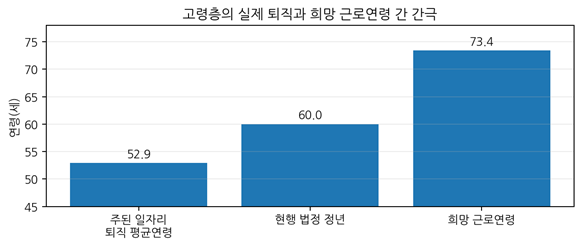
According to the May 2025 supplementary survey of older persons by the National Data Office, among those aged 55 to 79, 69.9% had already left the job they had worked at the longest in their lives, and the average age at which they left that job was 52.9. Although the statutory retirement age is 60, many workers leave their main job well before that age. By contrast, 69.4% of older people said they wished to continue working in the future, and their average desired working age was 73.4.
Note: National Data Office, “May 2025 Economically Active Population Survey Supplementary Survey of Older Persons.” The statutory retirement age is based on current law.
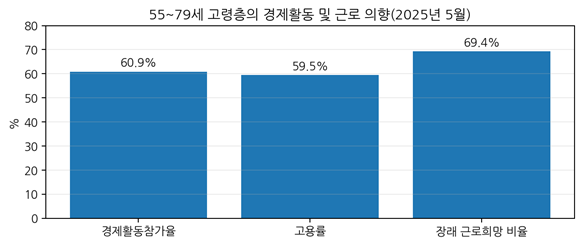
The same survey showed that the population aged 55 to 79 stood at 16.447 million, with a labor force participation rate of 60.9% and an employment rate of 59.5%. Economic activity among older persons is no longer an exception but an important pillar of the labor market. The problem is the gap between those who want to work longer and those who are actually able to maintain stable jobs.
Note: National Data Office, “May 2025 Economically Active Population Survey Supplementary Survey of Older Persons.”
Policy implications
Simply raising the retirement age to 65 would do little to protect the large number of workers who leave their main job at the average age of 52.9.
The direct beneficiaries of a mandatory retirement system are likely to be concentrated among regular workers in large firms and the public sector where mandatory retirement exists and long-term service is possible.
Policy for older workers must address not only extending the retirement age of incumbent employees, but also reemployment for early retirees in their 50s, job transition, and expansion of part-time and flexible jobs.
3. Four side effects that a uniform statutory retirement-age extension could produce
◩ Greater labor cost and organizational stagnation under a seniority-based wage system
Wages at Korean firms are strongly seniority-based, rising with years of service and age. Even if job duties and productivity do not change much, extending the retirement age by five years means workers in the high-wage range remain longer. Firms with fixed total labor costs then have stronger incentives to respond through reduced new hiring, delayed promotions, expanded voluntary retirement, outsourcing, and automation. A uniform retirement-age extension may be an even greater burden on SMEs, which find it harder to lock in workforce plans over a long period.
◩ The impact on youth employment may be concentrated in high-quality internal labor markets rather than the labor market as a whole
The jobs of older and younger workers are not always identical, so it cannot simply be assumed that employment for the two generations is mechanically substitutable across the economy as a whole. However, in large firms and public institutions where hiring budgets and headcounts are limited, and in industries with strong employment protection, competition between generations may intensify. KDI estimated that when the mandatory retirement age of 60 was introduced, a one-person increase in employment of older workers due to retirement-age extension reduced youth employment in private businesses by about 0.2 persons, with the effect larger in large-scale sectors and sectors with strong employment protection.
◩ Wider disparities between workers covered by mandatory retirement and those facing early retirement, non-regular work, or very small workplaces
Given the reality that workers leave their main jobs at an average age of 52.9, the group that directly benefits from a statutory retirement age of 65 is limited. Stable regular workers can retain their existing jobs and wages for longer, but early retirees and workers in very small workplaces may remain in the low-wage reemployment market. Extending the retirement age may ease old-age income problems, but if implemented while leaving labor market dualism untouched, it may instead entrench the gap between protected and unprotected workers.
◩ Delayed promotion and hiring for younger generations, and generational conflict within organizations
If extending the retirement age slows movement into higher ranks and positions, promotion paths for younger and middle-aged workers may narrow. If only older workers’ tenure is extended without wage adjustment, younger workers will have to accept relatively lower compensation and slower promotion within the same organization. To prevent retirement-age extension from becoming a zero-sum conflict between generations, it is essential to reform personnel systems so that rank and pay are linked not to age but to job, role, and performance.
Approach to avoid
A uniform legal guarantee of “the same job, the same wage, and the same working hours until age 65” would convert the cost of employment extension entirely into a fixed cost for firms.
To ensure that the policy goal of protecting older workers does not produce indirect responses such as reduced new hiring and early restructuring, employment extension and redesign of working conditions must be handled as a single package.
4. Implications of prior empirical studies: employment effects vary by firm, institution, and methodology
Korean studies on the relationship between retirement-age extension and youth employment do not reach completely identical conclusions. But this should not be interpreted simply as meaning that “every study says something different.” The period of analysis, data used, age boundaries for youth and older workers, firm size, and whether the firm benefited from the policy differ across studies. Rather, the consistent finding is that the effects of employment extension do not appear uniformly across the national labor market, but are more sensitive in internal labor markets where headcount and labor costs are constrained and where seniority pay and employment protection are strong.
◩ KDI Han Yoseb (2019): a sharp rise in the retirement age can increase employment of older workers but may also trigger adjustments in youth hiring
Han Yoseb (2019) analyzed the effects of the mandatory retirement age of 60, legislated in 2013 and phased in from 2016, using discontinuities across birth cohorts and establishment-level data on retirement-age changes. For cohorts subject to the system, employment rates and the probability of wage employment after the extended retirement age increased, confirming that raising the retirement age did have a real effect in maintaining employment for older workers. However, among cohorts facing larger retirement-age increases, the probability of wage employment temporarily declined before the law took effect. This suggests firms may have made preemptive adjustments such as voluntary retirement programs, encouraged resignations, and reduced new hiring in anticipation of future labor cost increases.
At the establishment level, the study estimated that when one additional older worker became eligible to benefit from retirement-age extension, employment of older workers rose by about 0.6 persons while youth employment fell by about 0.2 persons. These effects were relatively larger in workplaces with 100 or more employees, workplaces whose previous retirement age had been 55 or below, and industries with strong employment protection. In the public sector, the decline in youth employment was not pronounced, but employment of other middle-age groups fell somewhat, suggesting that in organizations with fixed headcounts, the burden of adjustment may shift to other groups.
◩ Korea Labor Institute, Kim Seum, Kang Sinhyeok, and Yoon Yoonkyu (2022): recent labor markets require caution about weak substitution effects
Kim Seum, Kang Sinhyeok, and Yoon Yoonkyu (2022) used establishment panel surveys and aggregate time-series data to estimate both the relationship in employment levels and employment shares between youth and middle-aged and older workers, and the elasticity of substitution in labor demand between generations. In an analysis controlling for establishment fixed effects and other factors, the study found the possibility of employment substitution between workers aged 55 and over and youth under 35 during 2015–2019, and concluded that the substitution relationship became clearer from the mid-2010s compared with 2005–2013. In elasticity-of-substitution analysis, both macro and micro data suggested a weak substitution relationship, though the robustness of the results was limited.
The key point of this study is not that whenever one older worker increases, one younger worker must decrease. Rather, it shows that even if differences across industries, jobs, and firms are large, the optimistic assumption that employment across generations is automatically complementary is also difficult to sustain. Its policy implication is that in the coming years, as labor supply from both youth and middle-aged or older groups rises simultaneously, the impact of retirement-related institutions on youth hiring must be carefully examined.
◩ Korea Labor Institute, Kim Gihong, Lee Seungho, and Noh Yonghwan (2024): rehiring may increase the compatibility of older and youth employment
Kim Gihong, Lee Seungho, and Noh Yonghwan (2024) evaluated the effects of continued employment subsidies and elderly employment support subsidies by combining Ministry of Employment and Labor administrative data with the Employment Insurance DB and using synthetic difference-in-differences, fixed-effects difference-in-differences, and propensity score matching. Establishments receiving continued employment subsidies received support equivalent to an average of 3.08 persons, and employment of those aged 60 and over increased by 2.64 persons. By type of system, abolition of mandatory retirement and retirement-age extension showed relatively large effects on older-worker employment, while post-retirement rehiring showed positive effects on both older-worker and youth employment.
However, the effects varied by workplace characteristics. In establishments with 50 or more employees, both older-worker and youth employment increased together, but among manufacturing establishments receiving continued employment subsidies, youth employment declined, and in workplaces in the Seoul metropolitan area the policy effect was minimal. In addition, because this was a short-term evaluation of firms participating in support programs, its results cannot be equated with the effects of a uniform statutory retirement-age increase. Even so, the finding remains important that rehiring, which allows firms to newly set job duties and wages, may offer more room to reduce intergenerational conflict than simply extending existing employment costs as they are.
◩ Song Heonjae, Jeon Byeonghil, and Jo Hayoung (2024): preemptive employment adjustment by firms before implementation must also be considered
Song Heonjae, Jeon Byeonghil, and Jo Hayoung (2024), in a reanalysis of the effects of the mandatory retirement age of 60, reported that both youth and prime-age employment declined significantly. Declines were also observed in analyses separating regular and non-regular workers. This suggests that raising the retirement age does not always produce a net increase in older-worker employment, and that firms may adjust workforce structure before implementation or reduce employment of workers before they become subject to the retirement-age rule. Evaluating policy effects only on workers who remain employed after implementation may miss such prior adjustments.
Study
Data and approach
Main findings
Policy lesson
Han Yoseb (2019)
Cohort discontinuities and establishment-level retirement-age changes
Older-worker employment increased; private-sector youth employment fell by about 0.2 persons; effects concentrated in large and rapid increases
Need to control the pace of increases and reform wage systems
Kim Seum et al. (2022)
Establishment panel, time series, and substitution elasticity
Weak recent intergenerational substitution relationship; limited evidence of complementarity
Impact assessment is needed on the premise of heterogeneity by industry and firm
Kim Gihong et al. (2024)
Administrative data from support programs and Employment Insurance DB
Older-worker employment rose in supported firms; rehiring may also positively affect youth employment
Employment type and wage adjustment determine results
Song Heonjae et al. (2024)
Reanalysis of the effects of the mandatory retirement age of 60
Both youth and prime-age employment declined
Preemptive restructuring before legal implementation must also be observed
Four lessons from the empirical research
First, the employment relationship between older and younger workers is more sensitive in internal labor markets such as large firms and public institutions, where headcount and budgets are constrained, than in the economy as a whole.
Second, since voluntary retirement and hiring cuts may occur before implementation, a sufficient notice period and phased schedule are necessary.
Third, even though all are forms of employment extension, raising the retirement age, abolishing mandatory retirement, and rehiring have different effects on youth hiring and corporate costs.
Fourth, rehiring and optional continued employment, which allow wages, job duties, and working hours to be adjusted, relatively increase the chances that employment of different generations can coexist.
Note: Compiled based on KDI (2019, 2024), the Korea Labor Institute (2022, 2024), and employment impact evaluations.
5. International cases: focus on diversifying employment paths and phased transition rather than simply raising the retirement age
Major countries do not rely on only one statutory retirement-age model even as they seek to lengthen older persons’ working lives. Their systems fall broadly into three types. Japan and Singapore are closer to an employment-security model in which opportunities to work are expanded up to a certain age while firms may choose from several means such as rehiring. The United Kingdom and the United States encourage employment based on ability and performance by abolishing uniform mandatory retirement ages or prohibiting age discrimination. Germany promotes voluntary longer working lives through tax and pension incentives for delaying pension receipt and earning labor income.
◩ Japan: firms choose the means up to age 65, and work opportunities are diversified up to age 70
Japan’s Act on Stabilization of Employment of Elderly Persons prohibits firms from setting a retirement age below 60, and firms that set a retirement age below 65 must choose one of the following to secure employment up to age 65: raising the retirement age, abolishing mandatory retirement, or introducing a continued employment system. The core idea is that rather than forcing all firms to adopt the same retirement age, the government presents a target age but lets each firm choose the means suited to its workforce structure and job characteristics. Post-retirement rehiring is widely used in Japanese firms, and in this process job duties, responsibilities, working hours, and wages can be adjusted under a new contract.
Since 2021, for the 65–70 age range, firms have also had a duty to make efforts to secure work opportunities, with options expanded beyond raising or abolishing the retirement age and continued employment to include service contracts, entrepreneurship support, and participation in social contribution projects. This is not a model that guarantees the same status and wage until age 70, but one that broadens the boundary between employment and work so that older people’s experience can be used in various forms. For Korea, the implication is that even if a target of age 65 is discussed, multiple paths such as rehiring, reduced hours, and project contracts should be recognized.
◩ Singapore: phased rehiring combining a long-term roadmap and tripartite guidelines
Singapore distinguishes between the statutory retirement age and the reemployment age. As of June 2026, the retirement age is 63 and the reemployment age is 68; from July 2026, these will rise to 64 and 69, respectively. The target for 2030 is a retirement age of 65 and a reemployment age of 70. Eligible workers are given reemployment opportunities after retirement, but if their existing job is difficult to maintain, employers may offer different duties, adjusted wages, and shorter working hours. If it is difficult to provide a suitable job, a compensation procedure akin to employment support payments is also available.
Singapore’s distinctive feature is that it announced the schedule for raising the ages about 10 years in advance and had the government, employers, and labor jointly prepare rehiring guidelines. Firms gain time to adjust workforce planning and wage systems in advance, while workers can predict the conditions and procedures for reemployment. Korea, too, needs to present not just a higher legal number first, but a roadmap that integrates phased implementation timing, differentiated application by firm size, and principles for job transition and wage adjustment.
◩ United Kingdom and United States: age-discrimination bans and competence-based personnel management rather than a uniform retirement age
The United Kingdom abolished the default retirement age of 65 in 2011, making it difficult to force workers into retirement based on age alone unless there is a specifically justified reason. Workers can continue working beyond the state pension age and may request flexible work. The timing of retirement is determined not by a uniform age but by the worker’s choice, job performance ability, and the employer’s objective personnel judgment. However, firms with weak capacity for performance evaluation and job management may face more conflict, so transparent evaluation standards are a prerequisite.
The U.S. Age Discrimination in Employment Act (ADEA) prohibits age discrimination against workers aged 40 and over and generally does not allow mandatory retirement based on age alone in most occupations. There are exceptions for public safety occupations and a very small number of senior policymaking positions, but the general principle is employment based on ability rather than age. The U.K. and U.S. cases show that raising the statutory retirement age is not the only way to increase employment of older workers, and that a system abolishing mandatory retirement can function only when combined with job- and performance-based wages, objective performance management, and prevention of age discrimination.
◩ Germany: promoting voluntary longer work through delayed pension incentives and earned-income incentives
Germany is gradually raising the statutory pension age to 67, while also increasing pension benefits by 0.5% for each month a person delays claiming and continues working. After reaching the statutory pension age, individuals may receive a pension and earn labor income without an income ceiling. Rather than uniformly forcing firms to extend employment, the structure increases workers’ own incentive to keep working by allowing them to combine pension income and labor income freely.
From 2026, Germany also introduced the so-called “Active Pension” (Aktivrente), under which wage earners who voluntarily continue working after reaching the statutory pension age can earn up to 2,000 euros per month tax-free. This shows that policy for older-worker employment is not only a labor law issue but must also be linked to pensions and taxation. Korea likewise should consider higher benefits for delayed pension receipt, smoother combination of pension and earned income, and easing tax disadvantages on work by older persons.
Country and type
Core institution
Key operational feature
Implication for Korea
Japan
Employment-security model
Firms choose among raising the retirement age, abolishing retirement, and rehiring up to age 65
Job duties and wages are redesigned upon rehiring; work paths expanded to age 70
Set the target but diversify the means
Singapore
Phased rehiring model
Retirement age and reemployment age are separated and raised in stages
Long advance notice, tripartite guidelines, and adjusted job duties and wages permitted
Institutionalize a roadmap and preparation period
United Kingdom and United States
Retirement-abolition and anti-discrimination model
Uniform mandatory retirement is restricted and age discrimination prohibited
Ability- and performance-based HR management and flexible work
Build job-based pay and performance-management foundations first
Germany
Pension and tax incentive model
Bonuses for delayed pension receipt and combination of pension and labor income
Voluntary longer-work incentives such as the 2026 Active Pension
Design labor law together with pension and tax policy as a package
Note: Compiled based on materials from Japan’s Ministry of Health, Labour and Welfare, Singapore’s Ministry of Manpower, the U.K. government, the U.S. Equal Employment Opportunity Commission, and Germany’s Federal Ministry of Labour and Social Affairs and federal government.
6. Policy design and conclusion: optional continued employment rather than a uniform increase in the retirement age
To respond to income gaps among older persons and the decline in the working-age population, opportunities to work beyond age 60 must be expanded. But if the policy goal is reduced to a single figure—“a statutory retirement age of 65”—benefits will be concentrated among long-tenured workers in large firms and the public sector who are protected by the retirement system, while firms may respond by cutting new hiring and accelerating early restructuring. Taken together, empirical studies and international cases suggest that the government should present the goal of employment extension but allow firms and workers to choose the method, and design the system in a way that permits adjustment of job duties, wages, and working hours.
◩ Expand “optional continued employment,” not a “mandatory retirement age of 65”
The statutory retirement age should not be immediately raised across the board to 65, nor should all firms be required to adopt the same continued-employment method. Firms and workers should be allowed to choose among retirement-age extension, abolition of mandatory retirement, post-retirement rehiring, short-hours continued work, and project-based contracts. The government’s role is to clarify the legal standards for available options and support job transition and training for firms that introduce optional continued employment.
◩ Allow separate employment contracts after age 60 based on job duties, performance, and working hours
For continued employment to be sustainable, the gap between wages and productivity must be reduced. What is needed is not a simple age-based wage cut, but resetting wages according to assigned duties, responsibility, skill utilization, and working hours. Laws and guidelines should clearly state that a new employment contract may be concluded when workers are rehired after retirement, and predictable standards should be 마련되어야 so that reasonable changes to duties and wages do not lead to disputes over disadvantageous changes to workplace rules.
◩ A phased schedule linked to pension eligibility age and preparation periods by firm size
Rather than raising the employment age by five years at once, it would be preferable to expand it gradually from age 61 in line with the schedule for increasing the pension eligibility age. The timing of application should be announced at least several years in advance, and the preparedness of large firms and public institutions should be distinguished from that of SMEs. For high-intensity physical labor, safety-sensitive jobs, and microenterprises with unstable business continuity, alternative means such as reemployment support or linkage to external jobs should be recognized instead of imposing uniform extension.
◩ Impact assessments on youth hiring and management of total public-sector headcount
Before and after implementation, annual data should be disclosed by firm size, industry, and occupation on new youth hiring, employment of middle-aged and older workers, total labor costs, early retirement, and promotion stagnation. Public institutions in particular, where headcounts are controlled, should manage continued employment numbers together with youth hiring performance, and job redesign and reform of compensation systems should precede implementation so that increased older-worker employment does not automatically translate into reduced youth hiring.
◩ Build a mobile labor market for early retirees in their 50s outside the retirement-age system
Given the reality that workers leave their main job at an average age of 52.9, raising only the statutory retirement age cannot protect the majority of middle-aged workers. Reemployment support services should be shifted from one-time pre-retirement education to a system of career diagnosis, vocational training, and hiring linkage beginning in the early 50s. Part-time, professional contract, and project-based jobs should be activated, and regulations on fixed-term and dispatched work that unnecessarily block reemployment of skilled older workers should also be revised.
◩ Limit fiscal support to temporary and targeted measures, and combine it with pension and tax incentives
Social insurance contributions and job-transition training costs may be temporarily supported to help SMEs adapt in the initial stage. However, permanent wage subsidies aimed at preserving the existing high-wage, seniority-based structure would delay corporate restructuring and entrench fiscal burdens. Support should be linked not simply to the number of workers kept in continued employment, but to outcomes such as job transition, working-hour adjustment, and simultaneous hiring of young workers. At the same time, consideration should be given to higher benefits for delaying pension receipt, smoother combination of pension and earned income, and easing tax disadvantages on work by older persons.
◩ Conclusion: the goal is not a retirement-age number, but options for working longer in line with productivity
Given the income gap between retirement and the start of National Pension benefits, shortages of skilled workers, and rapid aging, extending employment for older workers is difficult to avoid. But if the same job, wage, and working hours are legally extended until age 65, employment costs become a fixed cost for firms, and that burden may fall most heavily on young job seekers and SMEs.
The policy goal should not be “everyone staying until age 65 under the same conditions,” but rather “giving those who want to work the option to work longer under conditions suited to their productivity and life circumstances.” Firms and workers should be allowed to choose among retirement-age extension, abolition of mandatory retirement, rehiring, and reduced working hours, while combining this with job- and performance-based wage systems, flexible working hours, and pension and tax incentives.
Older-worker employment and youth employment are not necessarily zero-sum, but poor institutional design can make them so. If Korea focuses on optional continued employment rather than a uniform retirement-age increase, while reforming labor mobility and wage systems together, it can protect both income stability for older persons and entry opportunities for the young.
Center for Free Enterprise (CFE) Recommendation
Political debate should not focus only on what age to set as the statutory retirement age.
Without imposing uniform costs on firms, the government should guarantee freedom to choose continued-employment methods and freedom to adjust wages, job duties, and working hours so as to expand work opportunities for older persons.
The retirement-age debate should proceed as a labor market reform package that includes seniority-pay reform, impact assessments on youth hiring, phased adaptation by SMEs, reemployment of early retirees in their 50s, and pension and tax incentives.
◩ References
· Economic, Social and Labor Council (2025), “Public Interest Members’ Recommendations and Press Release on Continued Employment for Older Workers”
· Organisation for Economic Co-operation and Development (OECD) (2025), OECD Employment Outlook 2025: Navigating the Golden Years - Making the Labour Market Work for Older Workers.
· National Data Office (August 6, 2025), “Results of the May 2025 Economically Active Population Survey Supplementary Survey of Older Persons”
· National Pension Service (2026), “Old-Age Pension Starting Age and Pension Reform FAQ”
· Kim Gihong, Lee Seungho, and Noh Yonghwan (2024), Employment Effects of Continued Employment and New Hiring Support Programs for Older Workers, Korea Labor Institute.
· Kim Seum, Kang Sinhyeok, and Yoon Yoonkyu (2022), A Study on the Employment Substitution Relationship Between Youth and Middle-Aged and Older Generations, Korea Labor Institute.
· Kim Jiyeon (2024), “The Current State of the Middle-Aged Labor Market and Ways to Improve It Through Job Analysis,” KDI FOCUS.
· German Federal Ministry of Labour and Social Affairs (BMAS) (2026), “Old-age Security in Germany”
· German Federal Government (2026), laws and policy materials related to the “Active Pension”
· Maeil Business Newspaper (June 19, 2026), “PPP Floor Leader Jeong Jeomsik Visits Federation of Korean Trade Unions: ‘We Will Listen Carefully to Voices from Labor Sites’”
· U.S. Equal Employment Opportunity Commission (EEOC), “Age Discrimination in Employment Act of 1967”
· Song Heonjae, Jeon Byeonghil, and Jo Hayoung (2024), “The Impact of Mandatory Retirement at Age 60 on Youth and Prime-Age Employment,” Labor Policy Research, 24(1), 57–74.
· Singapore Ministry of Manpower (MOM) (2026), “Retirement” and “Responsible Re-employment”
· U.K. Government (GOV.UK) (2011), “Default Retirement Age to End This Year” and related guidance
· Japan Ministry of Health, Labour and Welfare (MHLW) (2025), materials on the Act on Stabilization of Employment of Elderly Persons and policies for older-worker employment
· Korea Employers Federation (KEF) (2025), “Major Issues and Solutions in Extending the Retirement Age”
· Han Yoseb (2019), The Impact of Mandatory Retirement at Age 60: Focusing on the Effects on Youth Employment, KDI Policy Study Series 2019-03.
· Han Yoseb (2024), “Restoring Labor Market Function to Overcome Employment Instability Among the Middle-Aged and Older Population,” KDI FOCUS.
Original title: 초고령사회 고용연장 제도의 쟁점과 개선방안
Author: Center for Free Enterprise (CFE)
Date: 2026-06-22
Source: https://www.cfe.org/bbs/bbsDetail.php?cid=issue&pn=1&idx=29190