
Limits of a Uniform Minimum Wage-Setting System and Strategies for Making It More Realistic
-
Writer
CFE
-
1. Raising the Issue: Balancing the Demand for a 12,000 Won Minimum Wage and the Criteria for Determination
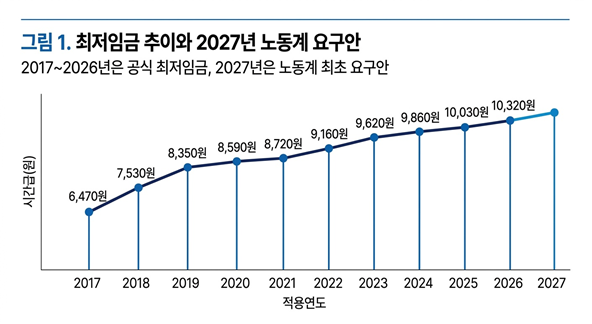
As deliberations on the minimum wage to be applied in 2027 begin in earnest, labor circles have presented an initial demand of 12,000 won per hour for next year’s minimum wage. This is 1,680 won higher than the 2026 minimum wage of 10,320 won per hour, representing an increase of 16.3%. Converted on the basis of 209 monthly working hours, this amounts to 2,508,000 won per month (Minimum Wage Commission, 2025a; Ministry of Employment and Labor, 2025; Gyeonggi Ilbo, 2026.6.15.). Stabilizing the livelihoods of low-wage workers is an important objective of the minimum wage system. However, the minimum wage is not a welfare benefit determined solely by living costs. It is a system that directly intervenes in labor market pricing and affects labor cost burdens for firms and small business owners, the sustainability of employment, industry-specific productivity, the ability to pass costs on to prices, and opportunities for labor market entry. Therefore, the minimum wage should be determined not only with workers’ living costs in mind, but also by taking into account productivity, ability to pay, employment effects, and industry-specific realities.
Article 4 of the current Minimum Wage Act stipulates that the minimum wage shall be determined in consideration of workers’ living costs, wages of comparable workers, labor productivity, and the income distribution ratio. The same provision also provides the legal basis for setting different minimum wages by type of business (Minimum Wage Act, Article 4(1); Ministry of Government Legislation, 2026). This means that minimum wage determination is not based on living costs alone, but must comprehensively consider overall labor market and economic conditions. In particular, the fact that double-digit increase demands are being raised when the minimum wage has already exceeded 10,000 won per hour cannot be taken lightly. A sharp increase in the minimum wage may, on the surface, appear to be a policy aimed at raising the incomes of low-wage workers. In practice, however, it may result in reduced hiring, shorter working hours, price increases, substitution through automation, greater reliance on family labor, expansion of informal employment, and increased noncompliance with the minimum wage.
Simply raising the nominal level of the minimum wage does not in itself ensure worker protection. It must be a system that can actually be complied with in practice. Workers protected by the minimum wage benefit only if their employment is maintained. But if workplaces reduce new hiring, cut part-time jobs, or shorten the working hours of existing employees, vulnerable workers may instead lose job opportunities. The minimum wage debate should no longer be reduced to the simple question of “how much should it be raised?” It should shift to questions of “what criteria should be used to determine it?”, “how should industry-specific realities be reflected?”, and “how can the system’s acceptability and sustainability be improved?” As shown in [Figure 1], the minimum wage rose from 6,470 won in 2017 to 10,320 won in 2026. If labor’s 2027 demand of 12,000 won is adopted, the minimum wage will once again rise sharply. The key issue is whether this pace of increase is in harmony with industry-specific productivity, the ability of small businesses to pay, and labor market conditions.
Source: Prepared based on Minimum Wage Commission (2025a), Ministry of Employment and Labor (2025), and Gyeonggi Ilbo (2026.6.15.)
Note: 2017–2026 are official minimum wages; 2027 is labor’s initial demand
2. Key Issues in the Current Minimum Wage Debate
The current minimum wage debate can be summarized around five key issues. First, whether the demand for a 12,000 won minimum wage is a level that our economy and labor market can bear. Second, whether the uniform system of applying the same minimum wage to all industries remains valid. Third, how to improve a decision-making structure in which the criteria are swayed each year by labor-management power struggles and political pressure. Fourth, how to ease the cost structure of small business owners who directly bear the shock of minimum wage increases. Fifth, how to make industry-specific differentiated application—which is already legally possible under current law—actually function in system operation.
Labor circles cite living-cost burdens, declining real wages, and improved income distribution as the main grounds for raising the minimum wage. It has also been argued that the average rate of increase in the minimum wage over the past three years has fallen short of inflation, and that the current monthly equivalent of the minimum wage is below the cost of living (Gyeonggi Ilbo, 2026.6.15.). These concerns are understandable from the standpoint of stabilizing the livelihoods of low-wage workers. However, while living costs are an important consideration, they cannot be the sole criterion for determining the minimum wage. If the minimum wage is set solely on the basis of living costs, it risks being transformed from a labor market institution into a de facto income support policy. The minimum wage is not a benefit paid directly by the government, but a statutory wage floor borne by private employers. Therefore, when deciding the level of increase, the ability of those who bear the cost to pay and to maintain employment must also be considered.
The cost of the minimum wage is borne directly not by government finances, but by individual firms, self-employed persons, and small merchants. In particular, the industries most heavily affected by the minimum wage are not large corporations or high value-added sectors, but low value-added, labor-intensive industries such as lodging and restaurants, convenience stores, small wholesale and retail businesses, and personal services. These sectors face high sales volatility, a high share of labor costs, and limited room to raise prices. Accordingly, when the minimum wage rises sharply, employers are more likely to reduce hiring, adjust working hours, or substitute with family labor and automation.
The deliberation process of the Minimum Wage Commission is also not designed around living costs alone. The Commission’s process calls for analysis of wage conditions, analysis of living costs, analysis of the effects of minimum wage application, research on foreign minimum wage systems, analysis of major labor and economic indicators, and collection of on-site opinions (Minimum Wage Commission, n.d.). This shows that minimum wage determination should be a process that comprehensively incorporates a range of economic and labor indicators.
Therefore, the following principle must be clearly stated in the minimum wage debate: the minimum wage is not a system determined by the scale of good intentions. It is an economic institution that must consider living costs, productivity, ability to pay, employment effects, and burdens on small business owners together.
Problems by Key Issue in the Current Minimum Wage System and Policy Response Directions
Issue
Current Status
Problem
Policy Response Direction
Demand for a
12,000 won
minimum wage
Proposal for a
16.3% increase
over the current level
Living-cost-centered logic lacks sufficient consideration of ability to pay and productivity
Prioritize employment stability and on-the-ground acceptability over a sharp increase
Uniform application method
Same minimum wage applied to all industries
Fails to reflect differences in industry-specific productivity, value added, and labor cost burdens
Launch full-scale discussion on differentiated application by industry
Unclear decision criteria
Deliberations centered each year on labor-management power struggles
Repeated political and symbolic competition over wage hikes
Introduce objective decision formulas and impact assessments
Burden on small business owners
Simultaneous burden of labor costs, rent, fees, and regulatory costs
Insufficient capacity to absorb the shock of minimum wage increases
Pursue regulatory reform focused on improving cost structures
Legal and institutional operation issues
Industry-specific differentiated application is legally possible
In practice, effectively avoided in actual deliberations
Improve the deliberation structure of the Minimum Wage Commission and the standards for public notice
3. Limits of a Uniform Minimum Wage and Gaps in Industry-Specific Ability to Pay
At present, Korea’s minimum wage is effectively applied uniformly across all industries. The minimum wage for 2026 was also officially announced at 10,320 won per hour for all workplaces without differentiation by type of business (Minimum Wage Commission, 2025b). But the real labor market is not uniform. Manufacturing, finance and insurance, information and communications, lodging and restaurants, convenience stores, taxi services, and care services all differ in productivity, value added, operating profit margins, labor cost shares, and ability to pass costs on to prices.
Nevertheless, if the same minimum wage is applied to all industries, sectors with lower productivity and a higher share of labor costs will inevitably face a greater shock. Even under the same minimum wage standard, the cost may be manageable for high value-added sectors, while for small-scale service industries it may become a burden that makes maintaining employment itself difficult. The same rule does not always produce fair outcomes.
A uniform minimum wage may appear to be a system that enhances equity, but in practice it can paradoxically be unfair because it ignores differences in ability to pay across industries. Applying the same wage standard to high value-added and low value-added industries may look like equal treatment, but the scale of the burden is entirely different. As a result, compliance with the minimum wage itself may become difficult for small-scale sectors, the rate of workers paid below the minimum wage may rise, and informal employment or adjustments in working hours may expand.
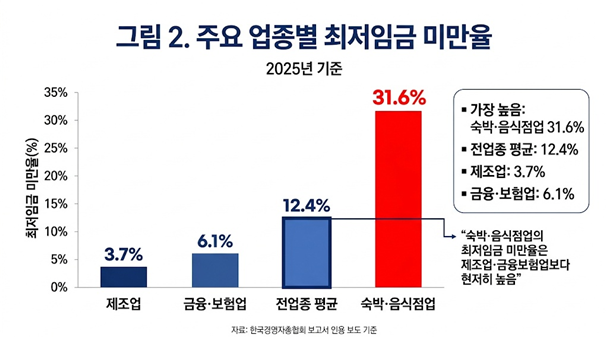
According to coverage of a report released by the Korea Employers Federation (KEF), as of 2025, value added per worker in the lodging and restaurant sector was far lower than in manufacturing and finance and insurance. In addition, the minimum wage as a share of median wages in lodging and restaurants was 87.1%, higher than the all-industry average of 62.2%, manufacturing’s 54.4%, and finance and insurance’s 43.6%. The under-minimum-wage rate in lodging and restaurants was also 31.6%, higher than the all-industry average of 12.4%, manufacturing’s 3.7%, and finance and insurance’s 6.1% (Korea Employers Federation (KEF), 2026; Dailian, 2026.6.14.).
In particular, industries with high under-minimum-wage rates should not be viewed simply as industries with more legal violations. Of course, legal compliance is important. But if the under-minimum-wage rate is structurally high in a particular industry, this may be a signal that the current minimum wage is disconnected from that industry’s ability to pay. A standard that cannot be observed does not enhance the authority of the system; it weakens its effectiveness.
The purpose of the minimum wage system is not to set a nominally high standard, but to establish a protective standard that actually works in practice. A minimum wage with low on-the-ground acceptability can lead to noncompliance, informal employment, fragmented working hours, and avoidance of hiring. Ultimately, it may push the low-wage workers whom the system is intended to protect outside the scope of the system. Differentiated application by industry is not a retreat from the minimum wage system. Rather, it is a realistic corrective mechanism to enhance the sustainability of the minimum wage system. The current Minimum Wage Act already provides the legal basis for setting different minimum wages by type of business. Therefore, differentiated application by industry is not an exceptional claim outside the legal framework, but a policy option already contemplated by law.
The problem is the framing of differentiated application by industry as nothing more than “discrimination.” It is not intended to discriminate against low-wage workers, but to improve the system’s acceptability by reflecting differences across industries in productivity, value added, ability to pay, and the under-minimum-wage rate. If the same standard is forced on all industries and this results in widespread noncompliance and employment contraction in some sectors, that would itself undermine the purpose of the minimum wage system. That said, differentiated application by industry must not be designed arbitrarily or politically. Objective criteria and transparent procedures are necessary. It should comprehensively consider industry-specific labor productivity, value added per worker, the minimum wage level relative to median wages, operating profit margins, labor cost shares, under-minimum-wage rates, employment elasticity, and the distribution of establishment size. In addition, differentiated application should not lock certain industries permanently into a low-wage structure, but should function as a means of easing sudden wage shocks while improving employment retention and compliance rates.
4. Legal and Policy Issues: Normalizing System Operation Must Come Before New Legislation
Differentiated application by industry is not a system that requires new legislation. The current Minimum Wage Act requires that workers’ living costs, wages of comparable workers, labor productivity, and the income distribution ratio be considered when determining the minimum wage, and it also provides the legal basis for differentiation by type of business. In other words, differentiated application by industry is not an exceptional claim outside the legal framework, but a policy option already contemplated by current law (Minimum Wage Act, Article 4(1); Ministry of Government Legislation, 2026).
The problem is that this system has in effect not functioned. Since the introduction of the minimum wage system, Korea has long maintained a single minimum wage approach. As a result, differences in industry-specific ability to pay, establishment size, labor productivity, and regional business conditions have not been sufficiently reflected in the minimum wage determination process. When the minimum wage was low, the burden of uniform application may have been relatively small. But now that the minimum wage has already exceeded 10,000 won per hour, the situation is different.
Therefore, what is needed first is not new legislation, but the normalization of system operation: specifically, how to make a system already possible under current law actually function in the deliberation and public notice process. First, the Minimum Wage Commission should deliberate separately on the “rate of increase” and on “whether differentiated application should be adopted.” Until now, minimum wage debates have often ended as annual labor-management power struggles over the final hourly rate. But differentiated application by industry is a matter of institutional design separate from the level of the minimum wage itself. Whether to differentiate, which industries should be covered, what criteria should be used, the period of application, and the method of ex post evaluation should all be systematically deliberated as separate agenda items. Second, statutory indicators or deliberation criteria should be established for determining differentiated application by industry. Current law leaves open the possibility of differentiation, but lacks specificity as to which industries should be differentiated and according to what standards. As a result, discussion of differentiated application remains stuck in annual political debates for and against. An objective scorecard is needed, including the under-minimum-wage rate by industry, value added per worker, the minimum wage level relative to median wages, labor cost shares, operating profit margins, and risks of employment decline. Third, ex ante impact assessments should be made mandatory before minimum wage decisions. Minimum wage increases have broad effects on labor costs, prices, employment, and the business environment of small merchants. Therefore, before deciding the rate of increase, impact assessments should be conducted by industry, establishment size, and region, and the results should be disclosed. In particular, industries with high minimum wage exposure and high under-minimum-wage rates require separate field surveys and cost-burden analyses. Fourth, the period of application and review procedures for differentiated application by industry should be clearly specified in the public notice process. Differentiated application need not be a permanent exception; it can be designed to apply for a set period and then be reevaluated. For example, it could be applied in two- or three-year increments, with continuation determined after evaluating changes in under-minimum-wage rates, employment rates, business survival rates, and workers’ wage levels. Fifth, if necessary, the Minimum Wage Act may be amended to codify the deliberation criteria for differentiated application by industry. Although differentiation is already possible under current law, the lack of clear standards is an obstacle to system operation. Accordingly, the direction of legal revision should not be to “prohibit differentiated application,” but to “objectify the criteria for differentiated application.” The goal of regulatory reform is not to abolish the system, but to establish standards so that a legally available system is not operated arbitrarily.
The minimum wage issue is both labor policy and regulatory policy. The minimum wage is a mandatory rule applied to all workplaces and a form of price regulation that directly intervenes in employers’ labor cost decisions. Therefore, the minimum wage debate should be reconsidered not simply as a dispute over wage increases, but from the perspective of regulatory appropriateness, predictability, differentiation, and enforceability.
The core of regulatory reform is to rationalize uniform regulations that do not fit reality. Applying the same regulation to all industries is not always rational. If the minimum wage likewise fails to reflect differences in industry-specific productivity and ability to pay, the side effects of uniform regulation are unavoidable. First, a baseline based on economic indicators should be introduced into minimum wage determination. If a reference range is established reflecting inflation, labor productivity growth, the ratio of the minimum wage to median wages, employment rates, and the business environment of small merchants, this would reduce the uncertainty created by annual political bargaining. The minimum wage should be determined not by political slogans but by economic criteria. Second, differentiated application by industry should be clearly designated as a regulatory reform task. Applying the same regulation to all industries is not always rational. The core of regulatory reform is to rationalize uniform regulations that do not fit reality. If the minimum wage cannot reflect differences in industry-specific productivity and ability to pay, uniform regulation will produce side effects. Third, support for small merchants should shift from compensating wage increases through fiscal spending to reducing their cost structure. Raising the minimum wage sharply and then offsetting part of the increase with government finances is not sustainable. Policies should instead be pursued in parallel to ease rents, card fees, various licensing and business regulations, tax burdens, and labor management regulations. Fourth, flexibility in working hours and wage systems should be increased. As the minimum wage rises, small establishments become more sensitive to the management of working hours. When uniform wage regulation is combined with rigid working-hour regulation, burdens on the ground can only increase. Greater institutional flexibility is needed so that job- and performance-based wage systems, flexible working-hour management, and rational management of part-time work can be implemented. Fifth, there are limits to an enforcement-centered approach to minimum wage noncompliance. Legal enforcement is necessary, but in industries where noncompliance is structurally high, policy analysis of why compliance is difficult must come first. Stronger enforcement does not create ability to pay. The goal of the system should not be expanded punishment, but the creation of standards that can actually be observed.
5. Policy Recommendations and Conclusion
The demand for a 12,000 won minimum wage for 2027 is justified in the name of stabilizing the livelihoods of low-wage workers. However, the minimum wage cannot be determined by living costs alone. The minimum wage is a system that affects the entire labor market and must take into account productivity, ability to pay, employment effects, and industry-specific realities. In particular, now that the minimum wage has already exceeded 10,000 won per hour, the approach of applying the same standard to all industries has reached its limits. Lodging and restaurants, convenience stores, and small wholesale and retail businesses have different productivity, value added, and labor cost burden structures from high value-added industries. A uniform minimum wage that ignores industry-specific realities may not represent fairness, but rather a disregard for reality. Accordingly, this issue report proposes the following policy directions.
Policy Tasks for Making the Minimum Wage Determination System More Realistic
Policy Task
Main Content
Expected Effect
Control the pace of minimum wage increases
For the 2027 minimum wage, prioritize employment stability and acceptability over a double-digit increase
Mitigate employment contraction and reduce burdens on small business owners
Introduce differentiated application by industry
Review sectors with weak capacity for acceptance, such as lodging and restaurants, first, based on objective criteria
Improve system compliance and reduce the under-minimum-wage rate
Mandate ex ante impact assessments
Analyze employment and cost impacts by industry, establishment size, and region before increases
Reduce political decision-making and enable evidence-based deliberation
Objectify decision criteria
Reflect productivity, ability to pay, and the level relative to median wages in addition to living costs
Increase predictability
Improve deliberation structure
Separate deliberations on the rate of increase from deliberations on differentiated application
Strengthen discussion of institutional design
Reduce regulatory costs
Improve card fees, business regulations, tax burdens, and labor management regulations
Improve the cost structure of small business owners
Institutionalize ex post evaluation
After minimum wage decisions, review changes in employment, working hours, and under-minimum-wage rates
Build a feedback system for institutional improvement
First, the minimum wage to be applied in 2027 should prioritize employment stability and on-the-ground acceptability over a sharp increase. The demand for 12,000 won per hour is justified in the name of protecting low-wage workers, but for industries and workplaces that cannot bear the burden, it may function as pressure to cut jobs. Minimum wage determination must consider not only living costs but also productivity, ability to pay, economic conditions, and burdens on small business owners. Second, discussion of differentiated application by industry should be fully brought into the institutional framework. Although it is a legally available system under the Minimum Wage Act, discussion of differentiated application has effectively been avoided due to political burdens. But now that the minimum wage has already surpassed 10,000 won, the approach of applying a single standard to all industries has reached its limits. Differentiated application based on objective criteria should be reviewed for sectors heavily affected by the minimum wage, such as lodging and restaurants, convenience stores, and small wholesale and retail businesses. Third, the criteria for minimum wage determination should be made more transparent and objective. A process driven each year by labor-management power struggles and political pressure undermines market predictability. A formula or reference table should be established that reflects labor productivity, inflation, the minimum wage relative to median wages, industry-specific ability to pay, and employment effects. The minimum wage should be determined not as a political declaration, but according to economic criteria. Fourth, support for small business owners should shift from offsetting wage increases to improving their cost structure. It is not sustainable to sharply raise the minimum wage and then partially compensate for it with fiscal spending. Policies should be pursued in parallel to ease rents, card fees, various regulatory costs, tax burdens, and labor management regulations. In particular, to reduce labor-cost burdens on small establishments, there is a need to expand flexibility in working-hour management, job- and performance-based wage systems, and support for digital transformation. Fifth, the system should be designed in a way that lowers the under-minimum-wage rate. Simply raising the nominal level of the minimum wage does not ensure worker protection. The system functions only when actual compliance rates are high. Standards that exceed ability to pay may increase noncompliance. In the minimum wage system, what matters is not “setting it high,” but “setting it at a level that can be observed.” Finally, the composition of employer members on the Commission should be supplemented to provide substantive representation for small business owners. At present, two employer members are allocated to individuals from the Korea Employers Federation (KEF), while it is difficult to say that the representation of the small-business sector—which bears the most direct impact of minimum wage increases—is adequately reflected. The minimum wage imposes a greater burden not on large corporations, but on small establishments, the self-employed, and labor-intensive sectors such as lodging and restaurants, wholesale and retail, and personal services. Therefore, the composition of employer members should ensure that the voice of small business owners is directly reflected, not only that of employer organizations centered on large and mid-sized firms. At a minimum, at least one of the two employer members from the Korea Employers Federation (KEF) should be replaced by a nominee recommended by the Korea Federation of Micro Enterprises, or a comparable method should be adopted to clearly allocate a share of representation to small business owners. This is not intended to expand the interests of any particular organization, but is a task of institutional improvement aimed at more accurately reflecting actual ability to pay and on-the-ground acceptability in the minimum wage determination process.
Differentiated application by industry is not a retreat from the minimum wage system. It is a policy option already contemplated by current law and a realistic corrective mechanism for enhancing the effectiveness and sustainability of the minimum wage system. What is needed now is not a sharp increase in the minimum wage, but the normalization of the minimum wage determination system. The minimum wage debate should not remain at the level of political slogans or a competition in good intentions. The minimum wage must be an economic institution that considers not only living costs but also productivity, ability to pay, employment effects, and industry-specific realities. The limits of a uniform minimum wage must be acknowledged, and discussion of differentiated application by industry should no longer be delayed. This is the realistic solution that takes into account worker protection, employment retention, and the survival of small business owners together.
◩ References
∙ Gyeonggi Ilbo. (2026.6.15.). “Labor circles demand a 12,000 won hourly minimum wage for 2027… 16.3% increase from this year.”
∙ Ministry of Employment and Labor. (2025). Press reference material, “Proposed minimum wage for 2026 set at 10,320 won per hour.”
∙ National Law Information Center. (2026). “Minimum Wage Act,” Article 4: Criteria and differentiation in minimum wage determination.
∙ Dailian. (2026.6.14.). “KEF: Industry gaps are severe… minimum wage should be differentiated by industry.”
∙ “Minimum Wage Act.”
∙ Minimum Wage Commission. (2025a). “Status of Minimum Wage Decisions by Year.”
∙ Minimum Wage Commission. (2025b). “Public Notice of the Minimum Wage for 2026.”
∙ Minimum Wage Commission. (2026). “Deliberation and Decision Process.” Retrieved: 2026.6.16.
∙ Korea Employers Federation (KEF). (2026). “The Need for and Implications of Differentiated Application of the Minimum Wage by Industry.”
Original title: 일률적 최저임금 결정구조의 한계와 현실화 전략
Author: Center for Free Enterprise (CFE)
Date: 2026-06-17
Source: https://www.cfe.org/bbs/bbsDetail.php?cid=issue&pn=1&idx=29160