
Reforming Local Education Grants Can No Longer Wait
-
Writer
CFE
-



1. Issue Overview
Discussion of reforming the Local Education Financial Grant has resurfaced. Under the current system, the Local Education Financial Grant is established pursuant to the Local Education Financial Grant Act, using 20.79% of internal tax revenue and part of the education tax as its funding source, and it is the central government’s primary fiscal transfer for elementary and secondary education to provincial and metropolitan offices of education. The National Assembly Budget Office summarizes that the Local Education Financial Grant accounts for about 70% of the revenue budget of provincial and metropolitan offices of education, and that the statutory grant rate for internal tax revenue has been raised from 19.4% in 2005, to 20.0% in 2008, 20.27% in 2010, 20.46% in 2019, and 20.79% since 2020.
The problem is that the decline in student numbers and the grant calculation structure have been moving in different directions. The number of elementary, middle, and high school students has not only been declining over the long term, but according to the Ministry of Education’s official projections, the downward trend is expected to continue. By contrast, the Local Education Financial Grant has expanded and fluctuated due to its linkage to internal tax revenue and increases in the statutory grant rate. Resolving this gap is at the heart of the debate over reforming the Local Education Financial Grant.
2. Analysis of Current System Issues and Problems
The core issue in the current Local Education Financial Grant system is the disconnect between declining student numbers and the automatic linkage to internal tax revenue. The number of students fell from about 7.95 million in 2000 to about 5.02 million in 2025, and according to Ministry of Education projections, it is expected to decline further to about 3.81 million by 2031. However, the statutory grant rate for internal tax revenue has been steadily raised since 2001 and has remained at 20.79% since 2020.
First, the decline in student numbers is not sufficiently reflected in grant calculations. Student numbers are a key variable in assessing demand for education finance. Of course, a decline in student numbers does not mean education spending falls at the same rate, but in a situation where the decline continues over a long period, a structure that automatically allocates a fixed share of increases in internal tax revenue widens the gap between fiscal demand and allocation.
Second, increases in the statutory grant rate for internal tax revenue have expanded fiscal rigidity. National finances must adjust priorities across diverse sectors such as welfare, defense, science and technology, higher education, responses to low birth rates, and responses to regional depopulation. But because the Local Education Financial Grant is automatically allocated according to a statutory rate, it tends to move separately from the government’s overall fiscal strategy.
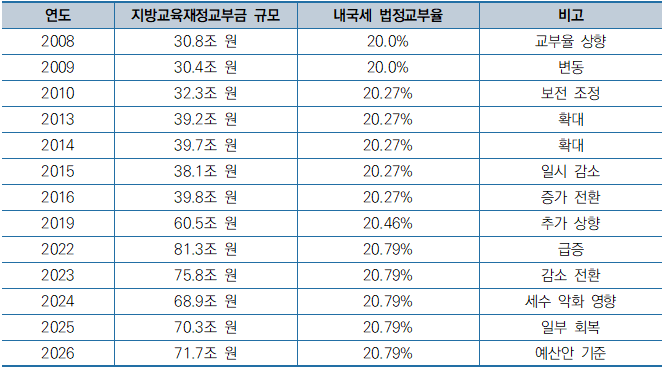
Third, periods of strong tax revenue create over-allocation, while periods of weak tax revenue create volatility. The grant increased to 81.3 trillion won in 2022, then fell to 68.9 trillion won in 2024. This shows the structural characteristic that the size of the grant is determined by tax revenue trends rather than student numbers or educational demand.
Fourth, given the expected future decline in student numbers, the inefficiency of the current structure is likely to grow. Student numbers are projected to fall by about 1.2 million more between 2025 and 2031, and if the current system is left unchanged, the mismatch between the demand and supply of education finance may deepen further.
Fifth, the issue of fiscal accountability for offices of education remains unresolved. Offices of education are the entities that receive and spend the grants, but responsibility for raising the funds is borne by the central government and taxpayers. Accordingly, there is a need to review spending performance, cash-based programs, fund accumulation, and pork-barrel spending. The current minimum wage system is basically premised on workers as defined under the Labor Standards Act. A worker is a person who provides labor under the direction and supervision of an employer for the purpose of earning wages. By contrast, contract workers, specially employed workers, and platform workers typically work under entrustment contracts, service contracts, or subcontracting contracts, and their compensation is often paid not as hourly wages but in the form of per-case commissions or performance-based pay.
3. Current Status and Future of the School-Age Population Decline
(1) Trends in Declining Elementary, Middle, and High School Student Numbers and Future Projections
According to the KOSIS Top 100 Indicators, “Number of Elementary, Middle, and High School Students,” the number of elementary, middle, and high school students fell from 7,951,998 in 2000 to 5,015,310 in 2025. This represents a decline of about 2.93 million students. The decline in student numbers should be understood not as a temporary phenomenon but as a long-term structural change.
Major Years of Change in Elementary, Middle, and High School Student Numbers and Future Projections
Year
Number of Students
Year
Projected Number of Students
Change from 2025
2000
7,951,998
2026
4,836,890
-178,420
2005
7,796,401
2027
4,661,385
-353,925
2010
7,236,248
2028
4,488,023
-527,287
2015
6,088,827
2029
4,280,164
-735,146
2020
5,346,874
2030
4,056,402
-958,908
2025
5,015,310
2031
3,811,087
-1,204,223
Source: KOSIS, “Number of Elementary, Middle, and High School Students,” each year; Korean Educational Development Institute, “Basic Statistics in Education”; Ministry of Education, “Adjusted Results of the 2025 Student Number Projections for Elementary, Middle, and High Schools (2026–2031).”
According to the Ministry of Education’s “Adjusted Results of the 2025 Student Number Projections for Elementary, Middle, and High Schools (2026–2031),” the decline in student numbers is expected to continue. The number of elementary, middle, and high school students, which stood at 5,015,310 in 2025, is projected to fall to 4,836,890 in 2026 and to 3,811,087 by 2031. In other words, compared with 2025, more than 1.2 million additional students are expected to disappear by 2031.
These projections are highly important in discussions of local education finance. If the current system remains more strongly linked to tax revenue trends than to changes in student numbers or educational demand, then in an era of rapidly falling student numbers, the gap between the fiscal structure and the demand structure will inevitably widen further.
(2) Direction of Local Education Financial Grant Reform
The size of the Local Education Financial Grant increased from 16.6 trillion won in 2000 to 32.3 trillion won in 2010. The expansion continued thereafter, reaching 60.5 trillion won in 2019 and 81.3 trillion won in 2022. It then fell to 68.9 trillion won in 2024 due to worsening tax revenue conditions, but was again budgeted at 70.3 trillion won in 2025 and 71.7 trillion won in 2026.
Meanwhile, the statutory grant rate for internal tax revenue was raised from 11.8% in 2000, to 13.0% in 2001, 19.4% in 2005, 20.0% in 2008, 20.27% in 2010, 20.46% in 2019, and 20.79% since 2020. In other words, student numbers declined, but the grant rate rose and was fixed, thereby reinforcing the automatic growth character of the grant structure.
Changes in the Size of the Local Education Financial Grant and the Statutory Grant Rate for Internal Tax Revenue
Source: Compiled based on KDI presentation materials, National Assembly Budget Office materials, and Ministry of Education materials.
4. Direction of Local Education Financial Grant Reform
The core of reforming the Local Education Financial Grant is not simple cuts, but a shift from automatic allocation to demand- and performance-based allocation.
First, the automatic linkage ratio to internal tax revenue should be adjusted. A structure that mechanically links the grant to increases in internal tax revenue, as under the current system, is not suited to an era of declining student numbers. At a minimum, it is necessary to consider a cap on the grant growth rate, adjustment coefficients, and student-number reflection coefficients.
Second, a formula reform that reflects student numbers and educational demand is needed. The structure should be revised to reflect student numbers, regional conditions, school maintenance costs, rural and fishing village schools, special education, basic academic skills, and digital transition needs.
Third, it should be linked to higher education, vocational education, lifelong education, and advanced talent development. A direction is needed in which the fiscal room created by declining student numbers is reallocated from the perspective of the entire education cycle.
Fourth, accountability and performance management for provincial and metropolitan offices of education should be strengthened. Rather than simply guaranteeing a total amount, performance, demand, execution efficiency, and fiscal soundness should all be reviewed together.
The expected counterarguments are concerns about reduced education finance, damage to educational autonomy, and weakened investment in future education. However, reforming the grant does not mean weakening elementary and secondary education; rather, it means guaranteeing necessary educational investment while reducing the automatic growth structure and inefficiency.
5. Conclusion and Policy Implications
Reform of the Local Education Financial Grant is not a debate over reducing education finance, but a matter of restoring fiscal principles. The number of elementary, middle, and high school students has declined over the long term, and according to Ministry of Education projections, this downward trend will continue. By contrast, the Local Education Financial Grant has expanded and fluctuated due to increases in the statutory grant rate for internal tax revenue and its linkage to tax revenue. If this structure continues, the distortion in which tax revenue trends determine the scale of education finance more than changes in student numbers and educational demand may persist.
The government and the National Assembly should not approach Local Education Financial Grant reform as a simple budget cut. While guaranteeing the resources needed for elementary and secondary education, the system should be redesigned to reflect changes in student numbers, regional conditions, demand for special education, basic academic skills, and digital education, demand for higher education and advanced talent development, and the government’s overall fiscal conditions.
The policy direction is clear. First, the automatic linkage structure to internal tax revenue should be eased to reduce fiscal rigidity. Second, an allocation formula that reflects student numbers and actual educational demand should be introduced. Third, the fixed fiscal structure centered on elementary and secondary education should be linked to higher education, vocational education, and lifelong education. Fourth, the spending performance and fiscal accountability of provincial and metropolitan offices of education should be strengthened.
In particular, in the era of local educational autonomy, as the autonomy of each provincial and metropolitan office of education has expanded, accountability in fiscal management must be strengthened as well. The practice of offices of education relying on stable grant funding to execute populist projects aimed at short-term popularity or political effect should be restrained. Education finance should be allocated first and foremost to essential educational needs such as guaranteeing students’ right to learn, improving basic academic skills, reducing educational disparities, and fostering future talent.
Resources secured through reform of the Local Education Financial Grant should not be viewed merely as simple fiscal savings, but should be used as national-level human capital investment resources to respond to demographic change. If the automatic growth structure of elementary and secondary education finance is adjusted due to falling student numbers, the resulting fiscal room should be strategically allocated to strengthening the competitiveness of higher education, expanding vocational and lifelong education, improving the education, language, and job competencies of multicultural workers in Korea, and supporting the attraction and settlement of talented individuals from abroad. As low birth rates and a shrinking working-age population become full-fledged realities, the goal of education finance can no longer remain limited to maintaining the existing school system. It must now be expanded into a human resource management system encompassing the retraining and redeployment of domestic talent, the social and economic integration of multicultural talent, and the inflow and settlement of overseas professionals. Reform of the Local Education Financial Grant should be understood not as weakening elementary and secondary education, but as restructuring education finance to secure future talent and strengthen national competitiveness.
Reform of the Local Education Financial Grant is a fiscal reform task that can no longer be postponed. The key is not reducing education finance, but normalizing it.
◩ References
∙ KDI, presentation materials for “Measures to Improve the Efficiency of Elementary and Secondary Education Budgets,” 2010.
∙ KDI, Haksu Kim, “Local Education Financial Grant: Why and How Should It Be Reformed?”
∙ KOSIS, “Number of Elementary, Middle, and High School Students”; Korean Educational Development Institute, “Basic Statistics in Education.”
∙ Ministry of Education, “Adjusted Results of the 2025 Student Number Projections for Elementary, Middle, and High Schools (2026–2031),” 2026.1.8.
∙ Ministry of Education, materials related to the “2026 Ministry of Education Budget Proposal.”
∙ National Assembly Budget Office, “Trends in Discussions on Reforming the Local Education Financial Grant,” NABO Focus No. 47, 2022.6.21.
∙ National Assembly Budget Office, “Analysis of the Adequacy of the Local Education Financial Grant Calculation Method,” 2016.
∙ “Local Education Financial Grant Act.”
Original title: 지방교육재정교부금 개편, 더 이상 미룰 수 없다
Author: Center for Free Enterprise (CFE)
Date: 2026-06-12
Source: https://www.cfe.org/bbs/bbsDetail.php?cid=issue&pn=1&idx=29137