
Economic Harm to the Platform Labor Market from Expanding Minimum Wage Coverage
-
Writer
CFE
-
1. Raising the Issue
In the process of deliberating the minimum wage to be applied in 2027, the 2026 Minimum Wage Commission discussed as a key agenda item whether the minimum wage should apply to piece-rate workers such as delivery riders, workbook tutors, and in-home installation technicians. Piece-rate workers are those who are compensated according to output or volume under a contract, with specially employed workers and platform workers being representative examples. At the request of labor groups, this issue was taken up in earnest by the Minimum Wage Commission, but the employer side argued in response that these workers are not employees but are classified as self-employed individuals, and therefore are not subject to deliberation by the Minimum Wage Commission (Yonhap News, 2026.06.09), “On Applying the Minimum Wage to Delivery Riders and Others… ‘Impossible Because They Are Self-Employed’ vs. ‘Sufficient Legal Basis’”).
This debate is not simply about whether to apply the minimum wage to certain occupations. It is about whether to expand the boundaries of the minimum wage system from wage employees to contractors, specially employed workers, and platform-based sole proprietors. If the minimum wage is applied to contractual relationships in which employee status has not been clearly established, this could also alter the legal nature of subcontracting and commissioned contracts, the price-setting mechanisms of platform businesses, the freedom of contract of the self-employed, the cost burden on small business owners, and the issue of passing costs on to consumers.
Labor groups argue that piece-rate and platform workers are not compensated for waiting time, travel time, and wasted trips caused by customer cancellations. By contrast, the employer side argues that, except for some workers whose employee status has been recognized by the courts, specially employed workers are sole proprietors, and setting a minimum wage for persons not confirmed as employees falls outside the authority of the Minimum Wage Commission (Yonhap News, 2026.06.09), “On Applying the Minimum Wage to Delivery Riders and Others… ‘Impossible Because They Are Self-Employed’ vs. ‘Sufficient Legal Basis’”).
This report examines the legal and economic issues involved in extending the minimum wage to piece-rate, specially employed, and platform workers, separately analyzes overseas cases, and then proposes policy alternatives that take into account both the flexibility of the platform economy and the protection of workers.
2. Current System and Major Issues
◩ The Basic Structure of the Minimum Wage Act and the Difference in Piece-Rate Work
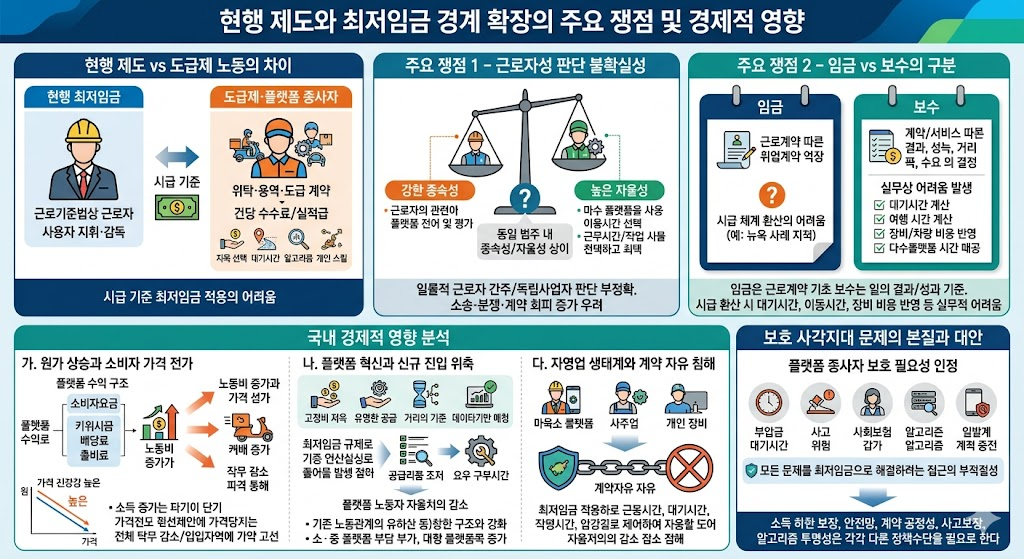
The current minimum wage system is fundamentally premised on workers as defined under the Labor Standards Act. A worker is a person who provides labor under the direction and supervision of an employer for the purpose of earning wages. By contrast, piece-rate workers, specially employed workers, and platform workers typically work under arrangements such as commission contracts, service contracts, or subcontracting contracts, and in many cases are paid not by the hour but by per-task fees or performance-based compensation.
This difference creates an important issue in applying the minimum wage. The wages of ordinary employees can be calculated based on working hours set by the employer and the labor-provision relationship, but the compensation of platform workers varies greatly depending on job selection, travel distance, periods of demand, waiting time, cancellation rates, platform algorithms, and the individual’s skill level. It is therefore difficult to apply the hourly minimum wage standard used for ordinary employees as is.
◩ Uncertainty in Determining Employee Status
To apply the minimum wage to piece-rate and platform workers, it must first be determined whether they are workers under the Minimum Wage Act. However, the legal status of platform workers varies significantly depending on the industry and the type of contract. Some workers are subject to strong control and evaluation by a platform, while others freely use multiple platforms and choose their own working hours and assignments. Even within the same category of “platform labor,” the degree of dependency and autonomy differs.
Accordingly, it may be inaccurate either to uniformly regard all platform workers as employees or, conversely, to treat them all as independent businesses. If the scope of minimum wage coverage is expanded first without legal criteria, there is a strong likelihood that lawsuits, disputes, and contract avoidance will increase in the actual labor market.
◩ The Problem of Distinguishing Wages from Compensation
The core issue raised by the employer side is that the remuneration of piece-rate workers is not wages but compensation. Indeed, in the deliberations of the Minimum Wage Commission, the employer side pointed out that overseas examples presented by labor groups, including the case of New York in the United States, are closer to methods of determining compensation rather than wages (Yonhap News, 2026.06.09), “On Applying the Minimum Wage to Delivery Riders and Others… ‘Impossible Because They Are Self-Employed’ vs. ‘Sufficient Legal Basis’”).
This distinction matters. Wages are an employer’s payment obligation based on an employment contract, whereas compensation under subcontracting or commission contracts is determined by the result of the work, performance, number of tasks, distance, and demand. Forcing these into the same hourly wage system creates practical difficulties such as calculating waiting time, calculating travel time, reflecting equipment and vehicle costs, and allocating time across multiple platforms.
3. Review of Overseas Cases and Implications
Debate over the protection of platform workers is spreading rapidly overseas as well. However, the approaches taken by major countries differ from the approach being discussed in Korea of “directly applying the minimum wage across the board to all piece-rate workers.” Overseas cases can be broadly divided into four types.
◩ New York City, United States: “Minimum Compensation” Regulation for Platform Delivery Workers
New York City applies a separate minimum pay standard to app-based food and grocery delivery workers. The New York City Department of Consumer and Worker Protection announced that it would adjust the minimum pay rate for delivery workers to $22.13 per hour starting with the first pay period after April 1, 2026. This structure is adjusted annually to reflect inflation (New York City Department of Consumer and Worker Protection, 2026, “Minimum Pay Rate for Delivery Workers”).
The distinguishing feature of the New York case is that it did not simply transfer the ordinary employee minimum wage to platform workers, but instead created a separate compensation system that reflects the characteristics of app-based delivery work. Platform workers were not fully reclassified as employees; rather, delivery app operators were obligated to pay compensation above a certain level.
There are two implications. First, a separate compensation standard can be designed to protect platform workers, but this is a different system from the ordinary minimum wage. Second, the issue of cost pass-through must be considered together. If the compensation floor rises, platforms may shift the cost through delivery fees, service charges, consumer prices, and merchant burdens. Therefore, to introduce the New York model in Korea, it should be understood not as applying the employee minimum wage, but as “industry-specific minimum compensation regulation,” and it would require careful analysis of how the cost is distributed among consumers, small business owners, and platform workers.
◩ European Union: Presumption of Employment Relationship and Regulation of Algorithmic Management
In 2024, when the European Union adopted the Platform Work Directive, it introduced a system of “legal presumption of an employment relationship” to address the issue of misclassification of platform workers’ legal status. The directive requires member states to establish methods in domestic law for presuming an employment relationship, and it is designed so that if a platform wishes to rebut that presumption, it must prove that the contractual relationship is not an employment relationship (European Parliament, 2024.04.24, “Parliament adopts Platform Work Directive”; Council of the EU, 2024, “EU rules on platform work”).
The core of the EU approach is not to apply the minimum wage in isolation, but first to determine the employment status of platform workers and to comprehensively regulate the transparency of algorithmic management and supervision, the degree of platform control, and the manner of labor provision. In other words, it is closer to the sequence of “determination of employee status → protection of working conditions → algorithm regulation.”
The implication is clear. In Korea as well, before discussing whether the minimum wage should apply, it is first necessary to determine the legal status of platform workers and the degree of platform control. If the platform substantially controls working hours, prices, dispatching, evaluations, and account suspension, then strong employee status or dependency may be recognized. Conversely, if workers freely decide their working hours, prices, customer selection, and use of multiple platforms, then their status as sole proprietors should be respected. Differential protection based on dependency criteria is more reasonable than blanket application of the minimum wage.
◩ United Kingdom: Recognition of “Worker” Status in the Uber Case
In 2021, in Uber BV v Aslam, the UK Supreme Court held that Uber drivers were not independent contractors but fell under the category of “workers” under UK labor law. In this case, the drivers contested whether they were entitled to statutory protections such as the national minimum wage and paid leave, and the Supreme Court placed significant weight on the fact that Uber substantially controlled fares, contract terms, dispatching, and evaluations (UK Supreme Court, 2021, “Uber BV and others v Aslam and others”).
The distinguishing feature of the UK case is that it did not abstractly apply the minimum wage to all platform workers, but determined legal status based on the actual control structure of a specific platform. In other words, more importance was attached to the actual labor-provision relationship and the platform’s degree of direction and control than to the label “independent contractor” written in the contract.
The implication of this case is that “all platform workers should not be grouped into a single category.” Where a platform effectively functions like an employer, employee or quasi-employee protections may be recognized, but applying the same minimum wage regulation even to highly autonomous sole proprietors could amount to excessive regulation.
◩ California, United States: Proposition 22 and Retention of Independent Contractor Status
California’s Proposition 22 is a system that, in principle, classifies app-based transportation and delivery drivers as independent contractors while providing certain protections such as guaranteed minimum earnings, healthcare subsidies, and accident insurance. Rather than fully reclassifying drivers as employees, this approach combines the independent-contractor character of platform work with a limited safety net (CalMatters, 2024.07.25, “Prop. 22 gig-work law upheld by California Supreme Court”).
From labor groups’ perspective, the California model is criticized as providing insufficient protection, but it is worth noting as an attempt to balance the flexibility of the platform economy with a safety net for workers. In particular, it shows that policy instruments such as industrial accident protection, medical cost support, and a minimum income floor can be designed separately from the question of whether employee status is recognized.
◩ Overall Implications of Overseas Cases
The following conclusions can be drawn from overseas cases.
First, major countries are strengthening the protection of platform workers, but it is not common to apply the ordinary minimum wage as is to all piece-rate workers and sole proprietors. New York City designed a separate minimum compensation rate, the EU combined a presumption of employment relationship with algorithm regulation, the UK recognized worker status based on the degree of actual control by an individual platform, and California combined a separate safety net while maintaining independent contractor status.
Second, the core of overseas cases is not the “expansion of the minimum wage,” but the “refinement of legal status determinations and protective instruments.” In Korea as well, platform workers should be viewed along a broad spectrum between employees and sole proprietors, with levels of protection designed differently according to dependency, autonomy, income structure, and risk burden.
Third, the incidence of cost burdens must be considered. If a minimum compensation floor for platform work rises, the cost will be redistributed among platform companies, merchants, consumers, and workers. This may lead to higher delivery charges, fewer orders, greater commission burdens on small business owners, and fewer assignments for low-skilled workers.
Fourth, Korea’s institutional design requires not a stand-alone discussion by the Minimum Wage Commission, but an integrated approach including labor law, fair trade law, social insurance, and tax and fiscal policy. The core of protecting platform workers is not a single wage regulation, but a combination of legal status, contractual fairness, safety nets, and government fiscal support.
Major Countries’ Cases of Protecting Platform Workers and Their Implications
Category
Type of System
Key Features
Points to Note for Application in Korea
Policy Implications
New York City, United States
“Minimum compensation” regulation for platform delivery workers
Applies a separate minimum compensation rate to app-based food and grocery delivery workers. The minimum compensation rate for delivery workers was adjusted to $22.13 per hour starting from the first pay period after April 1, 2026. The structure is adjusted annually to reflect inflation.
It should be distinguished from simply applying the ordinary employee minimum wage; it is a separate compensation standard reflecting the characteristics of app-based delivery work. If the compensation floor rises, costs may be passed on through delivery fees, platform commissions, consumer prices, and merchant burdens.
A separate compensation standard can be designed to protect platform workers, but it is a different system from the ordinary minimum wage. If introduced in Korea, it should be approached not as applying the employee minimum wage, but as industry-specific minimum compensation regulation.
European Union (EU)
Presumption of employment relationship and regulation of algorithmic management
Responds to the issue of misclassification of platform workers’ legal status through the 2024 Platform Work Directive. Member states are required to establish methods for presuming an employment relationship, and the platform must prove that the contractual relationship is not an employment relationship if it wishes to rebut the presumption. It also regulates the transparency of algorithmic management and supervision.
Rather than applying only the minimum wage separately, this approach first determines platform workers’ legal status and the degree of platform control. In domestic application, the criteria for presuming an employment relationship and the scope of the platform’s burden of rebuttal must be clearly defined.
What should come first is not whether the minimum wage applies, but establishing criteria for determining employee status and dependency. It is necessary to distinguish between cases where the platform substantially controls working hours, prices, dispatching, evaluations, and account suspension and cases where workers enjoy broad autonomy.
United Kingdom
Recognition of “worker” status through the Uber case
In 2021, the UK Supreme Court held in Uber BV v Aslam that Uber drivers were not independent contractors but “workers” under labor law. It emphasized that Uber substantially controlled fares, contract terms, dispatching, and evaluations. Accordingly, it recognized the possibility of certain labor-law protections such as the national minimum wage and paid leave.
This was not a case of uniformly applying the minimum wage to all platform workers, but one of determining legal status based on the actual control structure of a specific platform. The actual labor-provision relationship matters more than the contractual label of independent contractor.
All platform workers should not be grouped into a single category. Where a platform effectively functions like an employer, employee or quasi-employee protection may be recognized, but applying the same minimum wage regulation to highly autonomous sole proprietors may constitute excessive regulation.
California, United States
Proposition 22 and retention of independent contractor status
Classifies app-based transportation and delivery drivers in principle as independent contractors, while granting limited protections such as a guaranteed minimum level of income, medical cost support, and accident insurance. It does not fully reclassify them as employees, but combines a safety net with independent contractor status.
Although labor groups criticize the level of protection as insufficient, it is useful as a model that attempts to balance the flexibility of the platform economy with worker protection. However, the allocation of burdens between companies and public finances must also be examined.
Regardless of whether employee status is recognized, policy instruments such as industrial accident protection, medical cost subsidies, and a minimum income floor can be designed separately. Korea likewise needs an approach that separates the social safety net from legal-status determinations.
Source: New York City Department of Consumer and Worker Protection (2026), “Minimum Pay Rate for Delivery Workers”; European Parliament (2024.04.24), “Parliament adopts Platform Work Directive”; Council of the EU (2024), “EU rules on platform work”; UK Supreme Court (2021), “Uber BV and others v Aslam and others”; CalMatters (2024.07.25), “Prop. 22 gig-work law upheld by California Supreme Court.”
4. Analysis of Economic Effects on the Platform Labor Market
◩ Rising Costs and Pass-Through to Consumer Prices
If the minimum wage is uniformly applied to piece-rate and platform workers, the cost burden on platform businesses and merchants will increase. The revenue structure of platform services such as delivery, parcel shipping, and designated driving consists of consumer charges, merchant commissions, delivery fees, call fees, and platform commissions. If labor-related costs are legally increased within this structure, the burden is highly likely to be passed on through higher consumer prices, higher merchant commissions, and reduced assignments for platform workers.
Platform services in particular are highly price-sensitive. If delivery fees rise, consumers may reduce their orders, and small business owners may scale back their use of platforms. As a result, while guaranteed minimum compensation may raise the short-term income of some workers, it may also reduce the total amount of work and raise barriers to entry.
◩ Reduced Platform Innovation and New Entry
The platform economy has grown on the basis of low fixed costs, flexible labor supply, and data-based matching. However, if minimum wage regulation is introduced, platform companies will be more likely to screen labor supply, control dispatching algorithms, and require fixed working hours in order to reduce cost uncertainty. This may ultimately reduce the autonomy of platform work and reinforce a structure similar to traditional employment relationships.
In addition, large platforms may respond by passing costs on through prices or investing in automation, but small and medium-sized platforms and region-based platforms may find it difficult to absorb the additional costs. Uniform application of the minimum wage could instead intensify market concentration around large platforms.
◩ Infringement on the Self-Employment Ecosystem and Freedom of Contract
A considerable number of specially employed and platform workers use multiple platforms, work only during certain time periods as a side job, or earn income using their own equipment and vehicles. If a uniform minimum wage is applied to them, their freedom of contract and autonomy as sole proprietors may be constrained. In particular, if application of the minimum wage requires control over working hours, waiting time, and work routes, this may paradoxically reduce the autonomy of platform workers.
◩ The Essence of the Protection Gap Problem
The need to protect platform workers itself cannot be denied. Unpaid waiting time, accident risk, blind spots in social insurance, opaque algorithms, and unilateral account suspension are real problems. However, an approach that seeks to solve all of these problems through the minimum wage is not appropriate. Income floors, safety nets, contractual fairness, accident protection, and algorithmic transparency each require different policy tools.
5. Policy Recommendations: Building a Sophisticated Protection System Rather Than Broadly Expanding the Minimum Wage
◩ First Clarify Criteria for Determining Employee Status While Respecting Sole Proprietor Status
To apply the minimum wage to piece-rate and platform workers, the criteria for determining employee status must first be clarified. If a platform substantially controls prices, dispatching, work methods, evaluations, account suspension, and customer contact, then employee or quasi-employee status may be recognized. Conversely, if workers enjoy substantial autonomy in choosing their working hours and assignments, using multiple platforms, and negotiating prices, then their status as sole proprietors should be respected.
Accordingly, the proper policy sequence is not “expand minimum wage coverage,” but first “establish standards for employee status and dependency.” Expanding the minimum wage while the standards remain unclear would only increase legal uncertainty and dispute costs across the labor market.
◩ Consider Industry-Specific “Minimum Compensation Standards” Rather Than the Ordinary Minimum Wage
It is difficult to apply the ordinary employee minimum wage as is to piece-rate and platform work. Therefore, for industries in need of protection, it would be more realistic to consider not the minimum wage but separate “minimum compensation standards” or “fair unit price standards.”
Even in that case, industry-specific fact-finding, cost-structure analysis, the impact on consumer prices, burdens on small business owners, and the net income structure of platform workers must all be examined together. In particular, nominal compensation standards that do not take account of equipment and vehicle maintenance costs, insurance premiums, fuel costs, and depreciation may distort actual income.
◩ Increase Transparency and Fairness in Platform Contracts
More urgent than the minimum wage is transparency in platform contracts. Platforms should clearly disclose to workers commissions, dispatching criteria, evaluation standards, account suspension criteria, and compensation calculation methods. In particular, where compensation and assignments are determined by algorithms, it is necessary to establish disclosure standards so that workers have at least a minimum level of predictability.
At the same time, algorithm regulation must be carried out within limits that do not infringe on corporate trade secrets or innovation. The key is not disclosure of the algorithm itself, but preventing unilateral disadvantages and opaque contract changes.
◩ Industry-Specific Fact-Finding and Pilot Projects Should Come First
The income structure and risk level of piece-rate and platform work differ by industry. It is difficult to regulate delivery, designated driving, parcel delivery, workbook tutoring, home inspection, and care services according to a single standard. The government should therefore investigate by industry net income, cost structures, waiting time, accident risk, platform commissions, and consumer-price effects, and then carry out pilot projects beginning with the industries where they are needed.
Rather than having the Minimum Wage Commission decide uniformly whether coverage should apply, the Ministry of Employment and Labor, the Korea Fair Trade Commission, the Ministry of Economy and Finance, and the Ministry of SMEs and Startups should jointly design platform labor policy. This is because the issue is not only labor policy but also industrial policy, self-employment policy, and social safety-net policy.
6. Conclusion
The debate over applying the minimum wage to piece-rate, specially employed, and platform workers illustrates the tension between worker protection and freedom of contract. The unpaid waiting time of platform workers, accident risk, and gaps in social insurance are problems that need to be addressed. However, applying the ordinary minimum wage across the board to all piece-rate and platform workers whose employee status is unclear could lead to legal uncertainty, cost pass-through, reduced assignments, and weakened platform innovation.
Overseas cases likewise show that blanket expansion of the minimum wage is not the answer. New York City applied a separate minimum compensation standard, the EU introduced a presumption of employment relationship and regulation of algorithmic management, the UK recognized worker status based on the degree of actual control exercised by an individual platform, and California combined a certain level of safety net while maintaining independent contractor status. Their common feature is that they recognized the distinctiveness of platform work and carefully designed both legal status and protective tools.
Accordingly, Korea’s policy direction should be not a forced expansion of the boundaries of the minimum wage, but the construction of a sophisticated protection system. The criteria for determining employee status should be clarified, industry-specific minimum compensation standards should be carefully considered, and contractual transparency and algorithmic fairness should be enhanced. A method that unilaterally shifts costs onto platform firms and small business owners may ultimately lead to higher consumer prices and fewer jobs.
The platform economy has provided new labor opportunities. If it is forcibly fitted into an existing regulatory framework centered on traditional wage employees, both innovation and employment opportunities may be undermined. What is needed is not an expansion of regulation, but a refinement of protection. The government should take responsibility for the basic safety net of platform workers while promoting a balanced institutional design that does not undermine market flexibility and freedom of contract.
◩ References
∙ Yonhap News (2026.06.09), “On Applying the Minimum Wage to Delivery Riders and Others… ‘Impossible Because They Are Self-Employed’ vs. ‘Sufficient Legal Basis.’”
∙ SBS Biz (2026.06.09), “Labor-Management Conflict Over Expanding the Minimum Wage to Piece-Rate Work… Labor Side Presents Formula.”
∙ New York City Department of Consumer and Worker Protection (2026), “Minimum Pay Rate for Delivery Workers.”
∙ European Parliament (2024.04.24), “Parliament adopts Platform Work Directive.”
∙ Council of the EU (2024), “EU rules on platform work.”
∙ UK Supreme Court (2021), “Uber BV and others v Aslam and others.”
∙ CalMatters (2024.07.25), “Prop. 22 gig-work law upheld by California Supreme Court.”
Original title: 최저임금의 경계 확장 시 플랫폼 노동시장에 미치는 경제적 악영향
Author: Center for Free Enterprise (CFE)
Date: 2026-06-11
Source: https://www.cfe.org/bbs/bbsDetail.php?cid=issue&pn=1&idx=29121