
Problems with Higher Property Holding Taxes and Policy Responses
-
Writer
CFE
-
1. Raising the Issue
Recently, discussions on restructuring real estate taxation have once again begun in earnest. It is reported that the government and some within the ruling camp are considering measures such as reducing the special long-term holding deduction, adjusting tax benefits for one-home owners who do not reside in their homes, and strengthening holding taxes on high-priced homes and multi-home owners, under the principle of taxation centered on actual residence. In addition to directly raising tax rates, methods that can be implemented solely through revisions to enforcement decrees—such as adjusting the fair market value ratio and the realization rate of officially assessed property values—are also being discussed.
However, proposals to increase holding taxes must be approached with great caution, contrary to the stated justification of stabilizing the real estate market. A holding tax is not imposed when a home is sold or when income is generated; rather, it is a tax repeatedly imposed simply because an asset is being held. In particular, the Comprehensive Real Estate Holding Tax has a structure in which a progressive tax is imposed once again on real estate for which property tax has already been paid. If the tax burden becomes excessive, it can directly constrain citizens’ private property rights, freedom to choose their housing arrangements, and freedom to build assets.
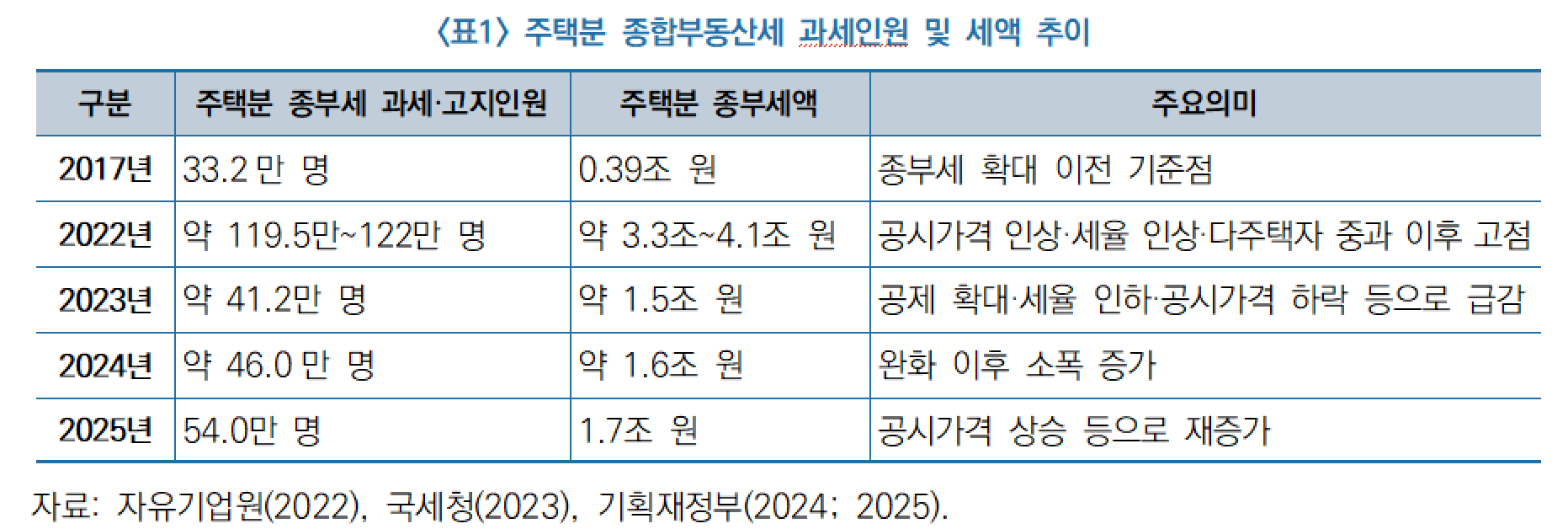
At the time of its introduction, the Comprehensive Real Estate Holding Tax was described as “a tax targeting a small number of owners of high-priced homes.” However, since 2017, the combination of rising housing prices, increases in officially assessed values, higher tax rates, heavier taxation on multi-home owners, and adjustments to the fair market value ratio has rapidly expanded both the number of taxpayers and the tax burden. In 2017, the number of taxpayers subject to the housing portion of the Comprehensive Real Estate Holding Tax was 332,000, and total tax revenue was KRW 0.39 trillion. By 2022, this had expanded to about 1.2 million taxpayers and more than KRW 3 trillion in total tax revenue (Center for Free Enterprise (CFE), 2022; National Tax Service, 2023). In Seoul, as of 2022, 22.4% of homeowners were subject to the Comprehensive Real Estate Holding Tax (Center for Free Enterprise (CFE), 2022).
After that, the burden of the Comprehensive Real Estate Holding Tax fell sharply in 2023 due to lower tax rates, a higher basic deduction, declines in officially assessed values, and the maintenance of the fair market value ratio at 60%. However, it began rising again in 2024 and 2025. In 2025, the number of taxpayers subject to the housing portion of the Comprehensive Real Estate Holding Tax reached 540,000, and the tax amount came to KRW 1.7 trillion, increases of 17.3% and 6.3%, respectively, from the previous year (Ministry of Economy and Finance, 2025). This shows that the burden of holding taxes can expand again at any time depending on institutional changes and fluctuations in asset prices.
Accordingly, recent calls to raise holding taxes are not simply about imposing more taxes on multi-home owners or owners of ultra-high-priced homes. Rather, they represent a policy under which the state judges the purpose for which citizens own homes and how they reside in them, and seeks to alter asset-holding behavior through taxation. From the perspective of a free-market economy, proposals to increase holding taxes should be comprehensively reviewed in terms of tax principles, market order, the rental market, tenant burdens, and housing mobility.
2. Major Issues in Proposals to Raise Holding Taxes
Recent proposals to raise holding taxes can largely be grouped into four directions. First, strengthening the burden of the Comprehensive Real Estate Holding Tax on high-priced homes and multi-home owners. This can be done not only by directly adjusting tax rates, but also by raising the tax base. In particular, increasing the fair market value ratio raises the tax base without touching the tax rate, thereby producing the practical effect of increasing holding taxes.
Second, strengthening the actual-residence requirement for the special long-term holding deduction. At present, the real estate tax system is structured to ease the capital gains tax burden for those who have held a home for a certain long period. However, if actual residence becomes the key standard, tax benefits may be reduced simply because the owner did not live in the home, even if it was held for a long time. This raises concerns that diverse life circumstances—such as job relocation, children’s education, family caregiving, living in another region, or overseas residence—may not be adequately reflected.
Third, reducing tax benefits for one-home owners who do not reside in their homes. The government may justify this in the name of demand-based taxation centered on genuine owner-occupiers, but in reality the distinction between actual residence and non-residence is highly complex. Many people cannot live in the homes they own due to work, education, caregiving, jeonse lease contracts, or temporary relocation. Treating non-residence as inherently speculative ownership is an excessive generalization.
Fourth, gradually increasing the overall burden of holding taxes, including both property tax and the Comprehensive Real Estate Holding Tax. Advocates of higher holding taxes argue that Korea’s holding tax burden is lower than that of major countries. However, Korea has high transaction taxes such as acquisition tax and capital gains tax, and it also has a separate progressive holding tax in the form of the Comprehensive Real Estate Holding Tax. Comparing holding taxes alone internationally can distort the overall structure of Korea’s real estate tax system.
3. Implications of Korea’s Experience with Expansion of the Comprehensive Real Estate Holding Tax and Overseas Cases of Holding Taxes
◩ Korea’s experience with the expansion of the Comprehensive Real Estate Holding Tax: from a “tax on the rich” to a middle-class holding tax
Since taxation began in 2005, the Comprehensive Real Estate Holding Tax has been a core issue in real estate policy for about 20 years. At the time of its introduction, it was explained as a supplementary tax on owners of high-value real estate. Over time, however, rising housing prices combined with institutional changes, and the scope of taxation expanded significantly.
In particular, the expansion of the Comprehensive Real Estate Holding Tax from 2017 to 2022 is a representative example showing the risks of proposals to increase holding taxes. The number of taxpayers subject to the housing portion of the tax rose from 332,000 in 2017 to about 1.2 million in 2022, while total tax revenue increased from KRW 0.39 trillion to over KRW 3 trillion (Center for Free Enterprise (CFE), 2022; National Tax Service, 2023). The average tax amount per taxpayer also rose from KRW 1.169 million in 2017 to KRW 4.733 million in 2021 (Center for Free Enterprise (CFE), 2022).
The concentration in the greater Seoul metropolitan area was also high. As of 2022, 961,000 taxpayers in the capital region were subject to the Comprehensive Real Estate Holding Tax, accounting for about 78.8% of all taxpayers subject to the tax. In Seoul, the share of taxpayers subject to the tax relative to all homeowners reached 22.4% (Center for Free Enterprise (CFE), 2022). This means it became difficult to regard the tax as one targeting only an extremely small number of wealthy asset holders.
Of course, the burden of the Comprehensive Real Estate Holding Tax fell sharply in 2023. The number of persons notified to pay the housing portion of the tax fell from 1.195 million in 2022 to 412,000 in 2023, while the tax amount declined from KRW 3.3 trillion to KRW 1.5 trillion (National Tax Service, 2023). This was the result of multiple factors, including a higher basic deduction, lower tax rates, the abolition of heavier taxation on owners of two homes in designated adjustment areas, lower officially assessed values, and the maintenance of the fair market value ratio at 60%. However, the upward trend reappeared in 2024 and 2025. In 2024, the number of taxpayers subject to the housing portion of the tax was 460,000 and the tax amount was KRW 1.6 trillion, and in 2025 these rose to 540,000 taxpayers and KRW 1.7 trillion (Ministry of Economy and Finance, 2024; Ministry of Economy and Finance, 2025). In particular, in 2025, the number of individual taxpayers subject to the housing portion of the tax rose to 481,000, up 19.9% from the previous year, and the number of taxed one-household, one-home owners also increased to 151,000 (Ministry of Economy and Finance, 2025).
This trend suggests two points. First, the tax base for the Comprehensive Real Estate Holding Tax can expand rapidly depending on institutional design and changes in real estate prices. Second, once strengthened, a holding tax system may fail to adequately reflect taxpayers’ life cycles and cash flow, and can spread the burden even to middle-class households and one-home owner-occupiers. Proposals to increase holding taxes always begin by targeting “a small number of owners of high-priced homes” or “speculative multi-home owners,” but over time they can expand to middle-class taxpayers through changes in officially assessed values, the fair market value ratio, the basic deduction, and tax rates.
◩ Three problems with stronger holding taxes shown by Korea’s experience
First, it is difficult to conclude that stronger holding taxes had a decisive effect in stabilizing real estate prices. According to existing studies, during the discussion stage of introducing the Comprehensive Real Estate Holding Tax, there was some effect in reducing housing price inflation due to anticipated policy effects. However, after the actual introduction of the system, no significant impact was confirmed on housing price growth in Seoul or on apartment price increases (Seungmoon Choi and Sanghwa Shin, 2018; Center for Free Enterprise (CFE), 2022). Housing prices are not determined by holding taxes alone. Interest rates, lending regulations, supply, population movement, regional infrastructure, education and transportation conditions, and market expectations all interact in complex ways. It is reasonable to view the price adjustment after 2021 as being driven more by the Bank of Korea’s policy rate hikes and changes in financial conditions than by stronger holding taxes.
Second, the income redistribution effect of stronger holding taxes is limited. Housing is an asset, not income, and asset value does not necessarily match current income. If elderly individuals whose incomes have fallen after retirement become subject to the Comprehensive Real Estate Holding Tax because the homes they purchased in the past have risen in value, the holding tax may actually work regressively against low-income elderly households. Existing studies also point out that strengthening asset-holding taxes is unlikely to produce the level of income redistribution effect expected, and in some cases may even have regressive effects (Myungho Park, 2019; Myeongjae Seong, 2022; Center for Free Enterprise (CFE), 2022).
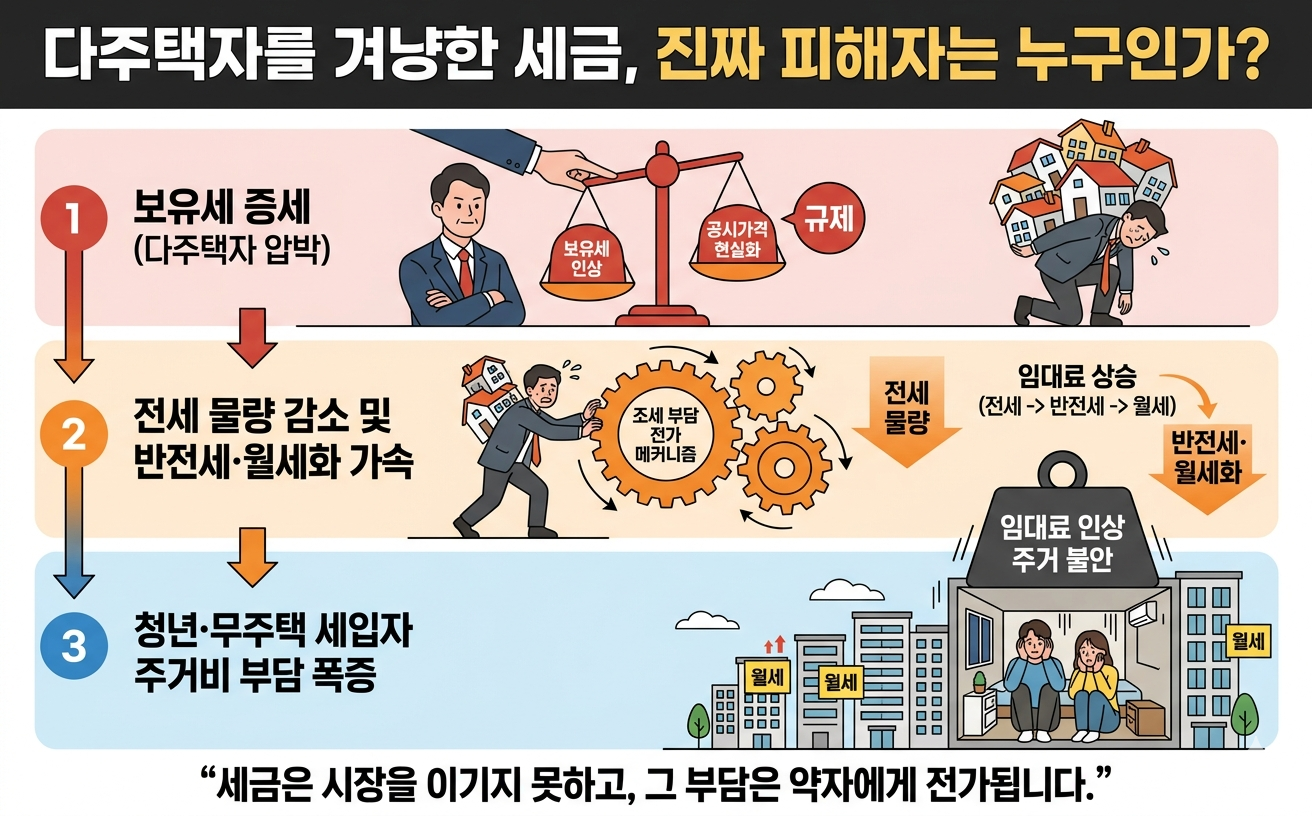
Third, the burden of holding taxes can be passed on to the rental market. Landlords may pass on increased holding tax burdens through higher jeonse deposits, conversion to monthly rent, or expansion of semi-jeonse arrangements. In particular, the likelihood of tax shifting is greater when the rental market is suffering from supply shortages or when rental regulations are stringent. A holding tax increase may appear to target multi-home owners, but multi-home owners also play the role of private rental housing suppliers. If their holding costs rise, that can lead to a reduction in jeonse supply, a faster shift toward monthly rentals, and higher housing costs for young people, newly married couples, and tenants without homes (Dongwon Lim, 2021; Center for Free Enterprise (CFE), 2022).
◩ Overseas cases of holding taxes: institutional structure matters more than a simple tax rate comparison
Advocates of raising holding taxes often argue that “Korea’s holding tax burden is lower than that of major countries.” However, when reviewing overseas cases, one should not simply compare holding tax rates or holding tax revenues. Real estate tax systems in each country operate in combination with acquisition taxes, capital gains taxes, inheritance and gift taxes, local public finance structures, methods of assessing official property values, and taxpayer protection mechanisms.
The OECD explains that all member countries operate recurring taxation on real estate holdings (OECD, 2022). However, each country’s holding tax is closely linked to local government finance, and tax-base assessment methods and taxpayer protection devices vary widely. In addition, the OECD’s classification of property-related taxes can include not only recurring taxes on real estate holdings but also taxes on real estate transfers, inheritances and gifts, and financial and capital transactions. Therefore, it is difficult to argue for the need to raise taxes in Korea based solely on a single indicator that “holding taxes are low” (OECD, 2025).
In the United States, the structure of property tax differs by state, but holding taxes are directly connected to local government finance, and taxpayer protection mechanisms are well developed. For example, California’s Proposition 13 limits the general property tax rate to 1% of assessed value, and limits annual increases in assessed value to within 2% unless there is a transfer of ownership or new construction (California State Board of Equalization, 2024). Although this system has generated controversy over its “lock-in effect,” which reduces housing mobility, and over intergenerational equity, it is important that it at least provides taxpayers with predictability regarding their tax burden (NBER, 2005).
In Japan, there is a fixed asset tax, but in principle land and housing values are reassessed once every three years (Kanazawa City, 2023; World Bank, 2025). Rather than immediately reflecting annual fluctuations in market prices in the tax base, the system uses a fixed assessment cycle to moderate sudden spikes in tax burdens. In other words, even when imposing holding taxes, the system is designed so that taxpayers bear a tax burden that is predictable over the long term.
The core lesson from overseas cases is not that “because there are holding taxes abroad, Korea should raise them too.” Rather, what matters is that even where holding taxes exist, tax burdens are managed in a predictable manner, sudden surges in assessed tax bases are mitigated, and the link between local government services and taxpayer burdens is strengthened. By contrast, Korea’s Comprehensive Real Estate Holding Tax has been used by the central government as a tool to simultaneously pursue multiple policy objectives, including stabilizing real estate prices, redistribution, and curbing speculation. In the process, various elements—officially assessed values, the fair market value ratio, tax rates, the basic deduction, and heavier taxation on multi-home owners—have changed abruptly based on political and policy judgments, seriously undermining taxpayer predictability.
◩ Overall implications of domestic and international cases
Taken together, Korea’s experience with the expansion of the Comprehensive Real Estate Holding Tax and overseas cases of holding taxes provide the following implications. First, holding taxes have limited effectiveness as a tool for price stabilization. Real estate prices are influenced more by interest rates, supply, financial regulations, regional demand, and market expectations than by taxes. Therefore, an approach that seeks to stabilize housing prices solely through stronger holding taxes has uncertain policy effectiveness.
Second, if holding taxes do not take account of taxpayers’ cash flow, they may violate the principle of ability to pay. Simply holding an asset does not mean income is generated. In particular, elderly one-home owners, long-term holders, and temporarily non-resident one-home owners may have high asset values but low actual tax-paying capacity.
Third, holding taxes can be passed on to tenants. If taxes are concentrated on rental suppliers, this can lead to higher rents, a shift toward semi-jeonse and monthly rentals, and a reduction in jeonse supply. The result is higher housing costs for young people, newly married couples, and tenants without homes.
Fourth, overseas cases show not the justification for higher taxes, but the importance of institutional stability. As seen in the cases of the United States and Japan, major countries, even while operating holding taxes, place importance on predictability of the tax burden through taxpayer protection mechanisms, limits on increases in assessed value, adjustments to assessment cycles, and links to local public finance.
Fifth, Korea is not simply a country with low holding taxes. Korea imposes heavy asset-related taxes such as acquisition tax, capital gains tax, inheritance tax, and gift tax, and in addition to property tax it has a separate progressive holding tax in the form of the Comprehensive Real Estate Holding Tax. Therefore, isolating holding taxes for international comparison and then using that comparison to justify higher taxes is an approach that distorts the overall structure of the real estate tax system.
4. Fundamental Problems with Proposals to Raise Holding Taxes
◩ Repeated taxation on unrealized gains
A holding tax is imposed even when income has not been realized. Even if housing prices rise, a person who has not sold the home has not generated cash income. In particular, elderly one-home owners, retirees, and long-term residents may have seen their asset values rise, but their actual cash flow may remain limited. If holding taxes are sharply increased in such circumstances, taxpayers must mobilize other income or savings simply to keep their homes. This leads to the result that taxation does not support citizens’ asset formation, but rather impedes it.
Taxes should be a means of operating state finances. However, if taxation reaches the level of punishing the holding of certain assets or substantially pressuring citizens in the exercise of ownership rights, it goes beyond the essential nature of taxation. A tax that effectively penalizes homeownership itself as a matter of policy is difficult to reconcile with the principles of a free-market economy and private property rights.
◩ The risks of taxation centered on actual residence
The principle of taxation centered on actual residence currently being discussed may seem, on the surface, to protect genuine end-users. However, a system under which the state divides the purpose of homeownership into residence and non-residence, and imposes a heavier tax burden on non-residential ownership, can restrict freedom of housing choice.
In reality, ownership and residence do not necessarily coincide. People may live in another area because of job relocation, or may be unable to live in a home they own for various reasons, including children’s education, caring for parents, rental contract arrangements, or overseas residence. If such circumstances are ignored and non-residential ownership is treated as speculative ownership, even ordinary life choices will be constrained by taxation.
The real estate tax system should not uniformly judge citizens’ living arrangements. Taxation should be simple and predictable, and should respect diverse housing arrangements and changes across the life cycle.
◩ The predictability problem of adjusting the fair market value ratio
One part of the debate over higher holding taxes that deserves particular attention is the fair market value ratio. The fair market value ratio is the rate multiplied by the officially assessed value to calculate the tax base, and it is a tool that can increase the tax burden without directly raising tax rates. The problem is that this ratio can be adjusted through revisions to enforcement decrees. Compared to amending the law, this entails less political burden, but from the taxpayer’s standpoint it means that the tax burden can change rapidly depending on the judgment of the executive branch.
Because holding taxes are imposed repeatedly every year, they should be administered in a stable manner so that taxpayers can make long-term plans for housing, retirement, and asset management. If officially assessed values, the fair market value ratio, tax rates, and deduction amounts are adjusted frequently, the predictability of taxation is undermined, and market participants will begin reflecting tax risk in prices and rents.
5. Policy Alternatives and Conclusion
Proposals to raise holding taxes are being advanced in the name of stabilizing the real estate market and achieving tax fairness. However, taken together, Korea’s experience with the expansion of the Comprehensive Real Estate Holding Tax and overseas cases of holding taxes show that stronger holding taxes have uncertain effects on price stability, may infringe property rights through repeated taxation of unrealized gains, and may work regressively against elderly and low-income one-home owners. Moreover, the burden of holding taxes can be passed on to the rental market, increasing housing costs for young people, newly married couples, and tenants without homes.
Accordingly, the direction the government should pursue is not higher holding taxes, but rationalization of the real estate tax system and restoration of market functions. To this end, the following policy alternatives are needed.
First, discussions of raising holding taxes should be halted, and tax predictability should be strengthened. Repeatedly adjusting tax rates, officially assessed values, the fair market value ratio, and the basic deduction over a short period undermines taxpayers’ trust. In particular, the fair market value ratio is a key variable that can change tax burdens even without amending the law, and therefore should not be used as a short-term means of securing tax revenue or suppressing real estate prices. Because holding taxes are directly tied to citizens’ housing and retirement plans, they should be administered under stable medium- to long-term standards.
Second, the Comprehensive Real Estate Holding Tax should be reduced and eased, or restructured in a direction that integrates it with property tax. The tax is structured to impose a progressive levy once again on real estate for which property tax has already been paid. This gives rise to controversy over double burden, and can impose excessive burdens especially on long-term one-home owners and the elderly. In the long term, the Comprehensive Real Estate Holding Tax should be integrated with property tax and converted into a simple, predictable holding tax system. At the very least, the tax burden should be substantially eased for one-household, one-home owners, the elderly, and long-term holders.
Third, any approach that makes actual residence the key criterion of taxation should be handled with caution. Taxation centered on actual residence carries the stated purpose of protecting genuine demand, but it is difficult to fully reflect the wide range of real-life circumstances. One-home owners who do not reside in their homes should not be uniformly regarded as speculative demand. In many cases, ownership and residence do not coincide due to job relocation, children’s education, parental care, rental contracts, or overseas residence. The tax system should not uniformly force citizens into a single lifestyle pattern.
Fourth, lowering transaction taxes and expanding supply should come first. To stabilize the real estate market, easing the burden of acquisition tax and capital gains tax, relaxing regulations on redevelopment and maintenance projects, and revitalizing private-sector supply should take priority over stronger holding taxes. When transaction taxes are high, listings become locked up because homeowners cannot or do not want to sell even if they wish to. This weakens the market’s voluntary price-adjustment function and may instead intensify concentration of demand in certain housing markets. Stability in the real estate market should begin not with tax pressure, but with sufficient supply and smooth transactions.
Fifth, the rental market must be normalized. Higher holding taxes are likely to be passed on to the rental market. If the goal is to protect tenants, the solution is not to raise holding taxes, but to ease regulations that shrink private rental supply. Options between jeonse and monthly rent should be broadened, and an environment should be created in which landlords and tenants can contract freely. Designing a stable tax and regulatory environment so that private rental suppliers do not exit the market is, in the long run, also beneficial for tenants.
Sixth, international comparisons of holding taxes should be conducted within the broader structure of overall asset taxation. Korea’s real estate tax system is not composed of holding taxes alone. Acquisition tax, capital gains tax, inheritance tax, gift tax, property tax, and the Comprehensive Real Estate Holding Tax all operate together. Therefore, it is inappropriate to isolate the holding tax burden and claim that “Korea is low.” International comparisons should comprehensively consider not only holding taxes but also transaction taxes, capital gains taxes, inheritance and gift taxes, official valuation methods, and local public finance structures.
In conclusion, despite being justified in the name of stabilizing the real estate market, proposals to raise holding taxes have uncertain actual policy effects and are highly likely to constrain citizens’ private property rights and freedom to choose their housing arrangements. Korea’s experience with expanding the Comprehensive Real Estate Holding Tax shows that although higher holding taxes may begin by targeting a small number of owners of high-priced homes, over time they can expand to middle-class households and one-home owner-occupiers. The fact that both the number of taxpayers subject to the housing portion of the tax and the total tax amount rose again in 2024 and 2025 after the temporary easing in 2023 suggests that this risk remains ongoing.
Taxes are not a tool for obstructing citizens’ asset formation. Taxation should be simple, predictable, and aligned with taxpayers’ ability to bear the burden. If the government truly seeks stability in the real estate market, it should move not toward stronger holding taxes, but toward greater supply, lower transaction taxes, normalization of the rental market, and rationalization of the Comprehensive Real Estate Holding Tax. What is needed now is not higher holding taxes, but the normalization of the real estate tax system in a manner that respects citizens’ property rights and market functions.
◩ References
∙
Center for Free Enterprise (CFE) (2022), “Recent Controversy over Revisions to the Comprehensive Real Estate Holding Tax Act and Immediate Response Tasks,” Issue and Liberty No. 3.
∙
Sung-no Choi (2021), “Comprehensive Real Estate Holding Tax, Is It Acceptable as It Is?,” Bridge Economy Op-Ed.
∙
National Tax Service (2023), “2023 Comprehensive Real Estate Holding Tax: Please Pay by December 15.”
∙
Ministry of Economy and Finance (2024), “2024 Comprehensive Real Estate Holding Tax Notice.”
∙
Ministry of Economy and Finance (2025), “2025 Comprehensive Real Estate Holding Tax Notice.”
∙
Myungho Park (2019), “An Analysis of the Income Redistribution Effects of the Reform Plan for the Housing Portion of the Comprehensive Real Estate Holding Tax,” paper presented at the 2019 Joint Economics Academic Conference.
∙
Myeongjae Seong (2022), “An Analysis of Redistribution Contributions through the Income Redistribution Effects of Property Tax and Decomposition of Elasticity Factors,” Korean Journal of Public Finance, Vol. 15, No. 2.
∙
Dongwon Lim (2021), “An International Comparison of the Comprehensive Real Estate Holding Tax and Its Implications,” Korea Economic Research Institute (KERI) Brief 21-07.
∙
Seungmoon Choi and Sanghwa Shin (2018), “An Analysis of the Tax Burden and Economic Effects of Real Estate Holding Taxes,” Korea Institute of Public Finance research report 18-06.
∙
OECD (2022), Housing Taxation in OECD Countries.
∙
OECD (2025), Revenue Statistics 2025.
∙
California State Board of Equalization (2024), California Property Tax: An Overview.
∙
NBER (2005), The Lock-in Effect of California’s Proposition 13.
∙
Kanazawa City (2023), Fixed Asset Tax Guide.
∙
World Bank (2025), Property Tax Practices in Japan.
Original title: 보유세 증세론의 문제점과 정책 대응과제
Author: Center for Free Enterprise (CFE)
Date: 2026-06-10
Source: https://www.cfe.org/bbs/bbsDetail.php?cid=issue&pn=1&idx=29119