
The Misconception That “Single-Source Contracts Equal Corruption” and How to Improve the School Meal Procurement System
-
Writer
CFE
-

1. Introduction
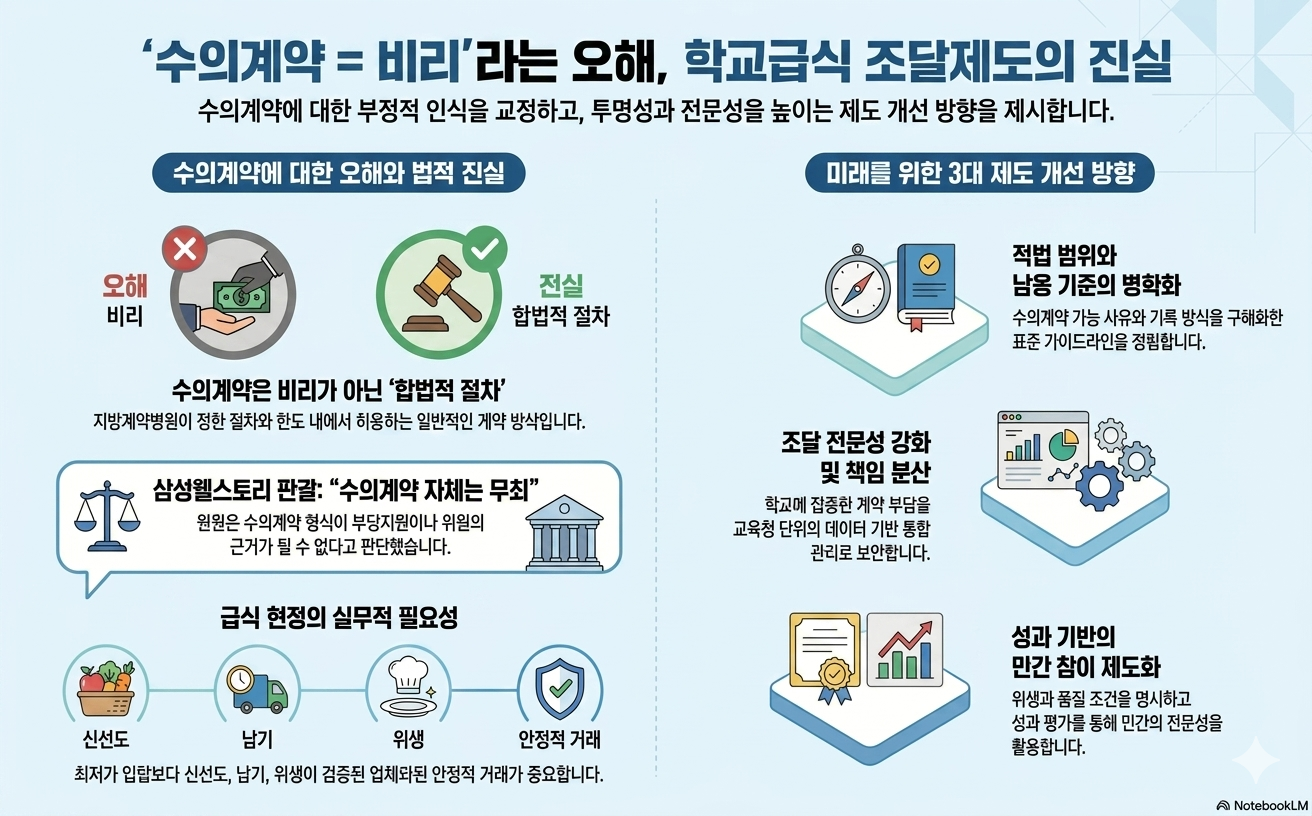
Controversy has recently resurfaced over private contracts in school meal procurement. The media has used provocative expressions such as “the practice of private contracts” and “they skimmed off employees’ meal money” in reporting on some school meal contracts and issues involving meal fees for school staff. Such language may be effective for attracting attention, but from a policy standpoint it creates a highly dangerous frame. Private contracts are not, in themselves, illegal or corrupt. They are a generally permitted method of contracting within the procedures and limits set by local government contract laws and regulations. The real issue is not the form of a private contract itself, but whether the contract was operated under appropriate prices and terms, proper inspection and disclosure, and safeguards against conflicts of interest. The Enforcement Decree of the Act on Contracts to Which a Local Government Is a Party provides that, in principle, at least two estimates should be obtained when entering into a private contract, but that in certain cases—such as construction, goods, and services with an estimated price of 20 million won or less—a single estimate is also permitted (Enforcement Decree of the Act on Contracts to Which a Local Government Is a Party).
This controversy has become even more important in light of the Seoul High Court’s April 23, 2026 ruling fully canceling the Korea Fair Trade Commission’s surcharge of about 234.9 billion won and corrective order in the Samsung Welstory “meal favoritism” case. The Fair Trade Commission had viewed the decision by affiliates such as Samsung Electronics to entrust in-house meal service volumes to Samsung Welstory through private contracts as unfair support. The court, however, held that private contracts themselves cannot serve as grounds for finding unfair support, and that there is no legal obligation to conduct competitive bidding or to divide up meal-service volumes. The court also found it difficult to conclude that the meal-service transactions provided excessive economic benefit to Samsung Welstory or undermined fair trade in the group catering market.
This ruling offers important implications for the school meal controversy as well. The mere fact that private contracts are repeated should not automatically lead to an inference of corruption or favoritism. More important than morally stigmatizing a contracting method is institutional design. School meals have long been operated under the principle of direct management, with the school principal bearing responsibility for operations. The School Meals Act makes direct management and operation by the principal the rule, allowing outsourcing only as an exception. In particular, the selection, purchase, and inspection of food ingredients may not be outsourced except where unavoidable under school meal conditions, and if a compulsory education institution seeks to outsource meal operations, it must obtain approval from the competent authority (School Meals Act).
Accordingly, the essence of the current system is closer to a “principle of direct management with outsourcing as an exception” than to a “complete ban on private participation.” In actual operation, however, responsibility for procurement, inspection, hygiene, safety, accounting, and accident reporting has become concentrated on principals and nutrition teachers/dietitians. Under this structure, when an accident occurs, the school is placed on the front line of accountability, and if sufficient external support and a transparent reporting system are lacking, there may be incentives for minimizing responses or engaging in defensive administration. This report seeks to correct misunderstandings surrounding private contracts in school meals, shift perceptions that stigmatize private contracts as corruption, and propose institutional reforms that can simultaneously improve competition, transparency, and accountability in school meal services.
2. The Structure of the School Meal System: The Principle of Direct Management and Concentrated Responsibility
The current school meal system is designed around direct management in order to protect student health and the public nature of school meals. The key purpose of the full revision of the School Meals Act in 2006 was to improve the quality of school meals, manage the quality of ingredients, strengthen hygiene and safety management, and tighten operational methods. The stated reason for the revision was to require school meals to be directly managed and operated by the principal, while allowing outsourcing to qualified parties subject to review by the school steering committee, but not allowing the selection, purchase, and inspection of food ingredients to be outsourced except in unavoidable circumstances.
This system began with the goal of enhancing the public nature of school meals. Over time, however, side effects emerged. First, principals became the ultimate persons responsible for meal operations, while participation by professional meal-service institutions or private specialist firms remained heavily restricted. Second, nutrition teachers and dietitians came to shoulder complex responsibilities ranging from menu planning and ingredient selection to purchase contracts, inspection, hygiene management, and complaint handling. Third, although school steering committee review and provincial office of education guidelines exist, the actual burden of procurement and inspection is concentrated at the school level. The Enforcement Decree of the School Meals Act also provides that the principal shall decide the operating method, meal recipients, budget and settlement, ingredient procurement methods, and supplier selection criteria for school meals after review by the school steering committee.
The problem is that this structure creates a threefold system in which “responsibility lies with the school, control lies with laws and guidelines, and costs are borne by taxpayers.” The room for private firms to participate freely and compete on price, quality, and service is limited, while schools must repeatedly handle the practical work of ingredient purchasing and contracting. In this setting, private contracts perform an unavoidable function on the ground. Given the characteristics of school meals—student numbers, menus, delivery deadlines, freshness, convenience of inspection, hygiene control, and local supply chains—simple lowest-price bidding does not always guarantee good results.
Nevertheless, in the language of the media and audits, private contracts are easily lumped together as “customary practice,” “favoritism,” or “collusion.” Of course, problems can arise if private contracts are abused. If a school repeatedly contracts with a particular supplier while conducting poor price comparisons, evades competitive bidding thresholds through split orders, or treats inspection and settlement as mere formalities, that should naturally be sanctioned. But the problem is not that it is a private contract; the problem is that the private contract was not operated in accordance with the purpose of the relevant laws and regulations. If policy fails to distinguish between a tool and its abuse, it will head in the wrong direction.
3. The Meaning of the Samsung Welstory Ruling: Private Contracts Are a Lawful and Normal Method and Procedure
The Samsung Welstory case is a representative example of recent legal judgment concerning private contracts. In 2021, the Fair Trade Commission concluded that four companies—Samsung Electronics, Samsung Display, Samsung Electro-Mechanics, and Samsung SDI—had funneled in-house meal-service volumes to Samsung Welstory through private contracts, and imposed surcharges totaling 234.927 billion won on Samsung Welstory and the four affiliates. At the time, the Fair Trade Commission took issue with the use of private contracts, guaranteed margins on ingredient costs, consignment fees, and the reflection of inflation and wage increases, and referred the Samsung Electronics corporate entity and former Future Strategy Office head Choi Gee-sung to prosecutors (Korea Economic Daily, June 24, 2021, “Fair Trade Commission imposes 234.9 billion won surcharge for unfair support in meal services”…Samsung “to file administrative lawsuit”).
However, on April 23, 2026, the Seoul High Court canceled the Fair Trade Commission’s measures in full. The court held that the mere fact that the meal-service transactions were large in scale did not mean Samsung Welstory had received excessive economic benefit, and that it was difficult to recognize the conduct as unfair support likely to impede fair trade. In particular, it held that the use of private contracts itself could not be grounds for finding unfair support. It pointed out that other business groups also frequently enter into private contracts with affiliates for meal services, and that private companies have no legal obligation either to subject all business sites to competitive bidding or to split on-site cafeterias and assign them to small and medium-sized enterprises (Korea Economic Daily, April 23, 2026, “Samsung clears the stigma of ‘skimming employees’ meal money’…‘200 billion won-range surcharge canceled’”).
This judgment bears directly on the debate over private contracts in school meals. The contractual form of a private contract may be the starting point for legal analysis, but it cannot itself be the conclusion of illegality. To determine illegality, one must examine whether the transaction terms were actually unfairly favorable, whether excessive profits arose compared with normal prices, whether the competitive order was harmed, whether the competitive conditions of other businesses deteriorated, and whether the intent and effect of support are proven. The same is true in school meals. The mere fact that a private contract was made with a particular supplier does not mean corruption. One must consider price, quality, inspection, supplier selection, information disclosure, and the reasons for repeated contracting as a whole.
The Samsung Welstory ruling also shows that emotional framing such as “they skimmed off employees’ meal money” cannot replace legal judgment. The media may use provocative language to explain conflict easily, but policy must be designed on the basis of legal standards and empirical evidence. The moment private contracts are treated as synonymous with corruption, schools may lose a rational procurement tool and be driven into more rigid administration. That, in turn, can reduce the quality of student meals and operational efficiency on the ground.
4. Review of Field Cases in the School Meal Private Contract Controversy and Their Lessons
◩ Incheon Case: Private Contracts as a Response to Low-Price, Low-Quality Deliveries
In November 2025, conflict arose in the Incheon area between local politicians and nutrition teachers/dietitians over single-estimate private contracts for school meals (Jungbu Ilbo, November 25, 2025, “Incheon nutrition teachers and dietitians: Councilman Kim Jong-bae should apologize for distorted remarks about school meal sites”). After one city council member pointed out that a specific supplier appeared to be monopolizing private contracts following the increase of the ceiling for such contracts from 10 million won to 20 million won, nutrition teachers and dietitians responded that “a lawful contracting method should not be treated as the problem.” They explained that single-estimate private contracts had been introduced in 2017 and had become a hard-won choice at school sites due to problems with low-price, low-quality product deliveries and suppliers’ litigation responses after contract terminations. They also stated that the adjustment of the ceiling amount followed the Ministry of Education’s 2020 revision of standards aimed at rapid fiscal execution and reducing the school administrative burden.
This case shows that private contracts cannot simply be viewed as “favoring suppliers.” School meal ingredients are different from ordinary goods. For food, freshness, delivery timeliness, consistency of quality, hygiene management, allergy response, and suitability for menus all matter. Repeated lowest-price bidding may look like budget savings in the short term, but it can increase the risks of low-price, low-quality deliveries, inspection burdens, and contract nonperformance. The reason private contracts are preferred in the field may not necessarily be collusion, but rather a practical need to secure quality and stable supply.
◩ Gyeonggi Case: Limiting the Number of Private Contracts Does Not Automatically Guarantee Better Quality
In 2025, the Gyeonggi Provincial Office of Education pursued guidelines to diversify school meal ingredient suppliers and prevent abuse of private contracts by limiting the number of private contracts with the same supplier and adjusting contract periods. In the field, however, concerns were raised that it would be difficult to diversify suppliers in a short time, that administrative preparation was inadequate, and that ingredient quality might deteriorate. The office of education ultimately postponed implementation (Yonhap News, August 7, 2025, “Gyeonggi Office of Education postpones guideline limiting the number of ‘private contracts’ for meal ingredients”).
This case illustrates the dilemma of policies restricting private contracts. Repeated private contracts should be subject to monitoring, but mechanically limiting the number of times does not automatically improve competition and quality. On the contrary, if transactions with proven suppliers are abruptly cut off, delivery stability may decline, and schools may be burdened with the administrative task of finding new suppliers. In areas with limited suppliers, such as eco-friendly and local ingredient supply chains, forced diversification may lead to lower quality or higher prices.
◩ Joint Government Inspection Case: The Problem Is Not the Contract Form but Failed Control
Of course, there have been cases of corruption related to school meal contracts. In 2016, a joint government inspection reviewed the entire process of production, distribution, and consumption of school meal ingredients and identified a total of 677 violations. In particular, inspections of 274 elementary, middle, and high schools suspected of legal violations found improper contracting, improper budget execution, and poor ingredient inspection and hygiene management. The report pointed out that expedient private contracts, improper limited-competition contracts by nomination, designation and purchase of specific brands, and unusually high settlement amounts could be prevented in advance through data analysis (Republic of Korea Policy Briefing press release, August 23, 2016, “Full disclosure of the actual state of school meal operations”).
The key conclusion here is not that private contracts themselves should be abolished. The problem is failed control. In other words, the problems are bid avoidance through split contracts, poor estimate comparisons, specification of particular brands, poor inspection, rebate suspicions, and poor document management. Such problems can also arise in competitive bidding. Bid rigging and quality deterioration after low-price awards are also chronic risks of competitive bidding. Therefore, the direction of policy should not be “abolish private contracts,” but “create a system that distinguishes and controls the risks of each contracting method.”
◩ Lesson: A Shift Away from the Perception that “Private Contracts = Corruption” and Recognition of Their Necessity and Positive Function
Private contracts are a convenient contracting method, but they are also a necessary one. Processing every contract through competitive bidding is not always efficient or fair. Particularly in areas such as school meals, where supply stability, quality, delivery timeliness, hygiene, student preferences, and allergy response are important, stable transactions with verified suppliers may be necessary. Excessive lowest-price competition may instead encourage low-price, low-quality deliveries, increase the burden of inspection, and ultimately harm students.
The problem is that the language of the media and audits immediately groups private contracts into a negative practice. The term “practice” may simply mean repeated administrative work, but in reporting contexts it often implies illegal inertia or concealed collusion. The phrase “they skimmed off employees’ meal money” creates an even stronger moral stigma. But meal fees, school staff meal fees, tasting inspection fees, labor costs, operating costs, and food costs each have different legal and accounting characteristics.
The standard shown by the Samsung Welstory ruling is clear. Private contracts themselves are not grounds for illegality. It must be proven whether the transaction terms were actually unfair, whether excessive economic benefit was provided, and whether the competitive order was harmed. The same applies to school meals. More important than the fact that a private contract existed is the following checklist: 1) Why was a private contract necessary? 2) Was a price comparison conducted? 3) Were the supplier selection criteria disclosed? 4) Was delivery quality verified? 5) Were the reasons for repeated contracts documented? 6) Were potential conflicts of interest blocked? 7) Was external reporting automated in the event of an accident?
It is now time to change the language of policy. The objective should not be “eradication of private contracts,” but “eradication of improper private contracts.” It should not be “elimination of customary practice,” but “distinguishing lawful contracts from unlawful abuse.” It should not be “strengthening school responsibility,” but “combining responsible autonomy with professional oversight.”
5. Conclusion and Directions for Institutional Reform
The essence of the controversy over private contracts in school meals is not whether to use private contracts or competitive bidding. The more fundamental issue is whether the structures of responsibility, cost, and oversight in school meal operations are properly designed. Korea’s school meal system operates mainly through direct management, with private outsourcing limited. Principals bear operational responsibility, but professional procurement support and external oversight systems are insufficient. In a structure funded by taxes, market pressure on cost and quality is weak, and when accidents occur, responsibility is concentrated at the school level. Under this structure, declining meal quality, delayed reporting, evasion of responsibility, and administrative burden can occur simultaneously. The Samsung Welstory ruling provides an important benchmark for this debate. Private contracts themselves are not grounds for illegality; they are a lawful and normal procedure and method. Illegality should be judged based on actual transaction terms, excessive economic benefit, harm to the competitive order, and whether oversight failed. The same is true for school meals. Stigmatizing private contracts as corruption merely reduces rational options in the field and drives school meals into more rigid administration.
What is needed is not the abolition of private contracts, but greater transparency in private contracts. Not the exclusion of private participation, but the institutionalization of responsible private participation. Not stronger principal responsibility, but the dispersion of responsibility and reinforcement of expertise. Not expanded tax input, but protection of food costs and disclosure of the cost structure. Not moralization of contracting methods, but data-based oversight and performance evaluation. School meals must now move beyond the outdated binary of “direct management or outsourcing” and transition to new meal governance combining competition, transparency, expertise, and accountability. Accordingly, this issue report proposes the following five directions for institutional improvement.
◩ A Clear Distinction Between the Lawful Scope of Private Contracts and the Standards for Abuse
First, the Ministry of Education and metropolitan/provincial offices of education should revise standard guidelines for private contracts in school meals. They should clearly define the permissible contract amount, grounds for allowing a single estimate, standards for permitting repeated contracts, criteria prohibiting split orders, conditions for using specific specifications or brands, and methods for recording exceptional grounds. The core issue is not to ban private contracts, but to distinguish lawful private contracts from unlawful ones. Since single-estimate private contracts are permitted in certain cases under the Enforcement Decree of the Act on Contracts to Which a Local Government Is a Party, what school sites need is not vague prohibition but clear standards for judgment.
◩ Supplementing Principals’ Responsibility with Procurement Expertise
Second, responsibility for contracts, inspection, and accident response concentrated on principals should be dispersed at the level of the Office of Education Support and school meal support centers. A principal is the head of an educational institution, not a professional purchasing manager capable of handling procurement, hygiene, logistics, and contract risks all at once. The Gyeonggi Provincial Office of Education’s 2026 Basic Plan for School Meal Policy Promotion also noted that school meals constitute a system linking hygiene, nutrition, food, facilities and equipment, budget, and personnel management, and that more than 60 percent of school budgets are meal budgets, creating excessive administrative work such as ingredient purchase contracts (Gyeonggi Provincial Office of Education, 2026). The same plan proposed building a school meal support system and strengthening administrative support. To institutionalize this, specialist personnel for meal procurement support should be assigned at the Office of Education Support level, and contract data from each school should be analyzed in an integrated manner. If repeated contracts, sharp unit price increases, concentration on particular suppliers, contract termination history, poor inspections, and complaints are managed through data, preventive oversight far more effective than after-the-fact audits becomes possible.
◩ Separate Support and Separate Disclosure for Labor Costs, Operating Costs, and Food Costs
Third, labor costs, operating costs, and food costs should be supported separately and disclosed separately. Under the current school meal cost structure, operating costs account for a large share, and food costs may be put under relative pressure. If labor costs, utility charges, and facility maintenance costs rise, the resources actually put into food ingredient quality may decline. Therefore, instead of looking only at the total meal cost, authorities should also disclose the net food cost per student meal, the food cost execution rate, changes in unit prices by item, the share of local and eco-friendly ingredients used, leftover rates, and satisfaction levels.
◩ Performance-Based Permission for Private Participation
Fourth, participation by private firms should not be treated as taboo, but rationalized on a performance- and accountability-based basis. The current School Meals Act establishes direct management as the principle and allows outsourcing only as an exception. But the principle of direct management should not mean excluding private-sector expertise. Areas such as food ingredient logistics, hygiene management, meal data management, operation of cooking facilities, emergency substitute meals, and allergy response systems are ones where specialized private firms can perform efficiently. Of course, private participation requires certain conditions. Contracts should specify the minimum ratio of food costs, responsibility for hygiene accidents, damages for defective deliveries, sanctions for false indication of origin or quality, the scope of disclosure of operating profit margins, parent evaluations, and accident reporting obligations. The core issue in private participation is not whether to allow or prohibit it, but under what rules competition should take place.
◩ Repeated Private Contracts Should Be Subject to Review, Not Prohibition
Fifth, limiting repeated private contracts with the same supplier solely by number should be approached with caution. As shown in the Gyeonggi case, numerical limits may result in inadequate field preparation, lower quality, and greater administrative burden despite the goal of supplier diversification. A better approach is risk-based management. Even where repeated contracts exist, there is no need to treat them as inherently problematic if price stability, quality satisfaction, inspection results, delivery reliability, and complaint records are sound. Conversely, if prices are high, inspection failures are repeated, or suppliers are fixed through someone’s discretion, such cases should become targets for focused audits and other review measures.
◩ References
∙ Fair Trade Commission, “Press Release on Sanctions Against Samsung Welstory’s Unfair Support Conduct,” 2021.
∙ National Law Information Center, “School Meals Act” and “Enforcement Decree of the School Meals Act.”
∙ National Law Information Center, Article 30 of the “Enforcement Decree of the Act on Contracts to Which a Local Government Is a Party.”
∙ Korea Economic Daily, “‘Samsung clears the stigma of skimming employees’ meal money’…‘200 billion won-range surcharge canceled,’” 2026.4.23.
∙ Republic of Korea Policy Briefing, “Full Disclosure of the Actual State of School Meal Operations,” 2016.8.23.
∙ Yonhap News, “Gyeonggi Office of Education Postpones Guideline Limiting the Number of ‘Private Contracts’ for Meal Ingredients,” 2025.8.7.
∙ Gyeonggi Provincial Office of Education, “2026 Basic Plan for School Meal Policy Promotion.”
Original title: ‘수의계약=비리’ 오해와 학교급식 조달제도 개선방향
Author: Center for Free Enterprise (CFE)
Date: 2026-04-29
Source: https://www.cfe.org/bbs/bbsDetail.php?cid=issue&pn=1&idx=28864