
Analysis and Assessment of the New Government’s First Tax Reform Plan for the Financial Sector
-
Writer
CFE
-


 1. Introduction: Tax Reform at the Crossroads of Growth and Equity — Can Market Confidence Be Restored?
On July 31, 2025, the Ministry of Economy and Finance announced the new government’s first tax reform proposal, presenting as its vision “a fair and efficient tax system for real growth.” The reform is built around three policy goals: ▲ supporting Korea’s leap to becoming a major economic power, ▲ an inclusive tax system for stabilizing people’s livelihoods, and ▲ expanding the revenue base and rationalizing the tax system. Capital market-related policies were also included within this framework.
In particular, the government pledged sweeping tax support for future strategic industries such as artificial intelligence (AI), autonomous driving, and defense technology, while also expanding tax reductions for households with multiple children, small business owners, and SMEs, revealing its intent to seek a balance between growth and equity. In the capital market sphere, it also presented a strategy to restore investment incentives and promote productive flows of capital by introducing a separate taxation scheme for high-dividend-paying companies.
However, the market’s initial reaction was cold. On August 1, immediately after the reform proposal was announced, the KOSPI plunged 3.88%, wiping out roughly 100 trillion won in market capitalization in a single day. This appears to reflect growing concern over a heavier burden on liquidity across the tax system as a whole, particularly as several measures were applied simultaneously, including ▲ restoring the major shareholder threshold for stock capital gains tax (5 billion won → 1 billion won), ▲ raising the securities transaction tax, and ▲ increasing corporate tax rates by bracket, all of which seem to have negatively affected market confidence.
The government maintains that this reform, grounded in the principle of ability-to-pay and the normalization of tax burdens, is not merely intended to secure short-term tax revenue through tax increases on high-income earners, including corporations, but constitutes a coherent adjustment aimed at balancing long-term economic dynamism and a stable fiscal foundation. In fact, the Ministry of Economy and Finance expects this reform to increase tax revenue by more than approximately 8 trillion won year-on-year, while also emphasizing the dual goal of restoring normalcy in the capital market by strengthening incentives for high-dividend investment.
The problem is that these multilayered policy goals are causing conflicts among policy instruments. For example, tightening capital gains taxation and increasing the transaction tax may raise investor costs and hinder asset mobility, while the separate taxation scheme was introduced as an incentive intended to offset such effects. However, the market is struggling to read a clear direction from these mixed signals, and confusion has intensified because the government has failed to provide a clear answer as to “which incentives it is prioritizing.”
The separate taxation scheme also reveals a gap between expectations and effectiveness. Some analyses suggest that actual investor incentives may be limited because the top tax rate reaches 35% and the eligibility requirements are complex. Ultimately, more important than whether the policy has been “structurally adjusted” is how it is read as a “signal” in the market, and the current reaction suggests that this signal has not been strong enough to restore confidence.
Accordingly, this report seeks to analyze from multiple angles the policy effects and market reactions to the key elements of the 2025 tax reform proposal that directly affect the capital market, focusing in particular on the restoration of the major shareholder threshold for capital gains tax and the introduction of a separate taxation scheme for dividend income. It also examines how the philosophy and priorities of tax policy should be redesigned from the perspective of harmonizing tax justice and market vitality and creating a virtuous cycle of capital inflows.
2. Current Status of Capital Gains Tax and Dividend Income Tax
As of 2024, capital gains tax cases totaled 100,145, fluctuating slightly around 100,000 over the past five years. Meanwhile, transfer value and acquisition value in 2024 increased by 2.4 times and 3 times, respectively, compared to 2020. In 2024, transfer value stood at 216.5 trillion won and acquisition value at 180.1 trillion won, while capital gains amounted to 34.1 trillion won. Total assessed tax for 2024 came to 8.2 trillion won, an increase of about 2.4 trillion won from 2020, though lower than in 2023.
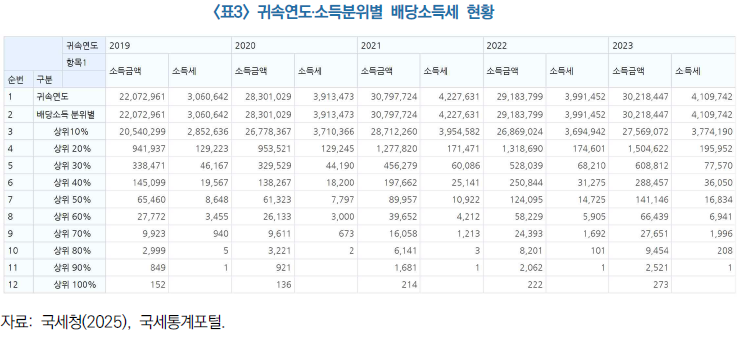
Dividend income tax, according to the most recent data from 2023, amounted to 4.1 trillion won, about 1 trillion won more than in 2019 and roughly half the level of capital gains tax. Aside from a temporary spike in 2021 after 2019, both dividend income and income tax have shown a steady upward trend. By income decile, the top 10% accounts for 91.8% of total income and income tax, while the top 20% accounts for about 4.8%. In other words, the top 20% of dividend income earners bear more than 96% of total dividend income tax.
3. Tightening the Major Shareholder Capital Gains Tax Threshold: “Tax Justice” or “Policy Confusion”?
◩ Policy Intent: Restoring Tax Justice and Ensuring Consistency in the Tax System
Through this tax reform, the government announced that it would restore the threshold for “major shareholders” subject to stock capital gains tax from 5 billion won per stock to 1 billion won. This measure reinstates the standard from the Moon Jae-in administration, and the Ministry of Economy and Finance explains it as part of “restoring tax justice” and “ensuring consistency in the tax system.” Based on past cases, the government stresses that no direct correlation has been proven between the major shareholder threshold and stock prices. For example, when the threshold was tightened to 1 billion won in 2017, stock prices actually rose, while when it was relaxed to 5 billion won in 2023, stock prices fell. This explanation reflects the government’s view that the economic effect of the capital gains tax system depends less on the “tax rate” than on “overall market returns” or “investor sentiment.” In particular, analyses suggest that although selling pressure did appear during the tightenings in 2017 and 2019, it was influenced more heavily by market returns and economic conditions. Accordingly, ruling party officials such as Policy Committee Chair Jin Sunjun have argued that “there is no basis for the claim that restoring the major shareholder threshold will immediately trigger a stock market crash.”
◩ The Market’s Sensitive Reaction to the Tightening of the Major Shareholder Threshold
Nevertheless, the market reacted more sensitively to the “policy signal” itself than to the government’s logic. Immediately after the announcement, the KOSPI and KOSDAQ plunged 3.88% and 4.03%, respectively, while foreign and institutional investors sold more than 1 trillion won in a single day. This was interpreted not as a simple numerical adjustment but as a sign that the government’s capital market policy stance might be shifting from “supporting stock prices” to “strengthening the revenue base.” In fact, in the securities industry, the dominant view is that this tax reform proposal signals a broader change in policy direction.
◩ The Realism and Consistency of Classifying 1 Billion Won in Holdings as “High-Value Assets”
The existing major shareholder threshold is applied based on asset holdings, but, as Democratic Party lawmaker Lee Soyoung—who has played a leading role in tax reform discussions—has noted, there is controversy over whether it is realistic or consistent to classify stock holdings of 1 billion won as “high-value assets” at a time when the average price of an apartment in Seoul exceeds 1.4 billion won. This acts as a factor undermining market confidence in tax equity. Above all, the structural problem of year-end selling to avoid being classified as a major shareholder is still likely to be repeated without resolution, highlighting a gap between the policy’s intended design and its actual effects.
Some have also noted that this reform proposal is still in the “pre-legislative stage” and could be adjusted during deliberations in the National Assembly. In fact, there have been past cases in which the major shareholder threshold or financial tax items were relaxed or postponed during parliamentary review. Moreover, given that criticism has also emerged within the Democratic Party—such as whether “1 billion won can really be regarded as major shareholder status” and whether “the increase in tax revenue would be insignificant”—there remains room for political adjustment.
If the government intends to improve the structure of the asset market by encouraging stock investment as an alternative to real estate, then capital gains tax should be redesigned not as a short-term taxation tool but as an incentive structure for long-term holding. Policy is a signal. Given that the market responds more to the direction of policy than to its effects, this is precisely the moment for the government to reestablish the balance between tax justice and confidence in the capital market.
4. Separate Taxation of Dividend Income: A Limited Incentive Amid Questions of Effectiveness
◩ Policy Intent: Normalizing the Capital Market Through Dividend Incentives
The 2025 tax reform proposal allows shareholders of high-dividend-paying companies, under certain conditions, to have dividend income taxed separately rather than under the comprehensive income tax system. Specifically, separate taxation applies to dividend income received from listed corporations that meet either of the following two conditions:
· Cash dividends do not decrease from the previous year and the dividend payout ratio is at least 40%
· The dividend payout ratio is at least 25%, and the dividend growth rate is at least 5% compared to the average of the previous three years
The applicable tax rates by income bracket are ▲ 14% for up to 20 million won, ▲ 20% for 20 million to 300 million won, and ▲ 35% for over 300 million won, which is significantly lower than the existing top comprehensive income tax rate of 45%. Through this, the government plans to restore dividend incentives and expand asset inflows into the capital market.
However, the market is also questioning the effectiveness of this system. First, there are criticisms that the eligibility requirements are overly restrictive, making it unlikely that the pool of actual beneficiaries will expand sufficiently. In particular, because the top rate remains as high as 35%, some argue that it is difficult to view this as a meaningful easing of the tax burden for upper-middle investors, pension funds, or institutional investors. In the securities industry, the prevailing view is that the measure “fell short of market expectations” and that “the actual incentive for changing corporate dividend policy is weak.”
According to the government, however, the new reform proposal does not run counter to the original purpose of separate taxation. Rather, it is part of a long-term strategy to improve corporate dividend payout ratios and reform an asset management structure centered on retained earnings by granting tax benefits only to high-dividend-paying firms. In particular, Korea’s tendency to avoid dividends and its low price-to-book ratio structure have long undermined shareholder rights and governance transparency. In this sense, separate taxation should be understood not simply as a tax cut but as “a signal of market structural reform.”
◩ Effectiveness and Market Response: Confused Incentives and a Weakened Policy Signal
The question is how strongly and clearly this signal is being conveyed. The introduction of the separate taxation system, still constrained by complex criteria and limited effects, has not been accepted by the market as a “credible incentive.” There are also concerns that the policy signal of separate taxation is being distorted or weakened because it is being pursued alongside policies moving in the opposite direction, such as tighter capital gains taxation and a higher transaction tax.
Ultimately, separate taxation of dividend income should serve not as a cause of lower tax revenue but as an opportunity to shift the structure of the tax base. In the medium to long term, it should be possible to expand the overall tax base through a virtuous cycle of greater corporate dividends → rising stock prices → increased transaction tax and corporate tax revenue. To this end, more ambitious incentive design and a clearer definition of the scope of beneficiaries are needed. In particular, only when a tax foundation is established that allows pension funds and middle-tier investors to continue stable long-term investment will the capital market finally come to trust “dividends.”
At the same time, this policy exposes the structural limitation of “mixed policy messaging.” In particular, because the same reform package also includes tighter capital gains tax and higher transaction tax, the dividend incentive is failing to function as a clear positive signal to the market. In fact, on August 1, 2025, just one day after the announcement, 116 trillion won in stock market capitalization was wiped out. Based on Nobel Prize-winning economist Robert Shiller’s consumption elasticity coefficient, one analysis suggested that this translated into a reduction of 8.1 trillion won in private consumption capacity.
This is exactly the same scale as the first-round consumption coupon budget separately compiled by the government to support people’s livelihoods. In other words, the government has fallen into a self-contradiction in which one side of the policy package seeks to stimulate consumption while the other suppresses it through tax signals. In particular, given the strict eligibility requirements for the high-dividend separate taxation policy and the fact that the top rate still reaches 35%, the structure is difficult to regard as a persuasive enough incentive to reverse market sentiment.
Indeed, some in the securities industry have assessed that “this separate taxation scheme is in effect not so much a market stabilization measure as a merely formal conciliatory gesture.” Even if one agrees with the intent of structural reform to normalize a retained earnings-centered corporate governance structure, a system that fails to provide effective incentives can have only limited effects beyond political symbolism. Separate taxation is not merely a matter of adjusting numbers; it requires the prior restoration of “expectations and trust,” and a design that excludes these emotional and psychological elements may ultimately be offset by anti-market signals.
5. Conclusion and Recommendations: Resetting Tax Policy to Restore Market Confidence
◩ The Paradox of Tax Policy: Confusion Caused by Distorted Policy Signals
Despite the government’s principled goals of tax equity and expanding the revenue base, the 2025 tax reform proposal faced fierce backlash immediately after its announcement—from the market, from political circles, and even from within the ruling party itself. The market’s consistent response has been that restoring the major shareholder threshold and watering down separate taxation of dividend income delivered an excessive shock to the capital market, and following the simultaneous plunge in the KOSPI and KOSDAQ, confidence in policy itself appears to be fundamentally shaken.
Recognizing the seriousness of the situation, the Ministry of Economy and Finance stated that “the tax bureau and policy line are closely monitoring the market response.” This effectively suggests that some parts of the tax reform proposal could be adjusted during National Assembly deliberations. However, the fact that 116 trillion won in KOSPI market capitalization disappeared immediately after the policy announcement and that private consumption potential contracted by more than 8 trillion won in a single day paradoxically demonstrates how significant the “signaling function” of tax policy truly is.
These political disputes and confusion ultimately widen the gap between the government’s policy direction and the market’s interpretation. The government frames tighter major shareholder standards and the introduction of separate taxation for high dividends as “harmonizing equity and growth,” but investors, businesses, and financial markets read them as “a mixed signal of tax hikes and regulation.” As a result, a short-term goal of increasing tax revenue may end up undermining the long-term tax base and the market foundation itself.
Moreover, the fact that the reform proposal was announced without prior coordination between the ruling party and the government paradoxically underscores how important political coherence and policy consistency are in the highly technical domain of tax policy design. In the end, the current confusion is not simply about a few individual provisions; it is a crisis of the overall persuasiveness of the policy and its social acceptability. Markets respond more to direction than to numbers, and more to signals than to details. If the twin goals of tax justice and efficiency are to be achieved simultaneously, restoring consistency and persuasiveness in policy signals must come first.
◩ Reestablishing Policy Coherence: Restoring a Consistent Philosophy of Taxation
The 2025 tax reform proposal has caused confusion in market interpretation because it simultaneously contains an incentive measure—separate taxation for high dividends—and a regulatory measure—tightening the major shareholder threshold—thus creating a dual signaling system. Although the government put forward “a fair and efficient tax system” as its guiding principle, the actual economic indicators and political reactions that followed show that this principle was not properly conveyed to the market.
Most concerning in this situation is that the essential function of tax policy—building trust among economic actors and designing incentives for behavior—is being distorted. In particular, contraction in the asset market can cause losses that go beyond short-term tax revenue, and this episode has reaffirmed that a single policy signal can completely shake market-wide expectations and sentiment.
Accordingly, the following shift in direction is required for future tax design. When tax policy seeks to pursue both growth promotion and equity at the same time, prioritization among policy tools and chronological alignment are essential. If, as now, the government promotes a message of encouraging capital inflows into the market while simultaneously implementing stronger taxation, the market cannot easily judge which direction it should respond to. Tax policy must be designed in a way that provides rewards for investment and predictable rules, and only when such coherence and consistency are secured can market participants trust the government’s signals.
◩ Readjusting the Major Shareholder Threshold: Reflecting Asset Reality and Rationalizing the Standard
The current major shareholder threshold sets taxable status based solely on the amount of assets held, but this does not sufficiently reflect actual asset distribution and investment behavior. In particular, 1 billion won is roughly equivalent to the price of a single apartment in the Seoul metropolitan area, and defining individual investors as high-asset holders on that basis and imposing a high capital gains tax lacks persuasiveness even from the standpoint of tax equity. A system that determines tax liability based solely on the amount held, regardless of actual control, undermines both the rationality and legitimacy of the tax standard and creates unpredictability and distrust among market participants.
Accordingly, since a tax system is needed that comprehensively takes into account not only the amount held but also shareholding ratio, holding period, and actual control, the “proposal to restore the major shareholder threshold” included in this government’s reform package must be excluded during the legislative process. If the current unrealistic standard is maintained, the structural losses in terms of damaged capital market confidence and weaker investment will far outweigh the short-term justification of higher tax revenue.
◩ Expanding Incentives for Separate Taxation: Toward Normalizing the Capital Market Through Market Incentives
The separate taxation scheme for high dividends provides an institutional foundation that can, in the long run, help raise corporate dividend payout ratios and improve the soundness of capital structures. In particular, the amendment bill introduced in April by lawmaker Lee Soyoung deserves attention as an attempt to directly address the structural limitations of the comprehensive taxation system. Under the current system, when dividend and interest income exceed 20 million won annually, they are aggregated into comprehensive income and subject to a progressive tax rate of up to 45%, a structure that has weakened corporate incentives to pay dividends and entrenched a distorted distribution pattern that encourages management-centered retained earnings.
To address this problem, Lee introduced a bill that would apply a separate single tax rate of up to 25% on such dividend income (excluding local tax) for listed companies with a dividend payout ratio of at least 35%. The aim is to induce greater corporate dividends and restore market liquidity through structural reform that changes the framework of taxation itself, rather than through a simple tax cut. In particular, the amendment includes mechanisms designed to provide a real incentive for greater dividends while minimizing revenue loss. Although a short-term tax revenue decrease of 250 billion won is expected, analyses have also suggested that, in the long term, several trillion won in additional revenue could be generated through increases in transaction tax and corporate tax.
Ultimately, separate taxation of dividend income is a strategic tool that can simultaneously revitalize the capital market and expand the tax base through a virtuous cycle that broadens the retail shareholder base and raises corporate value. Rather than limiting the system’s effect through narrow eligibility requirements and a high top rate as at present, its application should be expanded to a wider range of firms and the rate structure should be redesigned so that investors can feel a meaningful effective tax reduction. In particular, the design direction should focus not on “political justification” but on “market incentives,” so that pension funds and middle-tier investors can expect stable long-term dividend income.
The separate taxation system is a core design element for restoring confidence in the capital market, and more than tax rate adjustments, the key to policy success lies in “the coherence of incentive design.” What is urgently needed is not a limited and ineffective tax cut, but a shift to a separate taxation system that can provide the capital market with a clear direction.
◩ Improving the Political and Administrative Design Process: “Communication with the Market” Comes First
A situation in which tax policy is announced unilaterally without coordination between the ruling party and the government undermines both policy acceptance and market confidence. Since tax policy is an area requiring a high level of design sophistication, its process must be all the more transparent and systematic, and sufficient communication with the market must be secured before any announcement is made. In addition, announcing a reform package when even the ruling party itself has not settled on a consistent position regarding policy direction undermines not only administrative credibility but also political legitimacy. Going forward, tax policy must necessarily be accompanied by a design and public discussion process that fully takes into account market reactions and predictability.
◩ References
∙ National Tax Service (2023), Statistics on Dividend Income.
∙ Kukje Shinmun (2025.08.04), “Lee Soyoung of the Ruling Party: ‘The Tax Reform Proposal Should Be Humbly Reexamined and Withdrawn if Insufficient.’”
∙ Ministry of Economy and Finance (2025), 2025 Tax Reform Proposal.
∙ Ministry of Economy and Finance (forthcoming 2025), Presentation Materials for the Tax Development Review Committee.
∙ Global Economic (2025.08.04), “Stock Market ‘Shaken’ by Tax Reform Proposal… Securities Industry Divided Over Whether It Is an Opportunity or a Shock.”
∙ Korea Policy Briefing (2025.07.31), “First Tax Reform Proposal of the New Government Announced… ‘A Fair and Efficient Tax System for Real Growth.’”
∙ Maeil Business Newspaper (2025.07.29), “Who Would Invest in Korean Stocks If This Happens?”
∙ Bizhankook (2025.08.04), “[The Most Ordinary Investment] ‘The Problem Is the Direction, Not the Details’: Tax Reform Proposal Triggers Sharp Market Drop.”
∙ Seoul Economic Daily (2025.07.29), “Tax Clash: Jin Sunjun vs. Lee Soyoung, Round 2.”
∙ Yonhap News (2025.07.29), “Lee Soyoung Claims ‘Tax Revenue Will Increase Instead.’”
∙ Yonhap Infomax (2025.08.04), “Ministry of Economy and Finance: ‘Closely Monitoring’ Controversy Over Tax Reform Proposal.”
∙ Chosun Ilbo (2025.07.22), “Reform for Retail Investors vs. Tax Cuts for Chaebol.”
∙ Chosun Ilbo (2025.08.04), “116 Trillion Won in Market Cap Wiped Out by Tax Reform Proposal… All 8 Trillion Won in Consumption Coupon Effects Erased.”
∙ JTBC News (2025.07.27), “Government Finalizes Tax Reform Proposal.”
Wiki:
https://www.cfe.org/w/bbsDetail.php?&idx=16
Original title: 새정부 금융부분 첫 세제개편안 분석 및 평가
Author: Center for Free Enterprise (CFE)
Date: 2025-08-05
Source: https://www.cfe.org/bbs/bbsDetail.php?cid=issue&pn=1&idx=27942