
Assessment and Recommendations for the Public Delivery App “Ttaenggyeoyo”
-
Writer
CFE
-


 1. Introduction: The Emergence of the Public Delivery App “Ttaenggyeoyo” and the Need for Assessment
In Korea’s food delivery app market, which is dominated by Baedal Minjok (hereafter Baemin) and Coupang Eats (hereafter Coupang), one late entrant that has shown meaningful results is “Ttaenggyeoyo,” a public-private partnership delivery app launched by Shinhan Bank in January 2022. From the perspective of merchants, Ttaenggyeoyo entered the market with strengths such as price competitiveness and strong support from local governments, offering a low brokerage commission of 2% and no advertising fees while cooperating with the Seoul Metropolitan Government. Last April, Seoul also signed an agreement with 18 chicken franchise companies to introduce the “Seoul Delivery+ Price System.” Ttaenggyeoyo’s membership has grown rapidly from 1.65 million in 2022 to 5 million as of May 2025, increasing by more than 1 million users annually.
On April 18, the Ministry of Agriculture, Food and Rural Affairs announced a KRW 65 billion support program for public delivery apps, signaling a growing trend of stronger government intervention and support in the delivery app market. The new administration had also proposed a “delivery app commission cap” as a presidential campaign pledge, and it is expected to continue implementing support programs for public delivery apps. Accordingly, this issue report aims to analyze the current state of the delivery app market, review government and local government policy and financial support for “Ttaenggyeoyo,” and offer an assessment of and recommendations on future public intervention in the delivery app market.
2.
Current Status and Analysis of the Delivery App Market
◩ Introduction to delivery apps (food order brokerage service platforms) and the delivery fee structure
In Korea, food order brokerage service platforms, commonly referred to as delivery apps, are divided into private delivery apps and public delivery apps operated by local governments. Major private delivery apps include Baedal Minjok (Woowa Brothers), Coupang Eats (Coupang), and Yogiyo (Wesang), while public delivery apps include Ttaenggyeoyo (Seoul), Dongbaektong (Busan), Baedal Teukgeup (Gyeonggi), and Baedalui Myeongsu (Gunsan).
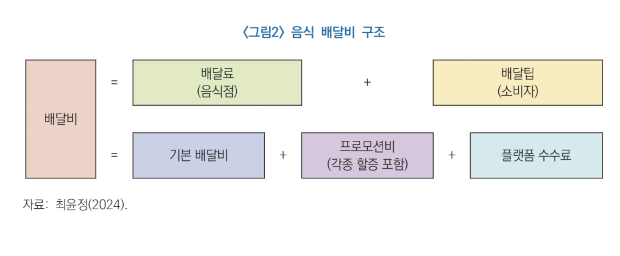
The revenue structure of food delivery service platforms works as follows: the platform charges consumers the order price plus the delivery fee, and then pays the rider the delivery fee minus certain commissions (Choi Yunjung, 2024). Delivery fees consist mainly of the “delivery charge” paid by food service businesses and the “delivery tip” (delivery service fee) borne by consumers, and may vary depending on the order amount, time of day, and distance traveled. From the perspective of delivery agency service providers, delivery fees consist of a “base delivery fee,” “promotional costs” (advertising, etc.), and a “platform commission.”
◩ Trends in delivery app users: 34.53 million in 2022 → 39.96 million in 2025 (up 5.4 million)
The number of delivery app users fell from 34.53 million in 2022 to 30.81 million in 2023, then rebounded to 34.34 million in 2024, showing signs of stagnation before rising sharply again to about 40 million in 2025. This amounts to roughly 77.3% of Korea’s total population of 51.68 million, indicating that a large majority of the public uses delivery apps. This suggests that after the market expanded through 2022 due to the effects of COVID-19 and then contracted in 2023, it has gradually recovered and resumed growth as consumers retained positive memories of their satisfaction with delivery services.
By app, the number of users is 22.38 million for Baemin (private), ranked first; 11.01 million for Coupang (private), ranked second; and 5.04 million for Yogiyo (private), ranked third. By contrast, Ttaenggyeoyo (public) has 1.53 million users, though that number is steadily rising.
◩ Trends in the size of the food delivery market: KRW 17.3 trillion in 2020 → KRW 37 trillion in 2025 (2.14-fold increase)
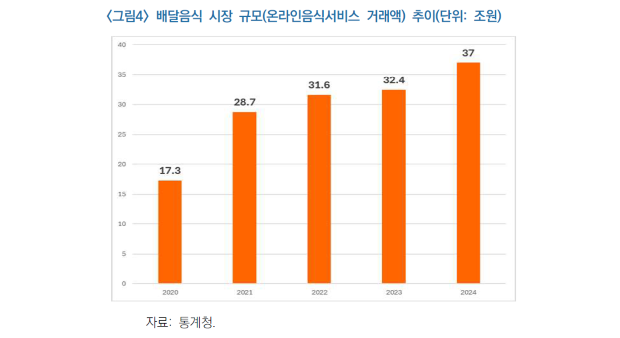
Looking at the estimated size of Korea’s food delivery market based on Statistics Korea’s online food service transaction value, the market grew approximately 2.14 times over about five years, from KRW 17.3 trillion in 2020 to KRW 37 trillion in 2025. While the number of delivery app users dropped sharply in 2023 and then increased again, the size of the food delivery market itself, measured by transaction value, continued to rise without declining even after its significant expansion during COVID-19.
3.
Current Status of the Public Delivery App “Ttaenggyeoyo” and Public Policy and Financial Support from the Government and Local Governments
◩ Concept and features of the Seoul Metropolitan Government–Shinhan Bank public-private partnership delivery service
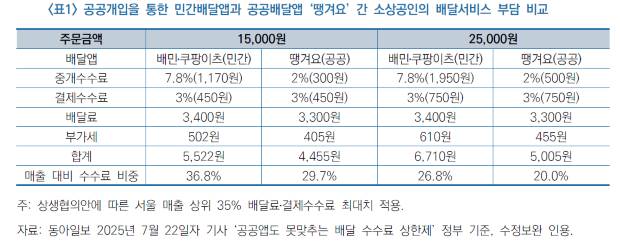
The Seoul Metropolitan Government is operating “Seoul Delivery+ Ttaenggyeoyo” in partnership with Shinhan Bank, based on the view that active public intervention is needed to reduce the burden on small business owners caused by delivery app companies’ commission increases (Seoul Metropolitan Government website, “Seoul Public Delivery Service”). Small business owners pay a 2% delivery brokerage commission and a flat delivery fee of KRW 3,300, improving their business environment, while consumers benefit from a wider range of choices among delivery platforms and lower household expenses through savings on delivery fees when using Seoul Love Gift Certificates. Compared with existing private delivery platforms, using Ttaenggyeoyo reduces merchants’ burden by about KRW 1,000 on a KRW 15,000 order and about KRW 1,700 on a KRW 25,000 order, in fact lowering the burden by more than 20%.
In operating this business, Shinhan Bank does not need to spend separately on promotion to attract users and, with support from the Seoul Metropolitan Government and district offices, sees business value in maintaining a stable public delivery app platform despite low commission revenue while also enjoying the promotional effect of being seen as an ESG company.
◩ Policy and financial support related to the public delivery app “Ttaenggyeoyo” from Seoul and district governments
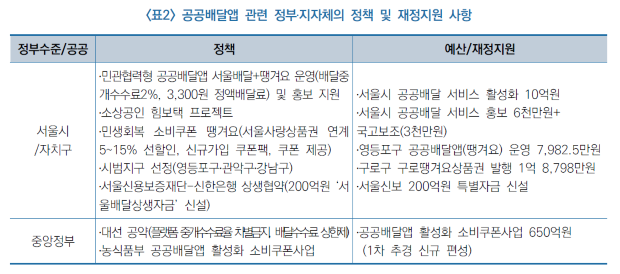
Looking at Seoul’s 2025 budget related to “Ttaenggyeoyo,” a total of KRW 1.09 billion has been allocated, including: 1) KRW 1 billion for support to expand online sales channels for small businesses (activation of Seoul’s public delivery service), 2) KRW 30 million in national treasury subsidies (promotion of Seoul’s public delivery service), and 3) KRW 60 million for a restaurant competitiveness enhancement package (promotion of Seoul’s public delivery service).
Seoul’s policies related to “Ttaenggyeoyo” include support for activating public delivery apps with commission rates of 1–2% under the “Himbo-Taem Project,” diversification of sales channel support for small businesses in response to online-centered consumption trends, and the “Livelihood Recovery Consumption Coupon Ttaenggyeoyo” program, which provides benefits such as: 1) advance discounts of 5–15% through Seoul Love Gift Certificates plus Ttaenggyeoyo gift certificates, 2) a new-member coupon pack worth KRW 16,000, and 3) a KRW 10,000 coupon to promote consumption through public delivery apps.
At the district level, regarding support for public delivery apps, Yeongdeungpo-gu, Gwanak-gu, and Gangnam-gu have first been selected and operated as pilot districts for activating public delivery services. They are offering 10% payback gift certificates for Seoul Delivery+ Ttaenggyeoyo (paid on the 20th of the following month) and 5% Ttaenggyeoyo points (paid after ordering), among other benefits. Looking at 2025 budget support by Seoul district for Ttaenggyeoyo, Yeongdeungpo-gu allocated KRW 79.825 million for operation of the public delivery app (Ttaenggyeoyo), while Guro-gu allocated KRW 187.98 million for issuing Guro Ttaenggyeoyo gift certificates.
In addition, on July 21, the Seoul Credit Guarantee Foundation (hereafter Seoul Shinbo) and Shinhan Bank signed a mutual growth agreement under which Shinhan Bank would make a special contribution of KRW 1.6 billion to Seoul Shinbo, and Seoul Shinbo would establish the “Seoul Delivery Mutual Growth Fund,” a KRW 20 billion special guarantee financing program. Under this program, small business owners using the special guarantee will receive a variety of preferential benefits, including an annual 2.0 percentage point interest subsidy, a higher guarantee ratio, and a reduction of up to 0.2% in guarantee fees (Seoul Shinbo website; Yonhap News, July 21, 2025).
◩ Government policy and financial support related to public delivery apps: a delivery commission cap and the Ministry of Agriculture, Food and Rural Affairs’ public delivery app activation program
First, the new administration stated in its presidential campaign pledge under “3. [Economy and Industry] Enhancing the Vitality of Households and Small Business Owners and Realizing a Fair Economy” that it would “establish a fair delivery culture by prohibiting discrimination in platform brokerage commission rates and introducing a commission cap” (National Election Commission policy and pledge platform). The National Assembly’s Political Affairs Committee is currently discussing whether to include a delivery app commission cap in the Online Platform Act. A delivery app commission cap is a government regulation and active intervention that would limit the “total commission”—combining the brokerage and payment fees and delivery costs paid by restaurant owners to delivery apps—so that it cannot exceed a certain percentage of the order amount.
The Ministry of Agriculture, Food and Rural Affairs (hereafter MAFRA) announced that it would begin a consumer coupon project to activate public delivery apps (local government and public-private partnership models) on June 10 (MAFRA press release, June 9, 2025). Under this program, 6.5 million consumer coupons worth KRW 10,000 each will be distributed on a first-come, first-served basis for use on the next order when a consumer places three pickup or delivery orders of KRW 20,000 or more each at food service businesses through a public delivery app. This year, KRW 65 billion in budget was newly allocated through the first supplementary budget. The program covers all 12 public delivery apps participating: 8 developed by local governments (Baedal Teukgeup, Daeguro, Baedalmoa, Jeonju Matbaedal, Baedalui Myeongsu, Baedal-eum, Ulsan Pedal, and Baedal Yangsan) and 4 public-private partnership apps (Ttaenggyeoyo, Meokkebi, Wemakeprice O, and Whiparam).
4.
Assessment and Analysis of the Public Delivery App “Ttaenggyeoyo” and the Delivery Commission Cap
◩ Insufficient grounds for public intervention and financial support in the delivery app market
Public delivery apps began from the awareness that a small number of large platforms in the delivery app market impose high commissions, burdening small business owners. However, this is less a case of market failure than a normal phenomenon arising from competition and voluntary transactions. As dissatisfaction with high commissions has grown, private delivery apps have already been changing and innovating to secure a variety of consumer choices, such as direct delivery by stores. In this situation, if the public sector directly intervenes in the delivery app market solely with the policy goal of easing small business owners’ delivery commission burden, the result is interference with the business activities of private platform companies competing in the market.
The platform market is a domain of constant competition and innovation, and the public sector should not intervene carelessly. Competition among private platforms continues across various factors such as commissions, service quality, and listing methods, and some small and medium-sized platforms and direct transaction apps are also being actively developed. Rather than intervening directly in the market, the government should limit its role to creating a fair competitive environment and ensuring transparency of information and consumer choice. That is the most effective way to protect small business owners while preserving market function.
◩ Continued fiscal spending and intervention in the delivery app market cause inefficiency and waste: the public sector cannot keep up with private innovation
Public delivery apps rely on budgets to cover promotion, operation, and system development, and therefore are prone to having a more inefficient structure than private firms. In fact, although Seoul and the central government are actively investing policy and budget resources into “Ttaenggyeoyo,” the number of users, while steadily increasing, still reflects low recognition and market share. Lower delivery prices alone do not make a service competitive. Ttaenggyeoyo has attracted small business owners with low commissions of 0–2%, but this is essentially a distorted price signal produced by subsidy-like fiscal input. Commissions are a legitimate price for the services delivery apps provide, including platform maintenance, payment systems, and customer acquisition. If these are artificially lowered, not only does this create fairness issues vis-à-vis private companies, but it also fails to secure long-term service sustainability.
In particular, private companies pursue reinvestment and service upgrading based on profits, whereas public platforms are operated according to political justification rather than profit and loss, placing them at a disadvantage in terms of sustainability and development potential. Compared with competitors, public delivery apps lag behind in the absolute number of merchants on the platform, UX/UI, app stability, the absence of an in-house delivery system, and rider linkage systems, including the inconvenience of securing delivery riders. Private platforms naturally improve quality through user ratings, reviews, and competitive pressure, but public apps have weaker such mechanisms. This means that even if the public sector makes excessive fiscal investments to increase public delivery apps’ market share, it fundamentally cannot keep pace with the speed of private-sector innovation, and thus may only generate inefficiency and waste.
◩ Resulting inhibition of private innovation and competition
The delivery app market has developed rapidly in terms of technological evolution, data-based recommendations, logistics efficiency, and advertising and discount strategies. If the public sector enters the market based solely on price, however, this reduces private operators’ incentives to invest and may significantly shrink the innovation ecosystem of the delivery platform market over the long term.
◩ Diagnosing the problems of a delivery commission cap: infringement on market autonomy and concerns over lower service quality
Despite being justified in the name of protecting small business owners, introducing a delivery commission cap is a dangerous approach that directly intervenes in and regulates delivery pricing, infringing on market autonomy and potentially lowering service quality. Commissions are not merely brokerage fees; they are legitimate compensation for the bundled services platforms provide, including marketing, advertising and promotion, payment systems, data analysis, linking small business owners and consumers, and connecting with delivery riders. If such commissions are artificially restricted, costs will be shifted in other ways—such as reduced incentives for riders, transfer of costs into advertising fees, or tighter listing restrictions—and, as a result, small business owners, consumers, and delivery riders may all suffer disadvantages. For the delivery app platform industry, reduced profitability could also adversely affect new services and investment.
Looking at overseas cases, during the spread of COVID-19 in 2020, 78 U.S. states introduced delivery commission caps, and New York and New Jersey limited the cap to 10–15%. However, Chicago, Denver, and San Francisco later withdrew or eased the policy because of balloon effects. As platform companies passed costs on to consumers, delivery fees instead increased and order volume also dropped sharply.
5.
Conclusion: Recommendations Regarding Public Policy and Intervention in the Delivery App Market
◩ Need to reconsider government and Seoul Metropolitan Government support for and intervention in the delivery app market: when the budget is taken into account, it is a more expensive platform than private alternatives
Although “Ttaenggyeoyo” was promoted as a public service in the name of protecting small business owners, in reality it is distorting the competitive order of the private market and confronting the structural limitation of tax-dependent operation. Low commissions and inefficient operation may provide short-term benefits to some small business owners, but over the long term they weaken the innovation drive of private platforms and ultimately negatively affect both consumers and suppliers. In fact, once the budget invested by the public sector is taken into account, maintaining and supporting public delivery apps such as Ttaenggyeoyo becomes a far more expensive service than private delivery apps. In other words, the government-led supply of public delivery app services and intervention in the delivery app market are not appropriate approaches and should be reconsidered. Alternatives such as greater transparency in platform commissions, fairer listing conditions, and lower entry barriers for small and medium-sized platforms could provide practical support to small business owners without undermining private-sector dynamism. What the public sector should do is create an environment in which platforms can become more diverse and develop through greater competition. Expansion of public platforms without guaranteed sustainability and innovation will inevitably become yet another inefficiency.
◩ Need for the National Assembly to reconsider discussions on introducing a delivery commission cap
A delivery commission cap may appear to be a well-intentioned intervention, but beneath the surface lies the risk of infringing on market autonomy and undermining the private sector’s innovative drive. While the cap nominally focuses on reducing the burden on small business owners, in reality it can distort platform autonomy and profit structures, with the burden ultimately shifted in other ways. In the short term, commissions may fall, but over the long term the side effects could be greater: lower service quality, contraction among providers, and higher delivery fees for consumers. Ultimately, the National Assembly’s discussion of introducing a delivery commission cap should also be reconsidered or withdrawn.
◩ References
∙ Ministry of Agriculture, Food and Rural Affairs (2025.04.18.), KRW 65 billion invested in the “public delivery app support project”... “KRW 10,000 discount after three orders,” Korea Policy Briefing.
∙ Ministry of Agriculture, Food and Rural Affairs Press Release (2025.06.09.), Use public delivery apps for dining orders!
∙ Dong-A Ilbo (2025.07.22.), Government standards for the “delivery commission cap” that even public apps cannot meet.
∙ Money Today (2025.07.23.), “Knock” and “Ttaenggyeoyo,” the catfish of the delivery market... shaking Baemin’s barriers.
∙ Seoul Metropolitan Government, 2025 Budget Statement.
∙ Seoul Metropolitan Government Seoul Love (2025.01.15.), Stay strong! The “Himbo-Taem Project” for small business owners on the brink.
∙ Choi Yunjung (2024), Current Status of the Food Delivery Service Platform Ecosystem and Policy Implications, KIET Monthly Industrial Economy (2024.02.).
Wiki:
https://www.cfe.org/w/bbsDetail.php?&idx=15
Original title: 공공배달앱 ‘땡겨요’의 진단 및 제언
Author: Center for Free Enterprise (CFE)
Date: 2025-07-28
Source: https://www.cfe.org/bbs/bbsDetail.php?cid=issue&pn=1&idx=27927