
The Reality of Introducing a 4.5-Day Workweek and Future Legislative Reform Tasks
-
Writer
CFE
-



 1.
1.
Introduction: The Rise of the Debate over a 4.5-Day Workweek
Recently, discussions on introducing a four-day workweek and a 4.5-day workweek have been spreading rapidly, led by the political sphere and the government. In particular, following Samsung Electronics’ announcement of a pilot 4.5-day workweek, politicians from both ruling and opposition parties have been driving the discourse by presenting it as a symbol of “improved quality of life” and “labor innovation.” The Democratic Party of Korea has proposed a series of bills to reduce working hours, including amendments to the Labor Standards Act and the Framework Act on Employment Policy, and is accelerating public debate with the long-term goal of a four-day workweek. The party leadership has made clear in National Assembly speeches and elsewhere that it intends to move from a 4.5-day workweek to a four-day workweek, while also actively holding meetings with labor and civic groups.
Meanwhile, a formal policy review has also begun at the government level. In June 2025, the Ministry of Employment and Labor reported its plan to introduce a 4.5-day workweek to the State Affairs Planning Committee and stated that it would pursue related legislation alongside pilot programs. This is regarded as the first case in which the government has officially adopted institutionalization of the four-day and 4.5-day workweek as a policy agenda. This trend aligns with the attitudes of younger generations, who place greater emphasis on “work-life balance,” and pilot cases are also emerging one after another in public institutions and some private companies.
However, discussion of the 4.5-day workweek still tends to revolve largely around emotional expectations and political promises. If the system is pushed forward without substantial and precise analysis of sectoral feasibility, labor market structure, productivity changes, and wage systems, its effectiveness and sustainability will inevitably be called into question. For the system to take root, detailed design must accompany it, including flexible methods of application, differentiated implementation by industry, and productivity-enhancement strategies. What is needed is a structural and balanced approach that goes beyond the simplistic frame of “a system that lets people work less and rest more.”
2. Review of the Current Five-Day Workweek and Existing Labor Law on Working Hours
In the early 2000s, Korean society engaged in lengthy social discussion and institutional design ahead of the introduction of the “five-day workweek.” At the time, the issue was not simply reducing the number of workdays; it involved analyzing and preparing from multiple angles for the impact the system would have across industry and society. Businesses, labor groups, academia, and civil society all participated in discussing the potential problems and opportunities arising from the system’s introduction, including changes in productivity, wage structures, the education system, and business operations. Changes in industrial structure, such as informatization, automation, and the expansion of the service sector, supported the transition, and as a result, the five-day workweek gradually became established despite some initial difficulties.
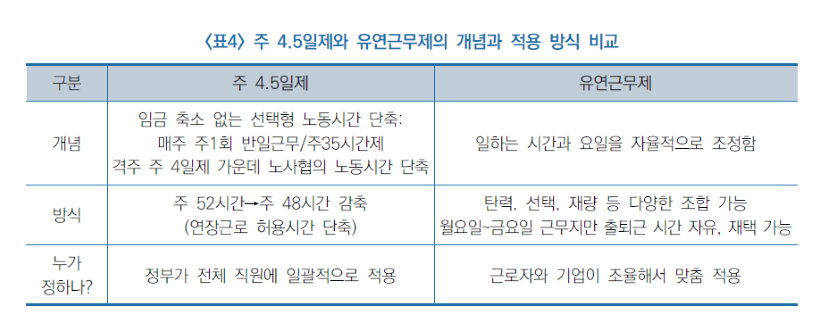
The current five-day workweek is based on Articles 50 and 53 of the Labor Standards Act (hereinafter “the Act”). Statutory working hours may not exceed 40 hours per week and 8 hours per day, excluding break time, and where the employer and employee agree, up to 12 hours of overtime per week is permitted. The Act also provides for flexible and selective working-hour systems. Under Articles 51 and 51-2, an employer may apply flexible working hours within a period of up to three months upon written agreement with the employee representative. Under Article 52, an employer may also, upon written agreement with the employee representative, permit selective use of working hours exceeding daily or weekly limits within one month (or three months for new product/new technology R&D work).
This “52-hour workweek system” has been implemented in stages since 2018 according to firm size and now applies to nearly all workplaces. This legal framework has become a minimum safeguard to protect workers’ health and quality of life.
Against this backdrop, the “4.5-day workweek” now being discussed by the new government is unfolding in a starkly different manner. Unlike the five-day workweek, which was institutionalized after years of social consensus and preparation, discussion of the four-day workweek is moving ahead while leaning heavily on the normative claim that “reducing work improves quality of life.” Although there have been limited experimental cases, such as Samsung Electronics’ pilot 4.5-day workweek and pilot programs in some public institutions, it would be a stretch to treat these as an immediate basis for nationwide institutionalization.
In particular, the discussion surrounding the 4.5-day workweek is being turned into policy without empirical analysis of key issues such as whether it increases productivity, whether wages can be maintained, whether different jobs can accommodate it, and how work will be redistributed. Even though foreseeable problems include greater work intensity and performance pressure, rising labor costs for small and medium-sized enterprises, and disparities in applicability across industries, an approach that emphasizes only the introduction of the system without realistic alternatives is highly likely to deepen confusion and imbalance in the labor market.
Moreover, reducing working hours cannot be achieved simply by cutting physical time. To produce real effects, productivity innovation, improved work processes, restructuring of employment arrangements, and organizational culture change must accompany it. A radical approach that prioritizes the system itself risks provoking social backlash and leaving behind ineffective administration.
In short, the 4.5-day workweek remains a normative approach grounded in the belief that “life will improve if people work less,” without clear evidence on productivity or analysis of employment structures. A policy that prioritizes institutional introduction without reviewing wage maintenance, methods of work redistribution, and job-specific feasibility may instead worsen labor market imbalances and employment insecurity.
3. Practical Problems with Introducing a 4.5-Day Workweek
◩ Differences in Acceptance by Industry and Occupation
Discussion of reducing workdays cannot be applied equally to all industries and occupations. Digital jobs centered on non-face-to-face work—such as IT, design, and content planning—are, by nature, well suited to flexible work arrangements or remote work, and applying a four-day workweek to them creates relatively little disruption. By contrast, manufacturing, logistics, services, and care work require on-site attendance and face-to-face work. In such industries, even one day of absence can immediately lead to interrupted production or service, making it necessary to add shift personnel, which in turn creates cost pressures that are difficult for SMEs to bear.
This is especially true in manufacturing, where equipment utilization and process continuity are directly tied to productivity. A four-day workweek can lead to fewer production days and higher equipment idle time, significantly affecting the entire production system. Hospitals, care facilities, and retail stores are industries premised on year-round operation, so shortening workdays without increasing staffing is virtually impossible. As a result, the same system could end up shifting structural burdens disproportionately onto SMEs and certain industries.
The current legal framework also provides various systems that allow working hours to be adjusted flexibly in recognition of differences in industry and job conditions. A representative example is the “flexible working-hour system by industry.” Under Article 51 of the Labor Standards Act, this system allows daily and weekly working hours to be adjusted flexibly, provided average weekly working hours do not exceed 40 over a given period. For example, industries such as manufacturing, information and communications, and content often experience concentrated workloads at certain times, making it possible to extend working hours during busy periods and reduce them during slower periods. This system is premised on written agreement with the employee representative and may be operated on a two-week or three-month basis. More recently, amendments have made it possible to introduce a six-month flexible working-hour system, increasing its usefulness in industries with strong seasonal workload fluctuations or project-based jobs. The fact that even under the current system flexible time management reflecting industry realities is already possible should be a major policy consideration in any discussion of introducing a four-day workweek.
◩ Increased Performance Pressure from Shorter Working Hours
A 4.5-day workweek may appear on the surface to support “work-life balance,” but if workload remains unchanged, the reality may instead be a greater burden from compressed work. In other words, workers must complete the same volume of work in fewer workdays, creating a structure that demands greater concentration and energy during the remaining four days.
Indeed, in some pilot four-day workweek cases at companies, workers reported that “the intensity of work became too high, and fatigue actually increased.” This tends to be more pronounced in workplaces where job characteristics or project schedules are less flexible. In organizations highly sensitive to evaluation and performance, shortened working hours may effectively be converted into performance pressure, increasing worker stress and the risk of burnout. Unless the actual “quality of rest” is guaranteed, a 4.5-day workweek may result not in a better quality of life, but in concentrated and repeated work fatigue.
◩ Shorter Working Hours without Higher Productivity Burden the Entire Economy
What is needed is not simply reducing the number of physical workdays, but accompanying that change with fundamental improvements such as productivity-enhancement strategies, innovation in work processes, digital automation, and better collaboration structures. Without such a foundation, however, reductions in working hours pushed at the level of legislation or political promises can distort business activity across the board.
In fact, while Korea has relatively long working hours, its labor productivity per hour remains low compared with major advanced economies. As of 2023, Korea’s labor productivity per hour was $54.64, barely more than half that of the United States ($97.05), Germany ($93.81), or France ($88.15).
In this situation, if reducing the number of workdays is pursued first, firms may have to either hire additional workers to compensate for reduced workdays or redesign overtime and compensation systems for existing workers. This leads not only to higher direct costs but also to greater management uncertainty and decision-making risk.
This is especially burdensome for SMEs, which have a high share of labor costs and are sensitive to rising fixed costs, while lacking the capacity to adapt to fewer statutory workdays. From a macroeconomic perspective, such institutional change could lead to reduced investment, lower hiring, and increased rigidity in the domestic employment environment, which in turn may become a factor driving domestic and foreign firms away.
For these reasons, the 4.5-day workweek is not an issue to be pursued as a political slogan or a tool for short-term popularity. Its feasibility and effects vary greatly depending on industrial structure, business conditions, and job characteristics, and a forced across-the-board introduction could instead reduce job quality and weaken economic vitality. Therefore, a workable working-hours policy should begin not with uniform legislation, but with institutional design that balances flexibility and realism.
4. Misconceptions and Reality Regarding Working Hours in Korea
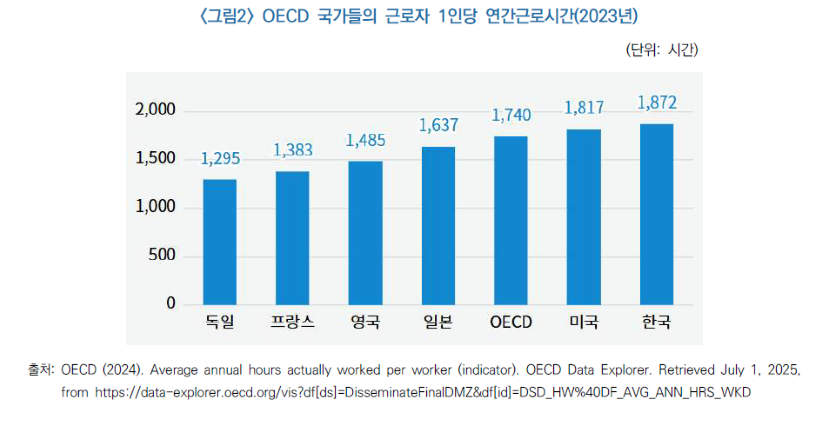
Korea has long been classified as a representative “long-hours country.” According to OECD statistics, as of 2023, annual working hours per worker in Korea stood at 1,874 hours, about 157 hours higher than the OECD average of 1,717. Looking only at this figure, Korea still appears to be a society of overwork. But this interpretation contains an important illusion.
The reason actual working hours appear high stems from the structure of employment in Korea’s labor market, particularly differences in the shares of the self-employed and part-time workers. According to a KDI analysis, when the share of the self-employed rises by 1 percentage point, annual working hours increase by an average of 10 hours, whereas when the share of part-time workers rises by 1 percentage point, annual working hours instead tend to decline by 9 hours.
As of 2021, the share of the self-employed in Korea was 23.9%, much higher than the OECD average of 17.0%. By contrast, the share of part-time workers was 12.9%, lower than the OECD average of 14.3%. In other words, the self-employed inevitably endure long working hours to sustain their livelihoods and businesses, while part-time workers by definition work relatively fewer hours. This difference in labor market composition is what produces annual working hours higher than the OECD average.
When the figures are recalculated to reflect these differences, Korea’s annual working hours in 2021 fall from 1,910 to 1,829. The gap with the OECD average narrows from 264 hours to 181, a reduction of about 83 hours. In other words, once employment structure is taken into account, Korea’s actual working hours may not be excessively higher than the OECD average.
Of course, even after adjustment, Korea still ranks near the top among long-hours OECD countries, placing third. But it is important to recognize clearly that the cause is not simply a culture of “working too much,” but institutional and structural characteristics such as a self-employment-centered structure and a shortage of part-time jobs. This suggests that the issue cannot be solved simply by legally mandating shorter working hours.
Another notable point is that working hours in Korea have shortened rapidly over a short period. Korea’s working hours, first reported to the OECD in 2011, were as high as 2,119 hours annually, but by 2023 had fallen to 1,874. That represents a reduction of 245 hours in 12 years—an extremely rapid change compared with Japan, which took 28 years, from 1995 to 2023, to reduce working hours by 259 hours.
These numerical changes therefore also represent substantial progress. For example, in 2011 the gap in working hours between Korea and the United States was 286 hours, but by 2023 it had narrowed to 64. Korea’s working hours have also become shorter than those of Israel, which in 2011 had much shorter hours than Korea at 1,939. This can be interpreted as the result of rapid reductions in working hours over a short period in terms of both institutions and business practices.
Such rapid change has also been accompanied by side effects. In particular, SMEs have continuously raised the need for greater flexibility in overtime since the introduction of the 52-hour workweek, and the government still has not applied working-hour limits to very small businesses with fewer than five employees. Nevertheless, discussion of introducing a four-day workweek is proceeding under the slogan that working hours must be reduced further.
Therefore, rather than simply legislating a 4.5-day workweek, there is a need for institutional design that can simultaneously address overwork among the self-employed and insufficient labor-market flexibility. Priority should be given to expanding diverse forms of work, including flexible work arrangements, part-time choice systems, remote work, and staggered commuting, while also reviewing the rigid regular-employee-centered wage system and working-hour regulations. More broadly, this could also help expand labor market participation among various groups, including parents with child-care responsibilities, older workers, and those undergoing retraining, while reducing career interruptions.
Ultimately, the key question regarding Korea’s working hours is not simply that they are “long,” but why they appear that way. Policy design, too, should begin not from average figures but from a flexible approach that reflects structural causes.
5. Flexibility in Working-Hour Arrangements: International Cases
The most important point in international comparisons surrounding the four-day workweek is “flexibility.” Most advanced countries have relatively shorter weekly working hours, but cases in which a four-day workweek has been uniformly mandated by law are extremely rare. What these countries have in common is that reductions in working hours have occurred gradually through autonomous choice and consultation in the workplace, rather than through uniform government-led policy. In other words, government policy capacity is focused less on designing the system itself and more on increasing the scope for its use. The general international trend is to promote selective and flexible systems that allow firms and workers to adjust workdays and hours according to real conditions.
The United States is often cited as a representative case of voluntary adoption. Because there is no federally mandated limit on statutory working hours, whether to introduce a four-day workweek is determined entirely by firms’ own judgment and consultation with workers (Kim Minseop, 2023). Recently, some politicians have proposed bills to legislate a 32-hour workweek, but no case has yet emerged in which this has been mandated or institutionalized at the federal level. In the private sector, various forms of flexible work arrangements are already in use, and the four-day workweek has naturally taken root as one of them (Yu Gyesuk et al., 2009). For example, selective working-hour systems and flexible working-hour systems are increasingly used to raise work intensity while taking workers’ quality of life into account, and firms are also actively experimenting with remote work and work-from-home arrangements. In particular, in industries such as IT, design, and startups, the four-day workweek is viewed as a strategy that can improve both productivity and creativity.
Japan, once known for its deeply rooted culture of long working hours, has recently been pursuing various institutional experiments aimed at reducing working hours (Seong Jaemin et al., 2024). While it does not mandate a four-day workweek by law, it has made the institutional framework more flexible so that firms and workers can autonomously design working arrangements. Representative examples include the selective working-hour system and the discretionary work system. The selective working-hour system allows daily hours to be adjusted flexibly within a predetermined total number of working hours, while the discretionary work system places greater emphasis on work results than on working hours themselves. These systems have become means of providing meaningful flexibility, especially to households needing work-family balance or workers with personal circumstances such as child care or caregiving (Yu Gyesuk et al., 2009). The Japanese government is also expanding incentives for firms and focusing on spreading best practices to help these systems take root.
European countries likewise have taken an approach that encourages the introduction of the four-day workweek through “social dialogue” rather than government coercion. The United Kingdom and Germany have conducted pilot projects under government leadership, but whether the system spreads is ultimately left to voluntary negotiation between firms and unions (Seong Jaemin et al., 2024). Many of the firms participating in these pilots have expressed a desire to continue the system due to higher worker satisfaction and productivity, but it remains optional, not mandatory. Belgium is a relatively leading example, legally guaranteeing that a five-day workweek’s total hours may be distributed across four days. However, this does not reduce total working hours themselves; rather, it adjusts the way working hours are allocated, aiming not at cutting hours but at making the use of time more flexible. Other European countries such as France and the Netherlands also design policy in a direction that enhances quality of life through diversification of working arrangements rather than reductions in working hours (Seong Jaemin et al., 2024).
In conclusion, there are almost no countries that have legally mandated and implemented a four-day workweek. Most countries regard flexibility and autonomy as core principles and focus less on the four-day workweek itself than on creating an environment where various flexible work arrangements can coexist. The government’s role is closer to that of a facilitator—supporting experimental models and providing an institutional foundation—than that of a normative enforcer. This is a policy direction that reflects the complexity and diversity of the labor market and seeks a balance between workers’ quality of life and firms’ productivity. Korea, too, should take this international trend into account and focus less on introducing a uniform system than on creating working conditions that allow autonomous choice.
6. Future Legislative Revisions and Policy Tasks: Expanding Flexibility and Autonomy in Working Hours
A uniform introduction of a 4.5-day workweek, without reflecting Korea’s industrial structure and employment realities, could instead cause confusion on the ground. What is needed now is not legislation under which the state mandates the same number of workdays for everyone, but the spread of customized flexible work arrangements suited to reality by industry, occupation, and firm size. The Labor Standards Act already provides a range of systems, including the selective working-hour system, the flexible working-hour system, and the discretionary working-hour system. In other words, legal mechanisms already exist for adjusting working hours flexibly in addition to the 52-hour workweek system.
The problem is not the absence of such legal systems, but the reality that SMEs cannot actually adopt them. In particular, SMEs often lack the computerized systems and management infrastructure needed to operate flexible work arrangements, and their capacity to run such systems is itself limited. In some firms, even where such systems have been introduced, autonomy over working hours is not properly guaranteed, and there are cases in which workers using pilot remote work or staggered commuting arrangements have faced disadvantages in personnel evaluations. More urgent than introducing a 4.5-day workweek is policy support that enables the current flexible work arrangements—selective and flexible working-hour systems—to be actively used not only by large firms but also by SMEs.
Recent discussion by the new government on the 4.5-day workweek is moving toward enacting a law to support reductions in actual working hours and having the state enforce it. Accordingly, the solution now needed is to move in the direction of expanding flexibility and autonomy in working hours under the current Labor Standards Act. It is necessary to revise Articles 51, 51-2, 52, 53, and 59 of the Labor Standards Act. Specifically, this paper proposes expanding the maximum application period of the flexible working-hour system from up to six months to one year, expanding the application period of the selective working-hour system from one month (three months for R&D) to six months (one year for R&D), and expanding the scope of special exemptions on working hours to advanced strategic industries such as AI and semiconductors. In other words, by giving employers and workers the freedom to choose when to work, it becomes possible to raise labor productivity as well.
◩ References
∙ Ministry of Employment and Labor (2025). “[Explanation] Nothing has yet been decided regarding a 4.5-day workweek, and it is being carefully reviewed while gathering diverse perspectives.” Ministry of Employment and Labor press clarification material, June 20, 2025.
∙ Kim Minseop (2023). “A Cross-Country Comparative Analysis of OECD Annual Working Hours and Its Implications.” KDI FOCUS, 128, Korea Development Institute.
∙ Labor Standards Act, Act No. 19520, partially amended on June 13, 2023.
∙ Dong-A Ilbo (2025). “A Four-Day Workweek Used in Pieces… Yet Working Hours Themselves Remain the Same.” Dong-A Ilbo, June 20, 2025.
∙ Seong Jaemin, Jeong Jinho, and Kim Giseon (2024). “Policy Directions Seen through an International Comparison of Working-Hours Statistics.” Korea Labor Institute.
∙ Yu Gyesuk, Han Jisuk, and Oh Arim (2009). “A Comparative Study of Flexible Work Arrangements in Korea and the United States and Measures to Promote Them.” Creation and Innovation, 2(2), 105–142.
∙ National Election Commission (2025). “Policy Pledges of Candidate Lee Jae-myung in the 21st Presidential Election.” National Election Commission Policy & Pledge Center.
∙ OECD (2024a). Compendium of Productivity Indicators 2024. OECD Publishing.
∙ OECD (2024b). GDP per hour worked (indicator). OECD Data. Retrieved June 30, 2025.
Wiki:
https://www.cfe.org/w/bbsDetail.php?&idx=13
Original title: 주 4.5일제 도입의 현실과 향후 법개정 과제
Author: Center for Free Enterprise (CFE)
Date: 2025-07-02
Source: https://www.cfe.org/bbs/bbsDetail.php?cid=issue&pn=1&idx=27852