
The Need to Legalize Telemedicine and the Follow-Up Tasks
-
Writer
CFE
-


 1. Introduction: The Status of Efforts to Legislate the Authorization of Telemedicine and Its Necessity
Telemedicine is a form of medical treatment in which patients receive healthcare services through various information and communication technologies without meeting medical personnel in person. (Han Miseon et al., 2024) Recently, the National Assembly has been actively moving to institutionalize telemedicine through amendments to the Medical Service Act. Telemedicine, which was initially introduced on a temporary basis during the pandemic, came to be fully permitted from February 2024 in order to minimize gaps in care caused by the prolonged collective walkout in the medical sector. As telemedicine has been positively evaluated for helping improve access to healthcare and enhancing the efficiency of medical services, discussions on establishing it as a formal system have begun in earnest.
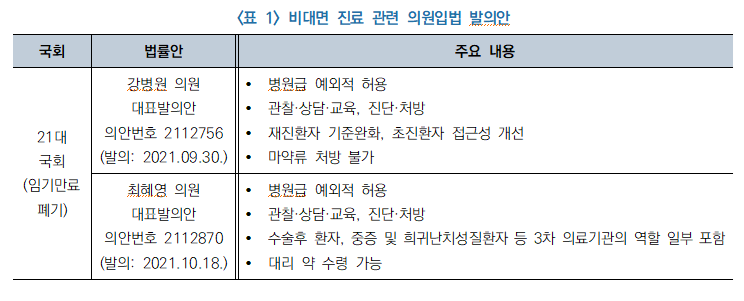
In response, Choi Boyoon, a People Power Party lawmaker serving on the National Assembly Health and Welfare Committee, introduced a bill to amend the Medical Service Act on Friday, March 21, 2025. The core of the amendment is to allow telemedicine on a permanent basis and to establish grounds for the management and supervision of online platforms that broker telemedicine services. According to Rep. Choi Boyoon, the rationale for the bill was that “most major OECD countries place almost no restrictions on telemedicine, and there is a growing international trend of fostering telemedicine and prescription drug delivery industries” (Welfare News, 2025). On April 18, Rep. Woo Jaejun also submitted a partial amendment to the Medical Service Act aimed at institutionalizing telemedicine by clearly specifying the target patients, methods, and legal scope of telemedicine.
Alongside the legislation of telemedicine, the issue of prescription drug delivery has also become a hotly contested matter. Under the current pilot program, drug delivery is prohibited due to concerns over misuse and abuse, and the amendment proposed by Rep. Choi Boyoon likewise does not include provisions allowing first-time consultations or drug delivery. However, among patients who have experienced telemedicine, there is substantial real demand for prescription drug delivery, and some argue that in order to build a truly non-face-to-face medical system, an environment must be created in which medicines can also be received remotely.
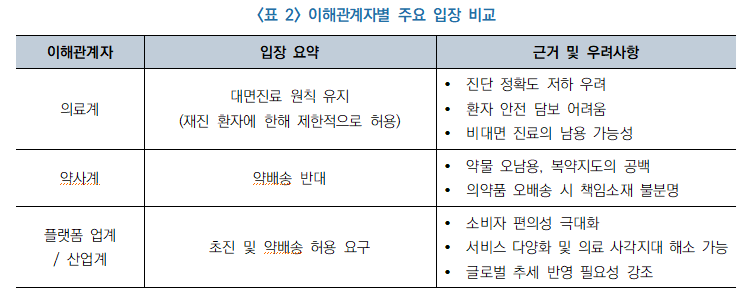
The differences in position among the medical community, pharmacists, and platform operators are also in sharp conflict. Both the medical profession and the pharmacy sector take the position that caution is needed regarding the institutionalization of telemedicine. They argue that sufficient data analysis and safety verification through the pilot program should come first. By contrast, the platform and broader industry sectors view the institutionalization of telemedicine as a growth opportunity for the digital healthcare industry. Since this debate involves not merely convenience but also patient safety, the quality of medical services, prevention of drug misuse and abuse, and the livelihoods of the medical and pharmaceutical sectors, a careful approach is required. This is why attention is focused on what kind of consensus will emerge in the legislative process ahead.
The discussion on amending the Medical Service Act is not simply about convenience; it is significant for improving access to healthcare, preventing the spread of infectious diseases, and increasing the efficiency of the healthcare system. This report seeks to analyze the need to permit telemedicine from various angles and, through this, explore directions for promoting public health and improving medical services.
2.
Current Status of Domestic Telemedicine and the Global Market
◩
The steadily increasing number of telemedicine users:
835,000 in 2020 → 1.333 million in 2023 (up 500,000 over 3 years)
Healthcare consumers mainly use telemedicine through apps such as Doctor Now, Namanui Doctor, and Goodoc. According to the Ministry of Health and Welfare’s “Current Status of Telemedicine” data compiled from 2020 to 2024, the cumulative number of telemedicine cases has surpassed 10 million, and calls to foster the sector as an industry are gradually growing louder (Medical Times, October 1, 2024).
According to the recently released report, “Evaluation Study on the Performance of the Telemedicine Pilot Program,” by the National Evidence-based Healthcare Collaborating Agency, user satisfaction with telemedicine was found to be high. A total of 60.2% of survey respondents said they were satisfied with telemedicine healthcare services. The reasons for satisfaction were, in order, ease of time management, convenience, and cost savings. Among patients who used telemedicine, 82.5% responded that “telemedicine is as safe as in-person care” (50.1%) or that it is “no more anxiety-inducing than in-person care” (32.4%), and 91.7% said they “intend to continue using it in the future” (Ko Minjung et al., 2025).
Telemedicine has been operated in the form of a pilot program for about five years, but because it has not been legislated, the guidelines have been revised frequently. Because of this uncertainty, active investment by platform companies is difficult, and telemedicine users are experiencing confusion. Now is the time for full-scale discussion of the proposed amendments to the Medical Service Act.
◩
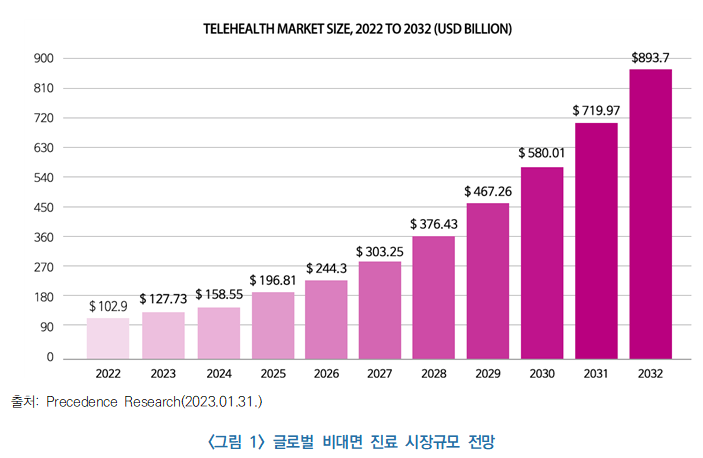
Global telemedicine market outlook: KRW 147.3 trillion in 2022 → KRW 1,276.7 trillion in 2032 (expected to grow 8.7 times over 10 years)
According to a 2023 release by market research firm Precedence Research, the projected size of the global telehealth market is expected to rise about 8.7 times, from USD 102.9 billion in 2022 (KRW 147.3 trillion, based on the April 23, 2025 exchange rate of KRW 1,428.6 per USD) to USD 893.7 billion in 2032 (KRW 1,276.7 trillion, based on the April 23, 2025 exchange rate of KRW 1,428.6 per USD). Over the same period, the compound annual growth rate is projected at around 24%. In other words, the growth potential of the telemedicine market is viewed as extremely high.
3.
Current Status and Comparison of Telemedicine Policies at Home and Abroad
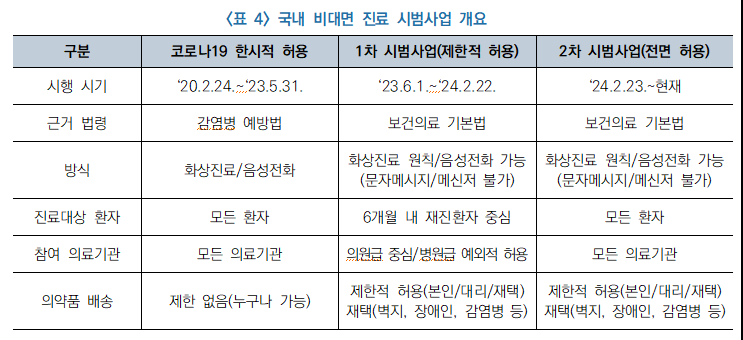
Korea is currently in the midst of discussions over whether to allow telemedicine on a permanent basis and over the scope of first-time consultations and prescription drug delivery, and full legislative codification has not yet been achieved. However, following the temporary authorization of telemedicine in response to the spread of COVID-19, the Ministry of Health and Welfare has conducted pilot programs in two phases, moving from limited authorization to full authorization.
During the three years of temporary authorization amid the COVID-19 pandemic, a total of approximately 36 million telemedicine cases took place. After the COVID-19 virus subsided, the need for telemedicine as a means of preventing infectious disease also diminished. However, considering the convenience of telemedicine that people had already experienced and various aspects of healthcare consumer rights, the government opted not to terminate it entirely but instead launched the first pilot program in June 2023, temporarily allowing it mainly for returning patients within six months. However, as the usage requirements were stringent and complaints were raised by healthcare consumers, doubts emerged about its effectiveness.
Then, as the Yoon Suk Yeol administration began healthcare reform and a healthcare service gap arose in early 2024 due to events such as the residents’ strike, the Ministry of Health and Welfare significantly eased the regulations on the telemedicine pilot program, and from February 23, 2024 onward it was fully permitted for all patients and all medical institutions (Ministry of Health and Welfare, press release dated February 23, 2024). Nevertheless, the legal basis for telemedicine under the Medical Service Act remains weak, and prescription drug delivery is still only permitted on a limited basis.
◩
Policy trends in major countries and implications
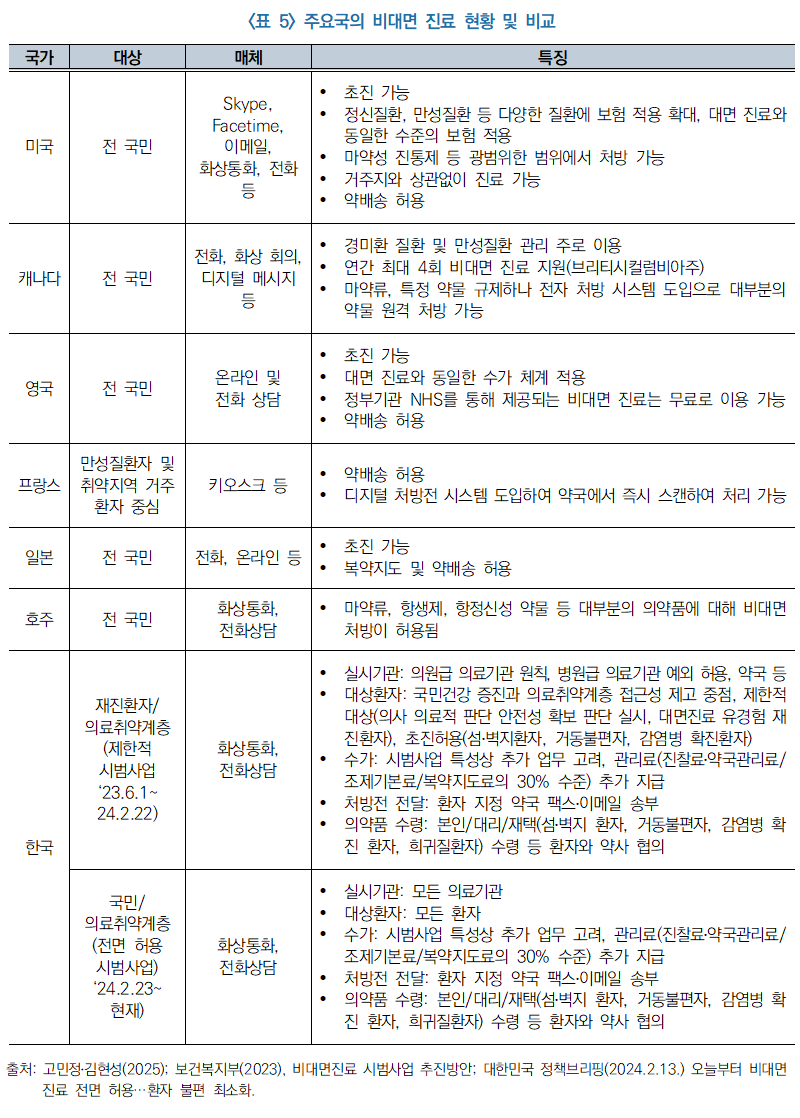
Since COVID-19, telemedicine policies have changed significantly around the world, and the current status of telemedicine in major countries is as follows.
Most major countries institutionally permit telemedicine and are implementing broad policies covering first-time consultations, prescription drug delivery, and insurance coverage. The United States and Japan allow first-time consultations and prescription drug delivery, while the United Kingdom provides free telemedicine services through the NHS. France has improved patient convenience by using a digital prescription system, and Canada and Australia likewise recognize telemedicine within certain bounds at the federal or provincial/state level.
The experiences of major countries provide institutional reference points that Korea can use in designing future telemedicine policy. In particular, the balance between service scope and safety assurance, as well as whether to integrate ancillary services such as prescription drug delivery, are judged to be key considerations.
4.
The Need to Amend the Medical Service Act for Telemedicine
◩
Improving access to healthcare
If telemedicine is allowed, anyone will be able to use medical services easily regardless of geographic location or physical limitations. In particular, people living in provincial areas or on remote islands and in mountainous regions often find it difficult to visit hospitals because medical facilities are lacking or too far away. For them, visiting large hospitals in major cities inevitably requires significant time and cost. But if telemedicine becomes more active, these problems can be resolved.
In addition, it is convenient for elderly people with limited mobility, persons with disabilities, and patients with chronic diseases to receive treatment without visiting a hospital. For example, conditions such as hypertension or diabetes require regular checkups and prescriptions, but with telemedicine, patients can consult a doctor and receive prescriptions from home. This not only reduces the burden of travel on patients but also helps substantially in addressing healthcare blind spots. (Kim Jongyeop et al., 2020)
◩
Increasing the efficiency of the healthcare system
At present, Korea’s healthcare system suffers from long wait times and growing burdens on medical staff because patients are concentrated in large hospitals. In particular, emergency rooms and outpatient clinics often become overcrowded as patients with minor illnesses visit hospitals.
If telemedicine is permitted, these problems can be alleviated. Patients with mild symptoms can receive treatment quickly through telemedicine, while medical resources can be more concentrated on patients who truly need in-person hospital visits. For example, mild conditions such as the common cold or skin troubles can be sufficiently diagnosed and treated remotely. This can reduce congestion in hospitals and create conditions in which medical personnel can focus more on severely ill patients.
In addition, from the perspective of medical staff, telemedicine can reduce workload. More patients can be treated efficiently in the same amount of time, and unnecessary hospital visits can be reduced, helping ease the problem of overwork among healthcare workers. Telemedicine can contribute to increasing the overall operational efficiency of the healthcare system. (Kim Jongyeop et al., 2020)
◩
Preventing the spread of infectious diseases
Telemedicine also plays an effective role in preventing the spread of infectious diseases. During the COVID-19 pandemic in 2020, hospital-acquired infection emerged as a major problem, prompting countries around the world to actively adopt telemedicine. Because hospitals are spaces where many patients gather, the risk of virus transmission is inevitably high. In particular, if patients suffering from contagious illnesses such as colds or influenza visit hospitals, there is a strong possibility that the disease will spread to other patients or medical staff.
However, using telemedicine can reduce this risk of infection. For example, patients with fever or severe coughing can receive consultations from home and obtain prescriptions remotely, minimizing hospital visits. This also helps protect the safety of elderly people with weak immune systems or patients with underlying diseases. In addition, during outbreaks of infectious disease, a rapid increase in patient numbers can overwhelm the healthcare system, but active use of telemedicine can also help solve this problem. (Kim Jongyeop et al., 2020)
◩
Expanding healthcare consumer choice and increasing utility through medical innovation
Telemedicine is a major change leading the digital healthcare era, providing healthcare consumers with more options while simultaneously improving the efficiency and convenience of treatment. The ability to directly choose the desired medical professional regardless of time or place and to receive care without waiting is a major advantage from the patient’s perspective. In particular, as access to treatment improves through various platforms, continuity of care is being further strengthened.
For people with chronic diseases and elderly individuals with limited mobility, these changes make everyday health management much easier. Medical resources can also be used more efficiently, raising the operational efficiency of the healthcare system as a whole. This patient-centered trend is creating a new standard for medical services and clearly shows the direction healthcare should take in the future.
◩
Fostering the digital healthcare industry and creating jobs and added value
The spread of telemedicine does not simply amount to a change in treatment methods. By forming a new industrial ecosystem, it is creating added value across a range of fields. As demand grows for related technologies such as medical platform development, remote care solutions, and patient monitoring devices, the medical device industry is growing rapidly. Hospital systems are also shifting to digital foundations, accelerating innovations such as smart hospitals and data-based treatment.
These changes also lead to job creation. New occupations are emerging, such as medical data analysts, healthcare IT specialists, and remote care coordinators, and demand is increasing for talent that bridges medicine and technology. In the end, telemedicine does more than improve the quality of medical services; it also acts as a driver of economic added value across industry as a whole. In the future-oriented medical environment, more opportunities and possibilities are opening up (BioTimes, June 26, 2024, “Institutionalizing Remote Healthcare Services Expected to Increase Employment by up to 1.5 Million and Impact the ICT Industry”).
5.
Conclusion: Legislating Telemedicine and Prescription Drug Delivery and Follow-up Tasks
◩
The only OECD country without legislated telemedicine; the Medical Service Act amendment must be passed within this session
Korea is still promoting telemedicine in the form of a pilot program without a legal basis, and prescription drug delivery is also only permitted on a limited basis for medically vulnerable groups. Major countries that, like Korea, have entered an aging society—including the United States, the United Kingdom, Germany, France, Japan, and Canada—have all already legislated both telemedicine and prescription drug delivery. Among OECD countries, Korea is the only one that has not legislated telemedicine. In the 22nd National Assembly, the Medical Service Act amendment should be swiftly passed within the current session, centered on the bill introduced by Rep. Choi Boyoon, including provisions to allow telemedicine and prescription drug delivery and to establish a legal basis for online platform brokerage.
◩
Follow-up tasks: Shift from a positive-list approach to a comprehensive listing (negative regulation) approach and foster industries incorporating AI
The scope of the current telemedicine pilot program follows a positive-list approach, under which telemedicine is allowed only after all conditions of a treatment case are reviewed and judged to meet the standards. This approach is extremely restrictive. Therefore, as a follow-up task, first, telemedicine should be completely prohibited in certain cases, such as severe illnesses, conditions involving narcotic analgesic prescriptions, and serious trauma, but for the rest, there is a need to shift to a comprehensive listing approach that broadly permits it. In that case, standard clinical guidelines for telemedicine would be required (Kim Eunjung, 2024).
Second, there is a need to improve the precision of telemedicine by integrating generative AI and to promote the digital healthcare industry and expand the market. For example, new AI remote healthcare and diagnostic products such as body composition analyzers and fully automatic blood pressure monitors, ChatGPT-based real-time medical consultation service models, and AI-based prescription drug delivery platforms are becoming a reality.
◩ References
∙ Ko Minjung, Kim Hyunseong (2025), Evaluation Study on the Performance of the Telemedicine Pilot Program, National Evidence-based Healthcare Collaborating Agency Research Report.
∙ Kim Jongyeop, Lee Gwanik (2020), Advantages and Necessity of Remote Healthcare Services, Korea Health Industry Development Institute Future Policy Support Division Research Report.
∙ Kim Eunjung (2024), Telemedicine Pilot Program: Opinions from Various Sectors, Problems, and Directions for Improvement, Issues and Points No. 2183.
∙ Kim Jinsuk (2024), A Study on the Current Status of the Telemedicine Pilot Program and Improvement Measures, Research Institute for Healthcare Policy Policy Issue Analysis 2023-05.
∙ Daily Medi, April 22, 2025, “Golden Time for Telemedicine, Urgent Need to Improve ‘Triple Regulation’.”
∙ Daily Pharm, January 24, 2025, “Platform Industry Begins Legislative Push for a Telemedicine-Prescription Drug Delivery Package.”
∙ Daily Pharm, April 18, 2025, “People Power Party Introduces Second Telemedicine Bill… Excludes Drug Delivery.”
∙ Medical Times, October 1, 2024, “Cumulative Telemedicine Cases Surpass 10 Million: ‘It Should Be Fostered as an Industry.’”
∙ Medical Times, April 1, 2025, “Will Telemedicine Legislation Gain Momentum Again… Opposition Party Also Preparing.”
∙ Medipana, January 18, 2025, “Continued Attempts to Legislate Telemedicine… Pharmaceutical Sector Says ‘Need to Respond to Drug Delivery.’”
∙ BioTimes, June 26, 2024, “Institutionalizing Remote Healthcare Services Expected to Increase Employment by up to 1.5 Million and Impact the ICT Industry.”
∙ BioTimes, December 11, 2024, “Ministry of Science and ICT Begins ‘Public Discussion on Telemedicine’… Startup Industry and Pharmacy Sector React Differently.”
∙ Ministry of Health and Welfare (June 2023), Plan for Promoting the Telemedicine Pilot Program.
∙ Won Hyeyeon (2025), [Consumer Policy Trends No. 143] Telemedicine Policy Trends and Implications for Consumer Policy, Korea Consumer Agency Research Report.
∙ Welfare News, March 21, 2025, “Rep. Choi Boyoon Pushes for ‘Institutionalization of Telemedicine.’”
∙ EToday, April 14, 2025, “What Is the Solution for the ‘Institutionalization’ of Telemedicine Blocked by the Medical Service Act? [Telemedicine at a Crossroads ③].”
∙ Presentation materials provided by the Ministry of Health and Welfare to Rep. Choi Boyoon’s office (2024), “Current Status of Telemedicine.”
∙ Han Miseon, Lee Gayoung, Park Jinyoung (2024), [Health Industry Brief Vol. 405] Telemedicine Market Trends and Outlook in Four Major Countries, Korea Health Industry Development Institute Research Report.
∙ HIT News, May 4, 2023, “HIT Monthly Bills | Proposal to Establish Legal Grounds for Telemedicine in the ‘Medical Service Act.’”
∙ CEO Score Daily, April 21, 2025, “[On Site] Lee Seul, Chair of the Remote Healthcare Industry Council, Argues ‘Now Is the Golden Time to Legislate Telemedicine.’”
Wiki:
https://www.cfe.org/w/bbsDetail.php?&idx=12
Original title: 비대면 진료 법제화 필요성과 후속과제
Author: Center for Free Enterprise (CFE)
Date: 2025-04-24
Source: https://www.cfe.org/bbs/bbsDetail.php?cid=issue&pn=1&idx=27555