
Problems with Reintroducing the Yellow Envelope Act (Revised Labor Commission Act) and Response Tasks
-
Writer
CFE
-


 1. Controversy Over Renewed Push for the Yellow Envelope Act (Revised Labor Commission Act)
◩ Concerns over the renewed introduction of the Yellow Envelope Act (Revised Labor Commission Act), discarded in September 2024
The Democratic Party of Korea, along with opposition parties including the Rebuilding Korea Party and the Progressive Party, is jointly pushing again for the “Yellow Envelope Act (partial amendment to the Trade Union and Labor Relations Adjustment Act),” which was scrapped twice after being blocked by the president’s request for reconsideration (veto power). The Yellow Envelope Act originated in 2014, when civic groups sent donations in yellow envelopes to help union members after they were ordered to pay 4.7 billion won in damages following the SsangYong Motor strike. Specifically, it consists of an amendment to Article 2 of the Trade Union Act, which expands the concept of “employer” and the scope of labor disputes and removes restrictions on union membership, and an amendment to Article 3, which limits claims for damages against striking workers. Previously, the bill passed the 21st and 22nd National Assembly in December 2023 and August 2024, respectively, led by the opposition, but legislation failed both times after President Yoon Suk Yeol exercised his veto. Concerns are being raised that, led by the Democratic Party of Korea and joined by minor parties, another anti-business policy is once again being pushed forward.
◩ The renewed Yellow Envelope Act (Revised Labor Commission Act) further eases liability for damages compared with the bill discarded last year
A representative version of the Yellow Envelope Act (Revised Labor Commission Act) now being pushed again by the Democratic Party of Korea and minor opposition parties was introduced by Representative Kim Taeseon (Bill No. 2208800). Compared with the version finally discarded in September last year, it has been revised in a direction that offers even stronger protection for workers’ rights, heightening concerns in the business community. In particular, it would allow workers who caused damage to employers through collective bargaining or industrial action to directly petition the court for a reduction in damages, and it would allow the court to comprehensively consider the liable party’s financial condition and ability to pay, as well as the appropriateness of the amount claimed, and exempt all or part of the damages or reduce the amount. This is the key difference from the previous version.
At first glance, such provisions may appear intended to protect workers’ rights and interests, but in practice they are highly likely to lead to an increase in illegal strikes and militant industrial action in the workplace. So far, corporate losses caused by illegal strikes have imposed a substantial burden on management and have been identified as a major factor undermining the vitality of the overall national economy. If courts are allowed to adjust damages claims arbitrarily, there is concern that companies will not receive adequate legal protection for normal business operations. This issue report examines the problems with the renewed Yellow Envelope Act (Revised Labor Commission Act), which is being pushed amid domestic and global economic crises, and seeks possible responses.
2.
Current Status of Labor Disputes and Workday Losses
◩ Continued increase in labor disputes (doubling over the past 10 years) and decline in lost workdays (halved over the past 10 years)
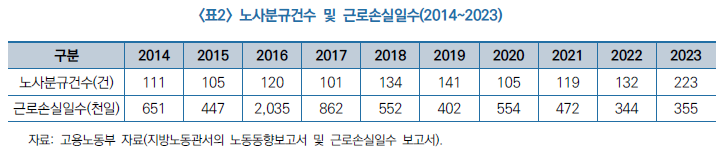
Over the past 10 years (2014–2023), the average number of labor disputes was 129.1, and the figure nearly doubled in 2023 compared with 2014. From 2014 to 2022, the number ranged between 100 and 140 before gradually rising to 223 in 2023. Not only has the number of labor disputes steadily increased, but the pattern also shows intensifying social tension and stronger conflict at industrial worksites resulting from such disputes. In contrast, although lost workdays varied somewhat by year, they stood at 651,000 days in 2014 and peaked at 2.035 million days in 2016, then gradually trended downward and have remained in the mid-300,000-day range since 2022.
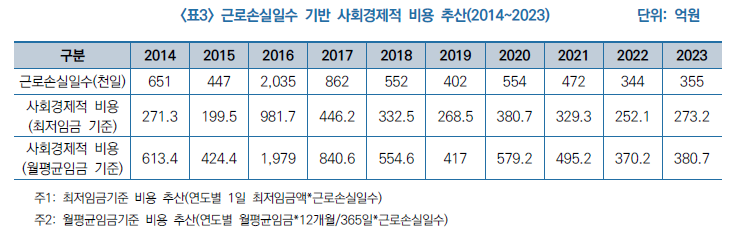
◩ Estimated socioeconomic costs over the past 10 years (2014–2023) based on lost workdays: at least 373.5 billion won to as much as 665.4 billion won
The burden of production disruptions and social costs borne by companies due to labor disputes and work losses remains significant. Estimating labor losses based on lost workdays as a socioeconomic cost, the total over the past 10 years is estimated at a minimum of 373.5 billion won (based on the minimum wage) and a maximum of 665.4 billion won (based on average monthly wages). On an annual average over the past 10 years, this comes to a minimum of 31.13 billion won and a maximum of 55.45 billion won. Since these calculations are based on the minimum wage and average monthly wages, the results are quite conservative.
◩ Comparison of lost workdays in major countries (per 1,000 wage workers): Korea 35.2 days / 176 times, 3.7 times, and 5.7 times those of Japan, the U.S., and Germany
To compare labor-loss days by country, lost workdays per 1,000 wage workers were calculated. Over the past 10 years (2013–2022), Korea averaged 35.2 days, compared with 9.5 days in the United States, 22.9 days in the United Kingdom, 0.2 days in Japan, and 6.2 days in Germany, making Korea the highest. Recently, Korea’s lost workdays per 1,000 wage workers have declined somewhat, but they remain about 176 times higher than Japan’s and 3.7 times higher than the United States’, indicating that Korea still has relatively high lost workdays by global standards.
3.
Diagnosis and Analysis of the Problems with the Reintroduced Yellow Envelope Act (Revised Labor Commission Act)
◩ Unconstitutionality of the reintroduced Yellow Envelope Act (Revised Labor Commission Act) 1: violation of the clarity principle under legality in criminal law and the essence of the three basic labor rights
Under these circumstances, the reintroduced bill includes many unconstitutional elements, such as infringing employers’ property rights, freedom of business, and equal protection, while centering on expanding the scope of “employer” and easing legal sanctions such as liability for damages arising from unlawful acts by labor organizations (Cha Jina, 2024). First, excessively expanding the concept of employer or allowing non-workers to join unions violates the clarity principle of legality in criminal law. A problem is that third parties subject to expanded employer status do not form a legal relationship with the workers demanding bargaining (Park Jonghee, 2024). Second, expanding the scope of labor disputes in terms of working conditions raises concern that labor-management disputes may occur frequently even over matters employers cannot decide or matters that fall within the essence of managerial rights, making it possible that the bill departs from the constitutional essence of the three basic labor rights.
◩ Unconstitutionality of the reintroduced Yellow Envelope Act (Revised Labor Commission Act) 2: infringement of employers’ property rights and hollowing out the right to claim damages
Measures to reduce liability for damages are highly likely to infringe corporate property rights and legal stability. First, limiting liability for damages would effectively grant immunity for illegal strikes and acts of violence or destruction, raising concerns about undermining the foundation of the rule of law and excessively infringing basic rights such as employers’ property rights, and thus carries unconstitutional elements (Cha Jina, 2024). Second, excluding joint liability and individualizing responsibility for unlawful acts that are not exempt from damages is not realistically feasible and creates the problem of hollowing out employers’ right to claim damages (Cha Jina, 2024). The easier it becomes to exempt or reduce legal responsibility, the more likely some unions are to choose stronger strikes or illegal actions without fear of legal sanctions, which could blur the line between lawful and unlawful industrial action and amplify conflict in industrial settings. As a result, the bill may be interpreted as institutional permission that encourages illegal strikes and induces prolonged disputes.
◩ If the Yellow Envelope Act (Revised Labor Commission Act) takes effect, concerns over the spread of strike absolutism and prolonged social conflict
If the Yellow Envelope Act (Revised Labor Commission Act) is enacted, concerns are growing that a structure in which strikes are effectively exempt from liability could spread “strike absolutism” throughout society. By expanding the concept of employer and limiting liability for damages resulting from industrial action, the amendment contains the potential to break down the balanced structure of responsibility between labor and management under the existing legal system. In particular, critics point out that provisions blurring the line between legitimate industrial action and illegal misconduct, and allowing practical evasion of damages liability even where illegality is recognized, will lead to the spread of strike absolutism.
Protecting workers’ rights and interests is important, but if that protection is expanded in a way that harms social order, it may ultimately result in disadvantages for the public as a whole. For example, if illegal acts such as large-scale unlawful occupation or blockades of production facilities are tolerated in the name of “union activity,” this could clash with the public’s sense of justice and even undermine the legitimacy of law enforcement. If industrial action without legal responsibility is repeated, social conflict may be prolonged and the trust foundation of the labor market may be seriously damaged.
◩ Concerns over a worsening corporate investment environment due to a vicious cycle of frequent and intense labor disputes
Furthermore, frequent and intense labor disputes may not only dampen domestic companies’ investment sentiment but also lead to declining confidence among foreign investors. In the absence of legal stability in the labor market, companies may move to countries with more flexible investment environments, which could result in serious losses in terms of national competitiveness. In this respect, criticism is difficult to avoid that the amendment to the Yellow Envelope Act (Revised Labor Commission Act) contains structural risks that could negatively affect the broader economy beyond questions of social equity.
Moreover, in an era when international competitiveness is crucial, pushing such an amendment could weaken companies’ global competitiveness and create anxiety among foreign investors, thereby adversely affecting the domestic investment climate. Accordingly, voices are growing not only in the business community but also in academia that the bill should be reconsidered and discussed with caution.
◩ On top of Trump-driven tariff pressure, a legislative offensive from the National Assembly as well—“when it rains, it pours” for Korean companies
The high-tariff policies during the Trump administration were a representative protectionist measure that dealt a substantial blow to Korean companies. The 25 percent tariff on steel and aluminum products, pressure under the principle of reciprocal tariffs, and supply-chain instability caused by the trade war with China all directly targeted Korea’s key export industries. As a result, many firms lost price competitiveness in the U.S. market, and some had to rely on costly responses such as relocating production bases and indirect export routes. In fact, Korea’s exports to the United States slowed for several years after the tariff impositions, and the decline in value-added creation resulting from reduced exports was also unavoidable.
Amid this worsening external trade environment, labor-related legislation such as the Yellow Envelope Act (Revised Labor Commission Act) is being pushed domestically. The bill expands the concept of employer and limits liability for damages arising from strikes. From the corporate perspective, this means legal means of response in labor-management disputes would be reduced, while management risks from production disruptions could become even heavier. In Korea, where the corporate structure is centered on manufacturing and exports, such imbalanced changes in the domestic labor environment, combined with uncertainty in the international trade environment, could act as a dual pressure that significantly shakes business stability.
At a time when Korean firms’ position in the global market is already being undermined by Trump-driven tariff barriers, if legislation that further restricts business activity continues to be enacted domestically, there is a significant risk that Korean companies will lose what little room they have left to respond and ultimately lose competitiveness. This is not merely a problem for individual firms; it is a structural risk factor that could also negatively affect the country’s export industries overall and employment stability. What is needed now, therefore, is not stronger legal regulation that tightens the business environment, but a cautious legislative approach that considers balance between labor and management so that Korean firms can survive and remain competitive amid global protectionism.
4.
Policy Response: Concerns over “government-labor collusion” and a call for defeat in the National Assembly
◩ Yellow Envelope Act (Revised Labor Commission Act): legislation that overprotects unions and raises concerns over “government-labor collusion”
If the Yellow Envelope Act (Revised Labor Commission Act) is pushed in earnest, controversy may arise over alleged government-labor collusion, given the direction of the legislation and its political background. In particular, the bill is designed to strengthen union power by limiting liability for damages arising from industrial action and expanding the concept of employer, while relatively weakening companies’ rights of defense, increasing the possibility of political interpretations and misunderstandings surrounding it.
Indeed, because the bill’s main beneficiaries are seen as some militant unions, suspicion has been raised about possible collusion between certain political forces and labor unions, and criticism exists that the bill excessively reflects labor’s position. Such criticism could spread the perception that the legislation is tilted toward the interests of specific organizations rather than the overall labor market or the national economy, and as a result could expand into controversy over an “imbalance in relationships” that goes beyond a cooperative structure between government and labor. Therefore, if the Yellow Envelope Act (Revised Labor Commission Act) becomes an actual制度—if it is implemented in practice—a cautious approach is required, given that it could lead to unnecessary political conflict and declining trust between the government and labor going forward.
◩ Policy response: call for an immediate halt or defeat at the standing committee level in the National Assembly
The Yellow Envelope Act (Revised Labor Commission Act), which has now been reintroduced in the National Assembly, should either be immediately halted or voted down at the standing committee level. It is inappropriate to place back on the table a bill that has already been vetoed twice by the president. The Yellow Envelope Act (Revised Labor Commission Act) is an anti-market and economically harmful law that legitimizes illegal strikes and constrains normal business operations. Korean companies are already facing domestic and external uncertainties, including the Trump administration’s tariff policies in the United States, accelerating global competition in advanced industries such as AI and semiconductors, and high interest rates and exchange rates. Under these conditions, pushing the Yellow Envelope Act (Revised Labor Commission Act) would only make the Korean economy even more difficult.
◩ References
∙ Ministry of Employment and Labor, Labor Relations Support Division (October 2024), Number of Labor Disputes and Lost Workdays by Year (2023)
∙ Partial Amendment to the Trade Union and Labor Relations Adjustment Act, Bill No. 2202444. Alternative bill proposed by the Chair of the Environment and Labor Committee.
∙ Partial Amendment to the Trade Union and Labor Relations Adjustment Act, Bill No. 2207799, introduced by Representative Kim Taeseon.
∙ Park Jonghee (2024), Evaluation and Suggestions on Legislative Discussions Regarding the Expansion of Employer Status Under the Trade Union Act, Labor Law Forum, No. 43.
∙ Cha Jina (2024), Review of Whether the Amendment to the Trade Union Act (Yellow Envelope Act) Is Unconstitutional, Kangwon Law Review, Vol. 76.
∙ Korea Labor Institute (2024), 2024 KLI International Labor Statistics.
Wiki:
https://www.cfe.org/w/bbsDetail.php?&idx=10
Original title: 노란봉투법 재발의의 문제점과 대응과제
Author: Center for Free Enterprise (CFE)
Date: 2025-04-16
Source: https://www.cfe.org/bbs/bbsDetail.php?cid=issue&pn=1&idx=27530