
Problems and Challenges of the Yellow Envelope Act (Revised Labor Commission Act), an Amnesty for the KCTU’s Illegal Strikes
-
Writer
CFE
-


 1. Main Contents of the Amnesty for Illegal Strikes (Yellow Envelope) Act
On February 21, the National Assembly’s Environment and Labor Committee (hereinafter, the Labor Committee) passed a partial amendment to the Trade Union and Labor Relations Adjustment Act—commonly known as the Yellow Envelope Act (Revised Labor Commission Act)—which expands the scope of industrial action under the Trade Union Act and limits companies’ ability to claim damages against workers, amid a collective walkout by People Power Party lawmakers. Joo Ho-young, floor leader of the People Power Party, protested by calling it the “Unconstitutional Envelope Act” or the “Universal Strike Envelope Act,” and the Presidential Office stated that if the opposition unilaterally pushes the Yellow Envelope Act (Revised Labor Commission Act) through the plenary session of the National Assembly, the president’s exercise of the veto would be considered.
The Yellow Envelope Act (Revised Labor Commission Act) is a committee bill passed by the chair of the Environment and Labor Committee, incorporating alternative provisions from 12 separate bills, including those introduced by Kang Byung-won, Kang Eun-mi, and Lee Eun-joo. It has currently been referred to the Legislation and Judiciary Committee for review of legal wording and structure. Its main contents are broadly as follows: 1) expansion of the definition of employer, 2) expansion of the scope of industrial action, and 3) individualized limitation of liability for damages arising from industrial action based on each liable party’s cause and degree of contribution, along with exemption of identity guarantors from liability for damages. Overall, it appears to be a law that broadly expands both the scope of employers and the subject matter of labor disputes, while effectively granting amnesty for various violent and political illegal strikes.
According to the Korea Economic Research Institute (KERI) (2022), the illegal strike (collective refusal of transport) by the Cargo Truckers Solidarity at the end of last year caused direct and indirect economic damage to the automobile, steel, petrochemical, cement, and tire industries, among others, estimated at as much as KRW 10.4 trillion. This issue report seeks to examine the problems posed by the Amnesty for Illegal Strikes (Yellow Envelope) Act, passed under the leadership of the Democratic Party and the Justice Party in the National Assembly’s Environment and Labor Committee, and to explore appropriate policy responses.
2. Current Status of Labor Disputes, Lost Workdays, and Illegal Strikes (Court Awards in Damages Suits)
◩ Labor disputes are steadily increasing, centered on large workplaces, and lost workdays have averaged about 710,000 per year over the past 12 years
Looking at the status of labor disputes in Korea, the number rose 1.4 times, from 86 cases in 2010 to 119 cases in 2021, showing a gradual upward trend. Labor disputes at workplaces with 300 or more employees increased from 37 cases in 2010 to 61 in 2021, following a pattern similar to overall labor disputes, indicating that labor disputes are increasingly concentrated in large workplaces.
As for lost workdays resulting from labor disputes such as union strikes, severe labor conflict in 2012, 2016, and 2017 led to 860,000 to 2.03 million lost workdays, while in general the figure has remained around 500,000. Over the past 12 years, the average has been about 710,000 lost workdays, indicating substantial labor losses.
◩ Strikes, lockouts, and lost workdays are among the highest compared with major countries; average lost workdays are 75.4 times Japan’s
According to International Labour Organization (ILO) statistics, a comparison of strike and lockout cases across major countries over the past 12 years shows that Japan recorded about 60 to 80 cases, Sweden fewer than 10, the United Kingdom 90 to 100, and the United States fewer than 25, whereas Korea recorded 140, a considerably high level. In terms of trends, Japan, the UK, and Sweden are showing declines, while Korea is instead on the rise.
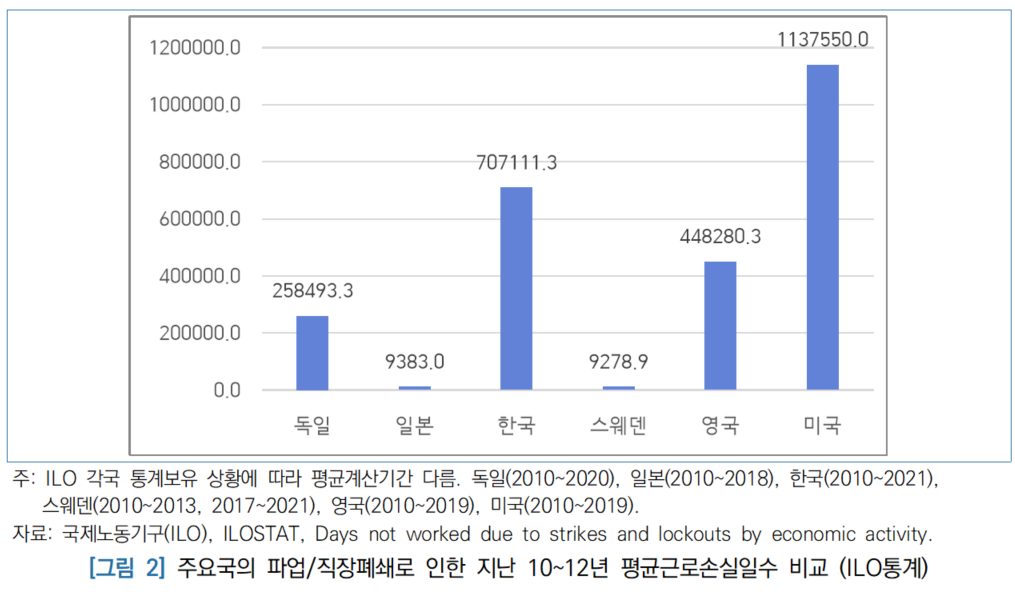
Comparing average lost workdays due to strikes and lockouts in major countries over the past 10 to 12 years, Germany recorded 258,000 days, Japan 9,400, Korea 707,000, Sweden 9,300, the UK 448,000, and the US 1.138 million. Excluding the United States, whose economy and employment scale are much larger, Korea ranks at the highest level among major countries. Korea’s lost workdays are 2.7 times Germany’s, 75.4 times Japan’s, 76.2 times Sweden’s, and 1.6 times the UK’s.
◩ Status of illegal strikes: court-awarded damages over the past 13 years totaled KRW 35.01 billion, 99.9% of which involved the KCTU
According to the Ministry of Employment and Labor’s Labor Relations Legal Affairs Division (2022) survey on the status of damages claims and provisional seizures, the total amount of damages awarded by the judiciary over the past 13 years (2009 to August 2022) came to KRW 35.01 billion (KRW 27.51 billion in concluded cases and KRW 7.5 billion in ongoing cases). The total amount claimed was KRW 275.27 billion, and based on cases in which awards were made, 58.4% of KRW 59.95 billion—well over half—was recognized by the courts. Looking at the distribution of damages suits by umbrella union organization, nearly all of the KRW 35.01 billion awarded—99.86%—involved the KCTU, accounting for 94% of all lawsuits, 99.6% of total claimed amounts, and 99.9% of awarded amounts. By contrast, damages awarded against the FKTU amounted to only KRW 50 million. The rate at which damages suits against unions were upheld was 67.1%, compared with 57.1% for ordinary civil damages suits overall, meaning the recognition rate for damages arising from union violence and similar acts was even higher. By type of illegal (industrial) action, workplace occupation accounted for the largest awarded amount at KRW 32.75 billion (93.5%), including KRW 19.52 billion for forcible occupation and KRW 13.16 billion for forcible occupation combined with assault and injury. This was followed by rallies, demonstrations, and sit-ins at KRW 410 million, and strikes (including slowdowns) at KRW 60 million.
◩ Problems with expanding the concept of employer: confusion and conflict in application, rising business costs, and weakening corporate competitiveness
If the concept of employer is broadly expanded, and subcontracted workers’ unions begin in practice demanding collective bargaining with prime contractors as employers, there are serious concerns about labor-management confusion and inter-union conflict, including over the application of the single bargaining channel system. It also ignores the industrial reality in which most companies lawfully use subcontracting arrangements in various forms, thereby undermining the foundation of existing law. At the same time, direct bargaining with subcontracted unions would raise business costs, reduce the use of subcontracting, and ultimately weaken corporate competitiveness (Federation of Korean Industries (FKI), 2022). Because the standards for determining employer status are not clearly specified, prime contractors would not be able to predict the scope of collective bargaining, and there is a high likelihood of undermining legal stability and increasing confusion through prolonged bargaining, major disorder in the bargaining system, and more judicial disputes (Ministry of Employment and Labor briefing, 2023).
◩ Problems with expanding labor disputes: granting amnesty for illegal strikes
If the subject of labor disputes is expanded from “matters concerning the determination of working conditions” to “matters concerning working conditions,” the scope of labor disputes and lawful strikes would be extended even to areas that should not be left outside judicial determination. If unions attempt to improve working conditions through hardline strikes without going through lawful procedures such as the courts or labor commissions, the costs of labor-management conflict are likely to rise excessively. If actions previously deemed illegal strikes become unclear due to the expanded subject matter of labor disputes, this would have the effect of obscuring judgments of illegality or granting effective amnesty. It may also encourage a tendency to make even matters beyond the employer’s authority the subject of industrial action, or to resolve various labor-management issues through industrial action rather than through agreement between labor and management (Kim Jong-hyun, 2022).
◩ Problems with limiting, reducing, and individualizing liability for damages: excessive protection of illegal acts by some unions (perpetrators)
The core amendment in the Amnesty for Illegal Strikes (Yellow Envelope) Act requires courts to determine individualized scopes of liability based on each liable party’s cause and degree of contribution to the damage, while entirely exempting identity guarantors from liability. In effect, this individualizes and mitigates liability for damages and amounts to granting amnesty for illegal strikes. In reality, from the standpoint of the employer—the victim—it is impossible to know individually the extent of the damage caused by each perpetrator of an illegal strike or each person’s proportion of fault, and it is likewise difficult for courts to calculate individual liability. For that reason, existing Supreme Court precedent has imposed joint liability, and this amendment conflicts with that approach (Ministry of Employment and Labor briefing). It also runs counter to the general principle that liability for damages should be based on full restoration. Ultimately, it forces only employers to bear excessive losses, including infringement of property rights, while at the same time excessively protecting the illegal acts of some unions affiliated with the KCTU—the perpetrators.
4. Policy Response: Withdraw the bill from the National Assembly’s Environment and Labor Committee and actively consider a presidential veto
In conclusion, the Yellow Envelope Act (Revised Labor Commission Act) is a bad law that excessively protects illegal strikes by the KCTU and reduces or excuses liability for damages. It is also highly likely to increase firms’ labor costs, significantly undermine corporate competitiveness, and adversely affect jobs for future generations. Accordingly, this is a bill that must either be withdrawn by the National Assembly’s Environment and Labor Committee or rejected in the plenary session. Moreover, if the majority opposition forces it through by organized voting in the plenary session, the president’s exercise of the veto must be actively considered. Going forward, it is essential to introduce a system requiring mandatory regulatory cost-benefit and impact analysis for lawmaker-initiated bills of this kind—bills that do not fit actual labor conditions and that, in the long term, harm labor relations, future jobs, and corporate competitiveness.
◩ References
∙ Ministry of Employment and Labor, Labor Relations Legal Affairs Division (October 2022), Results of the Survey on the Status of Damages Lawsuits and Provisional Seizures and Overseas Cases.
∙ Ministry of Employment and Labor Briefing (2023), Regarding the “Partial Amendment to the Trade Union and Labor Relations Adjustment Act,” released February 20, 2023 (Mon).
∙ Kim Jong-hyun (2022), The Orientation of the 2022 Version of the Yellow Envelope Act, SHIN&KIM LLC.
∙ Partial Amendment to the Trade Union and Labor Relations Adjustment Act, Committee Bill Passed by the Chair of the Environment and Labor Committee, Temporary No. DD11128, 2023-02-21.
∙ Federation of Korean Industries (FKI) (October 2022), Problems with the Amendment to the Trade Union Act (Yellow Envelope Act).
∙ Korea Employers Federation (KEF) (June 8, 2021), Discussion Forum on Problems with the Revised Trade Union Act and Directions for Supplementary Legislation, Sourcebook.
∙ Korea Economic Research Institute (KERI) press release dated December 15, 2022, “Two Cargo Truckers Solidarity Strikes Caused KRW 10.4 Trillion in Economic Losses This Year.”
∙ Expert Commissioner Wonmo Kim of the Environment and Labor Committee (November 2022), Review Report on the Partial Amendment to the Trade Union and Labor Relations Adjustment Act, 400th National Assembly (Regular Session), 8th Environment and Labor Committee.
Wiki:
https://www.cfe.org/w/bbsDetail.php?&idx=6
Original title: 민주노총 불법파업 면죄부(노란봉투)법의 문제와 과제
Author: Center for Free Enterprise (CFE)
Date: 2023-03-27
Source: https://www.cfe.org/bbs/bbsDetail.php?cid=issue&pn=2&idx=25484