
Hayek’s *The Road to Serfdom* - 19th session
-
Writer
Liberalism Reading Group for Beg
-
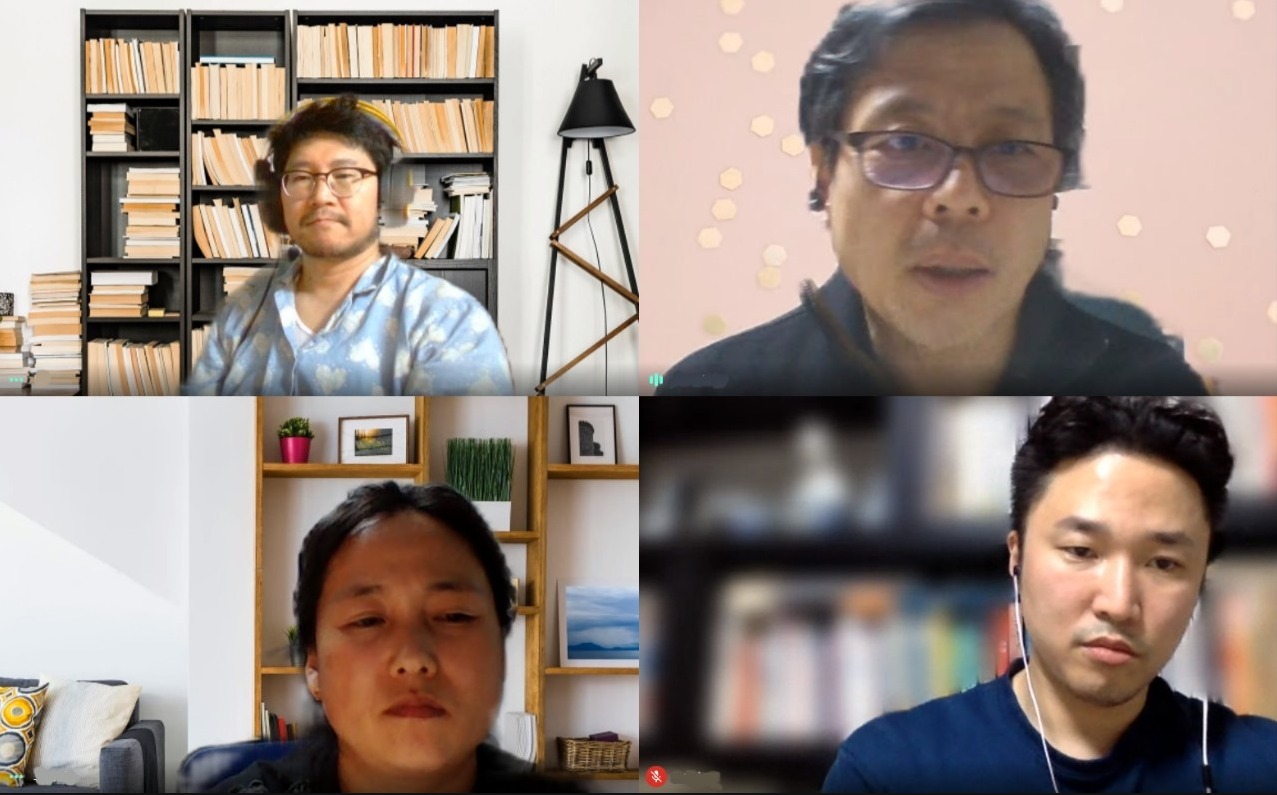 November 17, 2020 (Tue), 19th session
The Road to Serfdom Reading Discussion, 19th Online Meeting: Damje, Mori, Kangyoung Lee, Rocha
*Before starting the study, someone suggested it would be good to create a reading group for The Conservative Mind.
Chapter 6. Planning and the Rule of Law
“A New Threat to the Rule of Law”
- In short, this section can be summed up as follows: socialism exists within us as human beings, and in a planned society the rule of law cannot be maintained. What happened in Germany happens in our country too; what happened 200 years ago still happens today; once a planned society is created, the same pattern is bound to repeat itself.
- In South Korea today, there is no talk of the rule of law, only the opposite phenomenon. They say that if the opposition party does not cooperate in appointing the head of the Corruption Investigation Office for High-ranking Officials, they will change the law. And then they will say they are acting according to the law. The construction of a new airport is the same: Roh Moo-hyun said he would do it, Lee Myung-bak blocked it, and Moon Jae-in changed it again, all within a legal framework. Even if something is done within the rule of law, that does not necessarily make it just. We need to think about whether the rule of law is always right and how laws should be made rightly. Yoon Seok-yeol also says the rule of law is important.
- What seems important is the rule of law in the true sense. The law must be neutral, moralistic in neither direction, and must not infringe individual freedom. Only when such rule of law exists is freedom guaranteed.
- In the rule of law, what might be called the minimum level of justice is, I think, justice in predictability. The problem in distorted situations is that predictable conditions can be turned upside down. The rental housing issue is an example.
- Predictability seems crucial. Once a law is established, it is important to keep it in place. At that moment, someone may clearly lose and someone may gain, but through the market those gains and losses will disappear.
- Predictability also means this: even if a law is bad, if you know what you can be punished for, that can still be called the rule of law. But when it is not truly law-like law, you can be punished even for doing something legitimate. If a law is created and no one knows whether it will be applied or not, and if the law applied to a person named Cho Kuk differs from the law applied to a person named Han Dong-hoon, then predictability collapses and the rule of law ceases to function.
- Predictable laws, circumstances in which change is unavoidable, circumstances in which application must change, and pre-established rules are all important.
- To give an example concerning the rule of law: there are military service regulations, but they are not normally enforced. When are they used? When someone wants to go after a particular person. So laws that are enforced arbitrarily at the whim of the enforcer, with many regulations but random enforcement, are not proper laws.
- Socrates died because of democracy. Because of the saying, “Even a bad law is still law.” And his disciple Plato devised philosopher-rule to restrain democracy. The history of ideas repeats itself: people disappointed by democracy come to love dictatorship. Liberals may be famous like Aristotle, but are they the kind of people who try to hold everything together?
- Speaking of public law, it is law for the organization of government and public institutions, and the concept of public law increasingly defines what government should do and what government does. It becomes a law above all laws. Some say public law is not really law. Special laws damage the rule of law.
- The problem is creating laws for the sake of regulation.
- When taxes are not collected well, welfare expansion is checked, and in Sweden too, legal regulation decreases when the economy is bad. A tax resistance movement might also be meaningful. Fewer public laws would be made. We need to think about ideas like that. Local self-government, reduction of legislative power.
- What are the advantages of strengthening local self-government?
- If local self-government is pursued, first, taxes inevitably have to be reduced. Then there is legislative power. If local governments want to collect taxes and do something with them, they can bring legislative power down to the local level. Even in Seoul, it has not been that long since taxes paid by Seocho-gu and Gangnam-gu began to be taken away by other districts. Under Seoul Mayor Oh Se-hoon, such a bill was passed by Grand National Party lawmakers. It made it possible to transfer locally collected taxes from districts where a lot was collected to other districts. Then each district started building new district offices, and such things happened competitively. The local grant system is probably not much older than that either.
- I do not understand how the Grand National Party could have done that.
- The separation of prescribing and dispensing drugs was also pushed jointly by the conservative party. The comprehensive real estate holding tax was also promoted by the Grand National Party. The concept of a conservative party was not about guaranteeing property rights. I hope there will be an opportunity to discuss the development of the welfare state. It is the conservative party that introduces welfare systems.
- It is good to pay attention to the underprivileged in society, but the problem, it seems, is that in the end this leads to making the same arguments as socialists.
- Conservatives are people who seek social stability, so they differ from liberals. Liberals are basically merchants and industrialists. Conservatives often join hands with the lower classes in order to politically exclude merchants and industrialists. As a result, there have been cases where conservative parties collapsed. To say welfare was introduced out of generosity is to speak without understanding politics. Nothing is introduced simply out of good intentions to give. It is done to create and maintain political power.
- The important point in today’s reading is this passage: “The rule of law has consciously evolved only during the age of liberty, and is one of the greatest achievements of that age, not only as a safeguard of liberty but as its legal embodiment.”
- “We are free when we need not obey any person but solely the law.” — Immanuel Kant
- And Hayek says that in the past several centuries, the rule of law has never faced as serious a threat as it does now. It resembles the present situation so closely.
- This idea of unlimited legislative power was further strengthened by the belief that the ideal of the rule of law is preserved so long as all actions of the state are duly authorized by legislation. This is a complete misunderstanding of the meaning of the rule of law. The rules of the rule of law have little to do with whether every action of government is legal in the juridical sense. All actions of government may be fully legal and yet still fail to conform to the rules of the rule of law.
“The Rule of Law and Human Rights”
- When goods are imported, taxes are imposed, but Argentina imposes taxes when goods are exported. Crops grow well on their own even without irrigation, so agricultural prices are too low. That is why they tax exports. Even so, they remain competitive.
- Laws that specify rights to do certain things inevitably restrict freedom. Those engaged in socialist movements admit that individual freedom is merely an ideal. Those who want planning try to break down limits on legislative power and destroy freedom.
- members of the National Assembly in Korea seem to be under the illusion that a politician who makes many laws is a diligent politician who works hard. Park Jumin is exactly that kind of person. It is the same style as Lee Jae-myung.
- For Park Jumin and Lee Jae-myung, every force that opposes what they want to do is an enemy, and they present themselves as ready-made Hitlers who claim to accomplish things in sympathy with the people. There are more and more politicians who push things through aggressively, using harsh rhetoric and competing with one another. A second or third Hitler, Lee Jae-myung. Even if Lee Jae-myung is brought down, politicians like that will continue to appear. As long as people keep pushing and cheering planning, things cannot but go in that direction.
- They say the Communist Party got things done effectively and with drive. But freedom was severely violated. From a liberal standpoint, no value is greater than protecting freedom.
- Because Park Chung-hee also had that side to him, we need to look at what else people cheer about when they cheer Park Chung-hee for his drive. We need to distinguish what Park Chung-hee deserves applause for. Liberals should be like Aristotle. That seems to be difficult. Liberals focus on conditions, environment, and systems.
- No matter how much one strives, in the end the masses expect either Socrates saying even a bad law is law, or Plato’s great dictator called philosopher-rule—did Aristotle perhaps not live somewhere in between? Reality always swings back and forth, doesn’t it?
- Let us take comfort in Mises. Trends are not fixed. People are immersed in such thinking and pushing it forward, and that is why... pushing something through is difficult. It goes against human nature. Left-wing politicians are living exhausting lives. Human nature is not like that, and neither is the cycle of the people who make up modern commercial society. Since people are oriented toward freedom and the market economy, it must be difficult for the left to drag them along. Even making small cracks will be hard for them. In the end, there is history in which such trends changed. If you look into modern and contemporary history, you may come to adopt an optimistic rather than pessimistic attitude.
- Even if it is not a perfectly ideal free state, it eventually has major ripple effects. People shop overseas and experience expanding the scope of their lives. That happened because of a small clause changing the tariff-free limit to 200,000 won. The quality of internet shopping and the content of services are improving, and the sphere of people’s freedom is widening. It is important to change real absurdities, even small ones, and to create cracks.
- Awareness of the individual’s inalienable rights, rights of human beings that cannot be taken away.
- The important point in this section: there is a contradiction between asserting a declaration of the rights of man and at the same time asserting restrictions for welfare. There is in practice nothing that “the common welfare” cannot justify preventing, and there are no individual rights protected by such a clause.
Chapter 7. Economic Control and Totalitarianism
Political Freedom and Economic Freedom
- Our planners try to reassure us that dictatorial direction will be confined “merely” to economic matters.
- There is no such thing as a purely economic purpose. How should we understand that?
- The purpose of obtaining money is to achieve something. Even if one does not feel it immediately, one is trying to secure something that money can obtain.
- The frightening thing about taxes is the fear that I may not be able to keep earning money in the future. Taxes create anxiety about unpredictable circumstances.
- Socialism provides direct services for the sake of efficiency. In Northern Europe, even though civil servants work hard, the problem is opportunity cost. When the right took power in Sweden, they even introduced a system proposing that cash be given in the form of a basic income and public services abolished. They felt the problems of public services acutely.
If you would like to join the online reading group held every Tuesday evening, we invite you to the open chat room at the link below.
https://open.kakao.com/o/gX3OIqtb
Original title: 하이에크 <노예의 길>-19차
Author: Ja-yujuui Ipmun Dokseotoronmoim
Date: 2020-11-17
Source: https://www.cfe.org/bbs/bbsDetail.php?cid=reading01&pn=7&idx=23243