
Bastiat, *The Law*—2nd session
-
Writer
Liberalism Reading Group for Beg
-
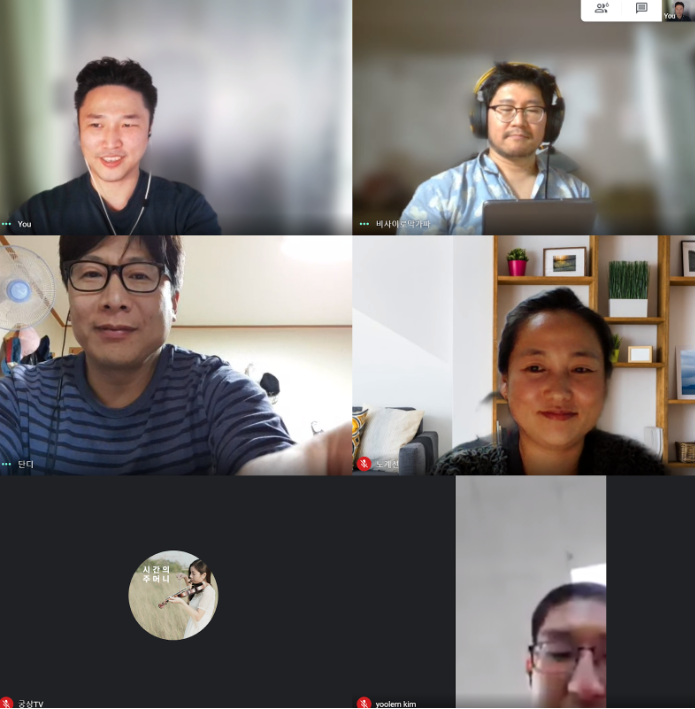 Monday, November 16, 2020, 2nd session
We began on time as scheduled. First, Mori and Gyeseon, who had joined early, briefly exchanged updates with me about how our week had gone. I had also been reading The Road to Serfdom with them for some time. Since we meet online twice a week for more than two hours each time, they are, these days, the people I spend the most time with after my family, coworkers, and personal trainer. That is meaningful not only in terms of time, but also because we are able to share together the wisdom awakened by books.
Being able to read a good book and deeply exchange our individual observations and judgments about current social phenomena is, in truth, not easy unless one is a student. Even if time permits, it is never easy to find people around you who share the same interests, or, even if such friends exist, to meet them regularly. This is all the more true when the activity has nothing to do with economic gain. Paradoxically, I consider it a great stroke of luck that the COVID situation led me to discover this kind of gathering.
Last Sunday, I took part for the first time in my family’s ancestral rite. As we talked briefly about that, we ended up discussing, in broad terms, the yangban-oriented society of the Joseon era, the background in which the country of Joseon was founded, and how it declined.
As it happened, I had once seen a YouTube video by a scholar who had studied this subject in depth, so I shared the link in the chat window.
https://www.youtube.com/watch?v=czmkn-B8V3A
Personally, Dr. Jaebong Hahm’s research helped me understand myself as a Korean and to understand Korea’s modern and contemporary history not just with my head, but with my heart.
P22 Demobilization
Bastiat uses the maintenance of the military as an example in discussing what is seen and what is not seen. The reason for maintaining a military is national security. There is no real disagreement about paying the cost required for that. However, he criticizes the argument that the military should be maintained because of the economic value generated by its existence.
What is seen: 100 million francs in taxes for maintaining the military; the economic activity of merchants and manufacturers generated by military consumption
What is not seen: the opportunity cost lost because those 100 million francs were taxed away; the economic activity reduced as a result; the labor young soldiers could have provided; the time they could have spent developing their skills
If one focuses only on what is seen, one ends up making sophistical arguments that miss what is unseen.
Gyeseon commented that “the military” might not be the most suitable example. Thinking about why that might be, I came to feel that it may be because “security” applies to all citizens. As better substitutes for “soldiers,” ideas such as “member of the National Assembly” and “civil servant” came up.
If more civil servants are hired, it is certainly true that they receive more wages and that various secondary economic effects result from that. However, if they are not engaged in work that creates greater added value, then more taxes must inevitably be used to employ more civil servants. Therefore, by the same logic, one can explain clearly and simply why the argument for maintaining an excessive number of civil servants is sophistry.
P26 Taxes
Using the same logic, he rebuts arguments about the usefulness of taxation.
What is seen: the livelihood of civil servants; the economic activity of merchants and manufacturers serving them
What is not seen: taxpayers’ spending decreases by that much; the economic activity of merchants and manufacturers declines to the extent that taxpayers’ purchasing power falls
Was the Sunshine Policy toward North Korea really effective? Did it merely help high-ranking officials consume luxury goods? Still, shouldn’t we help on humanitarian grounds? Past aid to Africa only enriched dictators. In the case of West Germany, when it gave help to East Germany, it also demanded changes that needed to be made. If we are to help North Korea properly, shouldn’t we be able to set conditions—not simply give unconditionally, but require them to create an environment in which they can sustain themselves?
P31 Theaters and the Arts
Should the state support the arts? At first glance, it seemed obvious to me that it should. Culture and the arts are essential to human society, but wouldn’t most artists find it difficult to make a living without assistance?
But Bastiat states clearly: “Public expenditure is always possible only by reducing private expenditure, and as a result, only the type of labor changes; no new jobs are created for the economy as a whole.”
Is it justified to build the Sejong Center for the Performing Arts or the Seoul Arts Center with the national budget? I do not know. But one thing is certain: they were built with someone’s money, and there are people who enjoy the benefits more than others. There may be visible economic gains from supporting the arts, but there must also have been unseen economic losses.
If someone argues that the economic gains from supporting the arts are greater, then we would also have to conclude that spending even more money to support the arts is justified.
We talked about pansori, the screen quota system, and traditional Korean archery.
There is no government support for the production of traditional Korean bows. Even so, they have become an export item and have developed into a leisure activity that is now easily encountered at domestic tourist sites. The pansori group Leenalchi could also serve as a good example. Entertainment, plastic surgery, and cosmetics all became globally competitive industries without government support.
How should we think about Germany’s Autobahn and Korea’s Gyeongbu Expressway? My own thought was that the Gyeongbu Expressway may have served as a pump-primer for economic development. An opposing view would be that, had the Gyeongbu Expressway not existed, perhaps we might instead have made rational use of other forms of transportation, such as waterways. But I think that lies in a realm we cannot truly know.
Taejun offered the view that there was not much difference between South and North Korea in the past. However, South Korea fostered companies and allowed them to remain privately owned rather than state-owned, whereas North Korea took them into state ownership, and that is why things turned out as they have today.
Mori told us that we borrowed the model of economist Erhard, who achieved the economic growth often called the “miracle of the Rhine” in Germany. Thanks to our country’s success, many other countries later adopted it as well. At the same time, however, he pointed out that those countries later experienced similar side effects too.
Yuron expressed the view that if preserving something has value, then the most proper method is for those who believe so to voluntarily pool their money and support it. In fact, a great deal of conservation in the United States is said to be done in that way.
This made me wonder whether the same would apply to the protection of endangered animals. As we discussed that, the conversation turned to global warming. Yuron pointed out that the biggest problem regarding global warming is the current reality in which arguments from the opposing side are completely dismissed. He was concerned by the very fact that papers studying whether global warming is truly being sustained by human activity, and whether specific human actions to prevent it actually have meaningful effects, are either rejected outright or pressured into silence.
Many renowned scientists are concerned about global warming. At the same time, we were able to discuss the fact that there are also scientists who argue that, given that Greenland and Norway had warm climates thousands of years ago, it is difficult to view global warming simply as an acceleration of change caused by human behavior. Unless one is an expert, it is hard to know what is right and wrong—and even for experts, I imagine it is no easy matter—but I think that if doubts exist, there must be a public forum where they can be thoroughly investigated and discussed to the end.
As we talked about how global warming used to be an environmental issue but has now, in some respects, become a political one, various remarks were exchanged about election fraud. Gyeseon lamented that when thinking about the other side, assuming “Surely they wouldn’t go that far?” may be far too naive a response. One must consider that they may be acting with what she called a “diabolical imagination,” yet people are being so naive that they are handing over things that really ought to be rigorously contested.
Closing
Today as well, along with the content of the book, we were able to exchange a wide range of views.
Although we were reading a book written in 1840, it did not seem different from the present situation at all. Even the current issues dealt with by each camp, and the logic used regarding them, had not changed in the slightest.
It was both surprising and interesting. I found myself thinking that 50 years ago, 100 years ago, even 200 years ago, there must have been people gathering and talking much as we do now.
There must also have been people playing word games like “warm conservatism,” and people who planned models that did not work, like income-led growth.
Perhaps 100 or 200 years from now things will not be much different either. That may be why it seems only natural that history repeats itself. Individual human beings live and die, but the modes of thought that govern them seem to live forever.
This may be one of the limits of human existence, but at the same time I hope it is something that can be overcome through the accumulation of new technology and knowledge. After all, there remains the unchanging fact that, through struggles against monarchy, hereditary status systems, and slavery—institutions that once seemed eternal—we have undeniably expanded the horizon of individual liberty.
Original title: 바스티아 <법>-2차
Author: Jayujuui Ipmun Dokseotoronmoim
Date: 2020-11-16
Source: https://www.cfe.org/bbs/bbsDetail.php?cid=reading01&pn=7&idx=23242