
Germany Overcame Populism Through Social and Labor Reform: “A Leader Must Stake Their Office on the National Interest” (Former C
-
Writer
Hyeok-cheol Kwon
-
 ⊙ Under Social Democratic Party governments in the 1970s, Germany was reduced to the “sick man of Europe” because of labor market rigidities, welfare expansion, and the like
⊙ When labor unions demanded measures such as higher taxes on the rich and more government debt, Schröder rebuked them, saying, “I’ve never heard such stupid nonsense in my life!”
⊙ He appointed Hartz, a former Volkswagen executive, and pushed through reforms such as labor market liberalization and cuts to welfare benefits
⊙ Schröder’s SPD lost power, but the number of jobs rose to the highest level in history… Germany reemerged as the “leader of Europe”
Hyukchul Kwon
Born in 1961. Graduated from the Department of Public Administration at Sungkyunkwan University. Received his M.A. and Ph.D. in economics from the University of Cologne in Germany. Formerly served as Director of the Law and Economics Office at the Center for Free Enterprise (CFE), Director of Strategy at the Free Economy Institute, Director of the Center for Free Enterprise, board member of the Foundation for Broadcast Culture, and president of the Academic Society for Liberal Democracy Studies. Currently Vice President of the Center for Free Enterprise (CFE)
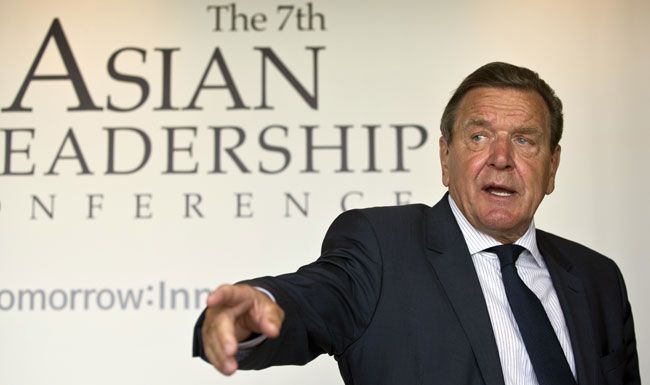
Gerhard Schröder, the former German chancellor who carried out social reform with the fate of his government on the line.
“Five million unemployed is absolutely unacceptable!”
This was the cry Gerhard Schröder uttered while serving as Germany’s chancellor. The remark captured the reality of a German economy that was gravely ill and gasping for breath, while also expressing his urgency and resolve that reform to cure this illness could no longer be delayed.
In 2003, when Chancellor Schröder began his reform drive, Germany’s population was 82.5 million, and the number of unemployed had already exceeded 4 million and was approaching 5 million. In February 2005, as the reforms were just getting underway, the number of unemployed reached an all-time high of nearly 5.3 million. The unemployment rate stood at 11.3%, the third-highest in the European Union after Poland and Slovakia.
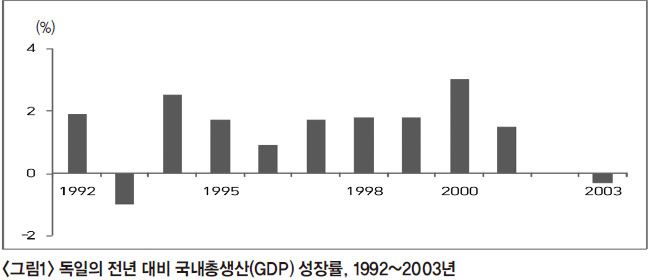
What made the problem especially serious was that these were not developments of just a day or two. In other words, this was not the result of a temporary downturn caused by a simple recession, but a structural problem in which the accumulated evils of populism had finally surfaced. The German economy, which had once achieved the “Miracle on the Rhine” through rapid growth, posted very low growth of under 2% from 1990 to 2003, except for the brief boom in 2000 caused by German reunification. By 2003, it had even recorded negative growth. (See Figure 1)
Schröder’s Decision for Political Suicide
As a natural consequence, unemployment hovered above 10% throughout the 1990s and never truly escaped that level. The number of unemployed rose from over 3.5 million to 4 million and then close to 5 million, ultimately reaching a record high in 2005 of 5.3 million unemployed and an unemployment rate above 11%. The German economy, once called the “locomotive of Europe” and the “heart of Europe’s economy,” kept falling and fell so far that many media outlets, including Britain’s The Economist, were calling Germany the “sick man of Europe.” Reform had become an urgent task that could no longer be postponed.
At the same time, as a politician, Chancellor Schröder could not ignore the fact that the reforms he envisioned could inflict enormous political damage not only on himself but also on his party, the Social Democratic Party (SPD). This is true of all reforms, but especially reforms that cut populist, benefit-driven welfare spending while emphasizing individual responsibility for one’s own life, and reforms that abolish all manner of regulations and privileges in order to expand the freedom of economic actors and revitalize the market economy. Such reforms inevitably face criticism and resistance from countless vested interests.
The SPD in particular had traditionally been a party built on the full support of labor unions. For an SPD government to undertake reforms aimed at increasing labor market flexibility, weakening union power, and reducing benefit-driven welfare spending was akin to a kind of “suicide,” destroying its own support base. Schröder’s statement, “Five million unemployed is absolutely unacceptable!” was an expression of his firm determination that, whatever the political or factional temptations, reform could never be abandoned and must be carried out. The fact that he pushed ahead with reforms that could cause great political harm to himself and his party for the sake of reviving Germany and its economy shows that Schröder was not a mere political operator, but a statesman worthy of respect.
“Competition Is the Driving Force of the Market Economy” (Erhard)
Germany was not originally the “sick man of Europe.” As is well known, Germany rose from the ruins of World War II to achieve the “Miracle on the Rhine,” becoming a model nation for Europe and the world. It stood at the center of the world as a leading advanced country that had achieved high economic growth, full employment, and robust welfare.
At the foundation of this “miracle” were an emphasis on individual freedom and responsibility, and a free market economy. In a word, it was “small government, big market, and strong individuals.” And the man who drove it was Ludwig Erhard, who served first as economics minister and later as chancellor.
Germany’s economic system is the “social market economy.” Today, most people think “social market economy = an activist welfare state led by the government.” But that is a distorted and altered version of the social market economy that has emerged over the past several decades.
As the term “social market economy” itself indicates, in its original meaning the “market economy” was primary, while the “social” element was meant only to supplement it. In a social market economy, the limits of government intervention extend only to preventing so-called “economic power,” such as monopolies, and guaranteeing free competition. In other words, in the original meaning of the social market economy, government intervention was clearly limited to establishing and maintaining a fair competitive order and was not to intervene in the market process itself or in the free economic activities of the private sector.
Erhard stressed that the dynamism created by competition in a free market economy must never be suppressed, saying, “Competition is the driving force of the market economy, and what coordinates this market economy is freely formed prices. Dynamism, continuity, and a firm commitment to freedom—these are the foundations of a healthy and stable national economy, and at the same time one that is useful for social welfare.”
He also said, “Germany’s prosperity can be fulfilled only when free entrepreneurs lead the destiny of our nation’s enterprises,” and added, “The ground on which we stand is the ground of freedom. This applies especially to you businesspeople.” Accordingly, he devoted great effort to expanding business freedom and creating favorable conditions for enterprise.
“The Best Social Security Is Economic Development”
As for interest groups, especially labor unions and strikes, he argued: “If economic policy advanced by majority rule in parliament is rendered powerless by the dictatorship of social, economic, or ideological interest groups, then democracy becomes nothing more than a ridiculous comedy.… I firmly oppose strikes because they do not ease or embrace the suffering of our people, but rather intensify it.” He dealt strictly with illegal strikes according to law and principle. He went further, saying, “Even in a world where atomic bombs are possible, it is impossible to consume more than is produced,” and criticized putting distribution ahead of growth as “truly childish thinking.”
Regarding welfare in a market economy, Erhard stressed that “the harms arising in a market economy should be removed through market-oriented policies.” He strongly opposed the welfare state, where more and more people depend on the state and welfare policy becomes excessive, warning that it creates a “classless, but soulless mechanized society.” He also maintained that “the economic policy that enables the economy to grow is the best social security policy, and the more successful economic policy is, the less need there is for social security policy.” In other words, the best welfare policy is to eradicate poverty, and the best way to do that is through prosperity generated by the free market economy.
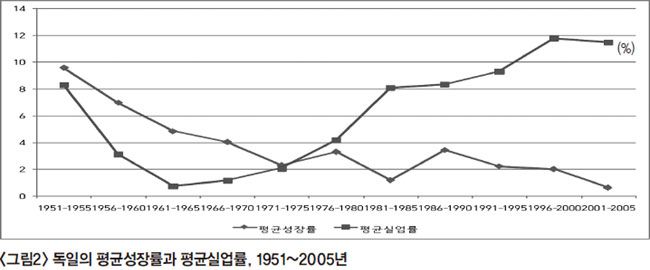
The results of the free market economy were remarkable. The average growth rates in the first and second halves of the 1950s were 9.56% and 6.96%, respectively. In the first and second halves of the 1960s, the average growth rates were 4.84% and 4.04%, respectively. As a result, the unemployment rate, which had been high immediately after the war, fell sharply and remained around 1%—the level of full employment—throughout the 1960s. (See Figure 2)
Labor Market Rigidification
But in the 1970s, the situation was completely reversed. After winning power in the 1972 general election, the SPD put distribution and welfare, equality of outcomes, and economic democratization ahead of the free market economy, individual freedom and responsibility, and free competition. Over time, regulations on the economy became increasingly dense, and welfare policy expanded excessively. This trend continued even during the 18 years after 1980 when the Christian Democratic Union (CDU) held power.
The rigidity of the labor market was clearly reflected in industry-wide collective bargaining. Industry-wide collective agreements, introduced by labor-related laws under the pretext of maintaining a balance of power between labor and management, were binding provisions that applied to all firms and workers within an industry. Only matters explicitly permitted by such collective agreements could be negotiated at the company level. The specific economic circumstances of individual firms, regional differences, and the circumstances of individual workers could not be taken into account at all.
This compulsory nature of industry-wide collective bargaining was especially fatal for small and medium-sized firms with low profitability. For example, one company faced closure if it complied with the working hours stipulated in the industry-wide collective agreement, so it introduced two hours of overtime per week with the consent of 95% of its employees. Even though both the employer and the workers agreed, and only those workers who supported it actually participated in the overtime work, the company was sued for violating the collective agreement and lost in court.
Dismissals were, of course, strictly restricted under dismissal protection laws. A “socially unjustified” dismissal was illegal, and the burden of proving that a dismissal was not unjustified rested on the employer. Even when dismissal was permitted, heavy severance pay remained a major burden.
Naturally, this rigidity in the labor market led to absurdly high labor costs. In 2000, labor costs in West German manufacturing were 25.81 euros per hour, far higher than the 22.81 euros in the United States, 18.26 euros in France, and 18.8 euros in the United Kingdom. Firms began moving their production bases overseas one after another.
Bloated Welfare
Alongside labor market rigidity, what made the German economy sick was the welfare system, which had been expanding continuously since the 1970s. There were old-age pensions, health insurance, and unemployment insurance, and unemployment insurance was subdivided into unemployment benefits (Arbeitslosengeld), unemployment assistance (Arbeitslosenhilfe), and social assistance (Sozialhilfe). When a worker lost a job and became unemployed, he or she first received unemployment benefits from unemployment insurance, amounting to 67% of previous wages for 32 months. After that came unemployment assistance (57% of previous wages), and then social assistance as a basic livelihood recipient. Those unable to work because of illness received sickness benefits. For the first 6 weeks, they received their full previous income, and afterward 80%. Sickness benefits could be used at any time within a limit of 78 weeks over a period of 3 years. Germany even had a famous ailment nicknamed “Monday sickness,” so called because the rate of absence due to illness was conspicuously high on Mondays.
Labor market rigidity increased unemployment, while the generous welfare system made it more attractive for the unemployed to remain social security recipients than to reenter the labor market. There was little reason for displaced workers to engage actively in job searching. As a result, nearly half of unemployed workers remained in long-term unemployment for more than a year.
The pension insurance system was also run loosely. In the early 1970s, although the pension eligibility age was 65, early pensions were allowed from age 60 or 63. Population aging and the shift to an inverted population pyramid worsened the pension system’s finances even further. In the early 1990s, under the justification of stabilizing the deteriorating finances, the government raised the pension eligibility age back to 65 and increased the contribution rate from 18.7% to 20.3%, but this was not enough.
The same was true of health insurance. In a situation where individuals had little need to be conscious of medical costs, health insurance spending rose rapidly. Combined with rapid aging, health insurance expenditures expanded to an uncontrollable degree.
Regulations on starting a business were also strong. While it took 11 days to start a business in the UK and 7 days in the US, in Germany it took as many as 90 days. In the skilled trades (Handwerk), moreover, one could start a business only with a master craftsman certificate (Meisterbrief).
From a “Social Market Economy” to “Market-Economy Socialism”
As unemployment rose on the one hand and welfare spending expanded on the other, the social security system and public finances fell into crisis. As of 2002, spending on various social security systems in Germany amounted to 40.7% of GDP, far higher than 28.9% in the United States and 37.7% in the United Kingdom. On the one hand, this increased the tax burden on the public; on the other, it continually expanded government deficits. From 1950 through the late 1960s, Germany’s debt ratio had remained steadily at 20% of GDP. But from the 1970s onward, it began to rise sharply, reaching 60% by the late 1990s and then soaring to 70%.
After the 1970s, Germany’s economic order was no longer a “social market economy.” Because populist policies caused the “social” element, originally only a supplement in the social market economy, to swallow up the primary “market economy,” Germany’s economic order had become not a “social market economy” but “market-economy socialism.” The result was stagnant growth and mass unemployment. Since the 1970s, growth had failed to rise above the 2% range, and by the early 2000s it had fallen below 1%. The unemployment rate rose steadily, reaching 8% in the 1980s and more than 11% from the mid-1990s onward. (See Figure 2)
After winning the general election in the late 1990s and taking office, SPD Chancellor Schröder took several reform measures, including easing the tax burden on individuals and businesses, but they were not enough to cure an economy already in serious trouble. Conditions worsened further in the early 2000s, and the number of unemployed, around 3.5 million when he took office, surged out of control toward 5 million.
Finally, the German central bank issued a report titled Wege aus der Krise (“Paths Out of the Crisis”), diagnosing Germany’s crisis as a structural one and identifying three main causes: ▲ a strongly redistribution-oriented social security system ▲ labor market rigidity ▲ excessive regulation of businesses.
Agenda 2010
Recognizing the gravity of the situation, Chancellor Schröder held “fireside talks” with business and labor representatives in an effort to persuade them of the need for reform.
But the labor unions called for greater state intervention, demanding “higher taxes on the rich, more debt, and an investment program worth tens of billions of euros.” Schröder exploded in response: “I’ve never heard such stupid nonsense in my life!” A few days later, Chancellor Schröder announced the now-famous Agenda 2010 and launched a full-scale reform drive. The direction of the reforms was to revise the excessively expanded welfare state system, and the core of the reform was “small government, big market, and strong individuals.” In other words, it meant reducing the role of government, expanding and revitalizing the role and functioning of the market, and emphasizing individual responsibility. More specifically, the main pillars of the reform were labor market liberalization, social security reform, and deregulation. This meant restoring a “social market economy” that had degenerated into “market-economy socialism” back toward its original meaning: a “free market economy.”
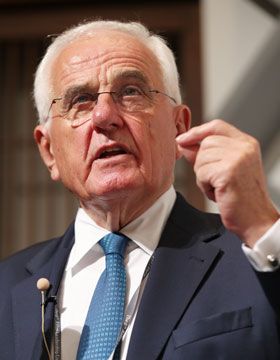
Having set the direction of reform, Chancellor Schröder formed the Commission for the Modernization of the Labor Market to discuss concrete measures. He appointed Peter Hartz as chairman. Hartz was a former executive at the German automaker Volkswagen (VW). The very fact that Schröder appointed a business executive to head the labor market reform commission made it easy to see how firm his commitment to reform was and what direction that reform would take. From 2003 to 2005, the Hartz Commission proposed reform plans in four stages, each of which was enacted and implemented. A variety of reform measures were adopted, of which the main ones are as follows.
Hartz Reforms
First, the system was changed so that company-level collective agreements were possible in addition to industry-wide collective agreements, which had been identified as a main cause of labor market rigidity. This eased labor market rigidity. The dismissal protection law was also reformed so that it would not apply to small firms and skilled trades. In addition, newly established firms were exempted from the dismissal protection law for their first 4 years. This opened the way for smoother new hiring.
To stimulate the economy, the number of skilled trades requiring a master craftsman certificate in order to start a business was reduced from 92 to 30. Ordinary people were also allowed to start a business if they hired a master craftsman. This encouraged new business formation in the skilled trades and was intended to lead to job creation. The conditions for low-income jobs eligible for special treatment under social insurance rules—Minijobs of 400 euros or less and Midijobs of 400 to 800 euros—were also relaxed, and their types were diversified.
The unemployment insurance system was also significantly revised. First, the duration of unemployment benefit payments was drastically reduced from 32 months to 12–18 months. Unemployment assistance and social assistance were integrated, and “Unemployment Benefit II” was newly created, with the benefit level lowered to that of social assistance. In addition, if an unemployed person refused a job that had been offered, benefit payments could be suspended. This eliminated the tendency of the unemployed to settle into unemployment benefits or assistance and encouraged them to engage actively in job searching.
As for pensions, it was decided that the pension starting age, then 65, would gradually be raised to 67 beginning in 2011, and the pension indexation rate linked to economic growth and income levels was reduced, effectively lowering pension payments. By curtailing pension entitlements and limiting the possibility of early retirement, the reform encouraged older workers to participate more actively in the labor market. In health insurance, patients’ out-of-pocket costs were raised to reduce the likelihood of moral hazard.
From the “Sick Man of Europe” to the “Leader of Europe”
The goal of Chancellor Schröder’s Agenda 2010 and the accompanying Hartz reforms was to make the labor market more flexible, encourage the unemployed to find work, and incentivize firms to create jobs. The results of reforms pursued with these goals were remarkable.
The number of unemployed, which had hovered above 5 million in 2005, fell to below 3 million by 2013. The unemployment rate, which had exceeded 11%, also dropped sharply to 5.3%. Youth unemployment among those under 25 also fell from 15.8% in 2005 to 7.8% in 2013, giving Germany the lowest youth unemployment rate in Europe. Since 2000, the employment rate rose from 71% to 77%, with particularly large gains among older workers. The employment rate for those aged 60–64 more than doubled, from 21% in 2000–2011 to 47%. For those aged 55–59, it rose from 66% to 79%.
Following the reforms, jobs increased substantially, and in 2008 the number of employed reached 40 million, the highest level in German history. In particular, jobs did not decline even during the severe economic crisis of 2008–2009. In 2011, the number of employed surpassed 41 million. In a report, the OECD said that a “jobs miracle” had occurred in Germany. Germany had gone from the “sick man of Europe” to once again becoming the “leader of Europe.”
As noted earlier, reforms—especially reforms of an anti-populist nature, such as labor market reform and cuts to benefit-driven welfare spending—are akin to “political suicide.” Germany rose again as the “leader of Europe” through reform, but Chancellor Schröder, who had pushed the reforms, lost the 2005 general election. Reform is that difficult and demanding a decision. Ironically, the fruits of those reforms went instead to Angela Merkel of the CDU, Schröder’s political rival and the current chancellor.
But a true national leader, not a mere political operator, must be able to make such decisions. When Schröder visited Korea in 2017, he said this:
“The public opposes reform even over small losses. But a leader must stake his office on the national interest.”⊙
Original title: 사회·노동개혁으로 포퓰리즘 극복한 독일 “리더라면 국익에 직책을 걸어야 한다”(슈뢰더 전 총리)
Author: Hyeok-cheol Kwon
Date: 2019-07-31
Source: https://www.cfe.org/bbs/bbsDetail.php?cid=press&pn=24&idx=20358