
13th Market Economy Colloquium: A Liberal Review of Laozi’s Small-State, Sparse-Population Model
-
Writer
Market Economy Colloquium
-
 13th Market Economy Colloquium
Date and Time: March 19, 2026, 11:00 a.m.
Venue: Pureun Hall
Topic: A Liberal Examination of Laozi’s Small-State-with-Few-People Model
Presenter: Sehee Oh, Visiting Research Fellow, Center for Free Enterprise (CFE)
Discussants: Yiseok Kim, Director of the Market Economy System Research Institute; Giman Kim, Secretary General of the Citizens Forum for Good Regulation; Jaewook Ahn, Professor Emeritus at Kyung Hee University; Sung-no Choi, President of the Center for Free Enterprise (CFE); Yunseok Jung, Professor at Myongji College; Gwang yong Go, Policy Director of the Center for Free Enterprise (CFE); and 8 others
A Liberal Examination of Laozi’s Small-State-with-Few-People Model
Sehee Oh, Visiting Research Fellow, Center for Free Enterprise (CFE)
1. Problem Awareness: Can Laozi’s small-state-with-few-people model be applied to modern civilized society?
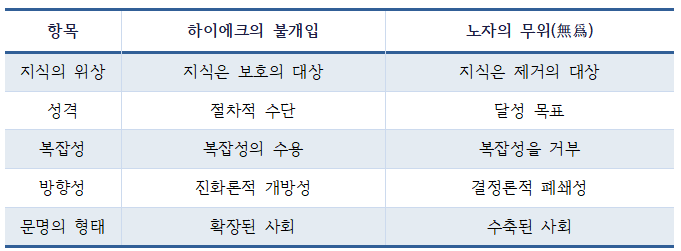
Some in liberal academic circles regard Laozi as humanity’s first liberal. However, Roderick Long criticizes Laozi’s model, arguing that its inherent structure has limitations when judged by Hayek’s concept of the Great Society, making it unsuitable for accommodating the complexity of modern large-scale civilization. In light of this issue, it is necessary to examine whether Laozi’s order of “non-action” (wu wei, 無爲) can function as a principle of the modern Extended Order.
2. The Measure of Civilization: Population Growth and the Expansion of Knowledge
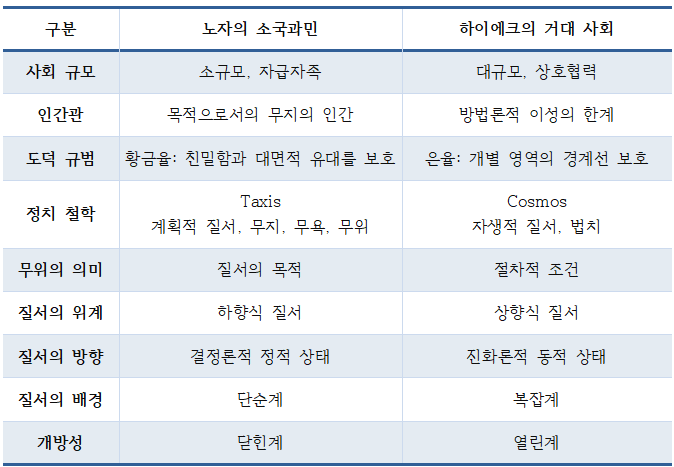
• The inherent structure of the small-state-with-few-people model: Laozi’s small-state-with-few-people model goes beyond simply envisioning a small country; it seeks a condition in which governance itself is unnecessary by radically minimizing population density. It is a project that views human intellectual ability and desire as the causes of civilizational corruption and violent politics, and seeks to preserve a state of desirelessness by blocking the use of knowledge.
• Problem awareness regarding civilization
① Laozi: Population growth is the result of the intellectual corruption of civilization
② Malthus: Population growth is a sign of civilizational catastrophe
③ Hayek: Population growth is a sign of the expansion of civilization
• Hayek’s view of population: For Hayek, population growth is both the result of civilizational development and a driving force that triggers the creation of new knowledge and the expansion of the division of labor. He interprets population growth not as a crisis of civilization, but as a sign of growth showing that a “self-maintaining order” is functioning successfully.
• The problem of knowledge and population control: From the perspective of spontaneous order, an appropriate population is not a target level that can be designed in advance, but a fluid outcome that emerges in the process of abstract rules operating. Therefore, Laozi’s population control measures, aimed at eliminating knowledge, cannot escape criticism as “constructivist rationalism.”
3. The Nature of Government: “Limited Government” and the “Planned Small State”
• The nature of limited government: The “small government” Hayek seeks refers not to physical size but to a government whose exercise of power is strictly limited by law (the constitution). The role of government is not to force specific outcomes, but to establish fair and abstract institutional conditions that enable individual members to achieve their own purposes.
• The small state as a planned order: Laozi’s small state presupposes a small community in which face-to-face knowledge can be shared, and this inevitably entails the setting of concrete goals and coercion to maintain a specific system. Hayek calls this a “planned order (Taxis)” and warns that “if such rules of the microcosm are applied to the Great Society, civilization may be destroyed.”
4. The Clash of Orders: “Determinism” vs. “Evolutionism”
Laozi’s non-action is meaningful in that it restrains the ruler’s arbitrary greed and exploitation, but by reducing the scale of civilization and blocking the use of knowledge, it results in confining society within a stagnant “closed system.” By contrast, Hayek’s order aims at an “open complex system” that continuously evolves through the use of dispersed knowledge and competition.
• Sima Qian’s assessment: If Laozi’s art of governance were applied to today’s society, it would be like blocking people’s eyes and ears.
• Roderick Long’s assessment: This is not exactly Hayek’s “Great Society.” It is closer to the primitive, acorn-chewing, anarchic stagnation found in Rousseau’s Second Discourse.
5. Conclusion
Laozi’s model of the state provides important insight in that it seeks freedom from state violence, but equating a small state with small government risks diluting the core value of constitutionalism. The true order of liberty is not a retreat achieved by contracting civilization, but a process of continually adapting to the unknown through voluntary cooperation. Therefore, the model needed for modern civilization is not a territorially limited small state, but a government that protects individual liberty by having its power strictly limited by law.
Original title: 제13회: 노자의 소국과민 국가 모델에 대한 자유주의적 관점의 검토
Author: Market Economy Colloquium
Date: 2026-03-19
Source: https://www.cfe.org/bbs/bbsDetail.php?cid=collo&pn=1&idx=28716