
[Proposal for the 22nd National Assembly] Act on Structural Reform of Private Universities
-
Writer
CFE
-


 Urgent University Restructuring Amid the Sharp Decline in the School-Age Population: Introducing “Dissolution Incentives” Is the Key
▪ As college admissions shortfalls worsen, universities must be given a “voluntary exit path,” including dissolution and mergers
▪ Under the current system, in which dissolution, mergers, and asset disposal are all controlled by the Private School Act, it is difficult to induce restructuring
▪ A private university restructuring law that allows the “payment of dissolution incentives to founders” should be introduced in the 22nd National Assembly
■ Introduction
According to the Ministry of Education, the total number of unfilled freshman seats at private universities nationwide in 2022 reached 29,535. In 2023, about 60% of four-year universities across the country failed to fill their early admissions quotas. With the school-age population and the number of college entrance exam takers rapidly declining, many universities nationwide now face a survival crisis. The number of prospective entrants expected in 2040 is estimated at 280,000—a 37% decline from 2023.
When demand—that is, the number of students wishing to enroll—falls, the supply of higher education services provided by universities should naturally decline as well. In fact, cram schools disappear from areas where the number of students actually declines. The number of CSAT takers peaked at 868,000 in 2000, and by 2020 had already fallen below the 600,000 range. Yet since 2000, only 19 universities have closed, and only 11 foundations have been dissolved. Only one university—Gyeongbuk University of Foreign Studies—has reached the final liquidation stage. In other words, the logic of supply and demand is not functioning at all in the higher education market.
Universities are trapped in the dilemma of “not being able to close even if they want to.” It is a structure in which a business or store cannot shut down. This article examines the fundamental causes of the continued stagnation in university restructuring and possible alternatives.
■ Current Status and Problems with the Existing System
Private schools in Korea are subject to very strong control and supervision by the Ministry of Education and the local education offices with jurisdiction over them. Private universities, too, must conduct all educational administration in accordance with the Private School Act and the Higher Education Act, including student recruitment, faculty hiring, establishment of departments and determination of enrollment quotas, and whether tuition may be raised.
The same is true for matters directly tied to university restructuring, such as asset disposal, mergers of foundations, and university closure (foundation dissolution or liquidation). If tuition alone makes it difficult to operate a university, even when a school foundation wishes to supplement its finances by disposing of land, buildings, intellectual property, and other assets it owns, it must obtain approval from the competent authority. Let us look at the relevant legal provisions.
Under these provisions, a school foundation’s right to freely dispose of its assets is not recognized in principle and is instead made subject to approval by the competent authority. The problem is that this “approval by the competent authority” is not only highly cumbersome but also highly uncertain, as it depends on the discretionary decision of the education office. Moreover, the disposal of “assets of the school foundation directly used for school education” is strictly restricted.
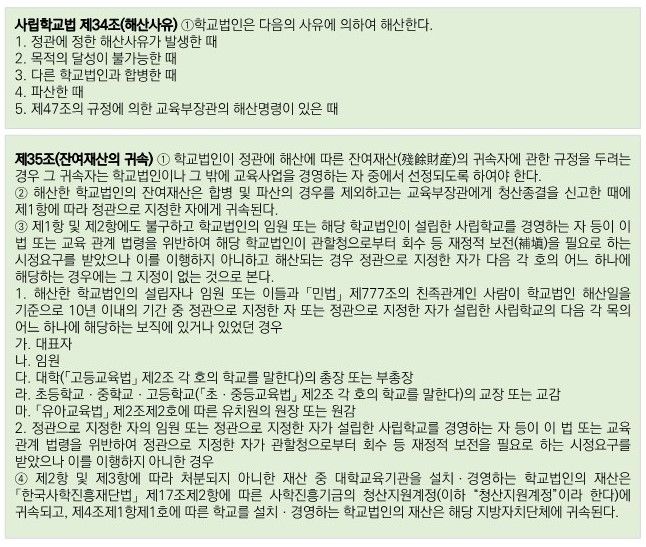
There is also another legal provision concerning private school asset disposal that deserves attention. It is the provision that stipulates the grounds for dissolution of a school foundation and the requirements for the attribution of residual assets upon dissolution.
Under Article 34, a private university cannot decide to dissolve even if it becomes difficult to operate because it cannot recruit enough students. Article 35-2 of the same Act, “Special Cases Concerning Dissolution and Attribution of Residual Assets,” provides for elementary, middle, and high schools that “where achievement of the school’s purpose becomes difficult due to a sharp decline in the number of students, the school may be dissolved with the approval of the superintendent of education, notwithstanding Article 34(1).” Private universities are excluded.
Founders of private universities view Article 35 in particular as a de facto “poison pill.” If a school foundation is dissolved, its residual assets are to vest in another school foundation, a person operating an educational business, or a person designated in the articles of incorporation; otherwise, they revert to the national treasury or local governments.
In other words, when a school foundation chooses dissolution because it can no longer operate, no assets revert to the founder. As a result, for the founder who holds effective control over the foundation, there is no economic difference between dissolving the school foundation and not dissolving it. The incentive to proceed with dissolution is correspondingly weak, given the various administrative and financial costs involved as well as the many conflicts that arise during the process, such as opposition from stakeholders and worsening local public opinion. This is precisely what makes voluntary dissolution difficult for school foundations struggling to recruit students. It is the result of a paralysis of the market order of autonomous adjustment.
■ Existing Legislative Discussions and Alternatives
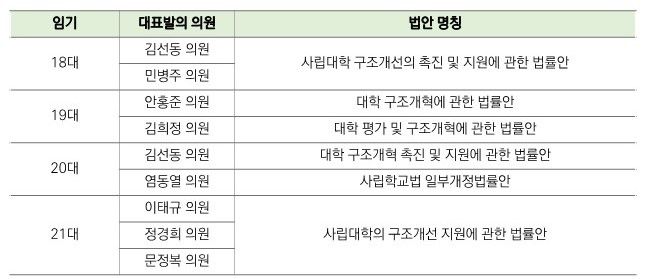
Issues such as the decline in the school-age population and the fiscal burden caused by supporting insolvent universities had already emerged as major social concerns from the early 2010s, and lawmakers from both ruling and opposition parties have introduced numerous bills to promote university restructuring. Let us look at the bills proposed since the 18th National Assembly.
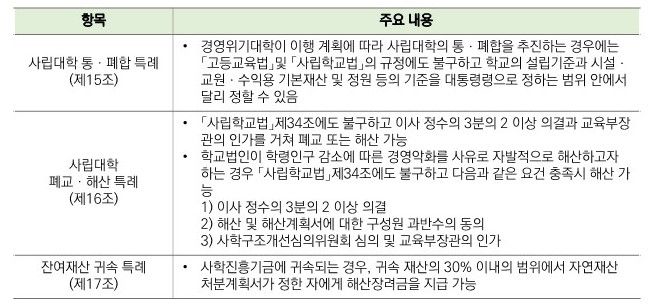
Various legislative attempts since the 18th National Assembly have generally taken the form of enacting a “special law” that would separately apply to distressed and insolvent universities while maintaining the basic framework of private schools under the general law. More recently, in the 21st National Assembly, lawmakers Taegyu Lee, Kyunghui Jeong, and Jeongbok Moon continued these legislative efforts by proposing what is known as the “Private University Restructuring Improvement Act.” The bills introduced by these three lawmakers have similar structures and content. Let us review the key points, focusing on the bill proposed by Kyunghui Jeong, a historian, university professor, and education expert.
A review of Kyunghui Jeong’s bill shows that it essentially simplifies the procedures for dissolving a school foundation and applies more relaxed special provisions than before to asset disposal and mergers. Most importantly, Article 17 provides a special provision for the attribution of residual assets—a “dissolution incentive.” It allows 30% of the assets reverting to the Fund for the Promotion of Private Schools to be attributed to the founder and others, thereby encouraging the voluntary dissolution of foundations established by insolvent private universities. It is a market-oriented solution that allows economic incentives so as to make voluntary supply reduction possible.
In September 2023, lawmakers Taegyu Lee and Jeongbok Moon held a discussion forum titled “Private Universities on the Brink: Will We Miss the Golden Time for University Restructuring?” and, together with education field experts, discussed the need to introduce a dissolution incentive system. Considering that the Democratic Party of Korea had maintained a negative stance on dissolution incentives, it was a symbolic change that a lawmaker from the Democratic Party lent support to the introduction of such incentives.
■ Proposals for the 22nd National Assembly
In Korea, private schools simultaneously carry the honor of being institutions led by social elites that helped fill the gaps in an inadequate public education system and resolve blind spots in educational access, and the disgrace of being seen as unethical forces rife with corruption and serving as little more than private vaults for founders and their families. The side effects of using school foundations as family business vehicles have long been invoked as grounds for opposing the creation of exit pathways for private schools.
But it is no longer possible to delay real university restructuring suited to an era of population decline. If insolvent universities are not dealt with, the burden of pouring money into a bottomless pit will intensify, and harm to students caused by unpaid faculty wages and deteriorating facilities will accumulate until the situation becomes irreparable. Stable and gradual market exit for insolvent universities must begin immediately, and even schools capable of normal operation must build sustainable management systems to improve their financial soundness.
Some argue that returning already-contributed assets to founders runs contrary to the spirit of establishing private schools. However, founders are also rational economic actors who weigh their interests. Only if founders are allowed to recover part of the assets will the dissolution and liquidation of insolvent foundations gain momentum. The 22nd National Assembly must take a more realistic view in approaching private school restructuring. More urgent than guarding against the greed of founders is preventing the harm caused by the chronic persistence of insolvent universities.
Original title: [22대 국회를 향한 제안] 사립대학 구조개선법
Author: Ju-jin Yoon
Date: 2023-12-13
Source: https://www.cfe.org/bbs/bbsDetail.php?cid=bill&pn=2&idx=26291