
[Recommendations for the 22nd National Assembly] Developing Alternatives to the Anti–North Korea Leaflet Law
-
Writer
CFE
-

 “Freedom of Expression Infringed”: Leaflet Ban Law Ruled Unconstitutional, Alternative Measures Needed
▪ The Moon Jae-in administration and the Democratic Party pushed through the ban law under North Korea’s pressure to halt leaflet launches to the North
▪ North Korean human rights groups filed a constitutional complaint, ultimately winning an unconstitutionality ruling… “Infringes freedom of expression and violates the principle against excessive restriction”
▪ A new legal framework is needed that permits activities informing North Korean residents of outside news while also ensuring safety
■ Introduction
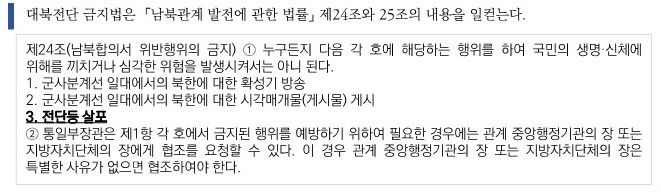
On September 26, 2023, the Constitutional Court ruled unconstitutional the so-called “anti-North Korea leaflet ban law.” The decision came 2 years and 10 months after civic groups engaged in North Korean human rights activism filed a constitutional complaint. As a result, the ban on sending leaflets to North Korea, first introduced under the Moon Jae-in administration, lost its legal basis.
The background to the Moon Jae-in government’s push for this system did include the argument that launching leaflets toward North Korea was fueling security anxiety in border areas due to North Korea’s threats against the South. But more fundamentally, many interpret it as a result of partially accepting North Korean demands as part of a conciliatory North Korea policy. However, the anti-North Korea leaflet ban law became the subject of broad criticism and controversy not only domestically but also internationally.
As a result, the anti-North Korea leaflet ban law has lost its effectiveness, and police can no longer crack down on or punish leaflet launches to North Korea. Since it has been ruled unconstitutional, immediate legal revision is required. This report examines the problems with the anti-North Korea leaflet ban law from a liberal perspective and explores how both the freedom to send leaflets to North Korea and relief from anxiety among residents in border areas might be achieved at the same time.
■ Current Status and Problems with the Existing System
□ Legislative Background and Process
Even before the launch of the Moon Jae-in administration, North Korea had continuously expressed a highly hostile stance toward leaflet launches to the North and repeatedly requested prohibition measures. During the Roh Moo-hyun administration, there were cases in which the government urged civic groups to stop launching anti-North Korea leaflets. Under the Lee Myung-bak administration as well, the government began legal review on the grounds that “private organizations’ leaflets” were hindering inter-Korean exchanges and cooperation, including the Kaesong Industrial Complex project. Later, after the sinking of the Cheonan and through the Park Geun-hye administration, inter-Korean relations remained frozen, and domestic North Korean human rights groups became even more active in launching leaflets to the North. North Korea pressured the government with a hardline position that inter-Korean dialogue could not be expected unless leaflet launches were banned.
There had been relatively broad bipartisan consensus on the concern that launching leaflets to North Korea heightened personal safety anxiety among residents in border areas as well as businesses and workers in the Kaesong Industrial Complex. In January 2015, the National Assembly’s Foreign Affairs and Unification Committee adopted a “Resolution Urging Implementation of the Agreement to Halt Mutual Slander and Defamation by the Two Koreas.” However, the ruling and opposition parties differed on whether restraint should apply to all anti-North Korea leaflets or only to certain leaflets deemed dangerous.
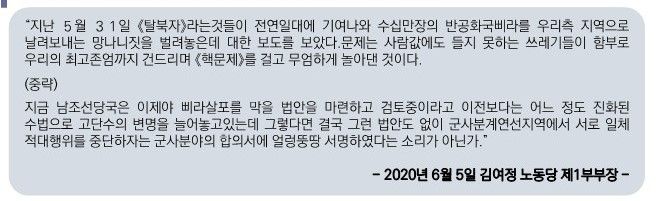
The anti-North Korea leaflet ban law entered a new phase shortly after the launch of the Moon Jae-in administration. In August 2017, soon after taking office, President Moon Jae-in instructed his aides to find a way to block leaflet launches to North Korea by private groups. The then-opposition Liberty Korea Party immediately protested, calling it “watching North Korea’s mood.” The anti-North Korea leaflet ban law had repeatedly stalled amid differences between the ruling and opposition parties, but in 2020, after the Democratic Party of Korea and other pro-government forces won a sweeping victory in the 21st general election, legislative discussions began in earnest. The immediate trigger was a statement by Kim Yo-jong, First Vice Department Director of the Workers’ Party of Korea.
Kim explicitly called for “legislation.” Immediately afterward, the Moon Jae-in administration’s Ministry of National Defense emphasized the need to stop leaflet launches, and the Ministry of Unification announced it was preparing a bill. The Ministry of Unification requested police investigations into groups sending leaflets to North Korea, while Incheon Metropolitan City and Gyeonggi Province took administrative measures banning such groups from entering border areas.
The ruling Democratic Party accelerated passage of the bill. On December 2, 2020, despite opposition protests, it passed the bill unilaterally in the Foreign Affairs and Unification Committee, and on December 8 it passed the Legislation and Judiciary Committee. The opposition People Power Party attempted to block the bill through a filibuster and other means, but on December 14 of that year, the anti-North Korea leaflet ban law was passed in the plenary session.
□ Problems with the Anti-North Korea Leaflet Ban Law as Identified by the Constitutional Court
Twenty-seven civic groups, including Fighters for a Free North Korea, filed a constitutional complaint against the anti-North Korea leaflet ban law on December 29 of the same year, shortly after the bill’s passage. Then, on September 26, 2023, the Constitutional Court ruled 7–2 that it was unconstitutional. The Court’s opinion in detail explains how the anti-North Korea leaflet ban law violated the spirit and values of the Constitution, which are grounded in the basic free democratic order.
The Constitutional Court explained that one cannot assert with certainty that prohibiting and punishing leaflet launches to North Korea would significantly reduce North Korea’s hostile actions, thereby ensuring the safety of residents in border areas and, furthermore, creating an atmosphere conducive to peaceful reunification between the two Koreas.
At the same time, the Court emphasized that restrictions on freedom of expression are extremely serious, defining freedom of expression as “on the individual level, a means of freely expressing one’s personality as well as a means for rational and constructive opinion formation and discovery of truth, and on the national and social level, an indispensable fundamental right for the existence and development of a democratic state and society.”
It further held that “considering the nature of the North Korean regime, which strictly controls inflows of information from outside and internal circulation of information in order to maintain the regime, it is highly urgent and directly connected to personal self-realization for actors to inform North Korean residents of developments in the outside world and to express opinions criticizing the contradictions of the North Korean regime, and in our country, a democratic state, this must be permitted.” Taken together, the Court found that the public-interest benefits gained by restricting freedom of expression were small, while the law excessively infringed on freedom of expression, a major fundamental right.
The Court also pointed out the problems with a blanket ban. According to some justices’ opinions finding the law unconstitutional, even without necessarily exercising the state’s penal power, the legislative objective of ensuring safety in border areas could be achieved by appropriately managing and controlling leaflet-launching activities through “a prior reporting system” and “on-site response” in order to guarantee the life and bodily safety of border-area residents. The Court determined that including criminal punishment provisions in the anti-North Korea leaflet ban law did not conform to the principle that criminal punishment must be supplementary and a last resort.
■ Previous Legislative Discussions and Alternatives
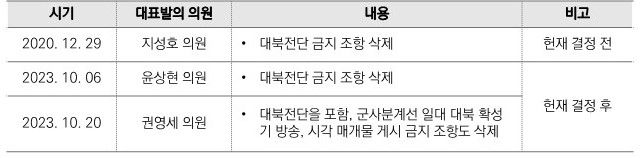
Following the Constitutional Court’s ruling that the anti-North Korea leaflet ban law was unconstitutional, the Ministry of Unification announced its intention to begin revising the law as soon as possible. It also abolished the Ministry’s internal “interpretive guidelines,” a subordinate administrative rule under the anti-North Korea leaflet ban law. Attempts in the National Assembly to revise the Development of Inter-Korean Relations Act in order to repeal the anti-North Korea leaflet ban law are as follows. The amendment proposed by Representative Youngse Kwon contains the broadest revisions.
In accordance with the Constitutional Court’s ruling, the anti-North Korea leaflet ban law has effectively no choice but to proceed toward repeal. Amending the Development of Inter-Korean Relations Act to remove provisions that have become dead letters is an unavoidable task. Using this legal revision as an opportunity to devise alternatives that satisfy both effectiveness and safety without infringing constitutionally protected liberties would, in the long run, help resolve political controversy surrounding North Korean human rights activism, including leaflet launches to North Korea.
1) As a matter of principle, a variety of means of delivering information to North Korean residents—not just leaflets—should be permitted
Under the Constitution, the area north of the armistice line is an unrecovered territory illegally occupied by North Korea, and North Korean residents unmistakably hold the status of citizens of the Republic of Korea. Therefore, conveying to North Korean residents, as fellow citizens, the realities and problems of North Korea’s ruling forces clearly falls under freedom of expression, and banning it in principle constitutes excessive legislation.
Not only should the mere act of launching leaflets be allowed; as a matter of principle, communication with North Korean residents through various methods should also be permitted. Such an approach would be consistent with a free democratic system.
2) There is a need to encourage North Korean human rights activities that satisfy both effectiveness and safety
Beyond leaflets and loudspeaker broadcasts directed toward North Korea, there are many means of supplying and circulating outside information inside North Korea. Reports that USB drives containing Korean dramas and news are widely traded in North Korea’s jangmadang markets are already familiar. At the same time, some analyses suggest that leaflet launches are of limited effectiveness because the probability of actual delivery to residents in North Korean territory is low. (North Korean human rights groups strongly object to this view, so hasty conclusions would be inappropriate.)
The security anxiety of residents in border areas is also a reality that cannot simply be dismissed. According to a June 2020 public opinion survey of Gyeonggi Province residents, 71% of respondents supported suspending leaflet launches to North Korea, and 59% said such launches threatened life and safety. In addition to security threats posed by North Korea, local residents are also said to experience significant stress from clashes between groups attempting to launch leaflets and police trying to stop or manage them.
One possible approach would be to permit leaflet launches to North Korea in principle, but operate under a reporting system that leaves room for authorities to refuse to accept a report only where the activity is judged likely to cause serious harm to the lives and safety of citizens or seriously undermine the public welfare. This is also in line with the Constitutional Court’s reference, in ruling the anti-North Korea leaflet ban law unconstitutional, to the need for “less restrictive means.”
The anti-North Korea leaflet ban law was a law excessively pushed through by the Moon Jae-in administration for the sake of short-term improvement in inter-Korean relations, and it was ultimately judged unconstitutional. Regardless of whether one supports or opposes leaflet launches to North Korea, the freedom of the act itself cannot be blocked. Infringement of freedom of expression and prior censorship are constitutionally untenable. The 22nd National Assembly must establish a legal framework suited to appropriate means of truly informing North Korean residents about freedom.
Original title: [22대 국회를 향한 제안] 대북전단 금지법 대안 마련
Author: Ju-jin Yoon
Date: 2023-12-06
Source: https://www.cfe.org/bbs/bbsDetail.php?cid=bill&pn=2&idx=26268