
[Proposal to the 22nd National Assembly] Repeal of the Mobile Device Distribution Improvement Act
-
Writer
CFE
-
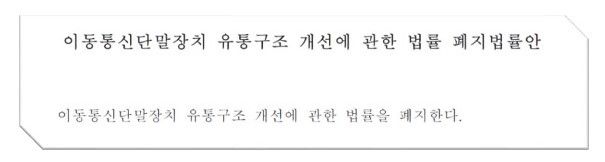 Repeal the Mobile Device Distribution Act, notorious as the “Rip-Off-the-Entire-Public Law,” and promote competition in the mobile telecommunications market
▪ Introduced to prevent “discriminatory subsidies,” but the result was higher prices, the disappearance of competition, and a decline in consumer rights
▪ Subsidy competition still persists online and in the underground economy… the Mobile Device Distribution Act has encouraged the market to go “underground”
▪ member of the National Assembly Youngsik Kim courageously proposed a bill to repeal the Mobile Device Distribution Act in the 21st National Assembly; it should be attempted again in the 22nd National Assembly
■ Introduction
The “Mobile Device Distribution Act,” formally titled the Act on the Improvement of Distribution Structure for Mobile Communications Devices, was pursued in earnest beginning with a bill introduced by Saenuri Party lawmaker Haejin Cho in 2014, and took effect on October 1 of that year. At the time, the government and political circles passed the law on the grounds that excessively large subsidies in the mobile telecommunications market were being provided irregularly, resulting in disparities in the benefits consumers received. However, even now, 10 years after its implementation, the law has remained constantly embroiled in debate over whether it should be repealed, and the argument for repeal gained momentum with the election of President Yoon Suk Yeol.
Nevertheless, in the end, the Yoon Suk Yeol administration also chose “revision” rather than repeal as its direction on the law, and in 2021 the Korea Communications Commission even gave advance legislative notice of a partial amendment bill. Yet even this amendment remains indefinitely pending in the National Assembly. The law, constantly burdened with the stigma of being the so-called “Rip-Off-the-Entire-Public Law,” is an excessive price-control regime that would be hard to imagine in a free-market economic order and is a regulation with virtually no global precedent. This paper examines why the 22nd National Assembly should repeal the law.
■ Problems with the Current System
Article 1 of the law explains that its purpose is “to contribute to the promotion of the public welfare by establishing a fair and transparent distribution order for mobile communications devices, thereby ensuring the sound development of the mobile telecommunications industry and protecting users’ rights and interests.” In reality, however, the law has not only shown decisive limitations in achieving a fair and transparent distribution order, but has also undermined the rights and interests of users—that is, the majority of customers—thereby reducing public welfare overall. The provisions of the law that warrant particular attention are as follows.
Prohibition on discriminatory payment of subsidies (Article 3)
This provision stipulates that mobile carriers, agencies, and retailers may not provide discriminatory subsidies to customers on the basis of: 1) subscription type, such as number portability, new subscription, or device replacement; 2) mobile service plan; or 3) the user’s place of residence, age, or physical condition. As a result, practices that had existed before the law—such as offering separate discounts to students or senior citizens, or providing more aggressive subsidy benefits to number portability customers in order to attract new subscribers from other carriers—could no longer be carried out as “events.”
Restrictions on excessive subsidies (Article 4)
Agencies and retailers may provide additional subsidies only within 15% of the subsidy publicly announced by the mobile carrier. This is the so-called “15% cap.” The text of the law originally provided that mobile carriers could not offer subsidies exceeding the “maximum amount of purchase support for mobile communications devices” set by the Korea Communications Commission in consideration of average expected profit per subscriber, the sales status of mobile devices, and competition in the telecommunications market, but this provision was automatically repealed under a three-year sunset clause. The initial cap applied before sunset was KRW 300,000, and it was raised once to KRW 330,000 in 2015.
Separate notice of mobile device purchase costs (Article 7)
This provision was intended to prevent confusion by clearly distinguishing and labeling the “device price” and the “telecommunications fee.” In the early discussions over the law, what consumer groups and civic groups strongly advocated was the so-called “separate disclosure system.” This system would have required separate disclosure of the subsidies applied to the device and to the telecommunications service fee. In the end, however, the separate disclosure system was not adopted. There was strong opposition centered on device manufacturers, and political leaders decided at the last minute to exclude it.
Emergency suspension orders, surcharges, criminal penalties, and administrative fines
For violations of the law, the Korea Communications Commission may order mobile carriers (including specially related parties), agencies, retailers, or mobile device manufacturers to temporarily suspend the relevant conduct or take corrective action, and may impose a surcharge of up to 3% of sales. (If sales are unclear, up to KRW 1 billion.)
Violations of emergency suspension orders or corrective orders may be punished by up to three years’ imprisonment or a fine of up to KRW 150 million, while conduct such as unjustly providing discriminatory subsidies may be punished by a fine of up to KRW 300 million. Refusing, obstructing, or evading various investigations may result in an administrative fine of up to KRW 50 million. Discriminatory subsidy payments and agencies’ or retailers’ provision of subsidies exceeding the 15% cap may result in an administrative fine of up to KRW 10 million.
As seen above, the core of the law is fundamentally to restrict price discounts such as subsidies provided by suppliers. Yet the law suffers simultaneously from a problem of “unfairness,” in that it reduces consumer rights and interests by hindering competition, and a problem of “effectiveness,” in that there is a severe disconnect between real market mechanisms and the law.
1) The unfairness of restricting subsidies: deterioration of consumer welfare
The law was originally introduced to eliminate disparities in subsidy benefits among consumers, but in practice its adoption led to a contraction in price discounts by mobile carriers, manufacturers, agencies, and retailers, resulting in an overall increase in mobile device prices and telecommunications charges. Mechanical equality in subsidies may have been achieved, but it created the paradox that “everyone must buy at equally high prices.”
It is also difficult to sustain the argument that disparities in subsidy benefits themselves are a harm that the government must control. By the same logic, “flash sales” at supermarkets, stores, and restaurants would also create discrimination because some people would miss out on those benefits. Even among consumers with the same demand for mobile telecommunications services, it is hard to argue that those who gather more information and make careful decisions and those who do not should unconditionally receive exactly the same benefits. In a market order, it is entirely natural that consumers willing to do more legwork are more likely to enjoy more generous subsidy benefits.
As a result, the utility consumers enjoy has declined overall, and the structure in which more diligent and loyal consumers are reverse-discriminated against has become entrenched through the law. Meanwhile, firms no longer needing to engage in cutthroat competition to capture customers have greatly benefited from it. In 2017, after three years under the law, the operating profits of the three major mobile carriers had increased while marketing costs had fallen.
2) Controversy over effectiveness: illegal subsidies rampant, market driven underground
Since the introduction of the law, has the “overheated competition” in the mobile device market actually been sufficiently resolved? Of course, the utility consumers enjoy has unquestionably decreased compared with the period before the law, but cases of illegal subsidies being provided covertly to evade the law’s regulatory net continue to be uncovered. In particular, with the growth of online promotion, there has been a growing number of cases in which customers are recruited via social media or messaging apps and given “paybacks” that effectively amount to subsidies.
In this environment, younger consumers who are relatively more adept at finding businesses that provide subsidies are able to enjoy such benefits through word of mouth, while older and elderly generations who are unfamiliar with the new media environment are left with no choice but to pay “full price” for their phones. In addition, with respect to the law’s stated purpose of making the market more transparent, it is difficult to avoid the criticism that the law has instead driven subsidy practices further into the underground economy.
In 2017, a case was uncovered in which an employee of the Korea Communications Commission—the agency responsible for enforcing the law—received cash and a payback from a mobile carrier in exchange for signing up as a new subscriber. As both an official charged with implementing and applying the law and a consumer seeking to buy a phone as cheaply as possible, he ultimately chose the subsidy benefit. It was a decisive scene—and an absurd episode—that vividly illustrated the paradox of the law.
■ Existing Legislative Discussions and Alternatives
The Yoon Suk Yeol administration has shown its intention to revise the law. In 2021, the Korea Communications Commission submitted to the National Assembly a bill to raise the additional subsidy that agencies and retailers may offer from the current 15% to 30%. It also revised the Detailed Standards on Methods of Public Notice and Posting of Subsidies, designating Tuesdays and Fridays as the days on which mobile carriers may change publicly announced subsidies, thereby shortening the minimum notice period from the current 7 days to 3–4 days.
However, the bill submitted by the Korea Communications Commission remains pending in the National Assembly, and although momentum for amendment has increased since the appointment of Korea Communications Commission Chairman Dongkwan Lee, there is still no clear prospect.
Meanwhile, in the 21st National Assembly, there was a highly groundbreaking legislative attempt regarding the law: a repeal bill introduced on November 2, 2020, by member of the National Assembly Youngsik Kim of the People Power Party, together with 27 other members of the National Assembly.
member of the National Assembly Kim explained the reason for the repeal bill by stating, “Rather than preventing discrimination among users, the ‘Mobile Device Distribution Act’ has caused a decline in user welfare by reducing the subsidies paid to users.” However, he sought to minimize any legislative vacuum by reflecting the law’s provisions related to enhancing consumer welfare and public disclosure of information through amendments to the Telecommunications Business Act.
■ Recommendations for the 22nd National Assembly
There are effectively no overseas legislative precedents similar to the law. In the United States, where price competition is fierce, the device sales process is left entirely to market order, and aggressive discount policies are widespread. In Europe, competition is promoted mainly by transparently disclosing information on pricing and subsidies. Even in Japan, which at least similarly introduced a subsidy cap, competition to attract subscribers through greater diversification of mobile service plans appears to have become more active.
To ease the household burden of telecommunications expenses, revitalize competition in the mobile telecommunications market, and improve consumer rights and interests, bold repeal of the law has long been discussed as the fundamental solution. In the 21st National Assembly, member of the National Assembly Youngsik Kim raised that courageous banner. It is now time for the government, too, to move actively toward repeal rather than relying on the stopgap measure of amendment. Thanks to the development of media platforms, consumers now have a wide variety of channels through which to obtain information. Consumers will no longer tolerate the old “luck-of-the-draw” harms associated with subsidies. As the 22nd National Assembly begins in 2014, one can hope that it will put an end to the 10-year history of the Mobile Device Distribution Act.
Original title: [22대 국회를 향한 제안] 단통법 폐지
Author: Ju-jin Yoon
Date: 2023-11-29
Source: https://www.cfe.org/bbs/bbsDetail.php?cid=bill&pn=2&idx=26182