
[Proposal to the 22nd National Assembly] Normalizing the Inheritance Tax
-
Writer
CFE
-
 It Really Is Time to “Tackle” Korea’s OECD-Highest Inheritance Tax Rate
▪
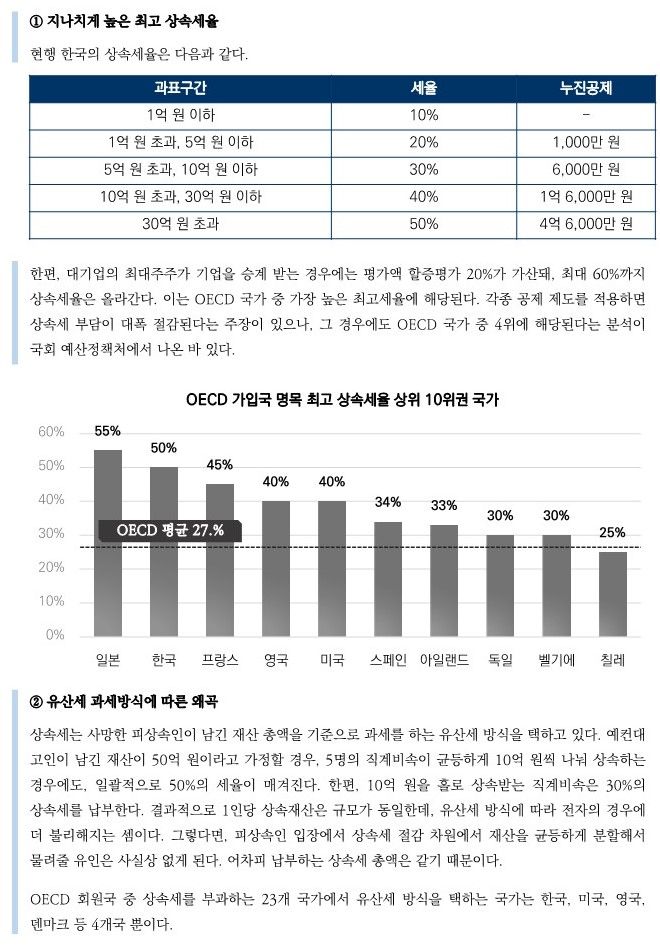
Korea has the OECD’s 2nd-highest nominal top inheritance tax rate; when the premium for controlling shareholders of large corporations is added, it rises to 60%, the highest in the OECD
▪
This inheritance tax bomb destabilizes management control and accelerates corporate relocation overseas, ultimately harming the broader public as well
▪
The rate should be cut by about half, and the system should be converted to an inheritance acquisition tax; introducing a capital gains tax should also be considered
■ Introduction
With the death of Lee Kunhee, the legendary entrepreneur and former chairman of Samsung, the inheritance tax his heirs must pay is estimated at around 12 trillion won. The heirs have been scrambling to secure funds for the tax payment through loans and stock sales. This has all fueled controversy by raising concerns about corporate competitiveness and management control. Meanwhile, after the sudden death of Kim Jungju, founder of Nexon and former chairman of NXC, his bereaved family paid 6 trillion won in inheritance tax in kind through company shares. In an almost absurd turn of events, the Ministry of Economy and Finance suddenly became the second-largest shareholder of the nation’s largest game company.
Deputy Prime Minister for Economic Affairs Choo Kyungho suggested the possibility of inheritance tax reform, saying, “It is time to tackle it.” At the same time, however, he also expressed concern about public resistance and aversion.
Korea imposes one of the highest inheritance tax rates among OECD member countries. Can the current inheritance tax system really be maintained as it is? Can inheritance tax truly be dismissed as simply a “tax on the rich”? The UK government, which introduced inheritance tax in 1796 and maintained it for more than 200 years, recently announced that it would move toward a phased abolition of the tax. This suggests that inheritance tax may no longer be regarded without qualification as a “global standard.”
This article examines why the 22nd National Assembly must seriously pursue the normalization of inheritance taxation.
■ Problems with the Current System
Inheritance tax is a tax imposed on an heir based on the value of property acquired without compensation from a deceased person as a result of death. Detailed provisions are set out in the Inheritance Tax and Gift Tax Act.
Along with gift tax, it is a representative tax imposed on so-called “unearned income,” introduced to curb the hereditary transfer of wealth and enhance redistribution through taxation. It has remained in place since the establishment of the government.
■ Previous Legislative Discussions and Alternatives
As discussed above, there is growing consensus that the excessively high top inheritance tax rate obstructs the smooth succession of corporate management control and hinders the emergence of so-called “century-old companies.” In response, the government and political circles have introduced and operated the “family business inheritance deduction” system. For example, if the deceased is deemed to have been engaged in front-line management for at least 30 years, up to 60 billion won may be deducted from the taxable inheritance value.
However, controversy over the effectiveness of the family business inheritance deduction continues. First, it applies only to small and medium-sized enterprises and mid-sized companies, meaning large corporations cannot use it. It is also pointed out that even SMEs and mid-sized firms face limitations because the requirements are excessively strict. In a May 2023 report, the Korea Economic Research Institute (KERI) diagnosed the situation as follows: “Korea’s family business inheritance deduction system has seen only 95.7 cases used on annual average between 2016 and 2021, with a total deduction amount of 296.7 billion won.” It attributed this to the fact that “the pre- and post-application requirements—such as eligible businesses, the CEO’s period of management, business-type maintenance, and asset maintenance—are so stringent that few business owners attempt to use the system, and the actual amount deducted is too small to be very meaningful.”
Ultimately, opinion is converging around the need for a fundamental solution: lowering the inheritance tax rate itself. Let us look at recent efforts in the National Assembly to revise inheritance tax rates.
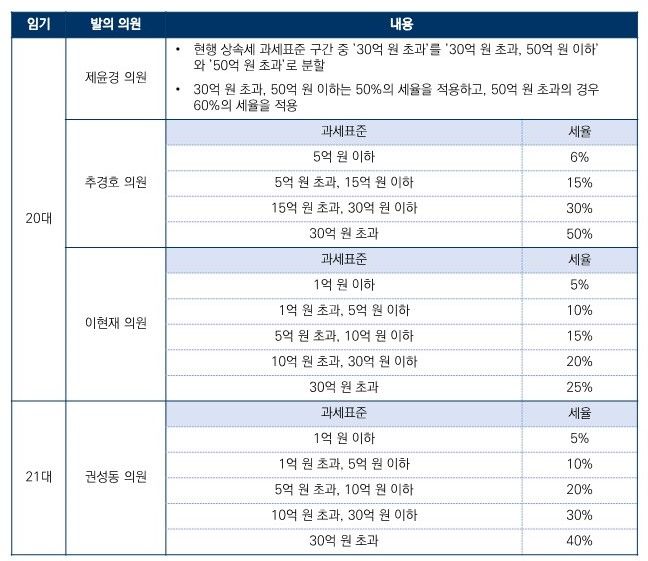
According to the bills reviewed, all but one of the four lawmakers—Rep. Jeyoon Kyung of the Democratic Party of Korea—place their emphasis on lowering inheritance tax rates. Among them, the boldest bill is the amendment proposed by Rep. Lee Hyunjae.
■ Proposals for the 22nd National Assembly
Inheritance tax is, strictly speaking, a form of double taxation because it imposes tax again on property that has already been accumulated after payment of various taxes such as income tax and property tax. According to a survey conducted in October 2023 by the Korea Employers Federation (KEF) of 140 venture and startup CEOs in their 30s and 40s, 85% of respondents supported abolishing the inheritance tax and introducing a capital gains tax. Australia and Sweden, both commonly classified as welfare states and known for strong income redistribution systems, have abolished inheritance tax altogether. Italy, Norway, and Switzerland have retained inheritance tax only in skeletal form, with rates reduced to below 10%. Worldwide, inheritance tax is trending toward abolition or reduction due to concerns such as corporate relocation overseas, unnecessary costs incurred in defending management control, and weakened entrepreneurship.
Given the sentiments unique to Korean society, the immediate abolition of inheritance tax would carry a heavy political burden. Therefore, phased relief of the inheritance tax burden may be considered as an alternative. Inheritance tax reform is needed in the following directions.
First, the rate should be lowered. Reducing the top inheritance tax rate by about half would be reasonable when compared with the OECD average. Given the scale of the national economy and the increase in citizens’ income, raising the tax base threshold at which the top rate applies could also be considered.
Second, the system should be converted from the current estate tax model to an inheritance acquisition tax model. Taxing according to the amount of property actually inherited is more consistent with the original purpose of inheritance tax: curbing the hereditary transfer of wealth. It could also encourage more even division of inherited assets.
Third, in the long term, an institutional foundation should be laid for a shift to a capital gains tax. One method is to deem inherited property as having been “sold” and impose capital gains tax accordingly; another is to tax the increase in wealth generated on the basis of inherited property. This is discussed as an alternative that can both ensure stable succession of family businesses and produce a redistributive effect by taxing gains arising from inheritance.
A major “generational shift” is now underway among Korea’s leading companies. As long as inheritance tax continues to carry labels such as a punitive tax or a predatory tax, it will be difficult to eliminate the “inheritance tax risk” facing businesses. Easing the inheritance tax burden may reduce tax revenue in the short term, but if the tax savings are used for corporate reinvestment and job creation, the benefits will ultimately return to the broader public. If people were already saying at the end of the 21st National Assembly that “it was time to fix it,” then the 22nd National Assembly must now solve that task.
Original title: [22대 국회를 향한 제안] 상속세 정상
Author: Ju-jin Yoon
Date: 2023-11-22
Source: https://www.cfe.org/bbs/bbsDetail.php?cid=bill&pn=2&idx=26146