
[Proposal to the 22nd National Assembly] Abolish the Large Business Group Designation System
-
Writer
CFE
-
 The Galapagos-Style Regulation That Induces the “Peter Pan Syndrome”: The Large Business Group Designation System
▪
Although legal improvements have been made, such as raising the threshold and tying asset size to GDP, the system’s fundamental limitations remain.
▪
As firms grow from small and medium-sized enterprises to mid-sized firms and then to large corporations, regulations increase like a snowball, creating a widespread tendency to avoid growth.
▪
Even Japan, with a similar economic structure, has effectively abolished the system... It is time to consider abolishing it from the ground up.
■ Introduction
The term “large corporation” is extremely familiar to us. It is often used interchangeably with “chaebol company.” In reality, however, it is uncommon around the world to define precisely the size, type, and business scope of a large corporation. More commonly, small and medium-sized enterprises are defined as entities to be protected in order to promote fair competition, and all other firms are then classified as large corporations. In English, a large corporation is sometimes referred to as a “conglomerate company,” but strictly speaking, that means a “diversified enterprise.” It refers to a giant corporate entity formed by a combination of companies in various industries. Of course, this is similar in nature to Korea’s large corporations. Even so, it does not simply mean a “big company.”
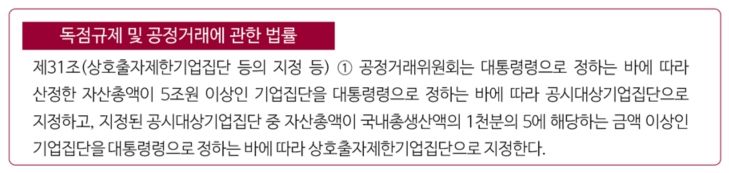
Meanwhile, Korea has a legally defined category of large corporations. The exact term is “large business group” (hereinafter “business group”). Every year, the Fair Trade Commission designates and announces these business groups. There are two types: disclosure subject business groups and cross-shareholding restricted business groups. The stated purpose is to curb concentration of economic power.
From the standpoint of small and medium-sized firms and mid-sized firms, is belonging to a business group a proud badge of success? At least in Korea, being incorporated into a business group is something firms seek to avoid and fear. Whenever possible, they would rather remain a mid-sized firm than become a large corporation, and rather remain an SME than become a mid-sized firm. This is also called the “Peter Pan syndrome.” By nature, firms seek growth and expansion. Why, then, would they voluntarily reject the honor of becoming part of a business group? That is the fundamental reason why the 22nd National Assembly should consider abolishing the large business group designation system.
■ Problems with the Current System
The large business group designation system, first introduced in 1987 under the Chun Doo-hwan administration through the Monopoly Regulation and Fair Trade Act (hereinafter the “Fair Trade Act”), has evolved alongside 35 years of economic growth. At the time of its introduction, the threshold was 400 billion won in assets, and 32 companies, including Samsung, were designated.
Later, the standard was changed to designate the top 30 firms by asset ranking in the business community, and in the 2000s it was changed back to total assets. The threshold gradually rose from 2 trillion won to 5 trillion won and then again to 10 trillion won. This reflected the expansion of the economy and the increase in global multinational corporations. Let us examine the current framework under the law.
Under current law, the criterion for determining a cross-shareholding restricted business group is a company holding assets of at least 0.5% of GDP. Considering that the Fair Trade Commission designates and announces business groups each year around April, this provision has applied since 2024. Korea’s nominal GDP in 2021 was provisionally recorded at 2,072 trillion won, and 0.5% of that exactly matches the current threshold of 10 trillion won. Changing the criterion from an absolute asset amount to a ratio relative to GDP, as such, can be regarded as a positive legislative example, as it eliminates the inconvenience of having to revise the law each time Korea’s economy grows and the total-asset threshold needs to be raised.
However, controversies surrounding the necessity, effectiveness, and appropriateness of the large business group designation system fundamentally continue. Let us look at several reasons why.
1) In an open economy, is concern over monopoly by domestic firms really appropriate?
The large business group designation system was introduced to prevent large corporations from enjoying excessive market power and potentially leading to monopolies through excessive business expansion and growth in scale.
In reality, however, most sales of major firms belonging to business groups are generated overseas, making the issue largely unrelated to monopoly in the domestic market. According to a 2022 survey by Asia Economy of the top 100 companies by market capitalization, overseas sales accounted for an average of 52.5%, and 9 firms were found to have overseas sales ratios above 90%.
Samsung Electronics earned 83.9% of its total sales overseas, while Hyundai Motor recorded an overseas sales ratio of 68.6%. Kia (71.7%), LG Electronics (60.1%), and SK hynix (97.3%) also had high shares of overseas sales.
The Federation of Korean Industries (FKI) also released an analysis showing that Korea’s economic openness rose from 65.6% in the 1980s to 91.5% in the 2010s, and argued that since foreign firms can freely enter the Korean market, separate regulation of business groups based on the assumption of a closed economy is no longer desirable.
2) A “Galapagos” regulation that exists only in Korea, weakening the global competitiveness of domestic firms
Korea is the only country in the world with a large business group designation system. There has been a steady argument that it is reverse discrimination to impose numerous additional regulations simply because a firm is large.
Even Japan, which previously operated a similar large business group designation system, liberalized the establishment and conversion of pure holding companies in 1997, except in cases where business control was excessively concentrated, and abolished the total investment ceiling system in 2002, effectively abolishing the large business group designation system.
There is also criticism that the system weakens competitiveness relative to multinational global corporations. At the special roundtable titled “What Is Wrong with the Large Business Group Designation System?” hosted in 2016 by the Korea Economic Research Institute (KERI), one business participant argued, “Overseas multinational corporations, which compete in innovative industries, are not subject to these regulations, so they will likely find it easier than Korean firms to secure the global market.” Another participant emphasized, “The real effect of concluding FTAs lies not simply in tariff elimination but in aligning regulatory levels between the two countries, so we should lower our regulations toward the level of our counterparts.” For example, foreign global companies operating in Korea are free from regulations arising from the large business group designation system, whereas Korean large corporations are not, meaning domestic firms are actually treated less favorably even in the Korean market.
■ Existing Legislative Discussions and Alternatives
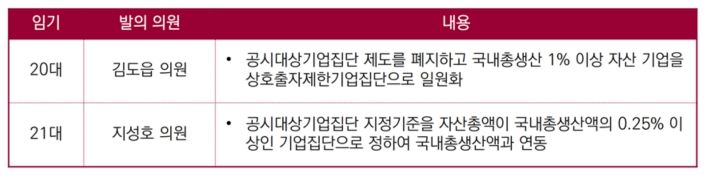
Legislative attempts in the National Assembly related to the large business group designation system have mainly focused on easing the criteria for designation. Some symbolic legislative efforts are as follows.
On April 28, 2021, the Federation of Korean Industries (FKI), a business organization representing the corporate sector, proposed that the government abolish the large business group designation system.
At the time, controversy was intensifying over the designation of the retail company Coupang as a business group. Its assets had exceeded 5 trillion won, so it was classified as a disclosure subject business group. The problem was the designation of the “same person,” that is, the controlling owner. Kim Beom-seok, chairman of the board and the de facto controlling owner, could not be designated as the same person because he held U.S. citizenship.
In the end, the Fair Trade Commission designated Coupang as a “business group with no controlling owner.” This alone showed how wide the gap is between Korean law and the current reality of global corporations, and FKI argued that the time had come to abolish the large business group designation system altogether.
At the time, FKI criticized the system, saying, “Excessive regulation is hindering venture firms and promising SMEs seeking to discover new industries through M&A. Even if these firms are small in size, once they are incorporated into a business group, they are classified as large corporations and therefore excluded from various support programs, while support from affiliates is impossible due to regulations on funneling business and unfair support practices. Coupang’s recent listing on the New York Stock Exchange also appears unrelated to this situation.”
Every April, the Fair Trade Commission’s announcement of designated business groups is always major news. As of April 2023, the Commission designated a total of 82 business groups as disclosure subject business groups, an increase of 6 from the previous year. The number of cross-shareholding restricted business groups was 48, up 1 from the previous year.
The aforementioned “Peter Pan syndrome” has already been a longstanding phenomenon in the business community. According to FKI research, when a small or medium-sized enterprise grows into a mid-sized firm, an additional 126 regulations apply; when it is designated as a disclosure subject business group, the total number of applicable regulations rises to 274. A cross-shareholding restricted business group with assets of 10 trillion won or more may be subject to as many as 342 regulations. In the “Survey on the Management Conditions and Implications for Mid-sized Firms” released by the Korea Chamber of Commerce and Industry (KCCI) in January 2023, 77% of responding firms said they “currently feel or have felt the impact of newly applied policy changes, such as reduced support and stronger regulation, after graduating from SME status.”
In August 2022, Rep. Yoon Chang-hyun of the People Power Party hosted a business seminar titled “30 Years of the Business Group Designation System Under the Fair Trade Act: Is It Still Appropriate?” He emphasized that “at a time when national borders are gradually disappearing in the global market and new forms of services and industries are emerging through constant technological innovation, a fundamental review is needed as to whether regulations created in an era of low economic openness, when some firms could monopolize the market, should still be applied as they are.”
Of course, immediately abolishing the large business group designation system would entail significant political and social burdens. It could easily create the impression of taking the side of large corporations.
However, as long as the framework of the large business group designation system remains in place, it is impossible to completely rule out the possibility that changing policy stances by the authorities and populist political conditions will continue to generate new regulations targeting large corporations. As Rep. Yoon Chang-hyun pointed out, a “fundamental review” is needed. The 22nd National Assembly should seriously discuss abolishing the large business group designation system, which undermines incentives for Korean firms to grow and functions as reverse discrimination against global companies.
Original title: [22대 국회를 향한 제안] 대기업 집단 지정 제도 폐지
Author: Ju-jin Yoon
Date: 2023-11-15
Source: https://www.cfe.org/bbs/bbsDetail.php?cid=bill&pn=2&idx=26136