
[Proposal for the 22nd National Assembly] Modernizing Breach of Trust Law
-
Writer
CFE
-
 Breach of Trust Offense That Stifles Entrepreneurship Must Be Modernized by Introducing the Business Judgment Rule
▪
The reality that even unexpected losses and failures must be borne as “breach of trust” … judicial risk tightening the noose on businesspeople
▪
The business judgment rule, which is difficult to have recognized in actual trials, needs to be explicitly codified in the Commercial Act
▪
For bold corporate investment and the establishment of long-term strategies, the 22nd National Assembly must modernize the breach of trust offense
■ Introduction
It is often said that “leading a business in South Korea is like walking along the top of a prison wall.” This means that corporate management is like walking on a dangerous boundary between legality and illegality. There are various reasons for this: the lingering link of cronyism between politics and business that has yet to be overcome, the burden of responsibility for severe labor-management conflict and recurring industrial accidents, and the unavoidable choices made in the process of raising funds for family business succession and defending management control.
Among these, however, what businesspeople find most burdensome is the charge of “breach of trust.” The pressure that choices and decisions made for the development and growth of a company may later come back like a boomerang in the form of a “breach of trust offense” has a chilling effect on businesspeople. In the course of investment, companies may very well have to bear short-term losses, and actual business ventures may fail. But the reality is that even those failures and losses can serve as a pretext for holding someone criminally liable for breach of trust. That is why the breach of trust offense has become one reason salaried employees are reluctant to accept promotion to executive positions.
In the 21st National Assembly, where the Democratic Party of Korea held an absolute majority, there was not even a proper discussion on improving the breach of trust offense. Will the 22nd National Assembly be able to solve the task of modernizing it? Let us examine why the breach of trust offense is a problem and how it should be fixed.
■ Problems with the Current System
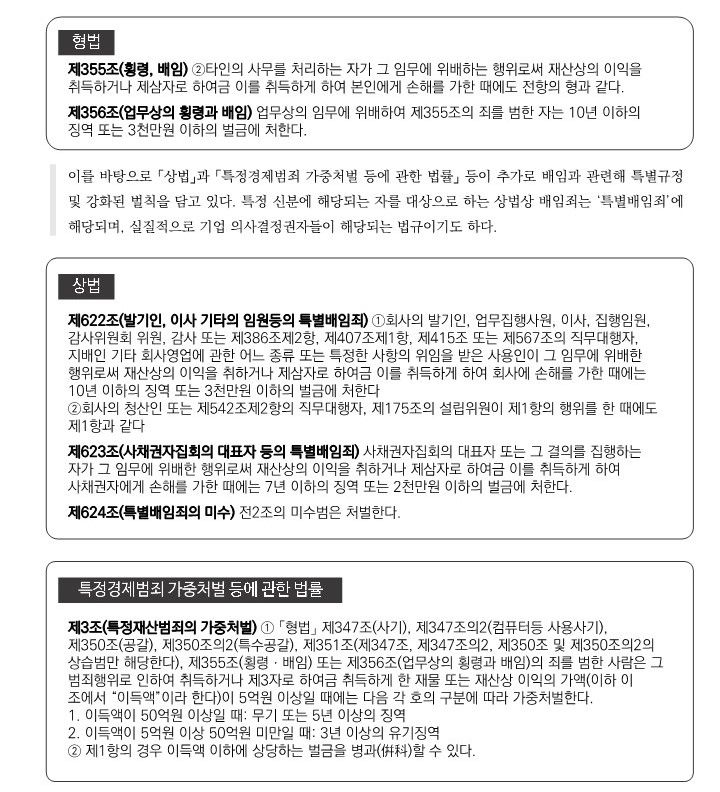
The essence of breach of trust is “betrayal.” The so-called “betrayal theory,” which holds that the offense lies in a violation of the duty of good faith or an infringement of a relationship of trust, is the prevailing view in both academia and judicial precedent. Some point out that, strictly speaking, breach of trust belongs to the private sphere. However, under current law, the source of the breach of trust offense is not the Civil Act, which governs private order, but the Criminal Act, which deals with the maintenance of public order and punishment by public authority.
The problem with the current breach of trust offense is that its constituent elements are highly unclear, so in practice almost any management activity can be treated as breach of trust if investigative authorities are so inclined, making it extremely difficult for businesspeople to predict legal outcomes. Even matters decided through a shareholders’ meeting or board of directors may be punished as breach of trust if they are deemed to have “deviated from the scope of ordinary business execution.” Attempted offenses are also punishable.
The standard for determining intent is also vague. The judiciary recognizes intent based even on “dolus eventualis,” that is, merely on the degree of awareness of the possibility that damage may occur or that a financial benefit may arise.
The problem is that dolus eventualis can only be inferred from surrounding circumstances, so conclusions can differ greatly depending on interpretation. From the standpoint of a businessperson, it is rare to be 100% certain that a project will succeed; at most, it is a matter of stronger or weaker conviction. If a decision is made while keeping in mind even a 0.1% chance that the project may fail, should that really be regarded as awareness of the possibility of damage? If interpretation proceeds that way, then there is nothing unreasonable about linking any managerial choice to breach of trust as soon as a loss occurs.
Because of these problems, breach of trust functions as a factor that makes it difficult for businesspeople to make bold investments, formulate management strategies from a long-term perspective, and enter next-generation industries.
■ Existing Legislative Discussions and Alternatives
With respect to the breach of trust offense, where the risk of differing guilty-or-not-guilty judgments is high due to vague and unclear standards, the alternative that has been raised continuously is the “explicit codification of the business judgment rule.”
According to Professor Choonsun Choi, the business judgment rule is a legal doctrine under which, if a manager in good faith made a managerial decision subjectively for the maximum benefit of the company and the decision-making process satisfied procedural requirements sufficient to be regarded as fair, then even if the decision later proves wrong and causes damage to the company, the manager’s business judgment is respected and the manager is exempted from liability arising from it. In academia, the business community, and some parts of the political sphere, voices have been raised calling for this business judgment rule to be inserted into statute so as to provide a legal basis for the judiciary to recognize it more actively.
It is not the case that the business judgment rule is never recognized in Korea. In a 2002 trial concerning the liability of directors of Korea First Bank for negligent loan decisions, the Supreme Court reflected the spirit of the business judgment rule for the first time. The problem is the rate of recognition. According to data released in May 2022 by the Federation of Korean Industries (FKI), of a total of 89 Supreme Court decisions from 2011 to 2021 in which the business judgment rule was mentioned, only 38.2% recognized it, roughly 40% compared to the opposite result; in particular, in criminal trials, precedents rejecting the business judgment rule were three times more numerous.
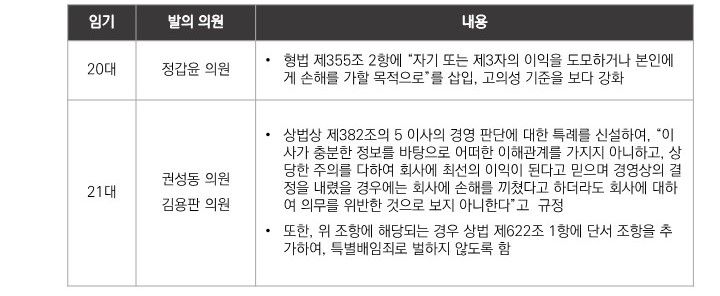
There have also been some legislative moves to improve the breach of trust offense in the 20th and 21st National Assemblies.
In the 20th National Assembly, lawmaker Kapyoon Chung sought to amend the Criminal Act, the source of the breach of trust offense, while in the 21st National Assembly lawmakers Seongdong Kwon and Yongpan Kim sought to create an exception clause in the Commercial Act regarding directors’ duties and, on that basis, exempt special breach of trust from punishment.
A bill to introduce the business judgment rule more clearly can be seen in the legislation proposed in the 21st National Assembly.
■ Proposals for the 22nd National Assembly
Looking at overseas cases, the only countries that have an offense called breach of trust are Germany and Japan. Even there, Germany introduced the business judgment rule in 2005, after which cases applying the breach of trust offense sharply declined, while Japan includes the clause “for the purpose of seeking the interest of oneself or a third party,” meaning that breach of trust is understood as a purpose-based crime. In other words, both Germany and Japan apply stricter standards than Korea in applying the breach of trust offense. The United States, which has no breach of trust offense, applies fraud under criminal law, but adopted the business judgment rule through a 1982 Louisiana Supreme Court ruling.
From the perspective of global standards, then, the ultimate and fundamental solution would be to abolish the breach of trust offense.
This is because a person who suffers damage in civil law can seek relief by claiming damages. However, in Korean society, where social concern about corporate crime remains high, abolishing the breach of trust offense would clearly face limitations in building public consensus.
In that sense, the attempt made in the 21st National Assembly by lawmakers Seongdong Kwon and Yongpan Kim to introduce the business judgment rule into the Commercial Act is evaluated as a realistically reasonable alternative. This is the method adopted under Germany’s Stock Corporation Act.
The harm caused by the contraction of corporate management ultimately falls entirely on the public. Jobs decrease, opportunities for economic prosperity are lost, and in the long run it leads back to stagnation in the national economy. Only when there are many cases of people taking risks and demonstrating entrepreneurship can industries grow and national income increase. The vague fear of the breach of trust offense—and even when a defendant is acquitted, the costs incurred during investigation and trial and the psychological fear that must be endured—are blocking the virtuous cycle of the national economy.
That is why the 22nd National Assembly must modernize the breach of trust offense.
Wiki:
https://www.cfe.org/w/bbsDetail.php?idx=98
Original title: [22대 국회를 향한 제안] 배임죄 선진화
Author: Ju-jin Yoon
Date: 2023-11-09
Source: https://www.cfe.org/bbs/bbsDetail.php?cid=bill&pn=2&idx=26125