
How the Three Lease Laws Backfired on Tenants and Threatened Housing Stability
-
Writer
CFE
-
 The “Backlash” of the Three Lease Laws Enacted to Protect Tenants: Armchair Legislation That Ignored Market Logic
▪ The 2+2 contract and 5% rent increase rule ultimately came back as a “surging jeonse” bomb after the right to request contract renewal was exercised
▪ Rational landlords responded by raising jeonse deposits on newly listed units or converting to monthly rent instead, leading to a decline in supply
▪ This is a real-world example of Hayek’s warning that “the road to hell is paved with good intentions”
■ Introduction
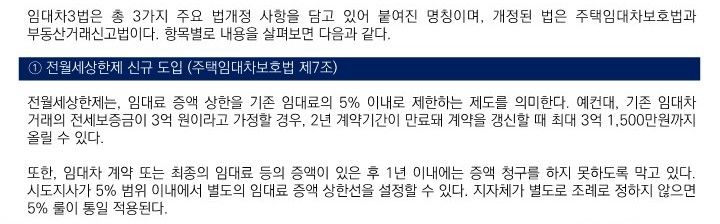
As housing and other real estate prices surged under the Moon Jae-in administration, jeonse and monthly rent prices also soared. In response, with the stated aim of improving tenants’ housing stability, the Democratic Party of Korea and the Moon Jae-in administration revised laws related to residential leases. These included partial amendments to the Housing Lease Protection Act and the Act on Report on Real Estate Transactions, centered on a rent cap system for jeonse and monthly rent, strengthened tenant rights to request contract renewal, and the introduction of a lease reporting system. Collectively, these measures are commonly known as the “Three Lease Laws.”
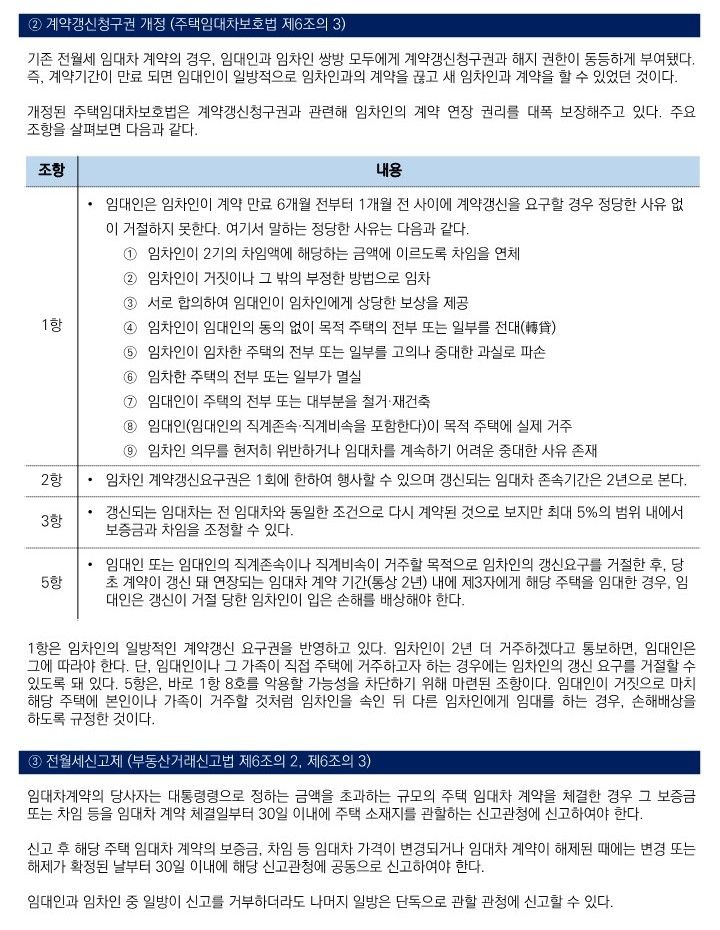
Except in limited cases, the Three Lease Laws guarantee tenants the right to extend an existing two-year jeonse or monthly rental contract for an additional two years, while restricting landlords to raising rent by no more than 5%. They also require that the terms of lease contracts be reported to local governments and other authorities within 30 days of the agreement.
The law triggered sharp confusion and backlash in the residential lease market. Even taking into account the unique nature of real estate transactions, it has been criticized for imposing uniform controls on transactions that should result from the free choices of landlords and tenants, ultimately producing nothing but side effects. Although the law was intended to promote housing stability for tenants, critics point out that landlords, when signing new lease contracts, began factoring in market conditions two years ahead and setting higher jeonse or monthly rents from the outset, thereby increasing tenants’ housing costs instead. It has also been criticized for reducing rental supply as landlords withdrew listings altogether to avoid conflicts with tenants arising from lease contracts.
■ Main Points
■
Legislative Revision Process and Status of Passage
The legislative process for the Three Lease Laws was marked by continuous controversy and conflict. The ruling Democratic Party of Korea and some lawmakers from smaller progressive opposition parties insisted the laws were unavoidable and even pushed for bills more radical than the final amendments that were ultimately passed. Meanwhile, the then-opposition United Future Party opposed the government and ruling party’s legislative drive, arguing for more cautious revisions on the grounds that the Three Lease Laws would distort the real estate market and restrict free transactions.
At the Legislation and Judiciary Committee, the standing committee with jurisdiction over the Housing Lease Protection Act, which included the most contentious revisions concerning the rent cap system and the right to request contract renewal, lawmakers from the ruling and opposition parties engaged in a heated exchange. The main arguments for and against were as follows.
■ Bill Assessment
A Law Made for Tenants That Instead Threatened Their Housing Stability
◈ After a Brief “Two-Year Breather,” What Then? Even in the Same Apartment Complex, Deposit Gaps Doubled
The original purpose of the Three Lease Laws was to improve tenants’ housing stability and prevent excessive increases in jeonse prices. However, the laws are seen as having focused only on short-term effects while overlooking the possibility that the market could become even more unstable in the long run.
The primary group these laws sought to protect was jeonse tenants, especially those living in highly preferred apartments. A tenant who newly signs a jeonse contract can, after two years, use the right to request contract renewal and continue living there for another two years by paying only up to an additional 5% in jeonse deposit. Naturally, this secures short-term housing stability. But after four years, once the one-time contract renewal right has been exercised, the tenant is then forced into a position of either finding a new jeonse property and signing a fresh contract or fully accepting the new jeonse deposit demanded by the landlord.
What is important here is that landlords also understand this situation perfectly well. As a result, there is a very high likelihood that, when signing the initial contract, they will judge that they must secure the highest possible jeonse deposit in order to make up for future increases in jeonse prices two years later. In the market economy, this decision by landlords constitutes a “rational choice.” There is no rule requiring landlords to accept losses.
Indeed, even within the same apartment complex, properties for which the contract renewal right had been exercised saw only modest increases in jeonse deposits, whereas units seeking new tenants often demanded jeonse deposits that were in some cases nearly double. This produced a severe “polarization” phenomenon even among comparable units.
◈ Landlords Are Not Fools Either: Possible Decline in Jeonse Supply as Conversion to Monthly Rent Accelerates
When the decline in new jeonse supply is added to this, landlords’ bargaining position in new jeonse contracts becomes even stronger. This, too, has more than enough reason behind it. From the perspective of landlords, once they sign a jeonse contract, the unit is effectively tied to the same tenant for up to four years. That gives them a stronger incentive to either live in the property themselves or with family members, or else secure lump-sum funds and convert the lease to a monthly rent contract instead.
In the era of low interest rates, it could in fact be more advantageous to convert to monthly rent and use the rental income to repay part of loan interest, rather than rely on the interest income earned from a jeonse deposit. To be sure, as the economy entered a high interest rate era, some of the side effects of the Three Lease Laws appeared to ease, with phenomena such as reverse jeonse emerging. But if the jeonse market begins to swing violently again, it remains uncertain how the backlash of the Three Lease Laws may once again become reality.
◈ We Must Heed Hayek’s Warning That “The Road to Hell Is Paved with Good Intentions”
What economist Friedrich Hayek sought to highlight through the subtitle of The Road to Serfdom—“the road to hell is paved with good intentions”—accurately reflects the turmoil in the jeonse market after the Three Lease Laws. A law enacted to protect tenants instead produced the side effect of destabilizing their housing conditions. It is a case of legislative failure caused by a lack of understanding of market economic order.
All actors in a market economy have the right and freedom to make rational choices. The real estate market cannot be fixed through a simplistic dichotomy that treats landlords as villains and tenants as victims. Only when landlords find it attractive to supply the homes they own will the volume of jeonse and monthly rental listings increase and competition be stimulated. If prices stabilize as a result, the benefits will return to tenants. What is needed is legislation grounded in a more multidimensional understanding of this market logic.
Original title: 임차인 위한 임대차 3법의 역습, 주거안정 위협했다
Author: Ju-jin Yoon
Date: 2023-11-01
Source: https://www.cfe.org/bbs/bbsDetail.php?cid=bill&pn=2&idx=26108