
Hopes Rise for New Business Growth by Repealing the “Four Aviation Acts” and Granting “One-Point” Regulatory Exceptions
-
Writer
CFE
-
 Apply “one-point” special regulatory exceptions in aviation to foster UAM, a next-generation mobility industry
▪ It is difficult to foster the industry under the existing aviation regulatory environment, which differs in nature from UAM… the so-called “four aviation laws” swept away at once
▪ Licensing and permit procedures related to vertiports are also deemed satisfied at one stroke through the special law, significantly reducing the administrative burden on both businesses and local governments
▪ Regarded as a model legislative precedent for a special law aimed at fostering a new industry, and also expected to serve as a catalyst for introducing a negative regulatory approach
■ Introduction
UAM (Urban Air Mobility), widely regarded as a leading next-generation mobility industry, requires flight paths, operating conditions, and infrastructure that are entirely different from those of existing air transport modes. Because UAM aircraft are smaller than conventional airplanes and helicopters and are designed for relatively short-distance travel, they must operate near city centers and residential areas. Their takeoff and landing points must also be located in places fundamentally different from existing airports. Accordingly, the current aviation legal framework inevitably has fundamental limitations in accommodating UAM.
Against this backdrop, the National Assembly enacted the Act on the Promotion of and Support for the Use of Urban Air Mobility (hereinafter, the “UAM Special Act”) during its 2023 regular session to provide the legal foundation needed for pilot operations and the full-scale introduction of UAM. The law includes provisions covering everything from definitions of various UAM-related technologies and facilities to approval for demonstration projects, government-level measures to promote the UAM industry, and obligations for prompt regulatory confirmation. In effect, it can be described as a law that lays out the overall blueprint for introducing UAM.
■ Main Content
Background to the Need for the Bill
Expectations and interest surrounding UAM are intense. UAM, often described as a “dream mode of transportation” capable of covering in just a little over ten minutes a distance that would otherwise take more than an hour by car or conventional public transportation, is one of the most representative next-generation mobility sectors.
The global UAM market is projected to grow to $1 trillion by 2040, and the United States and EU countries are already accelerating efforts to establish institutional frameworks necessary for UAM deployment. In the United States, the Federal Aviation Administration (FAA) and the National Aeronautics and Space Administration (NASA) have laid out stages of UAM development and presented goals, while the Department of Defense (DOD) is leading efforts to incorporate civilian UAM technology into military force enhancement.
In this environment, concerns have continued to be raised that Korea’s UAM technological capabilities remain only about 60–70% of those of the world’s leading countries, and that technological development and deployment have been slow due to safety concerns among the general public and local governments, as well as constraints on securing sufficient sites.
In particular, the fact that UAM’s unique characteristics conflict with the existing aviation legal regime has been identified as a fundamental limiting factor. The stated purpose of the UAM Special Act bill addresses this point directly: “Current aviation-related laws, including the Aviation Safety Act, the Aviation Security Act, the Aviation Business Act, and the Airport Facilities Act, regulate matters primarily with conventional fixed-wing aircraft and airport facilities with runways in mind, and thus have limitations in comprehensively covering matters such as safety management for urban air mobility and the installation and management of vertiports for the takeoff and landing of urban aircraft.” It further points out that “while recent rapid technological advances have increased the feasibility of UAM and the market is expected to expand sharply, making proactive support for UAM as a future competitive growth industry necessary, the legal basis for such policy support remains insufficient.”
With this problem in mind, the National Assembly and the government prepared an enactment covering “the introduction and expansion of urban air mobility, the establishment of an operational foundation for the safe and efficient navigation of urban aircraft, and the administrative and financial support necessary for such purposes.”
■ Revision Process and Legislative Status
The UAM Special Act was first introduced by Rep. Iljun Seo of the People Power Party, followed by a separate bill by Rep. Jongsik Huh of the Democratic Party of Korea, and was ultimately passed by the plenary session on October 6, 2023. At that session, all 250 members present voted in favor. This was interpreted as indicating bipartisan agreement on both the necessity and urgency of fostering the UAM industry. Earlier, the bill had also passed smoothly through the Land, Infrastructure and Transport Committee, the competent standing committee, and the Legislation and Judiciary Committee, which is responsible for legal and textual review, with virtually no opposition or debate. The only notable difference of opinion concerned pilot project locations, specifically between the Seoul metropolitan area and non-metropolitan regions.
The Ministry of Land, Infrastructure and Transport, the lead ministry, described the passed UAM Special Act as “bold special-regulation legislation with no precedent anywhere in the world.” It added that “it is highly meaningful that a legal basis has been established allowing new technologies and services to be freely developed and tested.” It also stated that “with the enactment of this law, Korea’s urban air mobility environment has removed regulations that acted as shackles, enabling companies to fly freely in real-world and urban environments and creating globally competitive conditions.” Minister of Land, Infrastructure and Transport Hee-ryong Won emphasized, “Now that the legal foundation is in place, the public-private demonstration project involving key domestic and international companies (the K-UAM Grand Challenge) will be able to conduct testing in the freest environment in the world.”
■ Evaluation of the Bill
1. Sweeping away regulations under the “four aviation laws” through a negative approach… significantly easing the industry’s administrative burden
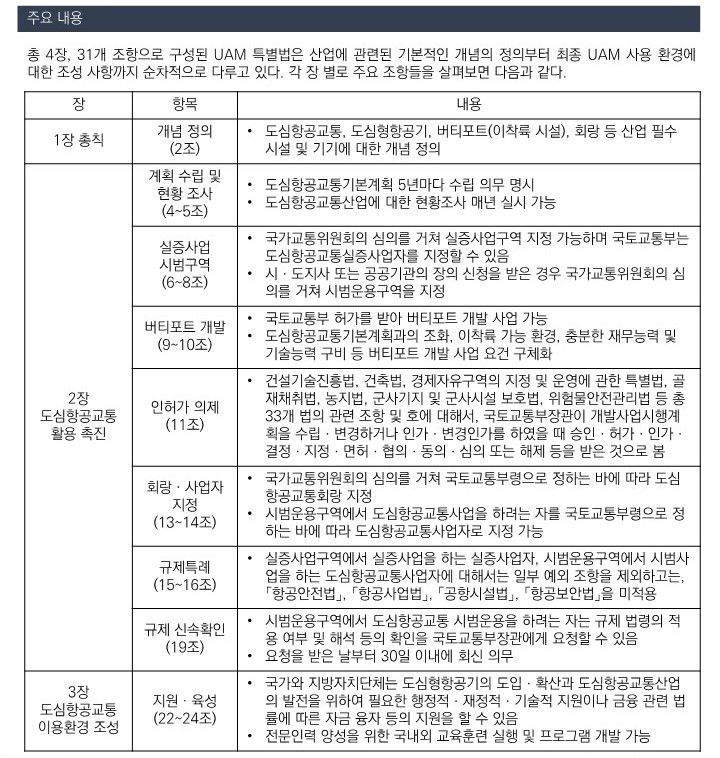
This law is especially meaningful in that it established an institutional mechanism to exclude, in one stroke through a single statute, the application of existing aviation-related regulations—the so-called “four aviation laws”—that stand in the way of the diffusion and expansion of UAM, a representative new industry.
Korea’s regulatory system follows a “positive” approach. This means laws and policies list what is permitted, and anything else is prohibited. By contrast, a negative approach permits everything that is not expressly prohibited by law or policy. Those who support “regulatory reform” generally argue that the legal system should shift from a positive to a negative framework.
Articles 15 and 16 of this law, which provide for “special regulatory exceptions,” indirectly adopt a negative regulatory approach. That is because they specify which regulations among the so-called “four aviation laws” must still apply—that is, the prohibited matters—and provide that the rest do not apply. From the industry’s perspective, this makes it possible to freely pursue new business ventures so long as they comply with only those laws that must still be observed.
Without this law, related industries would have no choice but to bear significant administrative and financial burdens, including applying one by one for regulatory sandbox exemptions to avoid not only the “four aviation laws” but also other related regulations. Through the UAM Special Act, the processing speed for demonstration projects and the designation of pilot zones is expected to improve significantly. As similar demand is likely to arise repeatedly in the future, the framework of the UAM Special Act is expected to serve as an exemplary precedent.
2. “One-point” deemed approval of permits and licenses to accelerate vertiport development projects
A vertiport is, in effect, an “urban airport” where UAM aircraft take off and land and where passengers board and disembark. As such, it has a strong civil engineering and development character, and its impact on the surrounding environment—including residential areas, transportation, forests, chemicals, and water quality—is broad.
In response, the law provides that when the Minister of Land, Infrastructure and Transport establishes or changes an implementation plan for a vertiport development project, or grants or changes approval for it, the necessary permits and licenses under a total of 33 statutes are also deemed to have been obtained.
These 33 statutes include not only laws under the jurisdiction of the Ministry of Land, Infrastructure and Transport, but also laws administered by other relevant ministries and agencies, including the Ministry of National Defense (Military Bases and Installations Act), the Ministry of Agriculture, Food and Rural Affairs (Farmland Act), the Ministry of Environment (Clean Air Conservation Act, Sewerage Act), the Korea Forest Service (Mountainous Districts Management Act, Forest Resources Act), the National Fire Agency (Hazardous Materials Safety Control Act), and the Ministry of Oceans and Fisheries (Port Act). As with the special regulatory exceptions discussed above, this is expected to accelerate vertiport development projects by substantially shortening the time required for permits and approvals.
Original title: '항공4법' 걷어내고 '원포인트' 규제 특례로 신사업 육성 기대
Author: Ju-jin Yoon
Date: 2023-10-24
Source: https://www.cfe.org/bbs/bbsDetail.php?cid=bill&pn=2&idx=26092