
Mandatory Price-Linking System Without Overseas Precedent Sparks Debate Over Effectiveness and Fairness
-
Writer
CFE
-


 Mandatory price-indexation system for subcontract payments with no overseas legislative precedent raises controversy over effectiveness and fairness
▪ The trade industry is concerned that it would effectively grant preferential treatment to domestic firms and could trigger trade disputes, including possible violations of WTO rules
▪ If incentives to reduce raw material costs disappear and final prices rise, the burden will ultimately be passed on to consumers
▪ It could reduce jobs and exports by discouraging foreign companies from investing in Korea and leading principal firms to prefer overseas small and medium-sized suppliers
■ Introduction
As global supply chains have become more unstable—due to Russia’s invasion of Ukraine and intensifying competition to secure critical mineral resources, among other factors—raw material prices have shown a sustained upward trend since 2022. Accordingly, concerns have continued to be raised that subcontractors, which must produce goods using raw materials and supply them to principal firms, are facing growing economic hardship because they are unable to receive additional delivery payments corresponding to the increase in raw material prices. In response, the political sphere passed a partial amendment to the Act on the Promotion of Mutual Cooperation Between Large Enterprises and Small and Medium Enterprises, introducing for the first time the so-called “delivery price indexation system.”
Following passage of the law, the business community’s reaction was mixed. Small and venture businesses welcomed it, while large corporations and mid-sized firms criticized it, citing side effects and the lack of legislative precedents abroad. While there is clearly a problem in that subcontractors, which are inevitably in a weaker bargaining position, must bear the full burden of rising raw material costs, critics argue that artificially linking delivery prices to raw material prices is excessive market intervention. There are also concerns that the system could violate World Trade Organization (WTO) rules or existing free trade agreements (FTAs) between countries, making it subject to legal challenge.
■ Main Contents
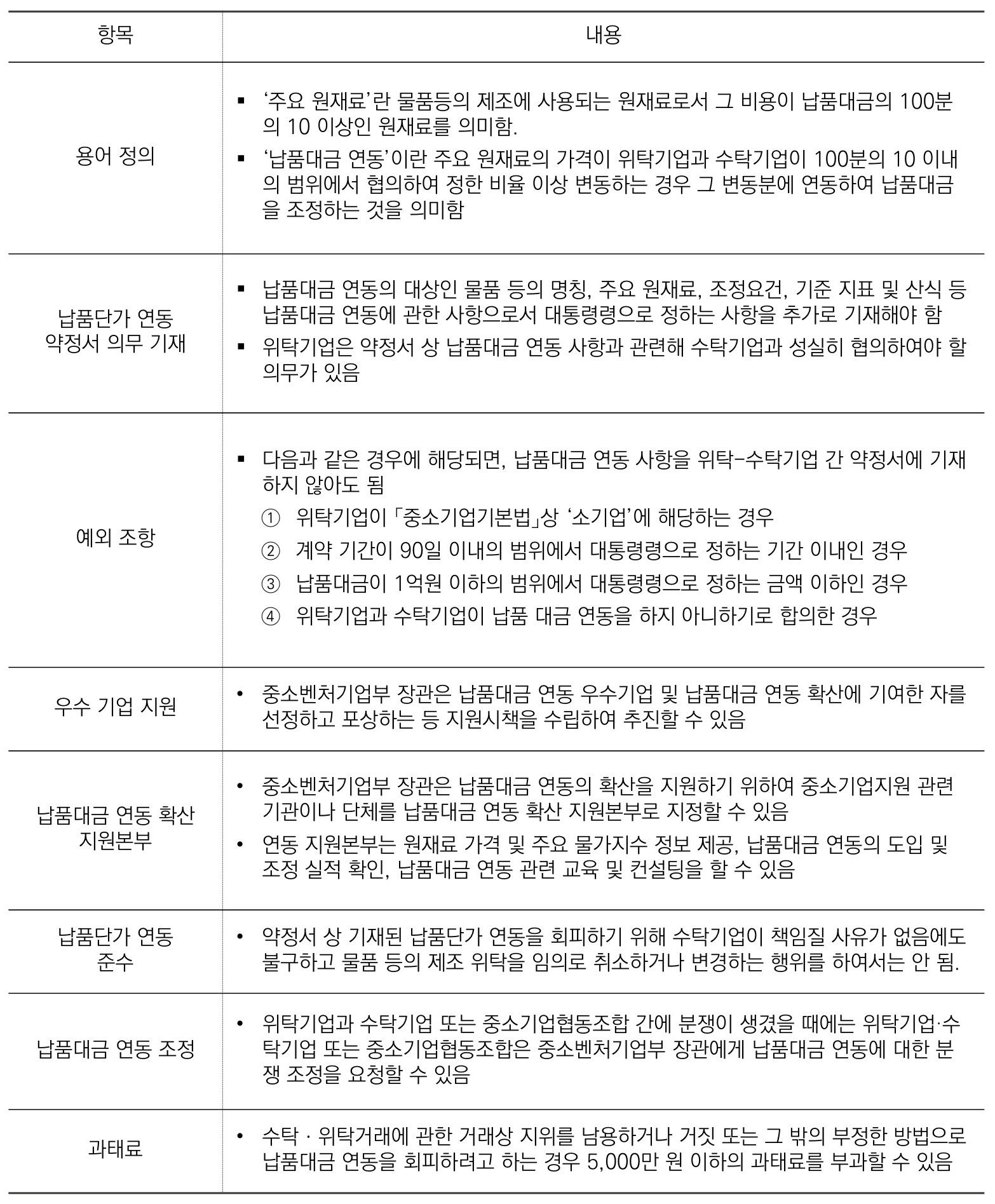
The bill emphasizes the need to legislate the delivery price indexation system on the grounds that “raw material prices have continued to rise recently, but many subcontractors have been unable to properly reflect those increases in delivery prices because of disparities in bargaining power stemming from their transactional position vis-à-vis principal firms,” and that “it is necessary to introduce a delivery payment indexation system that mandates principal firms and subcontractors to consult and record the result in a written agreement even without a request from the subcontractor.”
However, it states that exceptions to the delivery price indexation system are allowed in cases where contract size is small, where the contract applies only for a short period, or where the principal firm and subcontractor mutually agree not to apply the system. At the same time, the bill provides sanctions against illegal or evasive abuse of the delivery payment indexation system.
The bill states that its purpose is “to ease the management burden on subcontractors through the introduction of the delivery payment indexation system and to contribute to the spread of a culture of coexistence and the development of a fair market economy.”
The bill broadly sets out the overall framework of the delivery price indexation system, from defining new terms required for its introduction to specifying standards for administrative fines imposed in cases of legal violations.
■ Amendment Process and Legislative Status
This bill was smoothly processed by agreement between the ruling and opposition parties as a “noncontroversial bill,” from the relevant standing committee—the Trade, Industry, Energy, SMEs and Startups Committee—to the Legislation and Judiciary Committee, which reviews legal wording and structure, and finally the plenary session. However, some concerns about the effectiveness of parts of the system were raised in the subcommittee and reflected in the final bill.
Originally, bills proposed by several lawmakers, including People Power Party lawmaker Cheolgyu Lee, stipulated an administrative fine of up to 10 million won for unfairly evading the delivery price indexation system. In this regard, Democratic Party lawmaker Youngsoon Park asked, “In a superior-subordinate relationship, if the parties agreed not to link prices because of an imbalance of power, how can that possibly be uncovered?” He added, “If they wrote an agreement not to apply the indexation system based on some private consultation, how could anyone prove that?”
Kim Yongmin of the same party also argued regarding the administrative fine, “When you compare the gains from various illegal or evasive acts with a 10 million won fine, large companies will of course find a way out.” Democratic Party lawmaker Kyungman Kim then argued that the appropriate fine should be set at 50 million won, and ultimately the fine was raised from the original 10 million won to 50 million won.
People Power Party lawmaker Myeongho Kwon pointed out side effects that could arise from the bill. He asked, “Is this bill unprecedented, with no overseas legislative precedent?” and added, “I’ve also heard concerns that it could be challenged under the WTO or FTAs—is that true?” In response, Vice Minister Joohyun Cho of the Ministry of SMEs and Startups acknowledged those concerns. Kwon also accurately identified a blind spot in the bill, saying: “Raw material prices may have risen, but what if a small supplier used inventory it had already secured in advance? Should the system apply even then? In cases where suppliers and large companies have traded for decades, there could clearly be disputes such as, ‘Your company has ample inventory of a certain product, but because international raw material prices have surged, you want the system applied.’ Wouldn’t that also create concerns about having to share trade secrets or cost information?”
The subcommittee completed its review of the bill on November 23, 2022, and the National Assembly passed it at a plenary session on December 18, 2022, with 212 votes in favor and 5 abstentions out of 217 members present. All five lawmakers who abstained were from the People Power Party.
■ Evaluation of the Bill
1. Concerns over trade conflict due to possible reverse discrimination against foreign firms
The WTO agreements and various FTAs currently in force strictly prohibit applying unfavorable treatment only to foreign companies under the principle of “most-favored-nation treatment.” For example, the WTO previously ruled that incentives provided by the provincial government of Ontario, Canada, to domestic businesses constituted discrimination against foreign firms and were therefore illegal. Regarding the controversial U.S. Inflation Reduction Act (IRA), the European Commission also announced its intention to file a complaint, arguing that the U.S. government’s decision to provide subsidies only to domestic electric vehicle companies violates the WTO’s nondiscrimination principle.
The delivery price indexation system could likewise be vulnerable to charges of violating these trade principles. For example, principal firm A may apply the system to domestic subcontractor B and therefore pay more than before, while not needing to apply the system to overseas subcontractor C and thus paying the same amount.
In this regard, five major business groups—the Korea Chamber of Commerce and Industry (KCCI), the Federation of Korean Industries (FKI), the Korea International Trade Association, the Korea Employers Federation (KEF), and the Federation of Middle Market Enterprises of Korea—issued a joint statement saying, “A careful review is needed to determine whether trade issues may arise,” and pointed out that “if the indexation system is legalized, a domestic company may raise payments when subcontracting to a Korean firm but not when subcontracting to a foreign firm, creating the possibility of violating WTO agreements, including the principle of national treatment.”
2. Excessive intervention with no overseas legislative precedent… concerns about increasing consumer burdens
Systems that recommend linking delivery prices to increases in raw material costs through voluntary coordination between firms are widely used around the world. However, there is no overseas legislative precedent for a law that compels such delivery price indexation as a legal obligation, as in this amendment.
There are also concerns that mandatory introduction of the delivery price indexation system could actually increase the burden on consumers. In a September 2022 report, Economic Discussion on the Delivery Price Indexation System, Hwayeong Lee, a research fellow at the Korea Development Institute (KDI), stated, “If delivery prices rise in line with raw material prices, the principal contractor may appropriately pass that cost burden on to consumers depending on competitive conditions in the final consumer goods market,” adding that “making price indexation mandatory means that principal contractors and consumers will share the risk.”
It is clearly true that sharp increases in raw material prices impose excessive costs on subcontractors. However, from the subcontractor’s perspective, if it expects to be sufficiently compensated for raw material price increases through delivery price indexation, it is also true that its incentive to make various managerial efforts to reduce raw material costs may inevitably decline. To minimize risks stemming from growing supply chain instability, firms must also seriously consider solutions such as diversifying sources of raw material procurement or increasing contracted volumes.
3. Distortion of the industrial ecosystem could actually harm small and medium-sized enterprises
The Korea Economic Research Institute (KERI) pointed out that the delivery price indexation system could actually produce unfavorable results for domestic SMEs. The institute estimated that “assuming raw material prices rise by 10% and this is reflected in delivery prices, demand by large companies for products made by domestic SMEs would fall by 1.45%, while demand for products made by overseas SMEs would increase by 1.21%,” explaining that “large companies would substitute relatively cheaper imported goods for products made by domestic SMEs in order to lower production costs.”
It also forecast the possibility of job losses. KERI diagnosed that if transactions with domestic SMEs decline, labor demand will also fall, potentially reducing employment by around 47,000 jobs. It further pointed to side effects such as a decline in real wages and a resulting decrease in government tax revenue.
It is also foreseeable that foreign firms may avoid entering the Korean market. A delivery price indexation system with no overseas precedent would inevitably function as a clear “legal risk” from the standpoint of foreign companies. The five major business groups expressed concern that “if a legal risk unique to Korea emerges, uncertainty could increase as foreign firms operating in Korea may withdraw or revise their investment plans.”
Original title: 의무화 입법 해외 사례 없는 납품단가 연동제, 실효성·형평성 논란
Author: Ju-jin Yoon
Date: 2023-10-19
Source: https://www.cfe.org/bbs/bbsDetail.php?cid=bill&pn=2&idx=26068