
Land Transaction Permit System with “pinpoint regulation” expected to reduce unfair victims
-
Writer
CFE
-
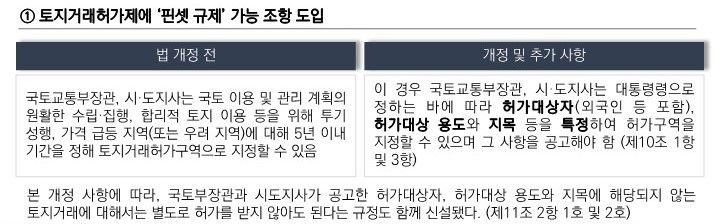
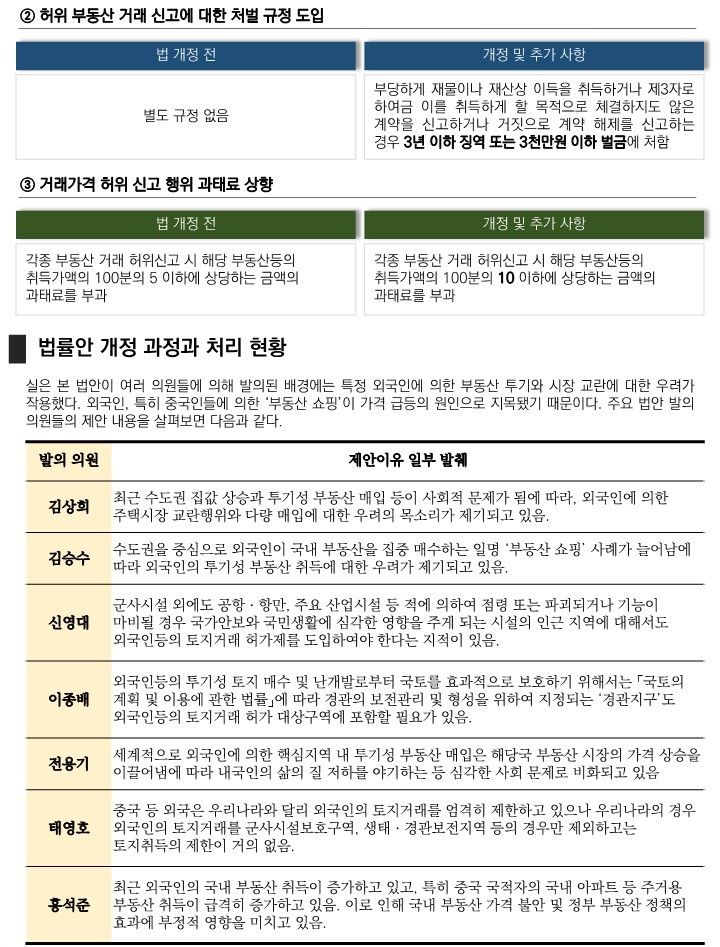
 Introduction of “Pinpoint Regulation” to the Land Transaction Permit System Produces a Dual Effect: Mitigating Side Effects and Preventing Risky Transactions
▪ Makes it possible to apply the Land Transaction Permit System with precision by specifying persons, purposes, and land categories… expected to reduce unfair victims
▪ Revision bill first discussed to block security risks and distortions of the economic order caused by real estate speculation by foreigners
▪ Substantially strengthens penalties for false reporting that fuels market disruption, expected to reduce harm from “fake listings”
■ Introduction
The land transaction permit system, under which a permit from the competent authority is required when entering into a contract (including a preliminary contract) to transfer or establish ownership or superficies rights for certain land, or when seeking to change permitted matters, can be regarded as the most representative form of direct real estate regulation. It was first introduced in 1979 as a regulation designed to make transactions more difficult, mostly in order to prevent real estate speculation and market overheating.
The Land Transaction Permit System has long been mired in controversy over whether it is unconstitutional, because it directly restricts private property rights. However, the Constitutional Court has repeatedly held that the Land Transaction Permit System itself is constitutional, on the grounds that it does not amount to an essential infringement of fundamental rights. Even so, criticism continued over the side effect that the system heavily restricts land transactions by many ordinary, law-abiding citizens who have nothing to do with speculation. As a result, the 21st National Assembly amended the relevant law. The Partial Amendment to the Act on Report of Real Estate Transactions, etc. (hereinafter, the “amended Real Estate Transaction Reporting Act”) corresponds to an administrative efficiency measure that allows land subject to the Land Transaction Permit System or the parties to such transactions to be specified in a so-called “pinpoint regulation” manner.
In addition, it is also evaluated as having contributed to stabilizing the real estate market by reflecting provisions that strengthen punishment for false real estate transaction reports and other acts that encourage unfair speculation, thereby minimizing market confusion.
■ Main Details
In this regard, discussions on reciprocity took place at the Land, Infrastructure and Transport Committee subcommittee meeting held on February 17, 2023. Reciprocity is the principle of exchanging equivalent treatment or taking the same action between countries, and it is one of the basic principles of diplomacy.
Reciprocity became controversial in relation to real estate transactions because some countries do not recognize foreign ownership of land or other real estate, or freedom to trade such property. For example, if a Korean residing in Country A cannot acquire real estate there, it is seen as unequal to allow a foreign national of Country A to acquire and trade real estate in Korea. China, in particular, emerged as an issue because it has adopted a socialist economic order. Not only is the number of Chinese nationals residing in Korea overwhelmingly large in relative terms, but criticism has also persisted that wealthy Chinese buyers with enormous financial resources are “sweeping up” domestic real estate.
The issue was how to legislate in concrete terms. Even under the current law, Article 7 reflects the principle of reciprocity, but only as a discretionary provision. The government expressed reservations about a bill proposing to revise it into a mandatory provision.
In other words, the government viewed it as sufficient to prevent real estate speculation by foreigners in advance by designating land transaction permit zones, requiring prior approval, and including foreigners among those subject to approval. Rather than making reciprocity mandatory for all land transactions by foreigners, this was interpreted as an indirect approach that would allow the principle of reciprocity to be reflected only where prior approval is necessary, at the discretion of the Minister of Land, Infrastructure and Transport or a provincial governor or metropolitan mayor.
The amended Real Estate Transaction Reporting Act passed smoothly through the Land, Infrastructure and Transport Committee, the Legislation and Judiciary Committee, and the plenary session as a completely “noncontroversial bill.” In fact, at the plenary session held on March 28, 2023, the bill was passed with all 199 members present voting in favor.
■ Assessment of the Bill
1. A more precise Land Transaction Permit System… expected expansion of benefits from exemptions from regulation
Under the amended Real Estate Transaction Reporting Act, land transaction permit zones can be designated by specifying those subject to permits, including foreigners, as well as by purpose and land category, raising the possibility that the number of contracting parties excluded from the system will increase.
In practice, for parties to land contracts that have nothing to do with real estate speculation or market overheating, there has been the side effect of excessive restrictions on property rights simply because the land happened to be included within a land transaction permit zone. Given the strong local opposition to the Land Transaction Permit System, and in cases where only some parts of an area are related to speculation due to regional characteristics, the amended Real Estate Transaction Reporting Act is expected to be especially useful.
The Ministry of Land, Infrastructure and Transport explained the intent of the amendment by giving examples such as specifying “corporations (planned real estate sales firms)” or “foreigners” as persons subject to permits, or announcing that permit targets will be specified by use or land category, such as “land including housing” or “forest land.”
In addition, where security concerns are high due to foreigners’ purchases of land (housing), foreigners can be specifically designated as subject to the land transaction permit requirement. Considering the possibility that some foreigners may intentionally purchase real estate near special public institutions, military units, or core facilities related to public safety and use the sites for purposes such as acquiring confidential information, this bill is expected to serve as a preventive measure. In such cases, infringement of the economic rights of Korean nationals can be minimized.
2. Effect of blocking false reports that distort market prices
In Korea’s real estate market, “actual transaction price” information has a very significant influence on transactions, because listing prices are set and purchase decisions are made based on actual transaction prices. However, there have been ongoing calls for preventive measures against market-disrupting practices that artificially raise property prices by falsely reporting contracts that were never concluded, thereby creating the misleading appearance of a “new reported high price.”
Previously, such false reporting was punishable only by an administrative fine of 30 million won. If that amount is far smaller than the improper capital gains obtained through false reporting, the likelihood increases that someone will file a false report despite the risk of being caught. In response, the amended Real Estate Transaction Reporting Act newly introduced a provision allowing imprisonment for up to three years, thereby substantially increasing the severity of punishment for false reporting. Since there is now a real risk of imprisonment, the risks associated with false reporting have grown significantly.
In addition, the upper limit on administrative fines for so-called “up/down contracts,” in which a transaction price different from the actual price is reported, was raised from 5 percent of the acquisition price of the relevant real estate, etc. to 10 percent. False reporting of transaction prices is also expected to decline.
Wiki:
https://www.cfe.org/w/bbsDetail.php?idx=94
Original title: '핀셋 규제' 도입된 토지거래허가제, 억울한 피해자 감소 기대
Author: Ju-jin Yoon
Date: 2023-10-11
Source: https://www.cfe.org/bbs/bbsDetail.php?cid=bill&pn=2&idx=26055