
Stripping Schools of Hiring Authority Undermines Private School Autonomy
-
Writer
CFE
-

 Even Hiring Is Subject to Meddling… The Private School Act Encroaches on the Identity and Autonomy of Private Schools
▪ The hiring of private school teachers is now required to outsource written exams to provincial and metropolitan offices of education, which have also been given the authority to demand disciplinary action against teachers
▪ Excessive intervention on the grounds that schools receive financial support… a direct infringement on the very reason private schools exist and their identity
▪ As schools are increasingly shunned, the solution to the “public education crisis” lies in ensuring the autonomy of private schools and revitalizing diversity and competition
■ Introduction
The 21st National Assembly passed a Partial Amendment to the Private School Act (hereinafter, the “amended Private School Act”), which further strengthens the jurisdiction of offices of education over matters related to school operations, such as the hiring and discipline of private school faculty and staff, while restricting the autonomy of private schools. The Democratic Party of Korea and others who led the amendment argued that corruption and irregularities in private schools were occurring structurally and repeatedly, thereby undermining trust in the entire education system. However, the People Power Party, then in opposition, and private school groups strongly protested, calling it a bill that effectively suppresses and oppresses private schools.
Private schools, literally speaking, are school corporations established by private individuals or legal entities. Therefore, the primary right to operate a private school naturally belongs to the school corporation that owns it and its board of directors. That said, private schools in Korea have long been required by law to meet a high level of public responsibility, receive broad government support and oversight, and operate in a manner that is virtually indistinguishable from public education. As a result, conflict has repeatedly arisen over the proper scope of government intervention in private schools.
However, the amended Private School Act passed by the 21st National Assembly has been criticized for significantly infringing on the autonomous rights of private schools grounded in ownership, because it directly controls the “personnel authority” of private schools in the areas of teacher hiring and discipline.
Strictly speaking, this law is not easy to classify as one concerning the economic order. Nonetheless, the continuing debate in Korean society over ownership rights and operational authority in private schools has important implications for the constitutional principles of private property rights and private autonomy. School corporations, too, can generate revenue for certain purposes and engage in economic activities such as acquiring or disposing of property. Examining the extent to which the government may intervene in and control decision-making at such school corporations in the name of public interest is also meaningful in assessing the legitimacy of government regulation of private economic activity.
■ Main Contents
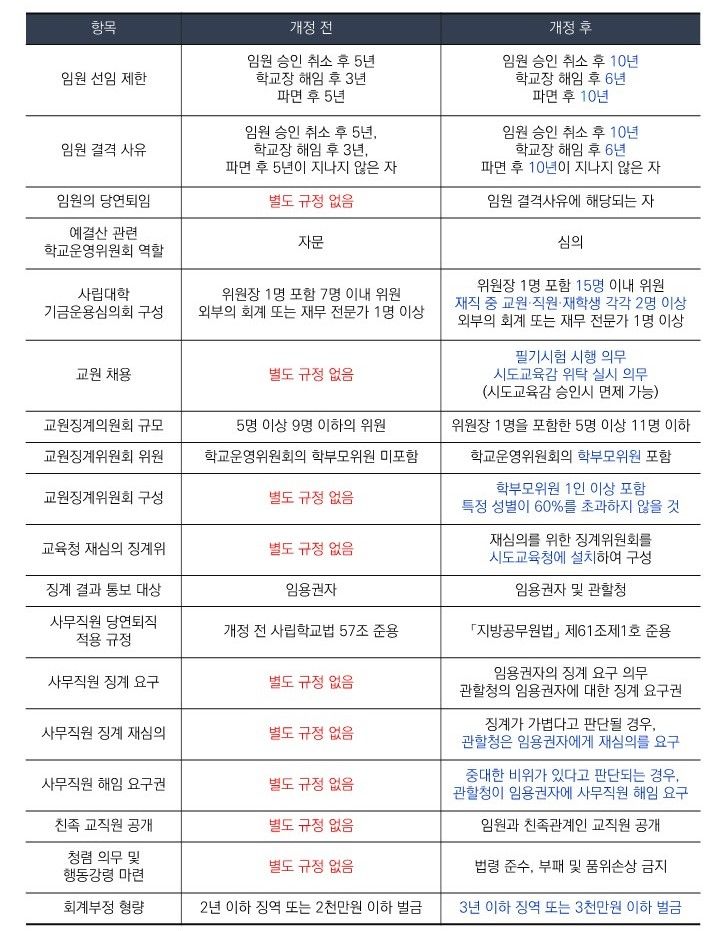
The amended Private School Act incorporates a total of 20 revisions, and overall it strengthens regulatory and oversight mechanisms over school operations. Let us examine its contents by comparing the pre-amendment Private School Act with the amended version.
Broadly speaking, the amendments have the following characteristics.
① Significant expansion of the supervisory authority’s personnel-related powers
Whereas the previous Private School Act mainly limited the supervisory authority’s jurisdiction over personnel matters to the head of the school, the amended Act allows the supervisory authority to directly affect personnel decisions regarding members of private schools, including faculty and administrative staff, by, for example, demanding disciplinary action. This appears to reflect a legislative intent to correct past abuses in which school corporations overlooked misconduct by certain faculty or staff or imposed only slap-on-the-wrist punishments.
② Restriction of autonomy in hiring procedures
The amended Private School Act requires that open competitive hiring for new teachers at schools at the high school level and below (excluding principals) must include a written examination, and that this written examination must be administered on consignment to the metropolitan or provincial superintendent of education. However, if approval is obtained from the superintendent as prescribed by presidential decree, the written exam may be omitted or need not be consigned to the superintendent. Certain special schools that do not receive government financial support are excluded.
Making written exams and outsourced administration by offices of education mandatory appears intended to fundamentally prevent improper solicitation, unfair hiring, and parachute appointments in the recruitment of private school teachers.
③ Expanded participation by school councils and school members, and enhanced gender equality
The revision includes measures such as elevating the school management committee, which had been only an advisory body on budget planning and settlement, into a deliberative body; requiring at least two faculty members, two staff members, and two students respectively to participate in private university fund management deliberation committees; and requiring that at least one parent participate in teacher disciplinary committees. All of these are legislative measures intended to expand the participation of persons other than the corporation’s executives in decision-making related to private school operations.
In addition, the provision that no more than six-tenths of the members of a teacher disciplinary committee may be of the same sex appears to reflect a value of “gender equality,” aiming as much as possible to balance the ratio of men and women on disciplinary committees. Considering that the Korean Teachers and Education Workers Union pointed out in relation to this amendment that “in disciplinary cases involving sexual misconduct in schools, only the voices of one gender were excessively reflected, resulting in tepid responses toward perpetrators and inadequate discipline,” the revision seems to stem from the perception that disciplinary committees composed mainly of men had imposed lenient penalties in sexual misconduct cases involving male faculty and staff.
■ Legislative Revision Process and Current Status
During the processing of this amended Private School Act, the ruling and opposition parties were in sharp conflict. The opposition People Power Party opposed the bill, arguing that it excessively infringed on the autonomy of private schools and raised concerns about the so-called “politicization of schools.” On August 19, 2021, at the Education Committee, the competent standing committee, Rep. Sangdo Kwak of the People Power Party requested that the bill be referred to a mediation committee for controversial bills and that a public hearing be held, saying he opposed unilateral handling of the Private School Act.
Yugihong Yoo, chair of the Education Committee and a member of the Democratic Party of Korea, did not recognize the need for a public hearing and instead had a mediation committee for controversial bills formed under the National Assembly Act. The Education Committee meeting was briefly suspended that morning, and later that evening the mediation committee was immediately formed. The Democratic Party of Korea then processed the Private School Act while the People Power Party members serving on the committee had walked out.
Under the National Assembly Act, the number of members belonging to the first negotiating group and those belonging to other negotiating groups is supposed to be equal. However, at the time, Rep. Minjung Kang, who was classified as belonging to the opposition, was a member of the Open Democratic Party, which in practice aligned politically with the Democratic Party of Korea. In other words, although the ruling-opposition ratio was formally 3:3, the bill was effectively passed in a 4:2 configuration. After passing the mediation committee, the amended Private School Act was also passed by the Education Committee at around 9 p.m. that same day, again in the absence of People Power Party members.
At the Legislation and Judiciary Committee meeting held on August 25, 2021, opposition People Power Party members walked out during the earlier handling of the Bill on Support for Social Services and the Establishment and Operation of Social Service Agencies and the Partial Amendment to the Medical Service Act, and the amended Private School Act was likewise processed with only Democratic Party of Korea members and others present.
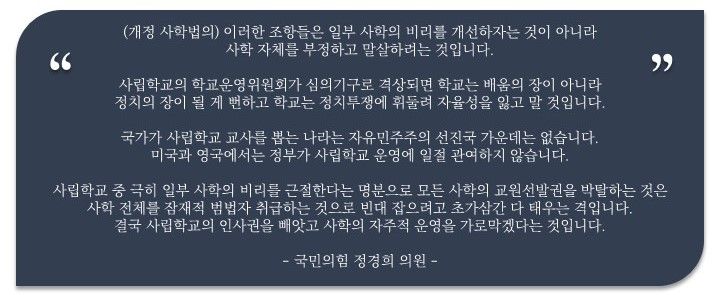
On August 31, 2021, the National Assembly held a plenary session and finally passed the amended Private School Act. At that plenary session, People Power Party lawmakers, pursuant to Article 63-2 of the National Assembly Act, formed a committee of the whole and submitted an amendment to the Private School Act that had passed the Legislation and Judiciary Committee. The amendment largely restored the pre-amendment provisions of the Private School Act and deleted various newly added regulatory and oversight provisions in the amended Act. It also changed the administration of written examinations and consignment to provincial and metropolitan offices of education from mandatory to optional. Rep. Kyunghee Jung offered the following explanation of the proposed amendment.
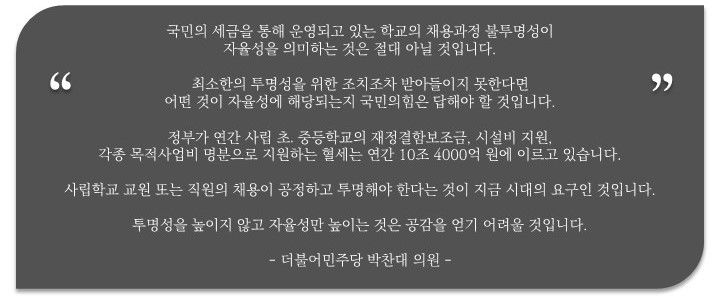
In response, Rep. Chandae Park of the Democratic Party of Korea requested an open debate and expressed opposition to the amendment.
Under the National Assembly Act, the amendment was voted on first, and it was rejected by 139 votes against and 67 in favor out of 206 members present. The amended Private School Act (the original bill) was then put to a vote and passed by 139 votes in favor and 73 against out of 212 members present.
As soon as the law passed, private school groups voiced immediate opposition. On September 1, 2021, the Korea Association of Private School Principals issued a statement saying, “We express serious concern and strong regret that such an unconstitutional and unlawful bill, one that will have a major impact on national education, was handled so hastily due to the biased perceptions of a temporary political force.” Earlier, when the bill passed the Education Committee, the association had also criticized it, saying, “We cannot suppress our dismay and concern at facing a situation in which school management committees are forcibly turned into deliberative bodies in disregard of the functions of school corporation boards, in which the hiring of new teachers is forcibly consigned to offices of education, and in which offices of education are allowed to intervene even in teachers’ personnel and disciplinary authority.”
■ Assessment of the Bill
1. Excessive government intervention that denies the identity of private schools
Public education in Korea is not a system in which students and parents, who hold the right to learn, can freely choose schools and teachers in a fully meaningful sense, and students at private schools in practice follow educational programs similar to those of public schools in environments not greatly different from them. Therefore, it is difficult to deny that private schools in Korean primary and secondary education occupy an ambiguous middle ground between private and public, with an unclear identity. This also explains why strong regulation and punishment for the various corruption and irregularities occurring in private schools are often welcomed.
Nevertheless, private schools are plainly schools established through the direct contribution of property by individuals or corporations, and the主体 of their operation is the school board, including the chairman of the board. The original purpose of establishing private schools is to allow them to operate with autonomous authority over student selection, curriculum design, financial management, revenue-generating and scholarship programs, and the hiring and personnel management of teachers. However, due to the “equalization” policy applied since the 1970s, the authority to select students has in effect become meaningless, and under strong government control, autonomy in curriculum design and financial management has also faded.
In that situation, even the “personnel authority” that private schools had at least been able to exercise has now been seriously curtailed by this amended Private School Act. Teachers belonging to private schools are, after all, merely “employees” of the school corporation; they are not civil servants like public school teachers. Only if private schools are granted the authority to recruit and cultivate differentiated teachers in accordance with their founding spirit and educational philosophy can they truly compete with public schools in terms of educational quality.
The mandatory written exam and the requirement that it be consigned to provincial and metropolitan offices of education can be seen as seriously infringing on the most fundamental personnel authority of all: the hiring of teachers. Moreover, by expanding the scope of intervention by offices of education in disciplinary matters and rehearings, the school corporation’s own authority to evaluate teachers has receded. If provincial and metropolitan offices of education are able to exert influence over disciplinary matters, private school faculty and staff may come to rely more on external offices of education than on school heads or boards, raising concerns that various conflicts and distrust within private schools, which are in effect private institutions, may actually deepen.
2. It is necessary not only to strengthen the autonomy of private schools but also to revitalize competition in the education market
With rapid technological innovation and increasing social diversification in recent years, the range and volume of knowledge that public education can provide are reaching clear limits, and public distrust of public education is also growing. The view that a standardized curriculum of the sort that has persisted since the 20th century cannot cultivate creative talent—the so-called “crisis of public education”—is already widespread.
Private schools originally began as separate educational institutions that supplemented or replaced public education, and there were even periods when private schools effectively performed the role of public education when public education was not functioning properly. In that sense, private schools are highly attractive and suitable institutions capable of meeting the renewed and urgent demand for diversity, autonomy, and dynamism in education. Providing conditions under which private schools can operate more freely in matters such as student and teacher selection and curriculum design can ultimately be said to be the direction in which our education system can be diversified.
In a March 2017 contribution to Monthly Education, Cheolwoong Je, a professor at Hanyang University Law School, argued as follows: “Today, as the Fourth Industrial Revolution unfolds, we must no longer maintain a public education system that mass-produces uniform ways of thinking. The trend of the times is no longer mass production but the production of individualized, customized products, and in order to cultivate talent suited to that trend as well, we must move not toward a state-led system but toward one in which the state and private actors, namely school corporations, compete.”
The fundamental reason Korean public education fails to satisfy the needs of citizens and businesses is that there is no competitive order among educational institutions, reducing the incentive to provide consumers with high-quality educational services. If autonomy is granted to private schools so that they can compete with public education through diverse means, and if private schools also compete among themselves to attract outstanding students and teachers and produce excellent talent, the ultimate beneficiaries will be ordinary citizens, the consumers of education.
Original title: 빼앗긴 교원채용권, 사학자율성 저하 시킨다
Author: Ju-jin Yoon
Date: 2023-09-27
Source: https://www.cfe.org/bbs/bbsDetail.php?cid=bill&pn=2&idx=26040