
Easing Floor Area Ratio Limits by 120% in Station Areas Boosts Efficiency and Public Interest
-
Writer
CFE
-

 The revised Urban Renewal Act that improved project viability, efficiency, and public interest in redevelopment projects
▪ Seoul’s “Shintong Planning” expanded nationwide, with integrated deliberation extended to private projects and made mandatory… reducing redevelopment project timelines by up to 2–3 years
▪ Higher floor area ratios and zoning upgrades, along with expanded public sale housing, improve project viability while meeting realistic market preferences
▪ Stronger rules to enhance public interest and transparency in order to prevent repeated abuses in association management
■ Introduction
As the Yoon Suk Yeol administration pursued various real estate deregulation measures in response to the sharp rise in housing prices during the Moon Jae-in administration, the 21st National Assembly passed a law that relaxes floor area ratio restrictions in highly preferred residential areas such as station areas and simplifies redevelopment procedures. This is the Partial Amendment to the Urban and Residential Environment Improvement Act (hereinafter, the “revised Urban Renewal Act”).
This law is seen as having increased the economic viability of redevelopment projects, thereby strengthening incentives for both association members in renewal districts and construction firms to participate, while also making integrated deliberation of architectural review and various impact assessments mandatory, enabling faster project implementation. It is also expected to improve the public interest and transparency of association management by tightening qualification requirements and disqualification criteria for association executives.
■ Main Contents
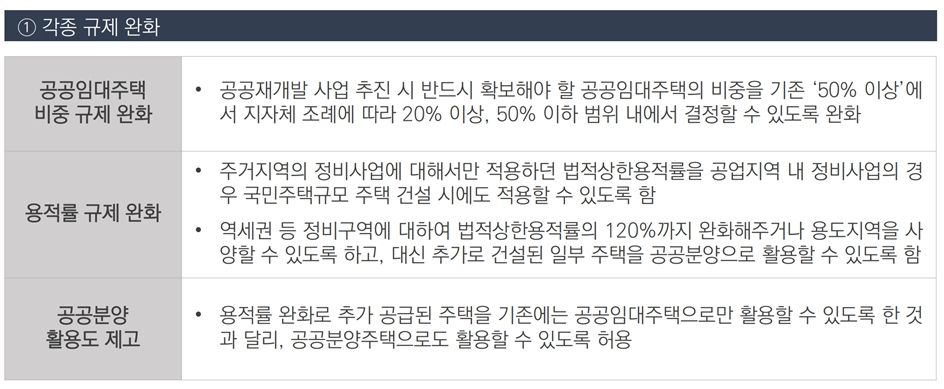
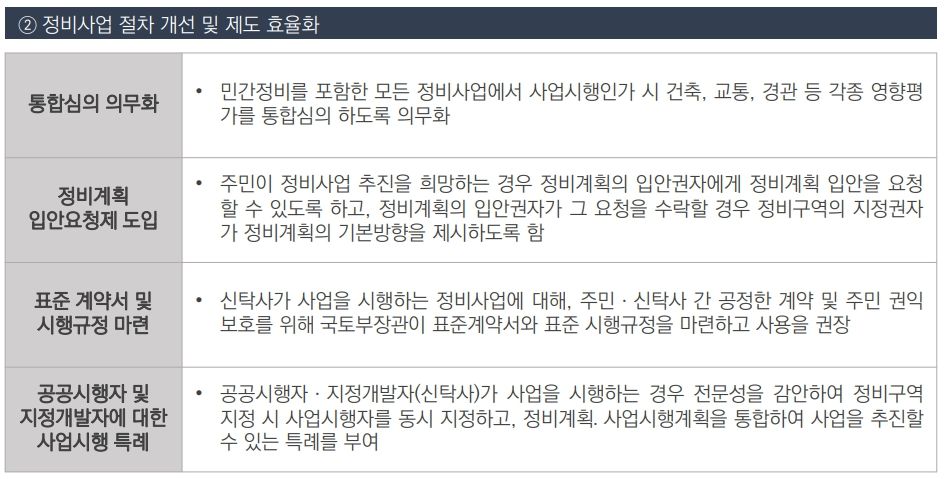
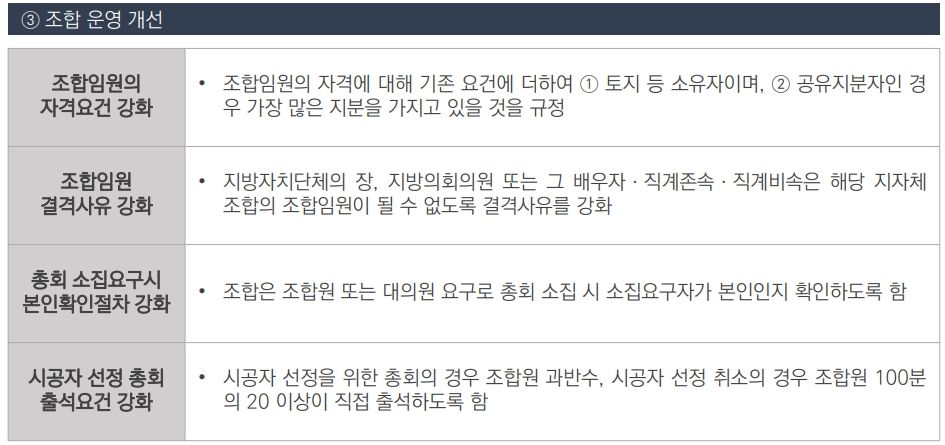
This law can broadly be divided into three parts: 1) relaxation of various regulations related to redevelopment projects; 2) improvement of redevelopment procedures and institutional efficiency; and 3) improvement of association management.
The details of each part are as follows.
In “Key Contents and Implications of the Partial Amendment to the Urban Renewal Act,” published in the Construction Trend Briefing by the Korea Research Institute for Construction Policy on August 4, 2023, it explains that “for Type 3 General Residential Areas in Seoul, if the zoning is upgraded by one level to Semi-Residential, construction up to a floor area ratio of 400% becomes possible.” Previously, the floor area ratio for Type 3 General Residential Areas ranged from 200% to 300%.
Take Samhwan Dobong in Dobong-gu, a representative reconstruction complex in a quasi-industrial area in Seoul, with 660 households, as an example. Under the revised Urban Renewal Act, the floor area ratio, which had previously been recognized up to 250%, can be raised to 300%. Compared with the previous 250% standard, under which 50 additional units could be secured, the 300% ratio would allow the construction of 210 additional units (including 90 rental housing units), and it is estimated that this would substantially reduce association members’ contribution burden.
The strengthening of qualification requirements for association executives is interpreted as a regulation intended to prevent the practice of recruiting so-called “star association presidents.” In repeated cases, outside figures with extensive experience and expertise in the field were brought in as association presidents to speed up and energize redevelopment projects. However, this often led to unnecessary internal conflict within associations, generating mounting dissatisfaction among renewal district association members. To address this, the barriers to becoming an association executive were significantly raised.
■ Legislative Amendment Process and Status
The revised Urban Renewal Act passed the plenary session on June 30, 2023. Of the total 263 members who voted, 251 voted in favor, 1 opposed, and 11 abstained, and it was passed by an overwhelming margin. It was effectively a noncontroversial bill and was smoothly handled through bipartisan agreement, although some lawmakers from the Democratic Party of Korea, the Justice Party, and the Progressive Party expressed negative views through abstentions or opposition votes.
Some discussion surrounding the bill took place in the Land Bill Review Subcommittee under the Land, Infrastructure and Transport Committee, the competent standing committee. According to the minutes of the subcommittee meeting held on March 22, 2023, subcommittee members expressed a range of views regarding the provision relaxing floor area ratio limits in station areas.
Overall, lawmakers from the Seoul metropolitan area—where the share of young people is high and urban development is concentrated around station areas—tended to view the relaxation positively. By contrast, lawmakers from non-metropolitan regions facing a “local crisis,” including youth outmigration and deterioration of old downtown districts, expressed concern that the measure could worsen regional imbalances. Regardless of party affiliation, views were commonly divided along metropolitan versus non-metropolitan constituency lines.
■ Evaluation of the Bill
1. Greater administrative efficiency to strengthen momentum for redevelopment projects
This law is significant in that it expanded nationwide the so-called “Shintong Planning” (Rapid Integrated Planning), which Seoul first introduced in order to revive stalled redevelopment and reconstruction projects and encourage active participation by local residents.
Previously, integrated deliberation had been applied optionally only to public redevelopment projects, but under this law it is now mandatory for private redevelopment projects as well, making it possible to streamline the permitting process and reduce time and costs. It also allows unavoidable changes to project plans arising during implementation to be handled in an integrated manner together with the redevelopment plan.
In areas where it is difficult to establish the boundaries and plans for a renewal district, residents are now allowed to request that local governments formulate a redevelopment plan on their behalf, which can also reduce the burden on district associations. Industry participants expect that passage of the revised Urban Renewal Act will shorten project periods by as much as 2–3 years.
2. “Incentive” administration that increases viability and meets realistic demand
Allowing some areas, such as station areas, to raise the floor area ratio by up to 1.2 times or to upgrade zoning classifications is expected to increase incentives for both association members in renewal districts and developers to pursue redevelopment projects.
The law allows the mandatory ratio of public rental housing to be relaxed through local ordinances and permits additional housing secured through the relaxed floor area ratio to be supplied as “New: Home” (public sale housing). In general, public sale housing tends to face less resistance than public rental housing not only from landowners but also from prospective residents, so this is likely to further increase the attractiveness of redevelopment projects.
3. Securing public interest and transparency in association management
The revised Urban Renewal Act strengthens both the qualification requirements and the disqualification criteria for association executives, and is therefore expected to help prevent the abuses that occur when executives ignore the will of association members and run associations arbitrarily. It is also expected to reduce cases in which individuals buy up small stakes, get elected as association president or other executives, and then enjoy various private benefits or misuse executive qualifications for speculative purposes.
By stipulating that local government heads, local council members, and their spouses, lineal ascendants, and lineal descendants may not serve as association executives or professional association managers, the law is also regarded as having enhanced the transparency and public interest of redevelopment projects.
In addition, it requires verification that those requesting the convening of a general meeting are in fact the persons themselves, thereby preventing situations in which deceased persons exercise written voting rights or persons without membership qualifications attend and exert influence at general meetings. The requirement that more than half of association members attend in person at the general meeting voting on the selection of a construction firm is likewise interpreted as a strengthened rule intended to minimize the possibility of selecting a contractor against the will of association members.
Original title: 역세권 용적률 120% 완화, 효율성·공공성 높인다
Author: Ju-jin Yoon
Date: 2023-09-20
Source: https://www.cfe.org/bbs/bbsDetail.php?cid=bill&pn=2&idx=26030