
The OTT Self-Rating Act, a Leading Example of Efficient Administration
-
Writer
CFE
-

 Introduction of the OTT industry’s long-awaited “self-rating system,” a leading example of efficient administration through deregulation
▪ “Self-rating business operators” designated by the Minister of Culture, Sports and Tourism can directly classify content ratings, including “restricted to youth”
▪ Although side effects are anticipated, the benefits enjoyed by consumers, businesses, and the government are expected to be greater
▪ A designation system was introduced to prevent short-term confusion, but in the long run a notification system would be preferable… hopes for reconsideration after three years
■ Introduction
As of March 28, 2023, OTT service providers operating in Korea that have been designated by the Minister as self-rating business operators are now permitted to determine screening ratings on their own—except for the “Restricted Screening” category—without prior review by the Korea Media Rating Board (hereinafter “KMRB”). This is the introduction of the so-called “self-rating system.”
The OTT industry appears to be looking forward to the changes the self-rating system will bring. That is because it has opened a path away from the constraints of the KMRB’s prior review system, which had long hindered the industry’s ability to provide and market video content quickly. At the same time, however, the industry has expressed some disappointment that the government must review and “designate” self-rating business operators. Some argue that regulation should be eased further by adopting a notification system instead of a designation system.
The introduction of the OTT self-rating system is significant in that it transformed what had previously been a form of prior regulation into a form of ex post regulation. It is also viewed positively for helping establish a market order that primarily trusts business operators’ autonomy while allowing consumers to make their own free choices and judgments. In addition, it is meaningful because it has created conditions for domestic OTT providers—who had been subject to “reverse discrimination” under the prior review system—to compete fairly with foreign OTT providers.
■ Main Points
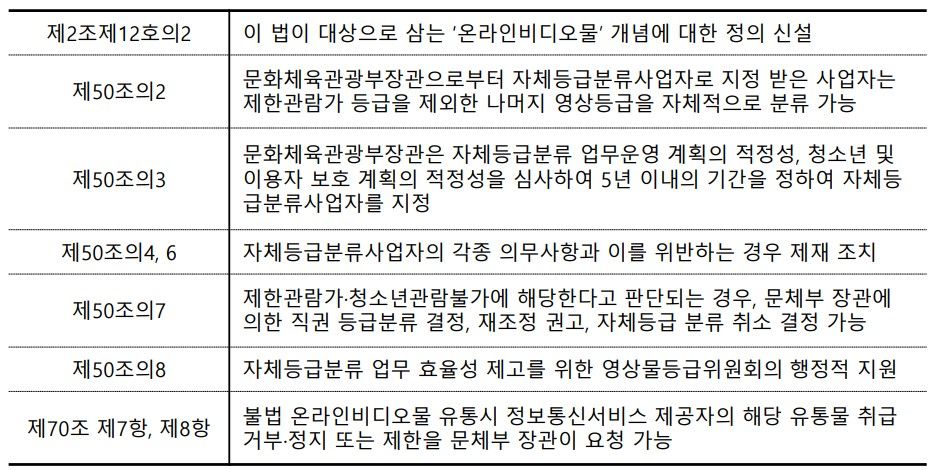
This amendment newly established the overall institutional framework necessary for introducing the OTT self-rating system. The key points of the amended and newly added provisions are as follows.
The self-rating system is optional for OTT providers. Article 50-2(3) stipulates that “where a self-rating business operator determines that it is difficult to make a self-rating decision, it may request the Korea Media Rating Board to classify the rating, and may substitute that result for its own self-rating decision.”
According to the “Guide for Designation of Self-Rating Business Operators” posted on the KMRB website, OTT providers must submit an operational plan for self-rating work (including plans for operating self-rating procedures and post-management of self-rating), along with various supporting documents. They must also prepare and submit detailed information on the person responsible for ratings, personnel in charge of self-rating classification (including overseas employees), and plans for completing various training programs. For smaller OTT providers, it may in practice be more efficient to leave rating classification to the KMRB. Seven companies were selected as the first self-rating business operators. Four out of 11 candidate companies were not designated.
■ Legislative Revision Process and Status of Passage
This bill revision moved swiftly through the National Assembly without major objections, from the competent standing committee, the Culture, Sports and Tourism Committee, to the Legislation and Judiciary Committee, which handled legal and textual review, and finally to the plenary session. On September 7, 2022, the National Assembly passed the bill in plenary session with 228 votes in favor, 1 against, and 5 abstentions out of 234 members present.
Three lawmakers introduced bills to establish the self-rating system: Park Jung, Lee Sangheon, and Hwangbo Seunghui. Like the final bill that passed, the bill introduced by Democratic Party lawmaker Lee Sangheon adopted a designation system. By contrast, Democratic Party lawmaker Park Jung and Hwangbo Seunghui, then a member of the People Power Party (now independent), proposed a notification system. Compared with the designation system—in which the Minister of Culture, Sports and Tourism independently reviews and designates operators meeting certain requirements as self-rating business operators—the notification system, under which operators meeting the requirements acquire qualification simply by filing with the relevant authority, can be seen as deregulation in a more fundamental sense.
In the Legislative Subcommittee on Culture, Sports and Tourism under the Culture, Sports and Tourism Committee, which handled detailed review of the bills, there was some discussion over the so-called “designation system vs. notification system.”
The government expressed support for the designation system. It cited the indiscriminate distribution of video content harmful to youth and the lack of effectiveness of post hoc sanctions against businesses as the basis for its position. In response, Hwangbo Seunghui, who had introduced the notification-system bill, expressed acceptance as follows.
Democratic Party lawmaker Yoo Jungjoo added, “It seems right to begin with a designation system, but after operating it for about three years as you mentioned, if there are no problems, it should be converted to a notification system or the like,” adding that “the designation system is not really the perfect answer, is it?” The government indicated its agreement.
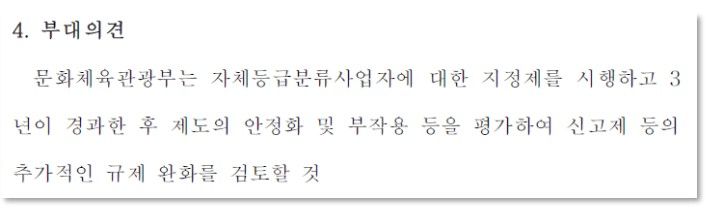
As a result of this legislative review process, the following supplementary opinion was reflected in the final amended bill.
1. A representative case of “efficient administration” through regulatory reform, with benefits outweighing social costs
With the introduction of the self-rating system, the Korea Media Rating Board has reduced the administrative burden of having to review and classify every OTT video individually, while OTT providers have also been able to reduce the workload involved in applying for review, waiting for results, and filing objections. The fact that the KMRB’s number of video rating classifications rose from 6,580 in 2016 to 16,167 in 2021—an increase of nearly threefold—lends weight to the argument that the prior review system can no longer keep up with the expanding size of the OTT market.
It is also advantageous for OTT businesses in terms of cost. Normally, when an OTT provider applies for review, it must pay a fee of 10,000 won per 10 minutes of content. For foreign content, the fee rises to 17,000 won. For example, for a 100-episode foreign drama series with 30-minute episodes, the cost of obtaining ratings through prior review alone would amount to 51 million won.
There is also a well-known case in which Coupang Play, one of Korea’s OTT providers, used what might be called a “workaround” to eliminate uncertainty caused by prior review. During the 2021 regular session of the National Assembly, lawmaker Yang Jeongsook noted that when Coupang Play aired the popular online content SNL Korea, it first broadcast it at 3 a.m. through QBS, a DMB broadcaster. The reason Coupang Play used this method was Article 23 of the Enforcement Decree, which provides that when a program previously aired by a broadcaster is produced as a video and simply rebroadcast, it is assigned the existing rating without undergoing prior rating review.
However, this reality of Coupang Play’s regulatory workaround instead served as a case underscoring the need for the early introduction of the self-rating system. The domestic OTT industry had already been calling for the introduction of self-rating since 2020, but criticism had mounted that legislation was being repeatedly delayed because the relevant ministries and agencies—the Ministry of Culture, Sports and Tourism, the Ministry of Science and ICT, and the Korea Communications Commission—were failing to coordinate their responsibilities promptly. It was amid that situation that this happened.
There are also concerns about side effects from the self-rating system. Some OTT providers may classify content at lower age ratings in order to broaden their viewer base, and there is also a high possibility that content may be misclassified due to mistakes or excessive workloads. Nevertheless, when considering overall social utility, the benefits enjoyed by the Korea Media Rating Board and OTT providers appear likely to outweigh the social costs and harms arising from the intentional or negligent acts of some OTT providers.
OTT consumers also benefit from the self-rating system. They can access OTT content more quickly than before, and in particular, situations in which content already available overseas must be accessed in Korea only after delays ranging from as little as two weeks to as much as several months will no longer occur. As the domestic OTT industry becomes more active, the diversity of content available to consumers will also increase. Ultimately, the introduction of the self-rating system can be said to be a win-win for consumers, businesses, and public institutions alike.
2. The “designation system” is another regulation; after serving a transitional role, it should give way to a “notification system”
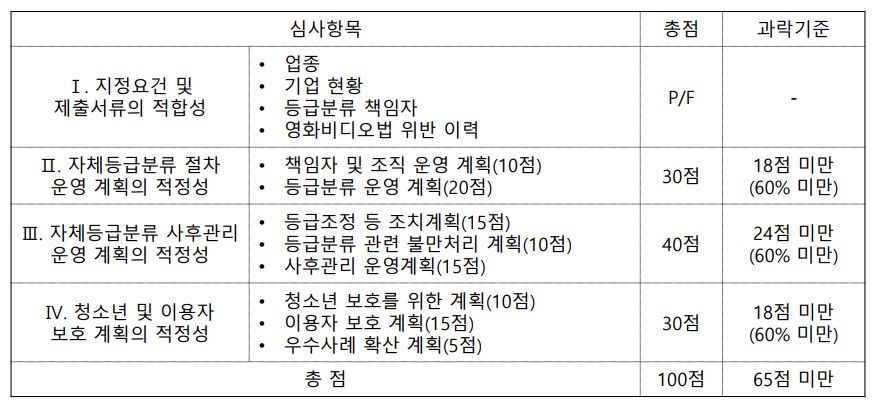
Strictly speaking, the designation system for self-rating business operators introduced together with the self-rating system can itself be regarded as a form of prior regulation akin to a licensing system. The evaluation criteria are as follows.
A closer look shows that while some items prepared by the company are matters of simple fact that can be assessed for adequacy, there are also so-called “qualitative evaluation” items, where scoring inevitably depends on an evaluator’s interpretation and the level of detail provided. From the perspective of OTT companies, this creates an unavoidable burden of so-called “government relations” work, since maintaining a favorable relationship with the KMRB may be necessary to minimize disadvantages in designation and redesignation.
The OTT industry’s position is that, although a designation system was introduced at the initial stage of the self-rating system to guard against concerns about early side effects, a notification system should ultimately be adopted because it is most consistent with the original purpose of deregulation. Even under a notification system, institutional-level ex post responses, reclassification by authority, and revocation are all possible, so critics argue that the designation system—with its strong prior-control character—is excessive regulation. The industry is looking forward to the “review of additional deregulation after three years” specified in the supplementary opinion attached to the amended bill.
Original title: OTT 자율등급제법, 효율행정 대표 사례
Author: Ju-jin Yoon
Date: 2023-08-30
Source: https://www.cfe.org/bbs/bbsDetail.php?cid=bill&pn=3&idx=25978