
Manufacturing’s Major Obstacle: The 40% Carbon Reduction Target Should Be Reconsidered
-
Writer
CFE
-


 “40% Cut in Greenhouse Gases by 2030”: Industry on Alert Over the Bombshell Dropped by Politics
▪ Expected to impose a severe burden on Korean industry, where energy-intensive manufacturing accounts for an overwhelmingly high share
▪ “Even the U.S., Japan, and the U.K. are not doing this…” — a “hasty decision” that copied Europe, which began reducing greenhouse gases much earlier
▪ An average annual greenhouse gas reduction of 4.17% is not only unrealistic, but could also lead to an energy crisis
■ Introduction
The Framework Act on Carbon Neutrality and Green Growth for Coping with Climate Crisis (hereinafter the “Carbon Neutrality Framework Act”), which took effect on March 25, 2022, is an enacted law designed to sharply reduce domestic greenhouse gas emissions in response to the climate crisis and to provide policy 추진 and institutional support for the transition to a carbon-neutral society. With the enactment of this law, the previous related law, the Framework Act on Low Carbon, Green Growth, was repealed. Following passage of the Carbon Neutrality Framework Act, Korea became the 14th country in the world to legislate carbon neutrality.
As soon as the law was passed, the business community voiced concerns in unison and called on the government to take a cautious approach in setting specific greenhouse gas reduction targets. While agreeing with the purpose of early action on climate change and reducing carbon emissions, they responded that, realistically, preparations were insufficient to achieve the reduction target presented for 2030. Nevertheless, despite those concerns, the government set an even higher reduction target in the process of drafting the detailed enforcement decree than the benchmark presented in the law, thereby increasing the burden of greenhouse gas reductions on industry. Critics point out that the law ignores the reality of Korea, where manufacturing accounts for a high share of the economy and where greenhouse gas reduction efforts began later than in major advanced countries.
■ Main Content
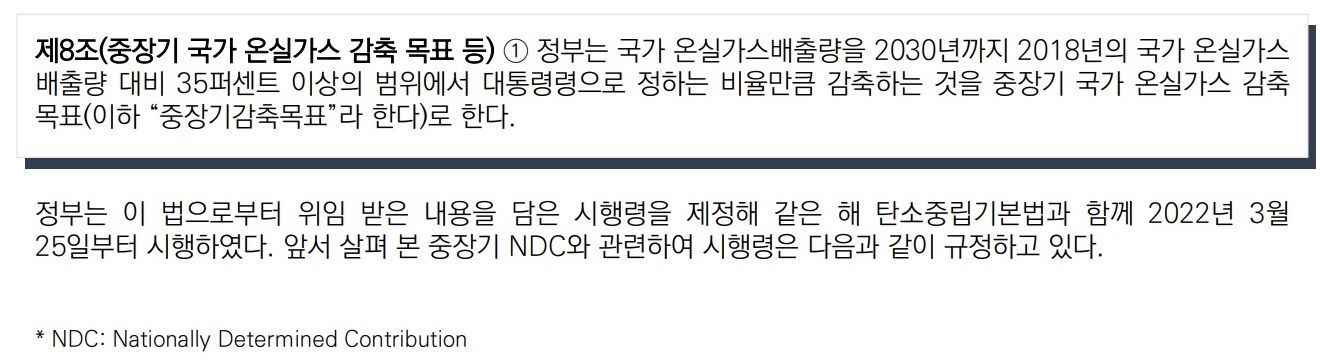
The most controversial issue during deliberations on the enactment of the Carbon Neutrality Framework Act was the figure for the “mid- to long-term national greenhouse gas reduction target (NDC).” The relevant provision is stipulated in Article 8, Paragraph 1 of the Act.
In 2018, domestic carbon emissions were approximately 727,600,000 tons. A 40% reduction from that figure amounts to roughly 291,000,000 tons. The target level of emissions for 2030 is 436,600,000 tons. In other words, emissions must be reduced by an average of 4.17% each year from the base year to the target year.
The reason 2018 was chosen as the reference point for emissions is that domestic carbon emissions began to decline from 2019, so 2018 was effectively regarded as the period of “peak carbon emissions.”
The government explained that “although this is not an easy target given domestic conditions, including the high share of manufacturing, it reflects our government’s strong commitment to achieving carbon neutrality and reducing greenhouse gases,” and then presented detailed reduction targets by sector as follows. After the launch of the Yoon Suk Yeol administration, some of the detailed targets were revised. However, the overall target of a 40% reduction remained unchanged.
As can be seen from the table, greenhouse gas emissions must be significantly reduced mainly in the “conversion” and “industry” sectors. “Conversion” refers to so-called power generation facilities that produce electricity or heat, while “industry” refers to manufacturing and production facilities.
In addition, the Act requires the government to formulate and implement a national master plan for carbon neutrality and green growth every five years, and provides the legal basis for establishing the presidential 2050 Carbon Neutrality and Green Growth Commission. Under this law, local governments may also establish their own 2050 Carbon Neutrality and Green Growth Commissions.
The Act also includes systems and measures necessary for climate change impact assessments, a greenhouse gas reduction budgeting system, an emissions trading scheme, a target management system, carbon-neutral cities, support for regional energy transition, green buildings, green transportation, expansion of carbon sinks, carbon capture, utilization and storage technologies, international reduction projects, and the establishment of an integrated greenhouse gas information management system. It also specifies the basis for management measures for facilities vulnerable to the climate crisis and for the establishment of various organizations and bodies to prepare for the social side effects of responding to climate change.
■ Legislative Amendment Process and Status
On August 31, 2021, the bill was passed with 109 votes in favor, 42 against, and 16 abstentions, out of a total of 167 lawmakers present. At the time, most members of the then-ruling Democratic Party of Korea voted in favor, while the People Power Party and other progressive opposition parties added votes against and abstaining, respectively.
Unlike in the plenary session, in both the Environment and Labor Committee, the competent standing committee, and the Legislation and Judiciary Committee, where legal and textual review was conducted, the Democratic Party of Korea pushed the bill through by itself. At 11 p.m. on August 19, 2022, the Democratic Party convened the Environment and Labor Committee’s agenda coordination committee on its own, passed the measure, and then passed the bill at midnight, one hour later.
Then, at the Legislation and Judiciary Committee meeting held on the 25th of the same month, the Democratic Party once again passed the bill on its own while opposition lawmakers, including those from the People Power Party, walked out.
Opposition to the law falls into two camps. One argues that the so-called “NDC 35%” is excessive, while the other argues that it is insufficient. At the Environment and Labor Committee’s bill subcommittee, People Power Party lawmaker Seokjoon Hong pointed out that dramatically reducing greenhouse gases would inevitably require a major increase in the share of renewable energy, but in reality domestic energy demand cannot be met simply by expanding the supply of renewable energy, stating that “its feasibility is currently zero (0).” He also emphasized that if dependence on renewable energy increases, energy storage systems (ESS) would become essential to compensate for the intermittency of energy supply, which would significantly increase costs.
Meanwhile, Justice Party lawmaker Eunmi Kang spoke against the bill during the plenary debate, saying, “This alternative is profoundly disappointing.” She continued: “To meet international recommendations, the 2030 NDC should reduce emissions by at least 45% compared to 2010 levels. If that standard is applied to Korea and recalculated using 2018 as the base year, the figure comes to a 50.4% reduction. The alternative in the Carbon Neutrality Act is only 35% or more compared to 2018. That is a gap of no less than 15%. Can we really look our growing children straight in the eye with such a level of reduction?” and opposed the bill.
■ Assessment of the Bill
1. A greater burden due to an industrial structure with a high share of manufacturing
Manufacturing accounts for about 25% of Korea’s GDP. (At the time the law was enacted, it was 28.4%.) In Germany and Japan, both representative manufacturing powerhouses, manufacturing accounts for about 19% and 20% of GDP, respectively. Korea’s share is more than twice that of the United States (11%) and also about twice the OECD average of 13%. In both the United Kingdom and France, the manufacturing share has fallen to single digits.
Given the nature of manufacturing, which inevitably entails large greenhouse gas emissions and high energy use—especially electricity consumption—Korea, whose key industry is manufacturing, cannot avoid seeing excessive carbon reduction regulations lead directly to higher business costs, reduced production, and sluggish exports. In particular, the fact that “basic materials industries” such as steel, chemicals, and ceramics—which use even more energy and directly use fossil fuels as raw materials—account for a high share even within manufacturing makes achieving carbon reduction more difficult. Industries such as semiconductors and displays are also directly affected by carbon reduction because greenhouse gas emissions are unavoidable in their processes.
There are also limits to reducing greenhouse gas emissions through improved energy efficiency. According to data published by Electric Journal in November 2021, Korea’s steel industry, which accounts for 17% of the country’s total greenhouse gas emissions, is about 15% more efficient than major overseas steelmakers. The refining industry is also 24% more efficient than the global average. In other words, these industries are already using energy very intensively.
According to a November 2022 survey by the Federation of Korean Industries (FKI) of the top 500 companies on the “feasibility of achieving the revised NDC 2030 target,” 48%—nearly half—said the NDC 2030 target had low feasibility. In addition, 56% of responding companies said that maintaining the 40% greenhouse gas reduction target would weaken corporate competitiveness. An overwhelming 82% said the carbon neutrality scenario needs to be reconsidered. The burden on businesses is an immediate reality.
2. Legislating the 2030 greenhouse gas reduction figure was a hasty decision
“NDC legislation” can be categorized in various ways. Some legislation merely contains a blueprint and vision for carbon neutrality, while other legislation goes so far as to specify the exact amount of greenhouse gases to be reduced. The Carbon Neutrality Framework Act falls into the latter category because it includes the specific ratio of “35% or more” in its provisions.
The presence or absence of a numerical target makes a significant difference. Once a numerical target is written into law, it carries considerable force and binding effect. Because the number can be adjusted only through a legal amendment, flexibility in responding to changes in the external environment or to whether neighboring countries are actually implementing carbon reduction measures is inevitably reduced. As calls for carbon reduction continue to grow louder, resistance from civil society to lowering the target will also be substantial, meaning that once legislated, the possibility of revision is bound to decline markedly.
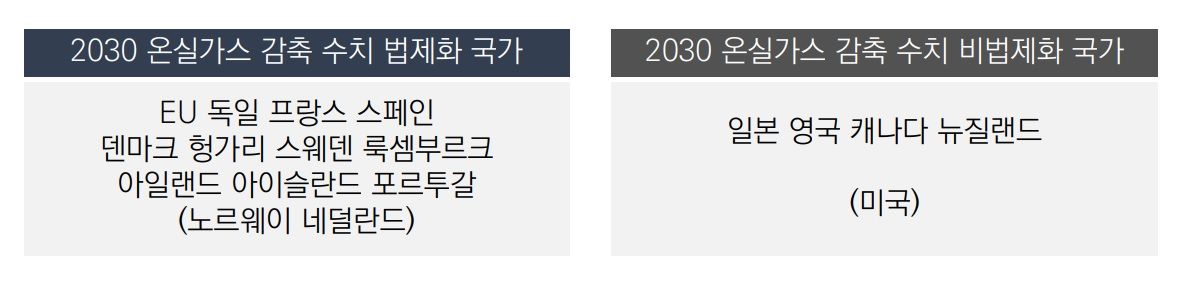
So which countries have legislated their mid- to long-term NDC figures for 2030? Looking at the situation in major countries, it is difficult to avoid the assessment that Korea moved excessively hastily in legislating its NDC figure.
In general, the countries that have legislated numerical targets are mostly members of the EU, where reductions in carbon emissions began relatively early. Norway and the Netherlands legislated their 2030 greenhouse gas reduction figures, but did not actually legislate their 2050 carbon neutrality targets.
Meanwhile, Japan, the United Kingdom, Canada, and New Zealand have not legislated their reduction targets, and the United States has not even set its 2050 carbon neutrality target by law. China, whose export sectors overlap with ours, has declared 2030 as the peak year for carbon emissions. That means it has no intention of reducing greenhouse gases by 2030.
Under these circumstances, it is hard not to question whether Korea really faced such urgency that it had to stipulate by law the amount of greenhouse gases it must cut by 2030 in advance.
3. Using 2018 as the reference point was also a case of “self-imposed disadvantage”
There has also been considerable criticism over whether 2018 is an appropriate reference point for the decision to cut greenhouse gas emissions by 40% by 2030. As the government explained, carbon emissions declined through 2019 and 2020, but greenhouse gas emissions rose again in 2021. This was the result of more active industrial production as the COVID-19 crisis eased. Although the provisional figure for 2022 greenhouse gas emissions fell by about 3.5% compared to the previous year, the possibility of emissions rising again still cannot be ruled out.
Compared with major countries that had already begun reducing greenhouse gases earlier, choosing 2018 as the comparison point has also drawn criticism as applying a disadvantageous standard to ourselves. Even the EU, which has been proactive in reducing greenhouse gases, already peaked in carbon emissions in 1990 and has been on a declining trend ever since. The U.S. carbon emissions peak came in 2007, and Japan’s carbon emissions have also declined since 2013. All reached peak emissions earlier than Korea did.
If the final target date for carbon neutrality is set at 2050, there is a stark difference: the EU has a 60-year assignment to complete, whereas Korea must accomplish it in just 38 years based on the law’s 2022 enforcement date. Using 2030, the mid- to long-term NDC target year, as the benchmark, Korea must reduce greenhouse gases by an average of 4.17% annually, whereas the United Kingdom and the United States need only reduce them by an average of 2.81% per year, and the EU by 1.98% per year. Advanced countries have more room to maneuver, while Korea has no choice but to race against time.
Wiki:
https://www.cfe.org/w/bbsDetail.php?idx=89
Original title: 제조업계 걸림돌 탄소감축 40% 재고해야
Author: Ju-jin Yoon
Date: 2023-08-24
Source: https://www.cfe.org/bbs/bbsDetail.php?cid=bill&pn=3&idx=25960