
Revised Distributed Energy Act Strengthens Consumer Choice, Expected to Boost the Electricity Market
-
Writer
CFE
-
 Distributed Energy Act Expected to Promote Competition in the Electricity Market by Allowing Direct Transactions and Price Differentiation
▪ “Allowing vertical integration” so power generators can also sell electricity directly… direct transactions with consumers without going through KEPCO
▪ In distributed energy specialized areas, electricity can be used at lower prices, helping attract businesses and revitalize local economies
▪ An innovative change that brings “competition” to a monopoly-centered electricity market; guaranteeing the economic viability of projects is a condition for successfully expanding the distributed energy system
■ Introduction
The Special Act on the Promotion of Distributed Energy, commonly known as the Distributed Energy Act, is scheduled to take effect on June 14, 2024. It was passed by the National Assembly on May 25, 2023, and enacted and promulgated on June 13. Rather than relying on the existing “centralized” power grid system, in which electricity is generated far away and transmitted over long distances to the area of consumption, this newly enacted law was designed to promote a “distributed energy” system in which electricity generated and transmitted near demand centers is consumed and traded within the local jurisdiction.
Unlike other energy-industry-related legislation, this law has special significance from a market-economy perspective. That is because it broadly attempts transaction liberalization and market diversification, which had rarely been tried in the existing energy market. It is expected to become the first step in a paradigm shift that goes beyond simply decentralizing and distributing the production, distribution, and consumption of electricity, and instead promotes the opening of Korea’s energy market to the private sector and price competition among businesses.
■ Main Contents
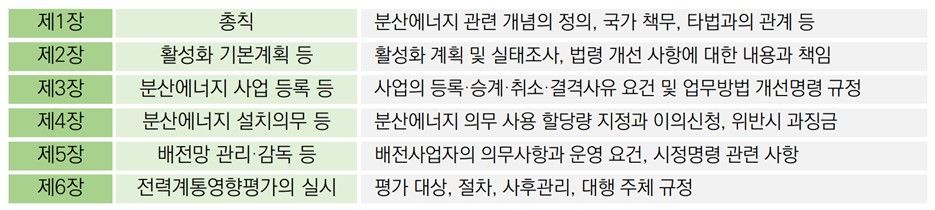
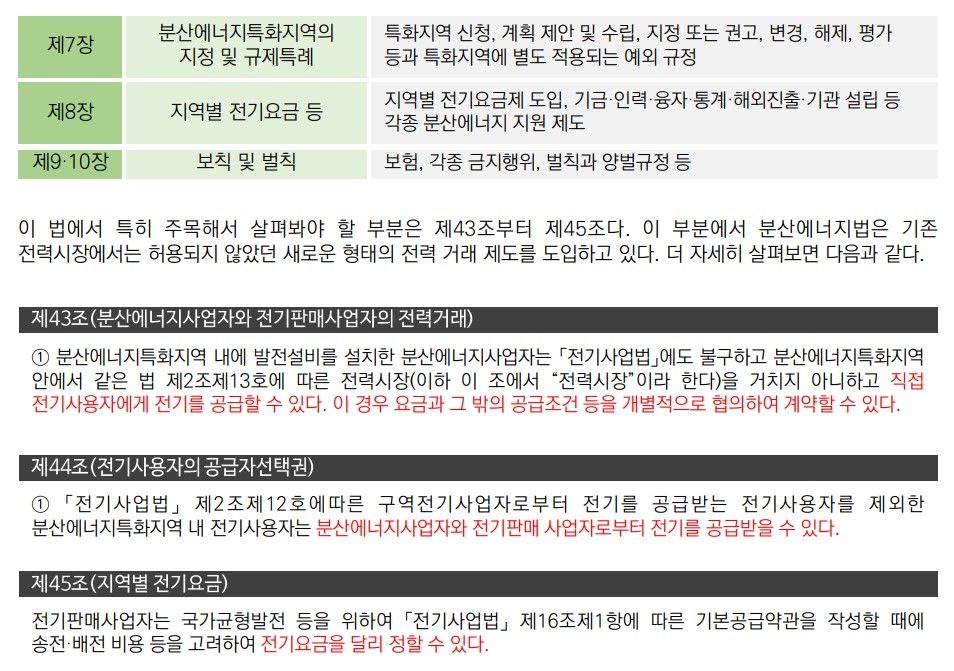
This law consists of a total of 10 chapters and includes provisions on the concept and definition of distributed energy, government responsibilities and business registration procedures, obligations of business operators, the power system impact assessment system, and the designation of distributed energy specialized areas and regulatory exceptions. The key points of each chapter are as follows.
To accurately understand the significance of these three provisions, it is necessary to compare them with the existing Electric Utility Act.
① Exceptions to the ban on combining power generation and retail sales
Article 2 of the Electric Utility Act divides the electricity business into five types: electricity generation, transmission, distribution, retail sales, and district electricity business. Article 7 restricts entry by stating that “any person who intends to engage in the electricity business shall obtain permission from the Minister of Trade, Industry and Energy for each type of electricity business,” and at the same time explicitly states that “the same person may not be granted permission for two or more types of electricity business.” Therefore, in principle, the production and sale of electricity cannot be combined. (ban on vertical integration)
By contrast, the Distributed Energy Act provides that within distributed energy specialized areas, electricity “may be supplied directly to electricity users,” thereby allowing an exception to the “ban on vertical integration,” together with the direct PPA system already in force.
☞ PPA: An abbreviation for Power Purchase Agreement, meaning a contractual arrangement in which a power seller and an electricity user trade electricity directly without going through the electricity market. It is divided into direct PPA, under which users and suppliers directly enter into contracts for renewable energy only, and third-party PPA, under which contracts are signed through Korea Electric Power Corporation, Korea’s monopoly electricity retailer.
② Guaranteeing consumers the right to choose suppliers
In addition, the law guarantees the freedom of electricity users within distributed energy specialized areas to choose to receive electricity directly from distributed energy operators and electricity retailers. Unlike the general situation, where there is usually no supplier selection process at all, this can be seen as a demand-centered institutional design. In fact, in countries such as the United States, the United Kingdom, and Japan, residents are free to compare and choose among the services and prices of multiple electricity and gas suppliers in their area.
③ Allowing differentiated electricity rates
Except when using the PPA system, all electricity consumers are required to pay electricity rates previously set by the government according to the type of electricity and time of use. The Distributed Energy Act began from the recognition that having all citizens and businesses pay the same electricity rates regardless of region was discriminatory toward residents living near generation facilities and preferential toward residents of urban areas. Accordingly, it allows electricity rates to be set differently by region.
■ Legislative Revision Process and Current Status
On May 25, 2023, the National Assembly held a plenary session and passed the Distributed Energy Act. Support was overwhelming, with 191 votes in favor, 5 against, and 17 abstentions.
The most contentious issue during deliberations on the law was whether SMRs (small modular reactors) should be recognized as one type of distributed energy. Kim Sung-hwan of the Democratic Party of Korea, who first introduced the bill, and the Democratic Party side opposed the inclusion of SMRs. By contrast, Park Soo-young of the People Power Party, who introduced the bill a second time, and the People Power Party side supported including SMRs. After discussion in the bill review subcommittee of the Trade, Industry, Energy, SMEs and Startups Committee, the competent standing committee, opinion ultimately coalesced around including SMRs, and some deficiencies were supplemented through partial revisions in wording.
Kang Sung-hee of the Progressive Party criticized both the inclusion of SMRs and the differentiated setting of electricity rates during plenary debate.
■ Evaluation of the Bill
1. An innovative attempt to bring “competition” to Korea’s electricity market
Korea’s electricity market can in effect be described as a “monopoly market” centered on Korea Electric Power Corporation (KEPCO). The six generation companies responsible for more than 70% of domestic power generation were physically split off from KEPCO in 2001, but they remain wholly owned subsidiaries of KEPCO. Therefore, the generation sector can also be seen as effectively falling within KEPCO’s sphere of influence.
The Korea Power Exchange, where wholesale electricity trading takes place, is a company jointly established by KEPCO and its six generation subsidiaries. The authority to sell electricity to individual consumers belongs exclusively to KEPCO. Power transmission and distribution are likewise monopolized by KEPCO and its subsidiaries. The entire process—from generation to transmission and distribution, wholesale, and retail—is centered on KEPCO.
There have been some attempts to open the electricity market, such as introducing third-party and direct PPA systems, but the market still has not significantly escaped the closed structure centered on KEPCO. Among the 37 OECD member countries, Korea is the only case where a state-owned enterprise monopolizes the electricity market. Even neighboring Japan has 10 electric power companies competing, while the transmission and distribution grid is operated by separately incorporated entities. Because individual consumers can choose their electricity suppliers, price competition is intense.
In this domestic electricity market environment, the Distributed Energy Act is expected to contribute to promoting competition in Korea’s electricity market by additionally allowing direct electricity transactions between suppliers and consumers and by enabling regionally differentiated pricing, thereby giving electricity consumers the opportunity to choose lower-priced electricity rates.
Although the scope of application of this law is limited to distributed energy specialized areas, if consumer satisfaction rises as a result of electricity market opening and price competition, and if businesses demonstrate a preference for distributed energy specialized areas, public support for opening the electricity market is expected to naturally increase. It may also serve as an opportunity for “interregional competition,” with local governments independently establishing distributed energy systems as part of employment policy and competing to attract businesses.
2. Guaranteeing stable profitability is the key to expanding distributed energy resources
The Distributed Energy Act partially realizes a market-friendly order for electricity transactions in that it enables suppliers and consumers to form mutually satisfactory prices through an institutional framework that allows electricity rates to be set differently by region. However, unless a stable source of revenue is created from the supplier’s perspective rather than the consumer’s, there will inevitably be insufficient incentive to participate as a distributed energy business operator.
The fundamental source of revenue for distributed energy operators should be operating profit, that is, the margin between electricity-rate revenue and generation costs. If the central and local governments unilaterally drive distributed energy projects and the model becomes fixed around covering insufficient revenue with fiscal subsidies, it will not only be difficult to expect the autonomous expansion of the distributed energy system, but may also create room for the recurrence of illegal corruption seen in renewable energy projects. What is needed is the creation of a market ecosystem in which distributed energy operators can secure stable business conditions through free transactions and customer acquisition.
Original title: 소비자 선택권 강화된 분산에너지법, 전력시장 활성화 기대
Author: Ju-jin Yoon
Date: 2023-08-16
Source: https://www.cfe.org/bbs/bbsDetail.php?cid=bill&pn=3&idx=25946