
Tesla, an Innovative Company, Also Needs Fair Trade Law Revision to Avoid Becoming a “Bad Company”
-
Writer
CFE
-

 The Complete Revision of the Fair Trade Act: “Excessive Regulation” That Increases Corporate Costs and Obstructs Efficient Management
- While encouraging holding companies, it expands regulation... increasing the cost of securing equity stakes and negatively affecting the free establishment of companies and transactions
- Expands regulation of “favoring affiliates with business opportunities,” a concept with no overseas precedent and vague definitions, while ignoring the necessity of internal transactions in a purely deskbound argument
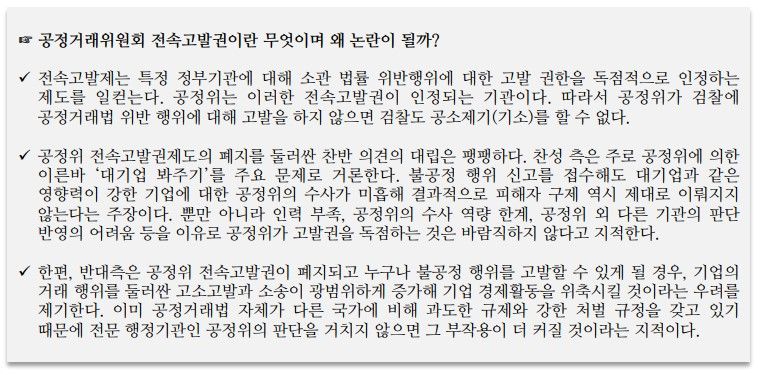
- Although the last-minute removal of the “abolition of the Fair Trade Commission’s exclusive right to file complaints” has shifted toward relaxation under the Yoon Suk Yeol administration, attempts to abolish it remain a live issue
Contents of the bill
During the first regular session of the 21st National Assembly, the full revision bill to the Monopoly Regulation and Fair Trade Act (hereinafter, the “Complete Revision of the Fair Trade Act”) was passed. This was the first full overhaul in 40 years since the law’s enactment and included revisions across a total of 12 areas.
The law had previously been discussed in the 20th National Assembly, but failed due to disagreements between the ruling and opposition parties. Immediately after the opening of the 21st National Assembly, the Moon Jae-in administration and the Democratic Party of Korea designated the bill as a “priority bill” and pushed hard for its passage from the outset.
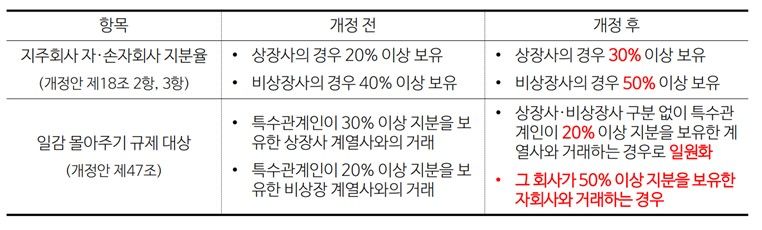
The core of the revision was “stronger regulation.” It raised by 10 percentage points the minimum shareholding ratio that holding companies must maintain in subsidiaries and sub-subsidiaries, and expanded the scope of transactions subject to regulation on favoring affiliates with business opportunities (private-interest expropriation). As a result, the costs required for converting to a holding company structure or newly incorporating subsidiaries and sub-subsidiaries increased, while internal transactions such as vertical integration were discouraged, increasing the managerial burden on firms. In detail, the following changes were made.
The bill doubled both the upper limit on surcharge rates and the ceiling for fixed-amount surcharges (applied in cases where there is no sales revenue or where calculating sales revenue is difficult) that may be imposed when various unfair trade practices are detected. For example, in the case of a violation of the regulation on favoring affiliates with business opportunities (legally termed private-interest expropriation), before the revision the maximum surcharge was 5% of sales or up to 2 billion won, but after the revision it was doubled to 10% of sales or up to 4 billion won. Overall, the bill can be seen as one focused squarely on strengthening fair trade regulation.
Legislative revision process and current status
The bill passed the National Assembly plenary session on December 9, 2020, and took effect on December 30, 2021, one year after promulgation. (Some provisions took effect two years later, on December 30, 2022.) At the final plenary session of the first regular session of the 21st National Assembly, where ruling-opposition tensions were extremely high, there was a relatively large number of opposing and abstaining votes. Nevertheless, with the cooperation of the ruling party, which held a majority of seats, and part of the opposition, the bill was processed with unusual speed.
At first glance, because there were 71 votes against and 44 abstentions, it appears that the margin between support and opposition was fewer than 30 votes. In reality, however, it was confirmed that some lawmakers from the ruling party and progressive opposition parties who were dissatisfied with the withdrawal of the plan to abolish the Fair Trade Commission’s exclusive right to file complaints broke away toward opposition and abstention. Lawmakers including Yongjin Park, Insun Nam, Woongrae Noh, Hyein Yong, Junghoon Cho, and Seongjun Jin chose to abstain. The list of opposing votes also included some supporters of the three fair economy bills, such as Hojeong Ryu and Sangho Woo.
Key Point 1. The failed attempt to abolish the Fair Trade Commission’s exclusive right to file complaints
This legislative revision was grouped together with the Revised Commercial Act examined in Part 2 of the Economic Bill Review series (covering the multiple derivative action system, separate election of audit committee members, and stronger restrictions on voting rights) as part of the three fair economy bills, or the three corporate regulation bills (hereinafter, the “three bills”). From the initial proposal of this bill, through the middle stages of discussion, and right up to just before final passage, the biggest point of contention was not the two items discussed above, but rather the “abolition of the Fair Trade Commission’s exclusive right to file complaints.”
In the end, abolition of the Fair Trade Commission’s exclusive right to file complaints was not pursued. This was because the Moon Jae-in administration and the Democratic Party of Korea abruptly changed course on December 8, near the end of the 2020 regular session. The reason can be seen in remarks made by the Democratic Party side before the competent standing committee, the Political Affairs Committee, processed the bill.
“With regard to abolishing the exclusive right to file complaints, there is also the issue of adjusting investigative powers between the police and the prosecution, as well as concerns over duplicative investigations and fishing expeditions into unrelated matters. Companies clearly have fears about this as well. It is necessary to continue maintaining the Fair Trade Commission’s exclusive right to file complaints.”
- Byungwook Kim, Democratic Party of Korea lawmaker -
Meanwhile, Yongjin Park of the Democratic Party of Korea, who had consistently led the push for the three bills, expressed that it was “regrettable” that abolition of the exclusive right to file complaints was not ultimately reflected in the final revision. Criticism of retaining the exclusive right also continued during the plenary session.
“The exclusive right to file complaints is a proposal that acknowledges the limits of the Fair Trade Commission itself in playing its proper role and returns the right to file complaints to the parties concerned. But the ruling party has now come forward with a proposal that this exclusive right should be maintained. The exclusive right to file complaints was President Moon Jae-in’s campaign pledge. The Democratic Party of Korea must clearly explain whether it has developed amnesia, whether it reversed its position due to special instructions from the Blue House, or whether it has revealed its true colors as a pro-chaebol party.”
- Jingyo Bae, Justice Party lawmaker -
Key Point 2. An opposition leader strongly in favor, a ruling party hesitating at the last minute
A notable feature of the approximately six months of discussion after the launch of the 21st National Assembly was that differences within the opposition People Power Party surfaced, creating some confusion in the usual ruling-opposition confrontation. The cause was Kim Jong-in, the former emergency committee chair who came to lead the People Power Party after its general election defeat.
Kim is a representative advocate of “economic democratization” and has strongly criticized corporate governance structures such as circular shareholding and internal vertical integration. Regardless of the People Power Party’s existing ideological orientation or official party line, Kim publicly expressed support for the three bills. In response, business groups including the Federation of Korean Industries (FKI), the Korea Chamber of Commerce and Industry (KCCI), and the Korea Enterprises Federation rushed to meet him and appeal for the opposition party to block and defeat the three bills.
However, Kim’s stance did not change much. In September 2020, he reaffirmed his support for the three bills and also confirmed common ground with then Democratic Party leader Nakyon Lee on processing them. In connection with this, criticism of Kim began to emerge within the opposition People Power Party. Former lawmaker Heesook Yoon and lawmaker Cheolsoo Ahn openly criticized him, and Daegu Mayor Joon-pyo Hong argued that the bills were “not compatible with a free-market economy.”
By November, about a month before the bill’s passage, the confusion deepened to the point that it almost seemed as though the positions of the ruling and opposition parties had reversed. While the ruling Democratic Party gradually shifted toward caution in response to intense backlash from the business community and media pressure over “economic slowdown,” Kim instead emphasized once again the necessity of passing the three bills and even made gestures that pressured the Democratic Party.
Assessment of the bill
1. A “regression” that worsened a regulation on favoring affiliates with business opportunities found nowhere else in the world
Through the Complete Revision of the Fair Trade Act, the number of companies subject to regulation on favoring affiliates with business opportunities increased from 210 to 598. This sharp rise resulted from lowering the shareholding threshold and partially including subsidiaries of affiliated companies within the scope.
Then is this kind of regulation also implemented in other countries? It is not. There are no overseas cases of uniformly sanctioning transactions based on the scale of dealings between affiliates. If a transaction harms market order and is confirmed to be unfair, penalties may be imposed under commercial law and competition law (the equivalent of Korea’s Fair Trade Act), regardless of whether it was between affiliates or how large it was.
When a company pursues vertical integration in order to reduce transaction costs, stabilize transactions, and ensure a consistent supply of uniformly high-quality parts or services, this can be regarded as an entirely normal and rational management decision.
Tesla, widely regarded as a global innovation leader, is also internalizing not only the batteries used in its electric vehicles but also battery materials and key minerals. The fact that under Korean law Tesla, too, could be labeled a “bad company” engaging in favoring affiliates with business opportunities is evidence of a fundamental problem in Korea’s legal system.
There are already reports that the Ecopro Group, which has stood out in the secondary battery industry, is facing this very dilemma under the regulation on favoring affiliates with business opportunities. Ecopro, the holding company, holds stakes in related affiliates ranging from about 45% to as high as 100%. Given that core technologies and trade secrets are, by the nature of the industry, decisive factors for corporate survival, establishing affiliates and expanding internal transactions are unavoidable management strategies for deep-tech companies.
Against this backdrop, strengthening a regulation on favoring affiliates with business opportunities that exists only in Korea can be described as regressive legislation that obstructs the free investment and business diversification of Korean firms. Doubts have also been raised about the effectiveness and validity of the 20% threshold. The simplistic judgment that transactions with a company in which a firm holds 20% or more are unfair, while transactions with an affiliate in which it holds 19.99% are not, has been criticized as a “deskbound argument” disconnected from the realities of corporate transactions.
For companies whose internal transactions are unavoidable for business reasons, the strengthened regulation may also force them to sell shares in affiliates simply to avoid falling under the regulation on favoring affiliates with business opportunities. In such cases, large-scale selling pressure could depress stock prices and potentially lead to a decline in corporate value.
2. Increased costs of converting to a holding company structure, raising concerns over reduced investment and hiring
The new mandatory shareholding ratios for subsidiaries and sub-subsidiaries established by this law do not apply retroactively to existing holding companies. They are new rules that apply only when a company newly becomes a holding company or when an existing holding company newly incorporates subsidiaries or sub-subsidiaries.
Even so, the business community has emphasized the negative side effects. To understand this issue, it is necessary to recall that the government had previously encouraged conversion to a holding company structure as an alternative for improving corporate governance. During the 2012 presidential election, as debate over economic democratization intensified and criticism grew that governance structures such as circular shareholding ran counter to economic democratization, the government encouraged conversion to holding companies by offering tax benefits and other incentives. Yet business circles have since repeatedly complained that, in the end, regulation of holding companies was increased, leaving companies with only greater costs and burdens.
The business community argues that the Complete Revision of the Fair Trade Act will inevitably dampen corporate hiring and investment. This is because when a company establishes a new subsidiary or sub-subsidiary or acquires an existing high-performing company through M&A and incorporates it as an affiliate, the holding company must now hold a larger equity stake, requiring more capital to be committed to maintaining the required ownership ratio. Economic groups warned that 240,000 jobs could be lost and calculated that, as of July 2020, if 16 non-holding companies among the 34 business groups subject to mutual investment restrictions were to convert into holding companies, it would require 30.9 trillion won.
3. Abolition of the Fair Trade Commission’s exclusive right to file complaints remains a “live ember”
Although the direction of the Fair Trade Commission’s exclusive right to file complaints changed from abolition to retention just before passage of the Complete Revision of the Fair Trade Act, the possibility of future efforts to abolish it cannot be ruled out. During the 20th presidential election, both major party candidates expressed positive views on abolishing the exclusive right, and in particular Jae-myung Lee, now leader of the Democratic Party of Korea, made it one of his key campaign pledges. However, after the inauguration of the Yoon Suk Yeol administration, emphasis shifted from abolition toward “supplementing” the system, making immediate abolition less likely.
Moves in the National Assembly to abolish it have also continued steadily. On June 15, 2023, Hankyoo Kim of the Democratic Party of Korea strongly raised the need to “revise” the exclusive right through legislation, pointing to what he called the Fair Trade Commission’s slap-on-the-wrist punishment of Hoban Construction. Some analysts argue that the prosecution’s expansion of the size and functions of its fair trade division, as well as its direct requests to the Fair Trade Commission for “additional complaints” in specific corporate crime cases, shows that the Commission’s exclusive right is in practice already being relaxed or modified.
Ahead of the 22nd general election in April 2024, attention is also focused on what party line the two major parties will adopt regarding the Fair Trade Commission’s exclusive right to file complaints. Given its previous position and the inclinations of its leadership, the Democratic Party of Korea is considered more likely to lean toward abolition, but because voices within the party warning against an “excessive expansion of prosecutorial power” have also grown stronger, the atmosphere suggests that some compromise at an appropriate level may ultimately emerge.
Original title: 혁신기업 테슬라도 '나쁜기업'만드는 공정거래법 개정필요
Author: Ju-jin Yoon
Date: 2023-08-02
Source: https://www.cfe.org/bbs/bbsDetail.php?cid=bill&pn=3&idx=25925