
Fears of a Second Tada: Problems and Challenges of the “Zigbang Ban” Law
-
Writer
CFE
-
 Legislative Policy Issue Report No. 2
Issues and Freedom
2022.11.15
1. Main Contents of the So-Called “Zigbang Ban Act” (Amendment to the Licensed Real Estate Agents Act)
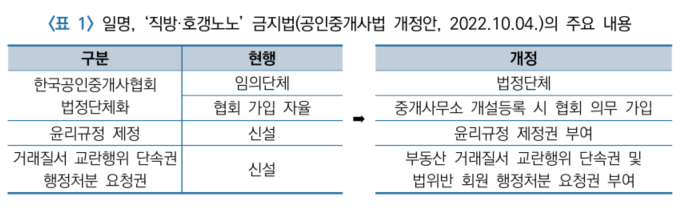
Recently, concerns have arisen in the National Assembly that a “second Tada incident” could occur, as a bill has been introduced that would turn the Korea Association of Realtors (hereinafter “KAR”) into a statutory organization and could substantially restrict the activities of proptech companies. On October 4, 24 lawmakers, led by Democratic Party lawmaker Kim Byungwook, introduced a partial amendment to the Licensed Real Estate Agents Act (Bill No. 2117738), which has now been referred to the Land, Infrastructure and Transport Committee. The key provisions of this amendment are as follows: first, making KAR a statutory organization; second, requiring membership in the association when registering to open a brokerage office; third, granting KAR the authority to establish a code of ethics for licensed real estate agents; and fourth, granting the association the power to crack down on acts that disrupt transaction order and to request administrative sanctions from provincial governors or registration authorities against members who violate the law. In other words, this is a bill that grants special privileges to the interest group Korea Association of Realtors. If passed, KAR would gain exclusive legal status as a statutory organization and appear likely to acquire not only the authority to guide and supervise its members through its own “code of ethics,” but also the power to investigate violating members and request administrative sanctions against them.
Meanwhile, the rapidly growing real estate platform industry—so-called proptech firms such as Zigbang and Hogangnono—has strongly objected to this amendment to the Licensed Real Estate Agents Act. This is because KAR has repeatedly filed criminal complaints against proptech companies that offer low brokerage fees and consumer-friendly services in an effort to check the growth of these competing firms. According to a YTN report (2022.10.22.), a proptech industry official said in an interview, “The Realtors Association has persistently interfered with brokers’ ability to list properties on platforms like Zigbang, and if this entrenched-interest group that is causing such turmoil in the market is also given legal status, it is obvious that this will become a ‘second Tada’ incident.” It is therefore necessary to review the problems with this amendment to the Licensed Real Estate Agents Act—which may in effect become a ban on proptech companies such as Zigbang and Hogangnono—and to derive corresponding response measures.
2. Legislative Background: Rapid Growth of the Proptech Market and Conflict with the Korea Association of Realtors
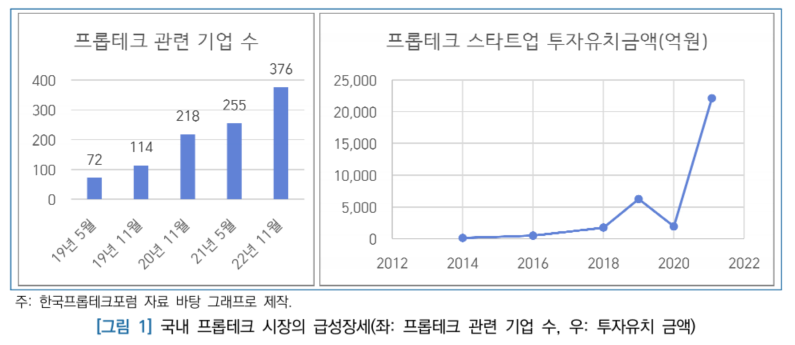
Proptech, a combination of “property” and “technology,” refers to new types of industries and services that apply IT technologies such as big data, artificial intelligence, and VR/IR to the construction and real estate sectors (Kang Junhee, 2021). Its major areas include real estate development, brokerage and leasing, and smart construction. Recently, the proptech industry has grown rapidly: the number of related companies increased from 114 in November 2019 to 376 in November 2022, more than tripling over the past three years, while the sales of proptech startups (based on 138 companies) reached KRW 1.9884 trillion (Korea Proptech Forum website, as of November 14, 2022). Looking at the main distribution of domestic proptech companies, the largest categories are shared services with 49 companies (19.1%), marketing platforms with 45 (17.6%), property management with 39 (15.2%), data and valuation with 35 (13.7%), construction solutions and XR with 27 (10.5), and decor and interior with 17 (6.6%) (Korea Proptech Forum, as of August 2022). In particular, the cumulative amount of investment raised by proptech startups reached KRW 5.8569 trillion as of November 2022. This sharp increase in investment was driven especially by the recognition, amid the COVID-19 pandemic, of the value of the proptech industry based on demand for non-face-to-face, IT, and digital services (Han Areum, 2022).
The government (the Ministry of Land, Infrastructure and Transport) has also recognized proptech as a promising new industry and has announced policy support plans to foster a real-estate-data-driven proptech industry and build its foundations on two occasions: in 2020 through the 1st Basic Plan for Promotion of the Real Estate Service Industry (2021–2025), and in 2021 through measures to foster new real estate industries.
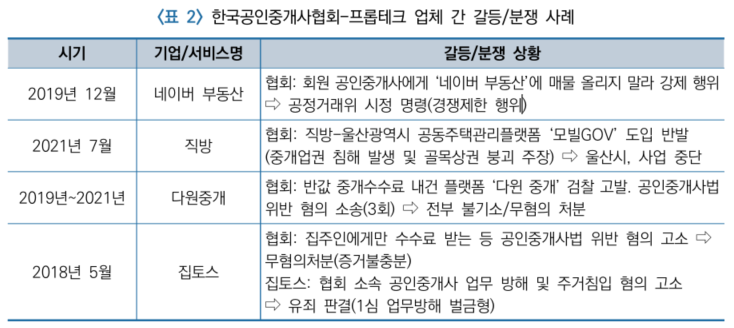
Along with the rapid growth of the domestic proptech market and the government’s policy support plans, KAR has recently come into conflict with these real estate platform companies, apparently out of a sense of crisis. At a seminar hosted by lawmaker Choi Seungjae on September 22—Policy Improvement Seminar for the Sustainable Development of Everyday Service Industries (Online Platforms)—the association emphasized the need to protect the business domain of licensed real estate agents from platform companies that it says are encroaching on their turf, as well as the need to protect the business rights of small business owners. Recent patterns of conflict between the association and proptech companies are shown in the table below. In most cases, the association filed lawsuits against proptech firms such as Naver Real Estate, Zigbang, Dawon Brokerage, and JipToss, which offer half-price brokerage fees or charge fees only to landlords, but those firms were mostly cleared of wrongdoing. By contrast, the association itself has been found guilty in court and has received corrective orders from the Fair Trade Commission, making it an organization that has also caused conflict and disputes.
3. Concerns over a Second Tada: Problems with the “Zigbang Ban Act” (Amendment to the Licensed Real Estate Agents Act)
◩ High Risk of Collusion and Market Monopoly by the Korea Association of Realtors, Which Has Representativeness Issues
The first core element of this amendment to the Licensed Real Estate Agents Act (2022.10.04.) is to turn KAR into a statutory organization as a single association and to make association membership mandatory when registering to open a brokerage office. If this happens, first, there is serious concern that KAR, an interest group, would secure a monopolistic position, thereby restricting fair competition in the real estate brokerage market and making the market rigid through monopoly.
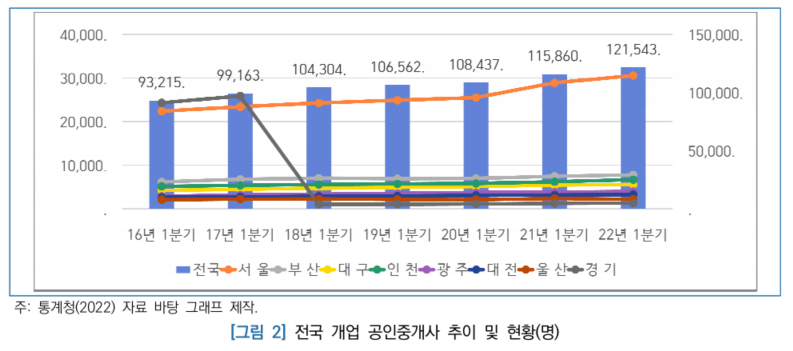
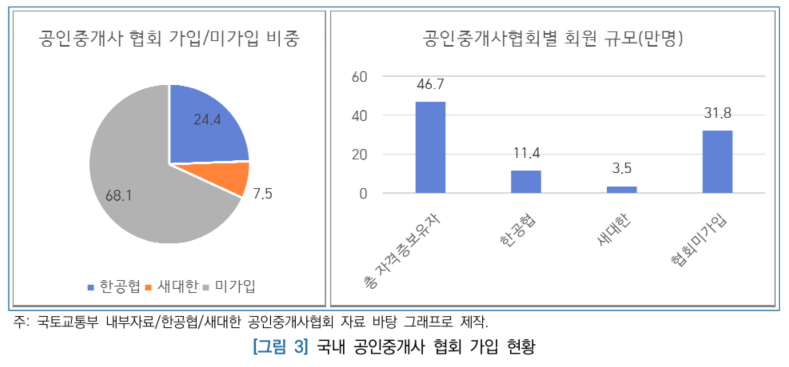
Second, whereas brokers can currently choose between two groups—KAR and the New Korea Association of Realtors (hereinafter “New Korea”)—they would be restricted to joining and operating only through KAR, while the freedom to establish and participate in new associations and organizations would be taken away. There were approximately 467,000 successful applicants holding realtor licenses from the 31st licensed real estate agent examination (2021), while the number of practicing licensed real estate agents nationwide (Statistics Korea) was counted at 121,543 as of the first quarter of 2022. Looking at the membership of the two associations, KAR has about 114,000 members, while New Korea has 35,461 members (official figure obtained by phone inquiry to the association), bringing the number of association-member brokers to about 150,000. This amounts to roughly 32% of all licensed real estate agent certificate holders, with KAR members accounting for 24.4% and New Korea members for 7.6%. This raises the issue of representativeness for KAR, which only 24.4% of all license holders have joined.
◩ Concerns over a Second Tada: Obstruction and Sanctions Against the Innovative Proptech Industry, and Further Damage to the Market
The second core element of the amendment to the Licensed Real Estate Agents Act (2022.10.04.) is to grant KAR: 1) the authority to crack down on acts that disrupt order in real estate transactions, and 2) the authority to request administrative sanctions against members who violate the law. KAR has already been a main instigator of repeated conflicts—including business obstruction, criminal complaints, and lawsuits—against various real estate platform services and a wide range of proptech firms that provide consumers with low fees, all for the purpose of protecting the association’s exclusive interests. If the authority to receive reports and conduct enforcement, currently delegated to the public institution Korea Real Estate Board, is transferred to KAR, it could use allegations of “disruptive acts” as a pretext to interfere with and discipline legitimate business activities by innovative proptech/startup firms and their workers. KAR also operates the real estate platform “Hanbang,” so as a direct competitor there are serious concerns about conflicts of interest and anti-competitive collusion. This makes the possibility of a second Tada incident highly likely, ultimately delivering a severe blow to the growth of the proptech market as a whole.
◩ Infringement of Consumer Choice and Rights in Real Estate Brokerage Services
Given the rapid growth of the proptech market, competition among proptech firms providing diverse real estate transaction and brokerage services had strong potential to enhance consumer choice and welfare by offering half-price brokerage fees or even free brokerage services for tenants. However, if KAR were to improperly use its enforcement and disciplinary powers following passage of the so-called “Zigbang Ban Act,” it could chill the business activities of proptech firms. This could in turn lead to higher fees and infringe consumer choice and rights, while also causing broad problems such as reduced diversity, innovation, and quality in real estate brokerage services.
4. Response and Tasks Regarding the “Zigbang Ban Act”
In conclusion, the amendment to the Licensed Real Estate Agents Act (Bill No. 2117738), which was referred to the National Assembly’s Land, Infrastructure and Transport Committee on October 4, should be withdrawn or voted down at the standing committee level because it would 1) enable anti-competitive collusion and market monopoly by KAR, 2) raise concerns over a second Tada by harming the fast-growing proptech market, and 3) infringe consumers’ freedom of choice in using real estate brokerage services. The competent ministry, the Ministry of Land, Infrastructure and Transport, plans to convey an opinion calling for careful review, citing concerns that the amendment could be abused in a situation of severe conflict between the association and the industry and could hinder the development of the new proptech industry (Dailyan, article dated November 2, 2022). The Fair Trade Commission also, in its review report on similar amendment bills (introduced by lawmaker Kim Seongyo in July 2021 and by lawmaker Jin Sunjun in May 2022), submitted the opinion that careful review is necessary because granting exclusive status and authority to a specific association could restrict business activities and lead to anti-competitive conduct. Active responses from the relevant authorities are therefore urged.
The marketing services of proptech focus on facilitating smooth real estate transactions by providing detailed information on local living conditions, as well as the value and location of a given property, thereby reducing information asymmetry and helping narrow the information gap between suppliers and consumers while promoting transactions (Koo Kangmo, 2022). Going forward, for the continued development of the proptech market, which is already emerging as a new industry, and for the expansion of consumer choice and welfare in real estate transactions, prompt improvements to the real estate information system and regulatory innovation are needed, including the construction of big-data systems for real estate and the opening of public information in line with government support policies (Lee Jeongyun et al., 2021). This would make it possible to accelerate the digital transformation of the real estate industry, develop new real estate products, and provide even lower brokerage fees through a low-cost transaction service structure. In addition, the current conflict between the traditional real estate industry and the proptech sector should be transformed into fair competition and cooperation, and excessive regulations related to information protection should be eased so that Korea’s proptech industry can establish itself in the global proptech market.
◩ References
· Kang Junhee (2021), Trends and Prospects of the Domestic Proptech Industry, KDB Future Strategy Research Institute Issue Brief, 2021. 9. 13.
· Partial Amendment to the Licensed Real Estate Agents Act (proposed by lawmaker Kim Byungwook), Bill No. 17738, 2022. 10. 04.
· Lee Jeongyun, Oh Gyeongju, and Ahn Jaejun (2021), A Study on the Development Direction of Domestic Proptech Companies, Knowledge Management Research, Vol. 22, No. 2.
· Han Areum (2022), Current Status and Implications of the Domestic Financial Industry’s Entry into the Proptech Market, Capital Market Focus No. 2022-20.
Wiki:
https://www.cfe.org/w/bbsDetail.php?&idx=2
Original title: 제2의 타다 우려, ‘직방금지법’의 문제와 과제
Author: Center for Free Enterprise (CFE)
Date: 2022-11-23
Source: https://www.cfe.org/bbs/bbsDetail.php?cid=issue&pn=2&idx=25095