
Problems with the Anti-Market Mandatory Rice Market Isolation Act and Policy Responses
-
Writer
CFE
-



 Legislative Policy Issue Report
Issues and Liberty
2022.10.28 | No. 1
Problems with the Anti-Market Mandatory Rice Market Isolation Act and Policy Responses
1. Problems with the Anti-Market Mandatory Rice Market Isolation Act and Policy Responses
The price of rice from the 2021 harvest during the off-season period (July–September) fell by as much as 20.5% compared with the 2020 harvest season (October–December), due to increased production and other factors. This marked the steepest collapse since 1997, when the government began surveying rice prices, despite three rounds of government market isolation measures totaling 350,000 tons, including an additional 100,000 tons isolated in July this year.
In response to this record-level plunge in rice prices and the resulting threat to the survival of rice-growing farmers, 62 lawmakers, including Rep. Shin Jeonghun, proposed on August 31 a partial amendment to the Grain Management Act requiring market isolation of excess rice production (full government purchase), and it was submitted to the competent standing committee, the Agriculture, Food, Rural Affairs, Oceans and Fisheries Committee, on September 26. The People Power Party and the Ministry of Agriculture, Food and Rural Affairs expressed opposition, arguing that making market isolation mandatory for excess rice supply would deepen the structural oversupply problem. On October 18, the ruling party decided to enter negotiations with the Democratic Party through a party-government consultation on the Grain Management Act at the National Assembly. However, on October 19, the amendment to the Grain Management Act was pushed through under the leadership of the Democratic Party. The ruling party strongly protested, calling it “excessive bulldozing legislation,” while the opposition party responded by demanding, “present an alternative,” intensifying the clash between the two sides.
The main provisions of the amendment to the Grain Management Act passed unilaterally by the Agriculture, Food, Rural Affairs, Oceans and Fisheries Committee are as follows. First, it makes market isolation mandatory when the conditions are met for market isolation allowing the purchase of rice up to the level of excess production, such as excess output of 3% or more or a price drop of 5% or more. Second, it provides that rice be purchased at market prices during the harvest season rather than through the lowest-price bidding reverse auction method. Third, it allows the Minister of Agriculture, Food and Rural Affairs to formulate and promote policies related to acreage for alternative crops and to carry out fiscal support programs.
2. Current Status and Outlook for the Rice Market
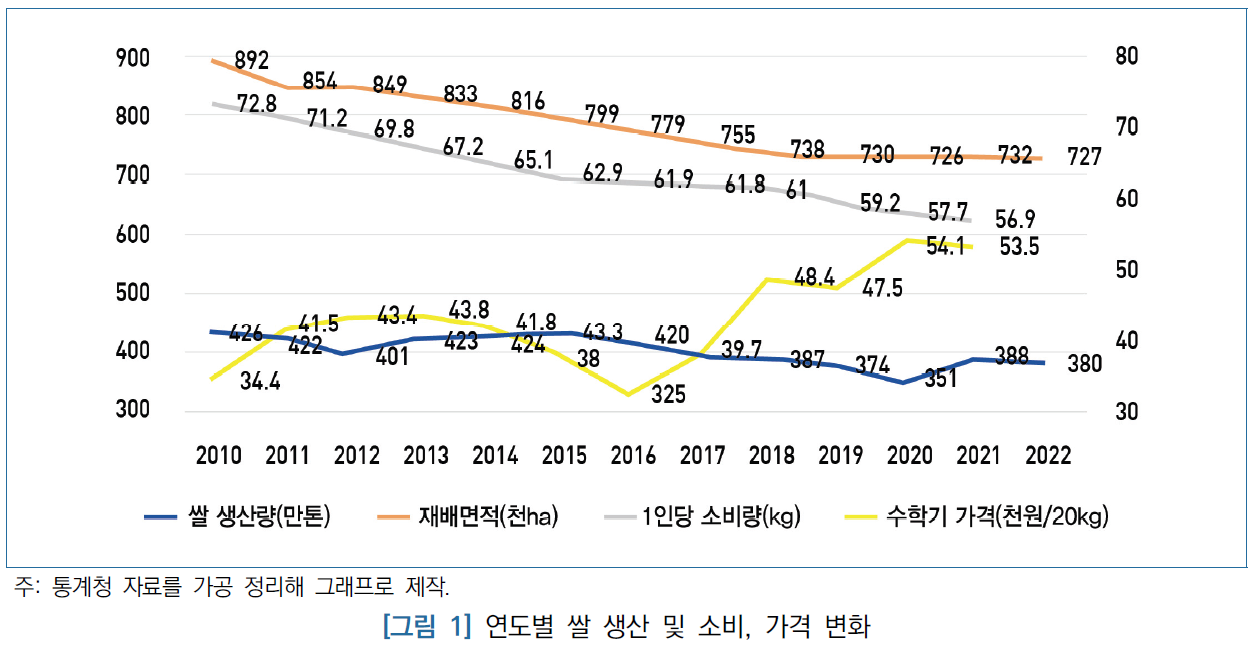
Over the past 10 years, per capita rice consumption in Korea has shown a steady decline, falling from 72.8 kg in 2010 to 56.9 kg in 2022. Along with this decline in rice demand, rice cultivation area has also steadily decreased, from 89,000 ha in 2010 to 72,000 ha in 2022. By contrast, because the government has implemented market isolation measures in response to excess rice production, rice output over the past 10 years has declined from 4.26 million tons in 2010 to 4.33 million tons in 2015 and 3.8 million tons in 2022, but has not fallen sharply and has instead remained at a certain level. These rice market isolation measures were largely intended to maintain rice prices, and it appears that prices, which had fallen to KRW 32,500 per 20 kg by 2016, were artificially pushed up to KRW 53,500 by 2022. However, amid the continued decline in rice demand, prices began falling again from 2020 despite repeated government market isolation measures.
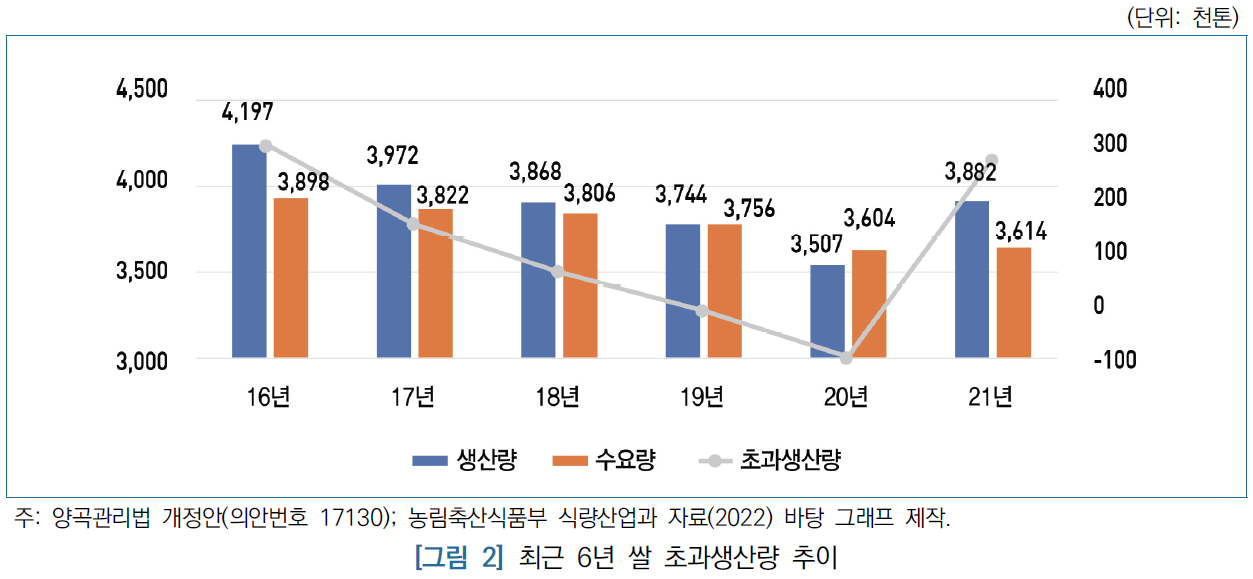
According to rice excess production statistics for the most recent six years from the Food Industry Division of the Ministry of Agriculture, Food and Rural Affairs, demand has been steadily decreasing, while production has not declined nearly as much, resulting in renewed excess output.
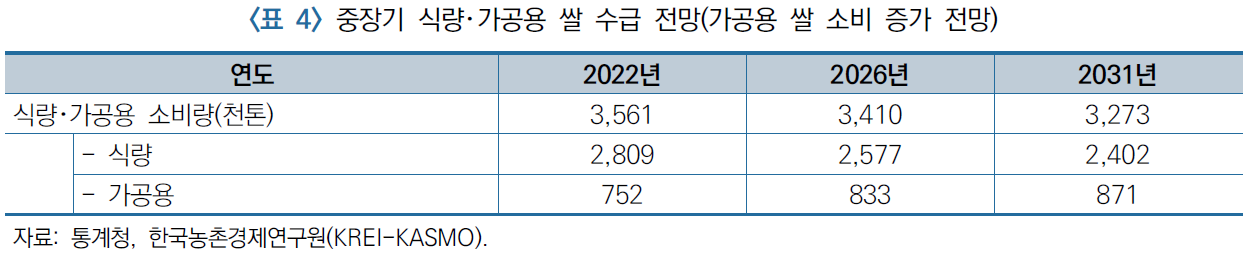
According to the medium- to long-term outlook for rice supply and demand in the Korea Rural Economic Institute issue report (Kim Jongin and Cho Namuk, 2022), the downward trend in rice cultivation area and output is likely to continue over the medium to long term. Rice consumption is also expected to continue declining as overall food consumption decreases. While per capita consumption is projected to decline by 1.8% annually, rice cultivation area is expected to decrease by an average of 1.3% per year, suggesting that excess production will remain at around 240,000 tons.
3. Problems with the “Mandatory Rice Market Isolation Act”
◩ Mandatory market isolation is likely to greatly expand the scale of oversupply
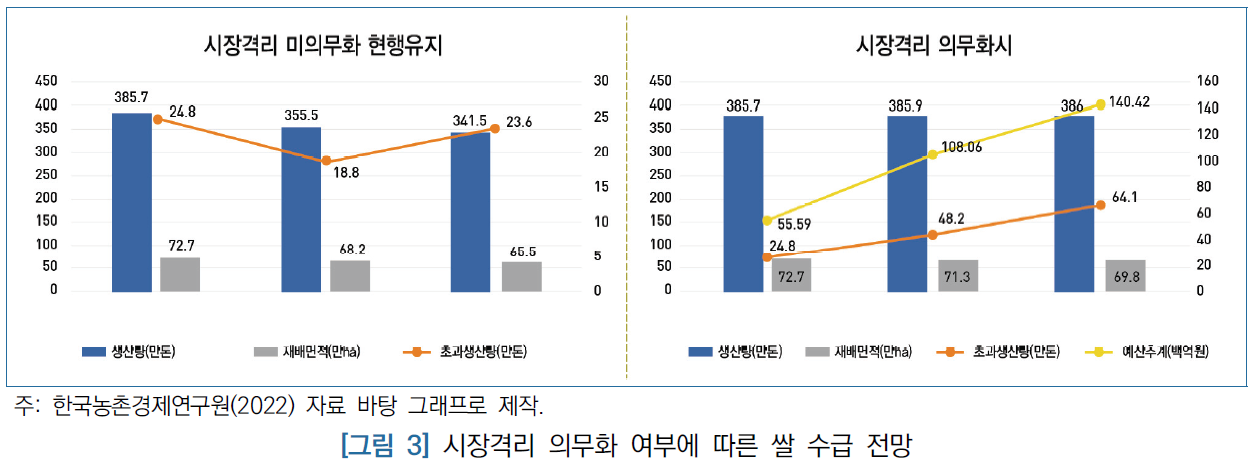
What would be the medium- to long-term outlook for supply and demand and public finances in the rice market if market isolation were made mandatory? According to the Korea Rural Economic Institute’s (2022) “Analysis of the Effects of Mandatory Market Isolation,” if the government is required each year to purchase and isolate excess rice production under the proposed partial amendment to the Grain Management Act, the scale of oversupply is expected to rise sharply because the decline in rice cultivation area would be reduced as a result of stabilized rice prices. Excess production is projected to increase rapidly to 248,000 tons in 2022, 482,000 tons in 2026, and 641,000 tons in 2030. Accordingly, the budget required to purchase excess rice at market prices is estimated at KRW 555.9 billion in 2022, KRW 1.0806 trillion in 2026, and KRW 1.4042 trillion in 2030.
◩ Rice market isolation measures have a history of failure
Then how effective were the rice market isolation measures pursued in the past? According to an analysis of the “Status of Rice Market Isolation Measures from 2011 to 2020,” submitted by the Ministry of Agriculture, Food and Rural Affairs to Rep. Seo Samsuk of the Agriculture, Food, Rural Affairs, Oceans and Fisheries Committee, there were a total of six attempts at market isolation over the past 10 years: four through purchases for the public rice stockpile and two through the lowest-price bidding reverse auction method. Only one attempt, in 2017, is considered to have succeeded. The two reverse auctions conducted in May 2015 and March 2016 failed to halt the price decline even one month after implementation. Likewise, the three market isolation measures through public stockpile purchases from 2014 to 2016 had no effect at all in raising prices. Kim Jongin and Cho Namuk (2022) attribute the failure of market isolation policy to stabilize prices to weak participation in government purchase bids and the prolonged purchase period. These frequent market isolation measures resulted in accumulated inventories, with stockpiles rising sharply to more than twice the appropriate inventory level in most cases. As a result, the government’s fiscal burden has also increased in tandem through rising inventory levels, aging public stockpiled rice, and higher storage and management costs (Kim Taehoon and Choi Juho, 2017).
◩ A vicious cycle of annual oversupply, plunging rice prices, and rising fiscal burdens
In the end, repeated overproduction has emerged as a producer protection measure amid continued declines in rice consumption. If market isolation for excess output is made mandatory, farmers will have even greater incentive not to reduce rice cultivation area and to maintain production levels. As a result, the scale of oversupply is likely to grow every year, making repeated collapses in rice prices inevitable and forcing the scale of market isolation to continue expanding as well. This will clearly worsen the fiscal burden arising from the purchase, storage, and management of rice for isolation. If this vicious cycle of plunging rice prices and growing fiscal burdens continues, it will also raise the opportunity cost of making diverse investments with limited agricultural fiscal resources that could otherwise be used to enhance agricultural competitiveness. These opportunity costs refer to a wide range of fiscal investment measures that could improve agricultural competitiveness and expand the overall food market.
4. Responses to and Tasks Regarding the Mandatory Rice Market Isolation Act
Even under the current system, in which market isolation is not mandatory and the lowest-price bidding reverse auction system is used, rice market intervention policy has clearly failed. Therefore, a reckless policy of mandatory market isolation to protect producers has virtually no chance of success and will only lead to mounting medium- to long-term fiscal burdens with no end in sight. First, therefore, the partial amendment to the Grain Management Act (the so-called Mandatory Rice Market Isolation Act) is a highly anti-market bill that would bring about excessive price intervention and market distortion through mandatory market isolation, along with a vicious cycle of long-term rice price collapses and severe waste of agricultural finances. It should therefore be voted down or withdrawn at the plenary session.
Second, the fundamental solution lies in supply-demand balancing measures aligned with rice consumption trends and diverse investments to strengthen agricultural competitiveness. To balance rice supply and demand, rice cultivation area should be gradually reduced, while support for and revitalization of the rice processing industry should be expanded through measures such as cultivating rice flour varieties suited to new consumption trends (demand for rice for processing is expected to rise gradually), opening overseas sales channels through the cultivation of high-quality, specialized rice varieties (for example, Dangjin Haenaru rice has been exported to the United States and Germany), and developing and selling a variety of products such as rice-based meal kits (through convenience stores, highway rest stops, and restaurants). Such efforts are needed to strengthen the self-competitiveness of agriculture and farmers. In addition, agricultural fiscal investment should prioritize facilities, R&D, cooperative farming (economies of scale), and export support for the cultivation and production of a variety of specialty crops other than rice that have strong consumer demand both domestically and abroad.
◩ References
∙ Kim Jongin and Cho Namuk (2022), Analysis of the Effects of Mandatory Rice Market Isolation, Korea Rural Economic Institute, KREI Current Issue Analysis No. 92.
∙ Kim Taehoon and Choi Juho (2017), The Reality of the Government’s Ex Post Rice Supply-Demand Management and Directions for Improvement, Korea Rural Economic Institute, 20th Agricultural Outlook.
∙ Partial Amendment to the Grain Management Act (proposed by Rep. Shin Jeonghun), Bill No. 17130, 2022. 8. 31.
Wiki:
https://www.cfe.org/w/bbsDetail.php?&idx=1
Original title: 반시장적 쌀 시장격리 의무화법의 문제와 대응 과제
Author: Center for Free Enterprise (CFE)
Date: 2022-11-01
Source: https://www.cfe.org/bbs/bbsDetail.php?cid=issue&pn=2&idx=25048